
- Education
- Fancy Colour Diamonds
- Red Diamond Guide: Colour, Grading, Argyle Reds and Lab-Grown
Fancy Colour Diamonds
Red Diamond Guide: Colour, Grading, Argyle Reds and Lab-Grown
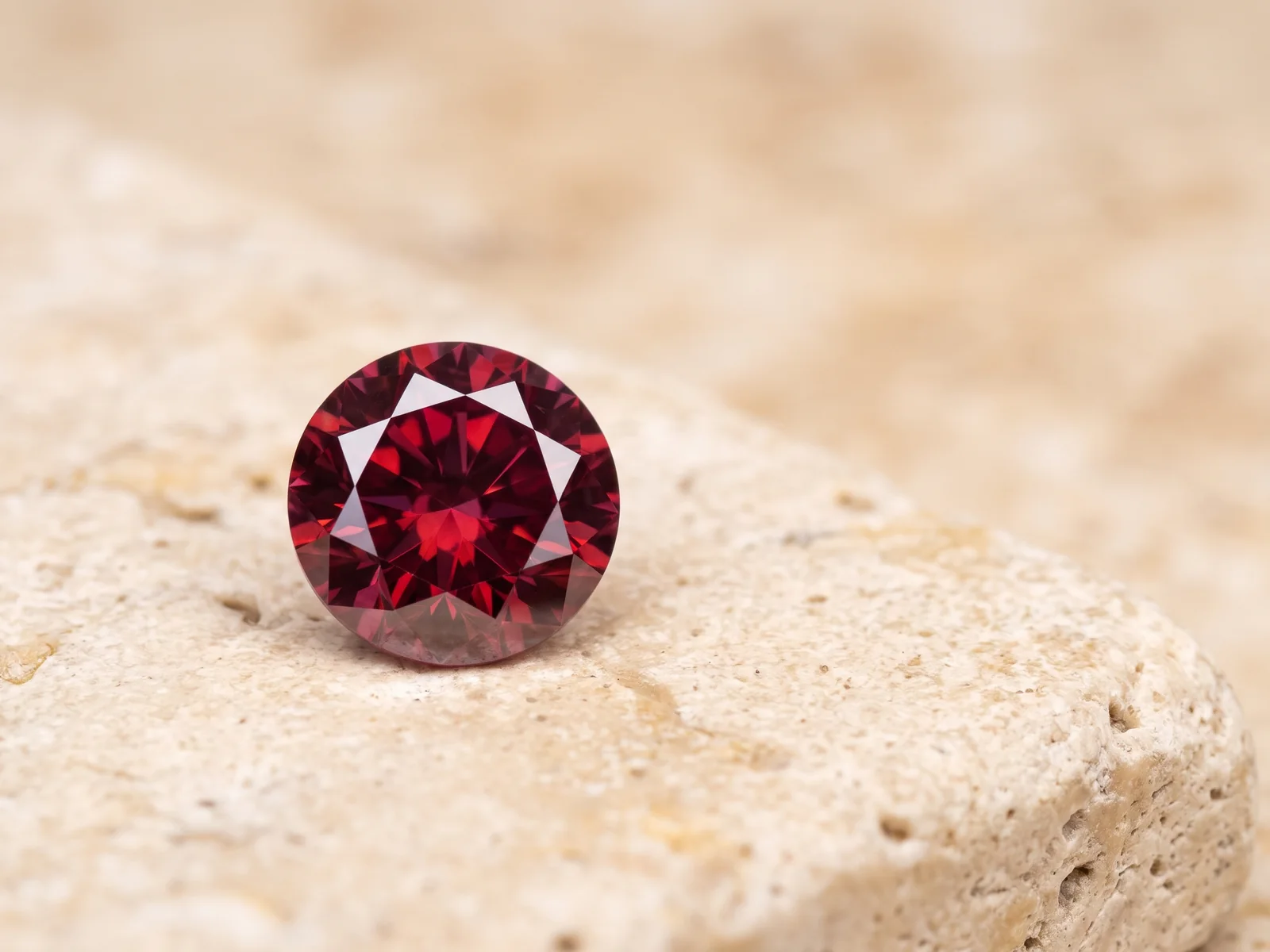
Red is the rarest colour a diamond can be, and most people will never see a natural one in person. Here is what makes a red diamond red, how it is graded, where Australia's Argyle reds fit in, and how to tell natural, treated and lab-grown apart.
 Reviewed by Raj Sood, Graduate Gemologist (GIA), AJP (GIA)Master jeweller and Graduate Gemologist (GIA) · reviewed 4 November 2026
Quick answer
A red diamond is among the rarest fancy colour diamonds. Its colour is thought to come from plastic deformation of the crystal lattice, the same cause as pink. GIA grades pure red only as Fancy Red. Natural reds are mostly under half a carat and cost far more than lab-grown or treated reds, which must be disclosed on the report.
What is a red diamond?
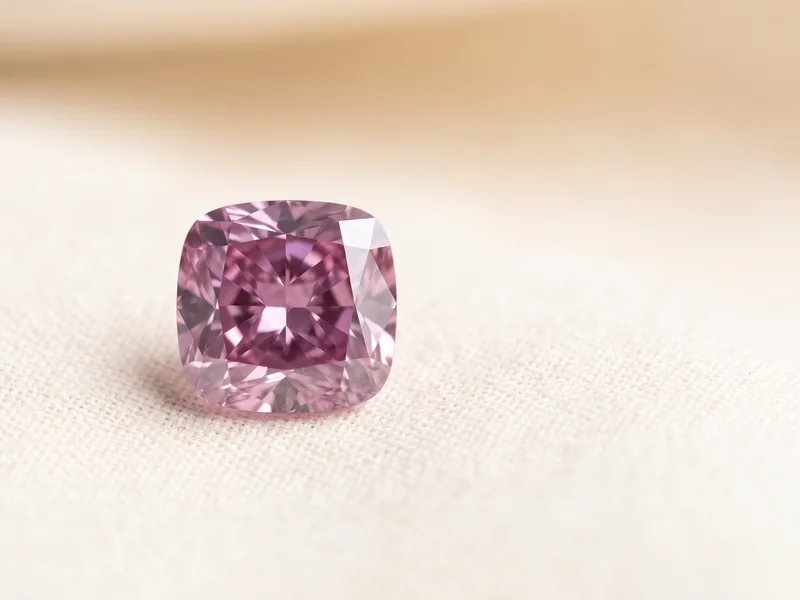
A red diamond is a diamond whose main colour, or hue, is red. It belongs to the fancy colour diamonds: diamonds with colour strong enough to be graded on a separate scale from the D-to-Z scale used for white diamonds. Our guide to fancy colour diamonds covers the whole family, from yellow to blue. Within that family, red is the scarcest. Gem labs see far fewer reds than any other hue, and most natural reds weigh less than half a carat; many are under 0.20 carat.
A red diamond is still diamond: pure carbon, 10 on the Mohs hardness scale, with a refractive index of about 2.42, exactly like a colourless stone. The colour does not make it softer or more fragile, so a red is as suitable for everyday wear as any other diamond, provided the setting protects its edges.
Three words describe any coloured diamond. Hue is the colour itself (red, pink, purple). Tone is how light or dark it is. Saturation is how strong or pure the colour looks. In red, these three are tightly linked, which is why red is graded differently from every other colour (more on that below). Any term here you have not met before is explained in our plain-English jewellery glossary.
Two famous stones show how small most reds are. The Moussaieff Red, a 5.11 carat triangular (trilliant) Fancy Red found in Brazil in the 1990s, is the largest red known. The Hancock Red, a 0.95 carat purplish red, made headlines in 1987 when it sold at auction for US$880,000. A stone just under one carat was world news.
What causes the colour in a red diamond?
Most coloured diamonds owe their colour to a trace element or a defect. Nitrogen produces yellow and canary diamonds, boron gives blue diamonds their colour, and natural radiation in the ground creates green diamonds. Red is different. A red diamond usually contains no colouring impurity at all.
Instead, the colour is linked to plastic deformation. Deep in the Earth's mantle, roughly 150–200 km down, intense heat and pressure bent the diamond crystal after it formed, so that layers of carbon atoms slipped against each other. Along those slip planes, tiny structural defects formed that absorb light in the green-yellow part of the spectrum, around 550 nanometres. With green-yellow removed, the light that comes back to your eye looks pink, and when the absorption is very strong, red. Scientists still debate the exact atomic structure of this colour centre, so you will see it described as 'thought to be' caused by deformation.
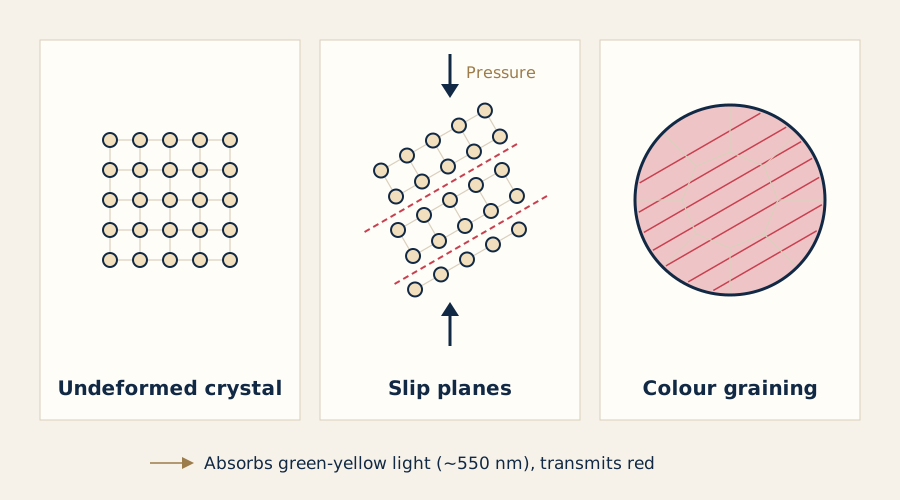
Because the colour sits along those slip planes, it is often uneven. Under magnification, a gemmologist will often see the red concentrated in fine parallel lines called colour graining. This graining, together with laboratory spectroscopy (measuring exactly which wavelengths the stone absorbs), is part of how labs confirm that a red's colour is natural.
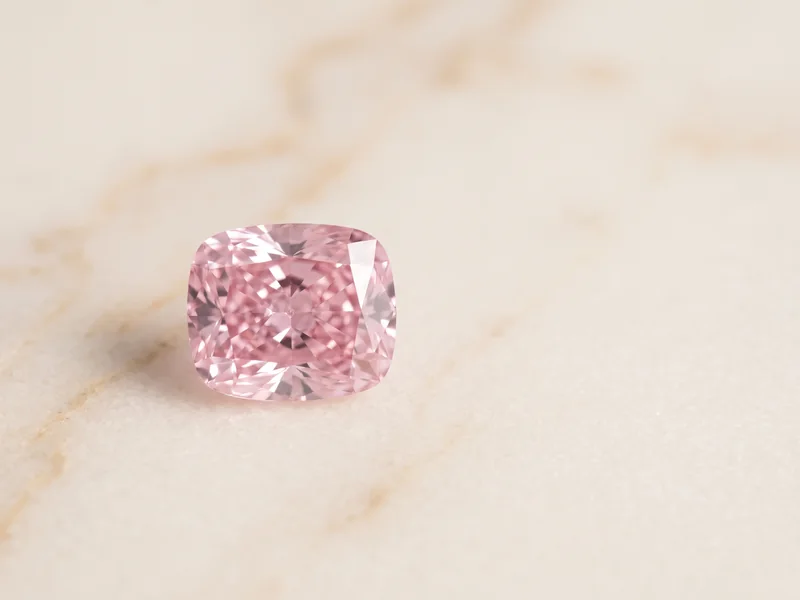
Red and pink share the same cause; a red is simply a stone where the effect is much stronger. That is why pink diamonds, which share the red's colour cause, are the natural place to start if red is out of reach. Deformation is also behind most brown, champagne and cognac diamonds, which is why brown is the modifier that most often creeps into darker reds. Most Argyle pinks and reds are Type Ia (they contain some nitrogen), while many pinks and reds from other sources are Type IIa (almost nitrogen-free), a difference labs use when they study a stone's origin.
How is a red diamond graded, and why is there only Fancy Red?
GIA grades fancy colour diamonds face-up, by comparing them with master stones under controlled light. For most hues there are nine intensity names, from Faint to Fancy Vivid and Fancy Deep, set out in our full intensity scale from Faint to Vivid. Red does not follow that pattern.
| Intensity name | Pink example | Red |
|---|---|---|
| Faint to Light | Light Pink | Not used |
| Fancy Light | Fancy Light Pink | Not used |
| Fancy | Fancy Pink | Fancy Red |
| Fancy Intense | Fancy Intense Pink | Not used |
| Fancy Vivid | Fancy Vivid Pink | Not used |
| Fancy Deep / Fancy Dark | Fancy Deep Pink | Not used; darker stones usually take a brown or purple modifier |
The reason is physical. Red only reads as red at a narrow mix of tone and saturation. Make it lighter or weaker and the eye sees pink; make it darker and brown appears. So a pure red has nowhere to move on the scale, and GIA simply calls it Fancy Red. A Fancy Red is not a step below Vivid. If you have read about what makes a diamond Fancy Vivid, think of Fancy Red as a separate description for a colour that is already at full strength.
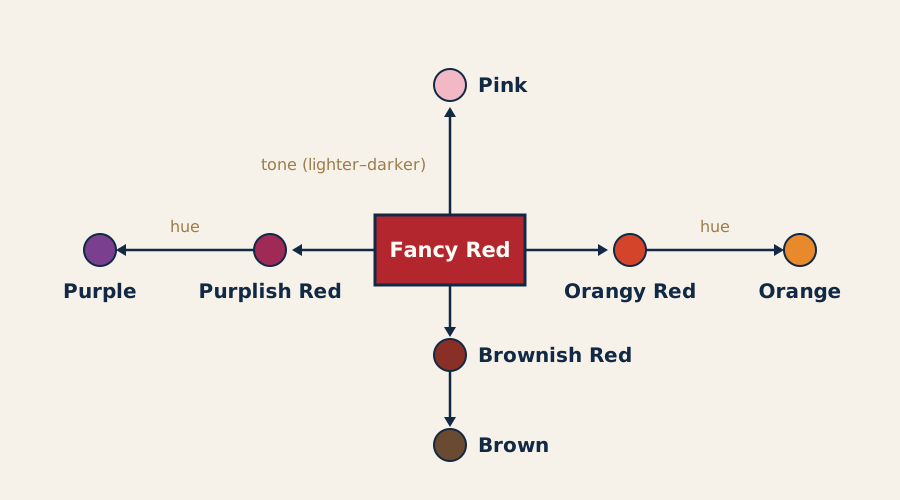
What does vary is the modifier, the secondary colour written before the main hue. The last word in the name is always the main colour, so a 'purplish red' is mainly red with a purple influence. Our page on how modifiers and overtones change a diamond's name explains the naming rules in depth.
- Fancy Red: pure red, no modifier. The rarest and most sought after.
- Fancy Purplish Red: the most common red description, especially among Argyle stones. It sits on the border with purple diamonds.
- Fancy Brownish Red: warmer and darker; usually valued below pure and purplish reds.
- Fancy Orangy Red: leans towards the orange diamond side of the colour wheel; uncommon.
Where do red diamonds come from? The Argyle story
For most of the past 40 years, the answer was largely Australia. The Argyle mine in the East Kimberley of Western Australia began production in the 1980s and closed in November 2020. By volume, most of its output was brown diamond, but it became famous for pinks, producing an estimated 90% or more of the world's supply. An argyle red diamond was rarer again: only a tiny fraction of Argyle's coloured rough was red.
Argyle's finest stones were sold through the annual Argyle Pink Diamonds Tender, an invitation-only sale of the year's most important pinks, reds and violets. Rio Tinto, which ran the mine, has said that fewer than 20 carats of Fancy Red diamonds were offered across the tender's entire history. One of the best known is the Argyle Phoenix, a 1.56 carat Fancy Red, which gives you a sense of what counts as a large Australian red.
Argyle stones from the tender usually carry a small laser inscription on the girdle (the thin edge around the stone) and an Argyle certificate, and many also have a GIA report. Outside Australia, natural reds have come from Brazil, parts of Africa, Russia and, historically, India, but none of these produce reds in any steady way. With Argyle closed, no new Australian reds are being mined; the stones you see are pieces already in circulation.
A natural red is a remarkable thing to own, but buy one because you love it, not with a price forecast in mind. Rare colours trade in a small market, and resale depends on finding the right buyer.
Related guidePink DiamondsNot sure which one is right?
Send us the stones you are looking at and our gemologist will tell you which to choose and why.
Natural, treated or lab-grown red diamond: what is the difference?
Red diamonds come in three main kinds, plus one to avoid for rings. They can look very similar, but their origin, durability of colour and price are completely different, and the grading report is where you find out which is which.
- Natural red diamond: mined, with colour formed in the Earth by deformation. Extremely rare.
- Treated red diamond: a natural diamond whose colour has been changed in a laboratory, usually by high pressure, high temperature (HPHT) processing, irradiation and annealing (controlled heating). This creates NV centres (a nitrogen atom next to a missing carbon atom) that absorb light and give a pinkish red to red colour. Treatment must be disclosed.
- Lab-grown red diamond: a laboratory-grown diamond, made by HPHT or CVD (chemical vapour deposition) growth, then usually irradiated and annealed after growth to turn it red. It is real diamond with the same hardness and sparkle, grown rather than mined.
- Coated diamond: a thin coloured film on the surface. The colour can wear or scratch off, so it is not suited to rings.
| Type | How the colour forms | What the report shows | Approx. price |
|---|---|---|---|
| Natural | Deformation in the Earth | Natural diamond; colour origin natural | Very high; often six figures and up |
| Treated natural | HPHT, irradiation and annealing | Natural diamond; colour origin treated, or an identification report noting treatment | Low to moderate |
| Lab-grown | Grown, then treated after growth | Laboratory-grown diamond; growth method; post-growth treatment noted | Low |
| Coated | Surface film | Identified as coated | Low; not for rings |
How to read a colour-origin report. On a GIA Colored Diamond Grading Report, look for two lines: the colour grade (for example 'Fancy Purplish Red') and the colour origin. Picture two stones of 0.30 carat, both graded Fancy Purplish Red. If one says colour origin Natural and the other says Treated, they may look much the same on the hand, but the first could cost a hundred times more. A lab-grown red comes with a laboratory-grown diamond report that names it lab-grown on the front, and GIA and IGI both laser-inscribe lab-grown stones on the girdle. For many colour-treated natural stones, GIA does not give a full colour grade; it identifies the diamond and states the treatment instead.
Treatment is common across fancy colours. Most black diamonds on the market are colour-treated too. Treated and lab-grown reds are stable in normal wear, but some treated colours can change with heat, so always tell your jeweller before any repair that uses a torch.
Browse red diamonds: natural and lab-grown
How much does a red diamond cost in Australia?
The red diamond price in Australia depends far more on origin than on anything else. A natural red and a lab-grown red of the same size and look sit at opposite ends of the diamond market.
| Type and size | Approximate price range (AUD) |
|---|---|
| Natural Fancy Red or Purplish Red, 0.10–0.30 ct | tens of thousands to several hundred thousand dollars |
| Natural Fancy Red, 0.50 ct and over | often well over $1 million per carat |
| Treated natural red, 0.30–0.50 ct | about $1,000–$5,000 |
| Lab-grown red, 0.50 ct | about $500–$2,000 |
| Lab-grown red, 1 ct | about $1,000–$4,000 |
These are broad ranges only, and natural reds in particular trade so rarely that every stone is priced individually. Within natural reds, the biggest price factors are the modifier (a pure Fancy Red above purplish red, and both well above brownish red), size, how evenly the colour is spread, the report and, for Argyle stones, documented provenance. Clarity matters less than in white diamonds; many natural reds have visible graining or small inclusions and are still highly valued.
For lab-grown and treated reds, the main thing to compare is how pure the red looks. Many lean pink or purple, and a stone that reads as a true red face-up usually costs more than one that looks deep pink.
What is the best setting and metal for a red diamond engagement ring?
Metal colour changes how a red looks, because light passing through the stone picks up the colour of the claws and gallery underneath.
- Platinum or white gold: the most contrast. Keeps a red looking pure and slightly cooler; a good choice for purplish reds.
- Rose gold: harmonises with red and pink, giving a soft, warm look. Can make a light stone look more pink.
- Yellow gold: warms the colour and can push a purplish red towards orange-red. Works well for warmer, brownish reds.
- Mixed metals: a white metal band with rose or yellow claws lets the colour reflect up through the stone while the rest of the ring stays white.
Because most reds are small, the setting often does the work of presence. A 0.20 carat round measures about 3.8 mm across; surround it with a halo of white diamonds and the whole centre reads closer to 7 mm. A bezel (a thin rim of metal) protects small, thin-edged stones and adds a frame of colour. Three-stone designs with white side stones and toi et moi rings pairing a red with a white or pink diamond are also common. For layouts and examples, see our fancy coloured diamond engagement ring designs.
What are the alternatives to a natural red diamond?
If a natural red is out of reach, there are several durable ways to get a red stone in a ring. Here is how they compare with diamond.
| Stone | Mohs hardness | Refractive index | Notes |
|---|---|---|---|
| Natural red diamond | 10 | about 2.42 | Extremely rare; mostly under 0.50 ct |
| Lab-grown red diamond | 10 | about 2.42 | Real diamond, laboratory-grown; low cost |
| Ruby (natural or lab-created) | 9 | about 1.76–1.78 | Red corundum; very durable for daily wear |
| Red spinel | 8 | about 1.72 | Bright, often untreated; good everyday choice |
| Garnet (pyrope, almandine) | 7–7.5 | about 1.72–1.83 | Deep red; affordable; best in protective settings |
| Rubellite tourmaline | 7–7.5 | about 1.62–1.64 | Pinkish red; softer, better for occasional wear |
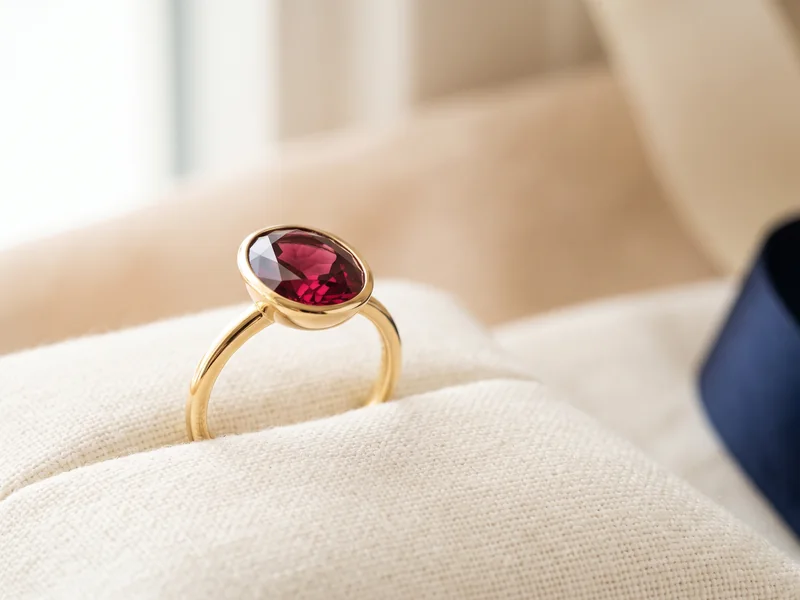
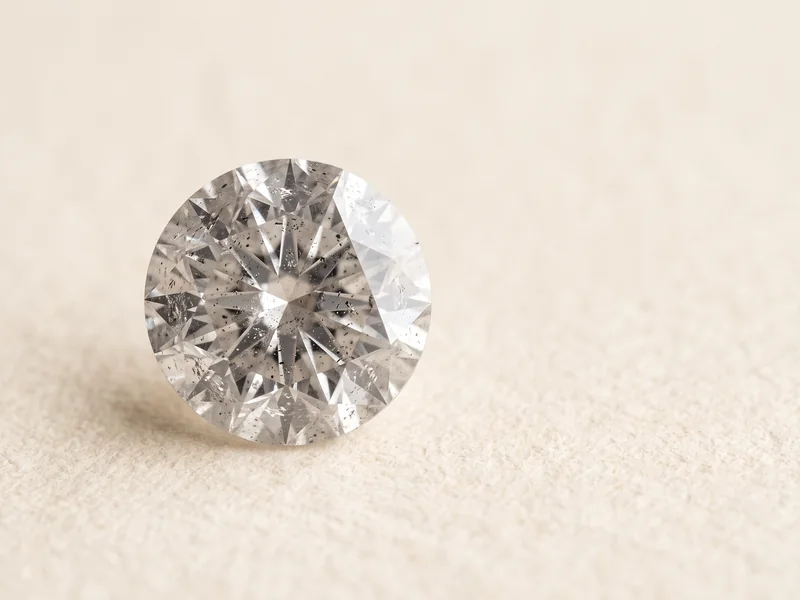
Ruby is the classic red stone and the closest match for durability. Garnet is far more varied than people expect, from wine red to orange and green; our guide to garnet engagement rings beyond dark red shows the range. If what draws you to red is simply wanting an unusual diamond, it is also worth looking at grey and salt-and-pepper diamonds, which offer character at a fraction of the price of rare colours.
How do you choose a red diamond? Step by step
- Decide on origin first. Natural, treated natural or lab-grown: the budget for each is completely different.
- Read the report. Check the colour grade, the modifier and the colour origin line, and whether the diamond is natural or lab-grown.
- Check the colour name. Fancy Red, Fancy Purplish Red and Fancy Brownish Red look and cost very differently.
- View it in several lights. Daylight, warm indoor light and LED, and against your chosen metal.
- Look for even colour. Watch a 360° video and check the colour does not collect in one area or leave the stone looking pale.
- Confirm provenance. For an Argyle stone, ask for the Argyle certificate and check the girdle inscription matches.
- Plan a protective setting. A bezel, halo or secure claws, and tell any jeweller about treatments before repairs involving heat.
Free consultation
Talk to a gemologist
Compare stones in person or online with Raj Sood, Graduate Gemologist (GIA), AJP (GIA).
Book a consultationShop this shape
FAQ
Common questions
Are red diamonds real?
Yes. Natural red diamonds exist but are extremely rare, mostly under half a carat. Lab-grown and treated red diamonds are also real diamond, and the grading report will say which kind you are looking at.
Why are red diamonds so rare?
Their colour comes from strong deformation of the crystal deep in the Earth, and only a tiny number of diamonds are deformed in exactly the way that produces red rather than pink or brown. Even Argyle, the main source of pinks, produced very few reds before it closed in 2020.
What is the difference between a pink and a red diamond?
They share the same colour cause. A red has much stronger, slightly darker colour; lighter or weaker versions of the same hue are graded pink.
How much is a 1 carat red diamond?
A natural 1 carat Fancy Red is so rare that it would usually be priced well over a million dollars and sold privately or at auction. A 1 carat lab-grown red is roughly AUD $1,000–$4,000, depending on how pure the red looks.
Can you get a lab-grown red diamond?
Yes. Lab-grown red diamonds are grown by HPHT or CVD and usually treated after growth to turn them red. They are real diamond and must always be sold and reported as laboratory-grown.
Is a red diamond good for an engagement ring?
Yes. A red diamond has the same hardness as any diamond, 10 on the Mohs scale, so it suits daily wear. Choose a setting such as a bezel or halo that protects its edges, especially for small stones.

Ask a gemologist
Not sure which diamond to choose?
Raj Sood is a Graduate Gemologist (GIA) and master jeweller. Bring the stones you are considering, or send the reports, and he will tell you honestly which one is better and why.
Keep learning
Related guides
 Fancy Colour DiamondsPink DiamondsFancy Colour DiamondsFancy Colour Diamonds Guide
 Fancy Colour DiamondsFancy Colour Intensity Scale: Faint to VividFancy Colour DiamondsFancy Colour Modifiers and Overtones
 GemstonesGarnet Engagement Rings: More Than Dark Red
 Fancy Colour DiamondsGrey and Salt-and-Pepper Diamonds
 Fancy Colour DiamondsGreen Diamonds
 Fancy Colour DiamondsPurple Diamonds
Explore more
More guides on this topic
Education