
Gemstones
Orange Sapphire Guide: Colour, Treatments, Origins and Value
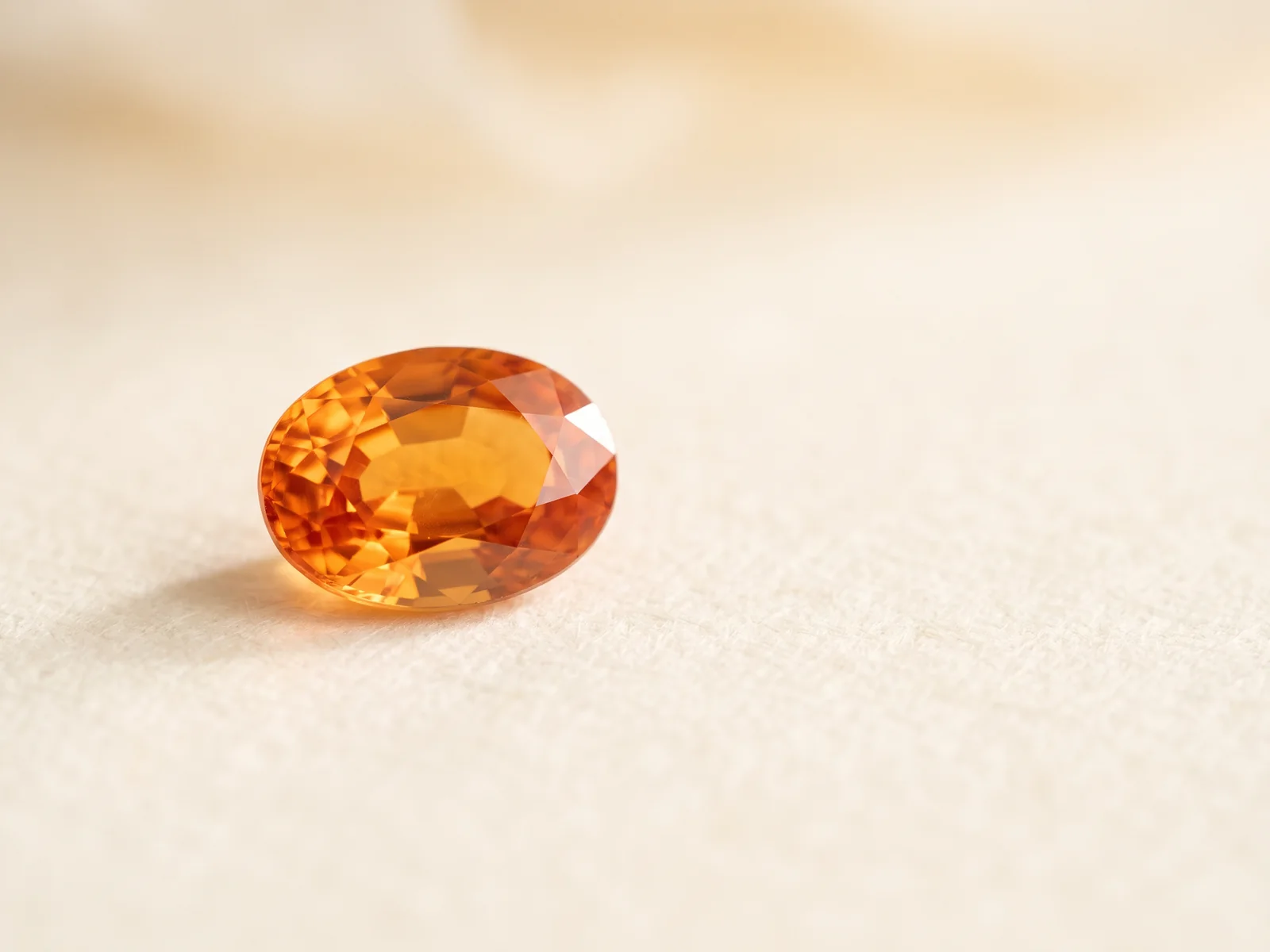
An orange sapphire has the warmth of a fire opal or spessartite garnet with the hardness of a sapphire, which makes it one of the few vivid orange gems that can be worn every day. Treatment matters more here than in almost any other sapphire, so it pays to know what to ask.
 Reviewed by Raj Sood, Graduate Gemologist (GIA), AJP (GIA)Master jeweller and Graduate Gemologist (GIA) · reviewed 4 November 2026
Quick answer
An orange sapphire is corundum, the same mineral as blue sapphire and ruby, coloured orange by traces of iron and chromium or by natural colour centres. It is 9 on the Mohs scale with excellent toughness, so it suits everyday rings. Most are heated; ask whether it has been beryllium-diffused, which changes value considerably.
What is an orange sapphire?
An orange sapphire is a gem-quality crystal of corundum, which is aluminium oxide (Al2O3). Red corundum is called ruby; every other colour, including orange, is called sapphire. Our main sapphire gemstone guide covers the whole family, from classic blue to the rarer fancy colours.
Pure corundum is colourless, which is what you see in a colourless white sapphire. Colour comes from tiny amounts of other elements, called trace elements, and from defects in the crystal. In orange sapphire the colour is usually a mix of two things: a yellow component, from iron and from natural colour centres (spots in the crystal where an electron is missing and light is absorbed), and a pink-to-red component from chromium. More chromium pushes the stone towards reddish orange; less pushes it towards golden yellow.
The key gemmological numbers are the same for every sapphire colour: a refractive index of about 1.762–1.778 (how strongly the stone bends light), a birefringence of about 0.008–0.010, and a specific gravity (density compared with water) of about 4.00. Sapphire is also pleochroic, meaning it shows slightly different colours when viewed from different directions. In orange sapphire that usually means orange in one direction and a more yellowish orange in another. If any of these terms are new, our plain-English jewellery glossary explains them, and the broader guide to coloured gemstones and birthstones shows where orange sapphire fits among other gems.
What colours does orange sapphire come in?
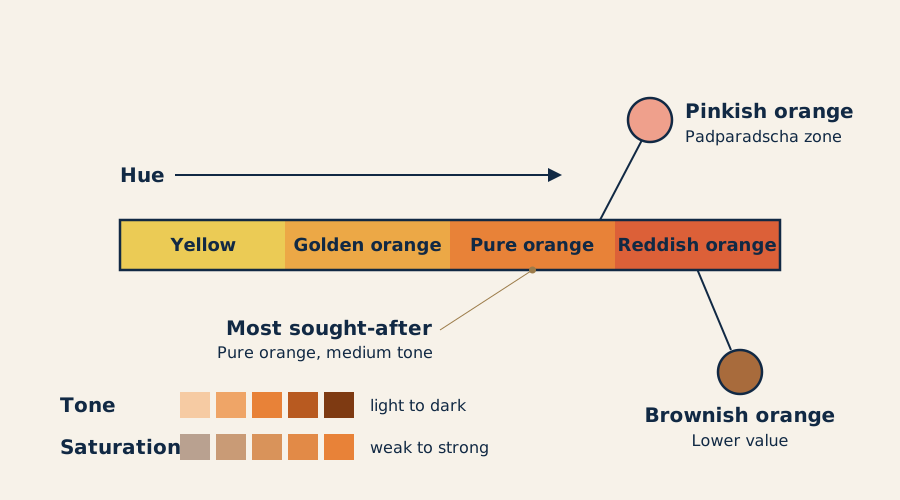
"Orange sapphire" covers a wide range, from pale apricot to deep reddish orange. Three things describe the colour: hue (the basic colour), tone (how light or dark) and saturation (how strong or how greyish or brownish). The most valued orange sapphires have a pure orange hue, a medium tone and strong saturation with no brown.
| Colour description | How it looks | Typical market view |
|---|---|---|
| Pale apricot or peach | Light orange, soft and pastel | Popular and affordable; can overlap with peach sapphire |
| Golden or yellowish orange | Yellow dominant with orange warmth | Common; often sold as golden sapphire |
| Pure orange (medium tone) | Bright, saturated, like a ripe mandarin | The most sought-after orange |
| Reddish orange | Deep, fiery, close to red | Valued, but check tone is not too dark |
| Pinkish orange | Balanced pink and orange, sunset-like | May be called padparadscha if the colour fits |
| Brownish orange | Muted, earthy | Lower value; brown reduces brightness |
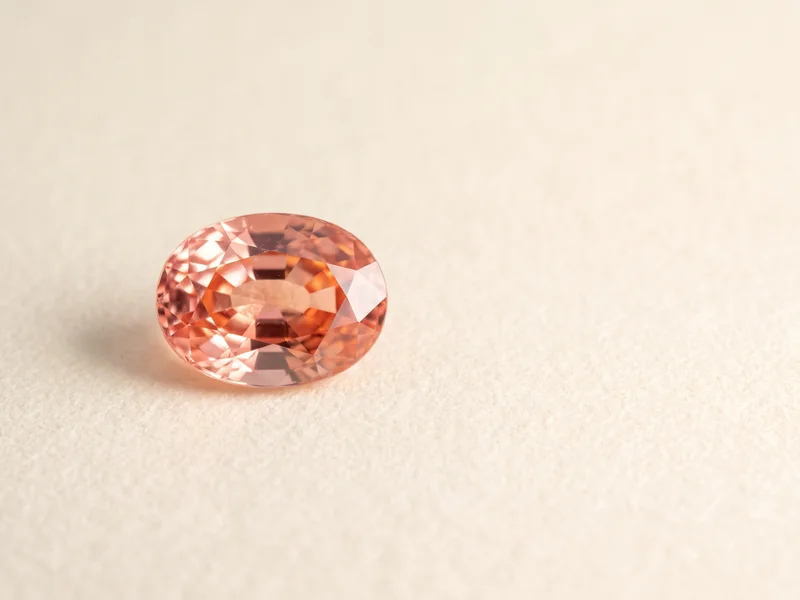
The line between orange sapphire and padparadscha causes the most confusion. Padparadscha is a trade name for sapphires with a delicate blend of pink and orange, usually light to medium in tone. A strongly orange stone with no pink is simply an orange sapphire, however fine its colour. Our padparadscha sapphire guide sets out how labs decide whether a stone qualifies, and why the name adds so much to the price.
Related guidePadparadscha SapphireOrange also turns up in sapphires that are not one single colour. Some stones show orange and yellow zones side by side, which is covered in our page on multi-coloured parti sapphire rings. A small number shift colour under different lighting, and you can read about how that works in our colour-change sapphire explainer. If you like the warmer end of the spectrum but want something cooler alongside it, a purple sapphire makes an interesting contrast in a three-stone ring.
Is orange sapphire durable enough for an engagement ring?
Yes. Durability has two parts. Hardness is resistance to scratching, measured on the Mohs scale. Toughness is resistance to chipping and breaking. Sapphire scores 9 for hardness, second only to diamond at 10, and it has excellent toughness because it has no cleavage (a natural plane along which a crystal splits easily). It can show parting, a weakness along twinning planes, but in practice that rarely causes problems in jewellery.
That combination matters most for orange, because many other orange gems are much softer or more fragile. Here is how an orange sapphire ring compares with the alternatives:
| Gem | Mohs hardness | Toughness | Everyday ring? |
|---|---|---|---|
| Diamond (orange) | 10 | Good; has cleavage | Yes |
| Sapphire (orange) | 9 | Excellent; no cleavage | Yes |
| Spinel (orange) | 8 | Good | Yes, with some care |
| Topaz (imperial or orange) | 8 | Poor; perfect cleavage | Occasional wear |
| Spessartite garnet | 6.5–7.5 | Fair to good | Occasional wear or protective setting |
| Citrine | 7 | Good | Occasional wear |
| Fire opal | 5.5–6.5 | Poor to fair | Pendants and earrings |
Natural fancy orange diamonds are harder again, but they are extremely rare and priced accordingly. For a deeper look at how the two compare on a ring worn daily, see our diamond vs sapphire engagement ring comparison. Emerald, at 7.5–8 and often fractured, is far more delicate; our emerald versus sapphire breakdown explains why.
For an orange sapphire engagement ring, four or six claws, a bezel or a halo all work well. Yellow and rose gold sit comfortably with orange and make the colour look warmer; white gold and platinum give more contrast and can make a golden orange look a touch more orange. Our page on sapphire engagement rings made in Melbourne shows the main setting styles.
Is orange sapphire treated? Heat and beryllium explained
Most orange sapphires on the market have been treated, and the type of treatment has a large effect on value. Treatment must be disclosed, and a good grading report will state it.
| Treatment | What it does | How common | Effect on value |
|---|---|---|---|
| None (unheated) | Natural colour as mined | Uncommon | Highest, for fine colour |
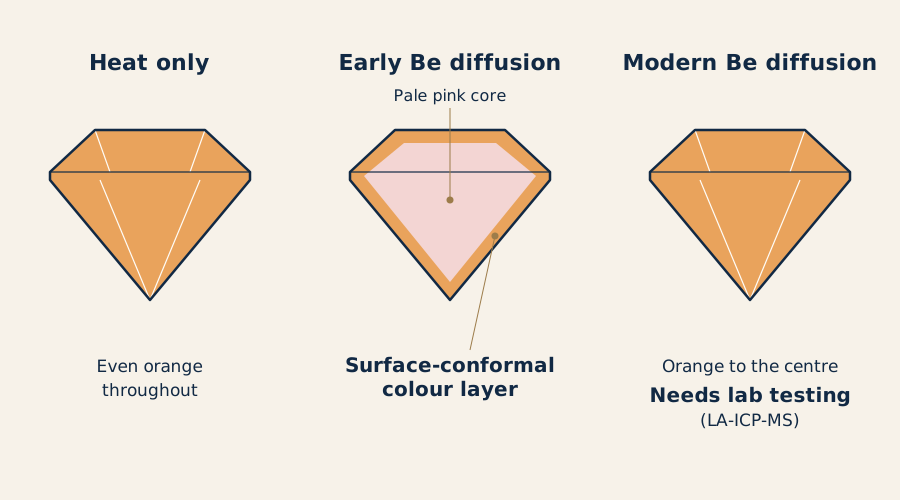
| Heat only | Heating to roughly 1,000–1,800 °C improves colour and clarity | Very common | Accepted standard; below unheated |
| Beryllium (Be) diffusion | Heating with beryllium drives it into the crystal and creates or strengthens orange | Common in orange and padparadscha-like stones | Much lower than heat-only |
| Lab-created (synthetic) | Not a treatment: the whole crystal is grown in a laboratory | Widely available | A small fraction of natural |
Heat treatment is long established and permanent. It can dissolve fine needle-like inclusions called silk, lift colour and improve transparency. Gemmologists look for signs such as partly dissolved silk and small disc-shaped stress fractures around crystals.
Beryllium diffusion is the one to ask about. In the early 2000s, gem labs found that some Thai heat-treaters were adding beryllium, a light element, during heating. Just a few parts per million of beryllium creates strong yellow-orange colour centres, turning pale pink or near-colourless sapphire into vivid orange or padparadscha-like stones. Early stones showed a shallow orange rim around a paler core; modern treatment can colour the stone right through. Because beryllium is so light, standard gem tests cannot see it. Detection needs laboratory chemical analysis such as LA-ICP-MS (laser ablation mass spectrometry).
Lab-created orange sapphire has been made since the early 1900s, mostly by flame fusion (the Verneuil process). It is real corundum with the same hardness and refractive index, just grown rather than mined. Under magnification flame-fusion stones often show curved growth lines and round gas bubbles, where natural stones show straight colour zoning and crystal inclusions. Lab-created stones must always be sold as lab-created or synthetic.
Not sure which one is right?
Send us the stones you are looking at and our gemologist will tell you which to choose and why.
Where does natural orange sapphire come from?
Natural orange sapphire is found in several of the world's sapphire regions, though fine pure orange is uncommon everywhere:
- Sri Lanka: a classic source of orange, yellow and padparadscha sapphires, often light to medium in tone.
- Madagascar: deposits such as Ilakaka produce a wide range of fancy colours, including orange and pinkish orange.
- Tanzania: the Umba Valley and the Songea area are known for orange, reddish orange and brownish orange sapphires.
- Thailand and Cambodia: more important as cutting and heat-treating centres than as orange sources.
- Australia: central Queensland and the New England region of New South Wales produce mostly blue, green, teal and yellow sapphire; golden and yellowish orange stones occur, but strong pure orange is rare.
Australian sapphire is mainly basalt-related and tends to be rich in iron, which is why so many local stones are deep blue, green or golden rather than bright orange. If you love the idea of a local stone, our page on rings set with Australian sapphire covers what the fields produce. The same iron-rich chemistry gives the greens and blue-greens described in our green sapphire guide and the teal sapphire engagement ring page.
For orange sapphire, origin usually matters less to price than colour and treatment. Labs can sometimes suggest a likely origin from inclusions and trace-element chemistry, but origin reports cost extra and are mainly worth it for larger, unheated stones.
How do gemmologists identify an orange sapphire?
Several orange gems look similar to an orange sapphire at first glance. Simple gemmological tests separate most of them:
| Gem | Refractive index | Refraction | Clues |
|---|---|---|---|
| Orange sapphire | 1.762–1.778 | Double | Pleochroic; silk, fingerprints, straight zoning |
| Lab-created orange sapphire | 1.762–1.778 | Double | Curved growth lines, gas bubbles |
| Spessartite garnet | about 1.79–1.81 | Single | No pleochroism; wavy inclusions |
| Orange spinel | about 1.71–1.72 | Single | No pleochroism; octahedral crystals |
| Imperial topaz | about 1.61–1.64 | Double | Lighter in the hand; cleavage cracks |
| Citrine | about 1.54–1.55 | Double | Low refractive index; often heated amethyst |
| Orange glass | variable, often 1.50–1.70 | Single | Gas bubbles, swirl marks, warm to the touch |
A refractometer reading and a check with a dichroscope (a small tool that shows pleochroism) will confirm corundum. Telling natural from lab-created needs a microscope, and telling heat-only from beryllium-treated needs a laboratory. That last step is the most important one for value, and it cannot be done by eye.
What affects orange sapphire price in Australia?
In rough order, the factors that move the price of an orange sapphire are:
- Treatment: unheated, heat-only and beryllium-treated stones of the same look can differ in price many times over.
- Colour: pure, saturated orange at a medium tone is worth most; brown, grey or very pale colour is worth less.
- Clarity: orange sapphire is usually expected to be eye-clean (no inclusions visible without magnification).
- Cut: a well-cut stone is bright across the face, without a dull or see-through centre, called a window.
- Carat weight: fine orange over 2 carats is noticeably rarer, so the price per carat rises with size.
| 1 ct orange sapphire, eye-clean, good colour | Approximate price range (AUD) |
|---|---|
| Lab-created | about $50–$300 |
| Natural, beryllium-treated | about $200–$800 |
| Natural, heat only | about $800–$3,000 |
| Natural, unheated | about $2,000–$6,000+ |
These are broad ranges only, and fine or large stones can fall outside them. Compared with a padparadscha of similar quality, an orange sapphire usually costs considerably less, and compared with a natural orange diamond it costs a tiny fraction. For a sense of how the colours sit against each other on price and wear, our teal versus blue sapphire ring comparison uses the same value factors.
Browse natural gemstones, including sapphires
How do you care for an orange sapphire ring?
Orange sapphire is one of the easier gems to look after. Because untreated, heated and beryllium-diffused stones are all stable, normal cleaning is safe:
- At home: warm water, a drop of mild detergent and a soft toothbrush, especially under the stone where lotion and soap build up.
- Ultrasonic and steam: generally safe for untreated, heated and beryllium-treated stones, but avoid them if the stone has surface-reaching fractures or any filling.
- Storage: keep it apart from diamond jewellery, which can scratch it, and from softer gems, which it can scratch.
- Checks: have the claws checked about once a year; a sapphire rarely breaks, but a worn claw can still lose it.
Avoid wearing any ring for heavy work such as gym weights or gardening. The stone will survive far more than most gems, but metal claws bend and wear.
How to choose an orange sapphire: step by step
- Decide on the colour. Pale apricot, pure orange, reddish orange or pinkish orange; know whether you want padparadscha or simply orange.
- Read the report. Confirm the stone is natural or lab-created corundum, and find the treatment line: none, heat, or beryllium.
- Ask about beryllium. For any natural orange over about 0.50 carat, check the lab tested for it.
- Check for brown. View the stone in daylight and under warm indoor light; a fine orange stays bright in both.
- Look for windows and clarity. Tilt the stone; the centre should stay lively, with no inclusions visible at arm's length.
- Compare millimetres. Sapphire is denser than diamond, so a 1 ct sapphire looks smaller than a 1 ct diamond; compare face-up size.
- Match the setting to your life. Claws, bezel or halo, and a metal colour that suits the orange.
Free consultation
Talk to a gemologist
Compare stones in person or online with Raj Sood, Graduate Gemologist (GIA), AJP (GIA).
Book a consultationShop this shape
FAQ
Common questions
Is orange sapphire a real sapphire?
Yes. Orange sapphire is corundum, the same mineral as blue sapphire and ruby, with the same hardness of 9 on the Mohs scale. Only red corundum is called ruby; every other colour is sapphire.
What is the difference between orange sapphire and padparadscha?
Padparadscha is a pinkish-orange sapphire with a balanced blend of both colours, usually light to medium in tone. A sapphire that is purely orange, with no pink, is an orange sapphire and is usually priced well below padparadscha.
Is orange sapphire good for everyday wear?
Yes. It is 9 on the Mohs scale and has excellent toughness with no cleavage, so it handles daily wear far better than orange topaz, citrine, garnet or fire opal.
What is a beryllium treated orange sapphire?
It is a natural sapphire heated with beryllium, which creates or deepens orange colour. The treatment is stable but must be disclosed, and these stones are worth much less than heat-only or unheated sapphires.
Are there Australian orange sapphires?
Yes, but strong pure orange is rare. Australian fields in Queensland and New South Wales mainly produce blue, green, teal and yellow sapphire, with some golden and yellowish orange stones.
How much does an orange sapphire cost in Australia?
As a broad guide, a 1 ct heat-only natural orange sapphire is roughly AUD $800–$3,000, beryllium-treated stones are much less, and lab-created ones cost a small fraction. Unheated stones with fine colour cost more.

Ask a gemologist
Not sure which diamond to choose?
Raj Sood is a Graduate Gemologist (GIA) and master jeweller. Bring the stones you are considering, or send the reports, and he will tell you honestly which one is better and why.
Keep learning
Related guides
 GemstonesPadparadscha Sapphire
 GemstonesSapphire Gemstones
 GemstonesSapphire Engagement Rings in Melbourne
 Fancy Colour DiamondsOrange DiamondsGemstonesGemstones | Coloured Gemstones, Birthstones and Custom Jewellery
 GemstonesDiamond vs Sapphire Engagement Rings
 GemstonesAustralian Sapphire Engagement Rings
 GemstonesGreen Sapphire
Explore more
More guides on this topic
Education