
- Education
- Fancy Colour Diamonds
- Fancy Coloured Diamond Engagement Rings: Colour, Grades, Origin and Settings
Fancy Colour Diamonds
Fancy Coloured Diamond Engagement Rings: Colour, Grades, Origin and Settings
Fancy coloured diamond engagement rings give you colour with the toughness of diamond, but the same pink or yellow can be natural, treated or lab-grown, at very different prices. Here is how to read the colour, the grade and the report before you choose.
 Reviewed by Raj Sood, Graduate Gemologist (GIA), AJP (GIA)Master jeweller and Graduate Gemologist (GIA) · reviewed 4 November 2026
Quick answer
Fancy coloured diamond engagement rings use diamonds with natural, treated or lab-grown colour strong enough to be graded on GIA's fancy scale, from Faint to Fancy Vivid. Colour comes from nitrogen (yellow), boron (blue), lattice distortion (pink, red, brown) or radiation (green). Always check the report's colour origin line: natural, treated or lab-grown.
What are fancy coloured diamond engagement rings?
A fancy coloured diamond is one whose colour is strong enough, or unusual enough, to be graded on a separate scale from white diamonds. Most diamonds are graded on the D-to-Z scale, where D is colourless and Z shows a noticeable light yellow or brown tint. A yellow or brown diamond with more colour than Z, or any diamond with a clear pink, blue, green, orange, purple or red hue, is graded as a fancy colour instead. Our full fancy colour diamonds guide covers every hue in detail; this page focuses on choosing one for an engagement ring.
Natural fancy colours are rare. The figure usually quoted is roughly 1 in 10,000 mined diamonds, and most of those are yellow or brown. Pink, blue, green, purple and red are far scarcer. Lab-grown fancy colours are now widely available and are real diamond, with the same hardness (10 on the Mohs scale) and refractive index (about 2.42, the measure of how strongly a stone bends light) as natural stones.
Fancy coloured diamond engagement rings sit between a classic white diamond solitaire and engagement rings set with sapphires, emeralds and other gemstones. You get colour plus the scratch resistance of diamond for daily wear, which matters on a ring that is knocked against benches and car doors for decades. Every technical term here is explained as we go, and again in the GemTrove jewellery glossary.
What causes colour in a diamond?
Pure diamond is made only of carbon and is colourless. Colour appears when something interrupts the crystal: a stray atom of another element, a distortion in the way the carbon atoms are stacked, or damage from natural radiation. Gemmologists also sort diamonds into types by their nitrogen and boron content: Type Ia and Ib contain nitrogen, Type IIa contains almost none, and Type IIb contains boron. The type often explains the colour.
| Colour | Main cause | What it means for you |
|---|---|---|
| Yellow (canary) | Nitrogen atoms in the crystal | Isolated nitrogen (Type Ib) gives the most saturated canary yellows; the most affordable of the bright natural fancy colours |
| Brown, champagne, cognac | Distortion of the crystal lattice (plastic deformation) | The most common fancy colour; good value in warm metals |
| Pink and red | Lattice distortion, often visible as coloured graining | The exact mechanism is still studied; Argyle supplied most natural pinks |
| Blue | Boron (Type IIb) | Boron-blue diamonds conduct electricity; some grey-blues come from hydrogen instead |
| Green | Natural radiation exposure over very long periods | Colour is often only skin-deep, so cutters keep some original surface |
| Orange | Nitrogen-related absorption | Pure orange is very rare; most have yellow or brown modifiers |
| Purple and violet | Lattice distortion or hydrogen | Very rare, usually small |
| Black | Dense dark inclusions such as graphite, or treatment | Most black diamonds sold are treated natural diamonds |
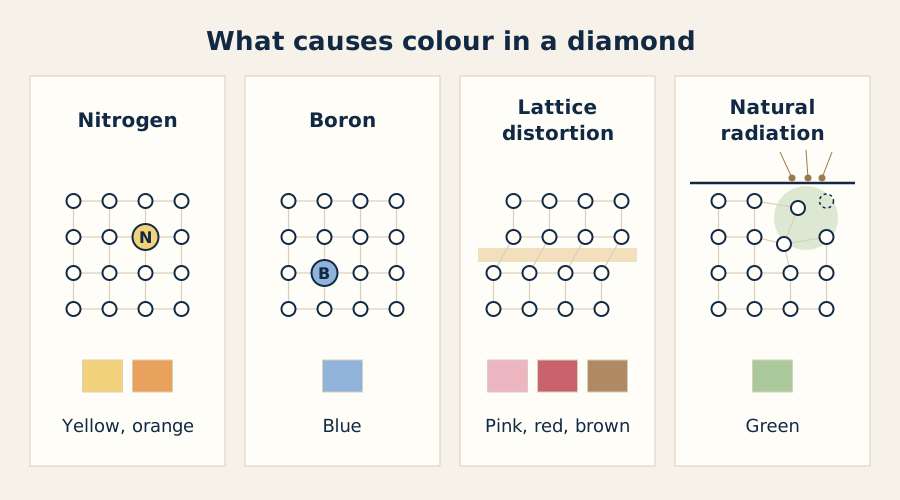
The cause matters beyond curiosity. It tells a lab what to test for, it affects how stable and even the colour is, and it links directly to rarity. Nitrogen is common in diamond, which is why yellow and canary diamonds are the most accessible of the bright natural fancy colours. Lattice distortion is also common at low levels, which is why champagne and cognac browns are plentiful, while the same distortion producing pink is exceptional.
How are fancy colour diamond intensity grades decided?
White diamonds are graded on how little colour they have. Fancy colours are graded on how much colour they have and what that colour looks like. GIA judges the stone face-up (from the top, as it is seen in a ring) under controlled lighting against reference stones, and describes colour with three ideas:
- Hue: the colour itself, such as pink, yellow or blue. GIA uses 27 hue names.
- Tone: how light or dark the colour is.
- Saturation: how strong or pure the colour is, from greyish or brownish to vivid.
Tone and saturation together give the intensity grade. These are the grades you will see on a report:
| Intensity grade | How it looks | Notes |
|---|---|---|
| Faint, Very Light, Light | A soft hint of colour | Used for pink, blue, green and other rarer hues; yellow and brown at this level stay on the D-to-Z scale |
| Fancy Light | Clear but pale colour | Often the entry point for natural pinks and blues |
| Fancy | Definite, moderate colour | A common grade for yellows and champagne browns |
| Fancy Intense | Strong colour | A popular choice for yellow engagement rings |
| Fancy Vivid | Very strong, pure colour at a medium tone | The top saturation grade; usually the highest prices |
| Fancy Deep | Rich, darker colour with strong saturation | Can look deeper than Vivid; valued in some hues |
| Fancy Dark | Dark tone, lower saturation | Often brownish or greyish; usually less costly |
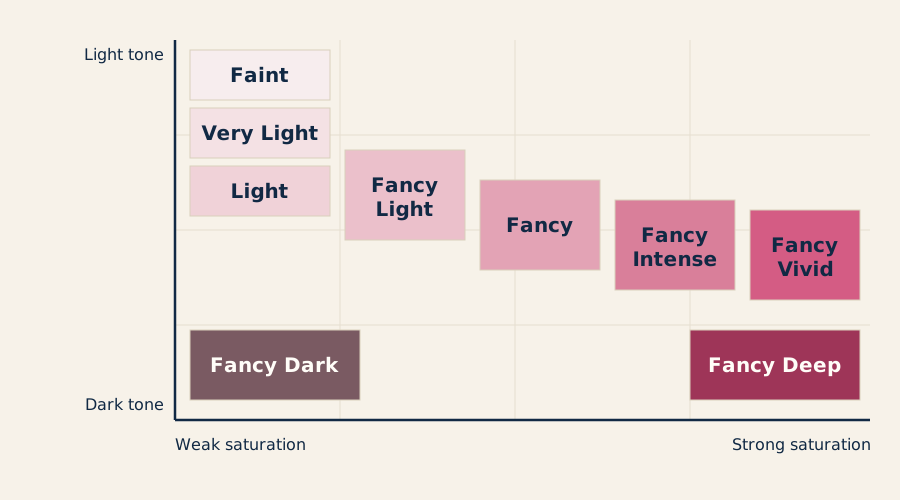
Two exceptions are worth knowing. Red is graded only as Fancy Red, with no intensity range, because a red that is lighter or weaker becomes pink. And the grade sits alongside the full colour name, so you might see 'Fancy Intense Orangy Yellow' or 'Fancy Purplish Pink'. The last word is the main hue; anything before it is a modifier, a secondary colour that shifts the look and the price. Our pages on the full intensity scale from Faint to Vivid, what makes a diamond Fancy Vivid and modifiers and overtones such as purplish or greenish go deeper.
Related guideHow Fancy Colour Diamonds Are GradedNatural vs lab-grown coloured diamonds: how can you tell?
A pink, blue or yellow diamond can reach that colour in three ways, and you cannot tell them apart by eye. A natural diamond can be coloured by the earth. A natural diamond with weak or unwanted colour can be treated to change it. Or the diamond can be lab-grown, either with colour built in during growth or added afterwards. Only laboratory testing separates them, which is why the report is the most important document in the whole purchase.
| Natural colour | Treated natural | Lab-grown | |
|---|---|---|---|
| Where the colour comes from | Formed in the earth | Changed after mining by heat, pressure or irradiation | Grown in a lab; pink and red usually treated after growth |
| Rarity | Rare to extremely rare | Common | Readily available |
| Relative price | Highest | Much lower than natural colour | Usually lowest |
| Hardness and wear | Mohs 10 | Mohs 10; coated stones are the exception | Mohs 10 |
| Report wording | Colour origin: natural | Colour origin: treated | Laboratory-grown diamond report |
| Typical colours | Mostly yellow and brown | Blue, green, pink, yellow, black | Pink, blue, yellow, green, red |
On a GIA Coloured Diamond Grading Report, the line to read is the colour origin, printed beside the colour grade. Here is how it reads in practice:
- 'Natural': no treatment was detected. A Fancy Intense Yellow from the earth would read this way.
- 'Treated': the colour was changed after mining, for example a brownish diamond turned yellow-green by irradiation and annealing (gentle heating), or a brown Type IIa diamond turned pink by HPHT (high pressure, high temperature) processing. The comments usually note the method.
- Laboratory-grown report: the diamond was grown, not mined, and the report says so; the girdle (outer edge) is normally laser-inscribed with that fact. Any post-growth treatment is noted.
- 'Undetermined' or no grade: testing could not reach a conclusion. This is uncommon; ask for further testing before you commit.
Coatings deserve a specific warning. A thin coloured film on the pavilion (the underside) can make a white diamond look pink or blue, but it can wear or scratch off in an ultrasonic clean or with re-polishing. HPHT and irradiation colours are generally stable in normal wear, though a jeweller's torch during repairs can affect some irradiated colours, so always tell your jeweller. Our page on how lab-grown fancy colours are made explains CVD (chemical vapour deposition) and HPHT growth, and which colours grow in and which are added.
Not sure which one is right?
Send us the stones you are looking at and our gemologist will tell you which to choose and why.
Why are Argyle pink diamonds so rare?
Australia has a direct part in the fancy colour story. The Argyle mine in the East Kimberley region of Western Australia began producing in the 1980s and, until it closed in November 2020, supplied the large majority of the world's pink diamonds, often quoted as around 90%. Even at Argyle, pinks were a tiny fraction of total output, commonly cited as well under 1%. Most of the mine's production was brown, which helped create the 'champagne' and 'cognac' names now used across the trade.
Argyle pinks are known for strong colour in small sizes; many in jewellery are under 0.20 carat and are used as accent stones or in pairs beside a white centre. Argyle used its own colour codes (such as P for pink, PP for purplish pink and PR for pink rosé, with a number from 1 to 9, where 1 is the strongest), and the most important stones were sold through an annual invitation-only tender with certificates and laser-inscribed serial numbers.
For anyone buying today, two points matter. First, with the mine closed, the supply of new Argyle rough has ended, and prices for documented stones have generally risen. Second, the Argyle name needs paperwork: an original Argyle certificate, an inscription that matches it, or an independent report linking the stone to Argyle. A pink diamond described as 'Australian' without documentation is just a pink diamond. Our pink diamonds guide, including the Argyle history covers pinks in more depth.
Which fancy colours suit an engagement ring?
Every diamond colour has the same hardness, but they differ in rarity, price and how they behave day to day. Here is how the main colours compare as an engagement stone:
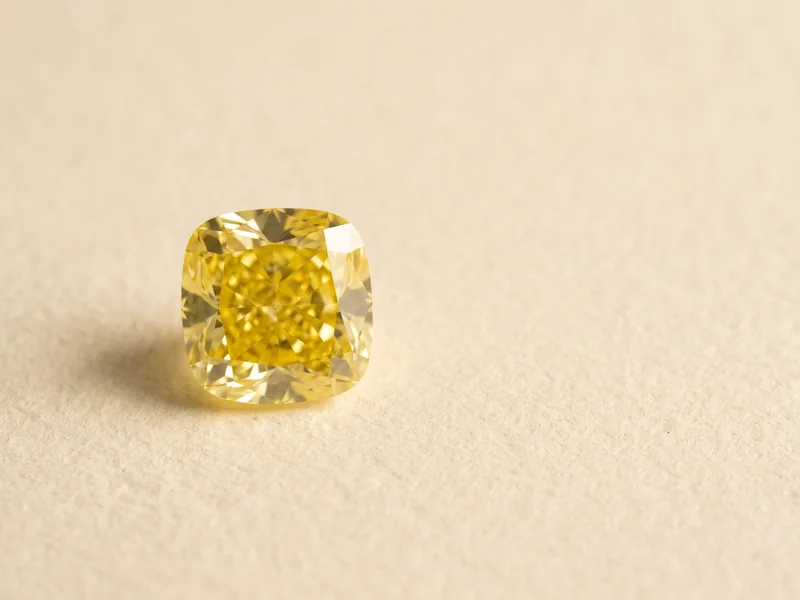
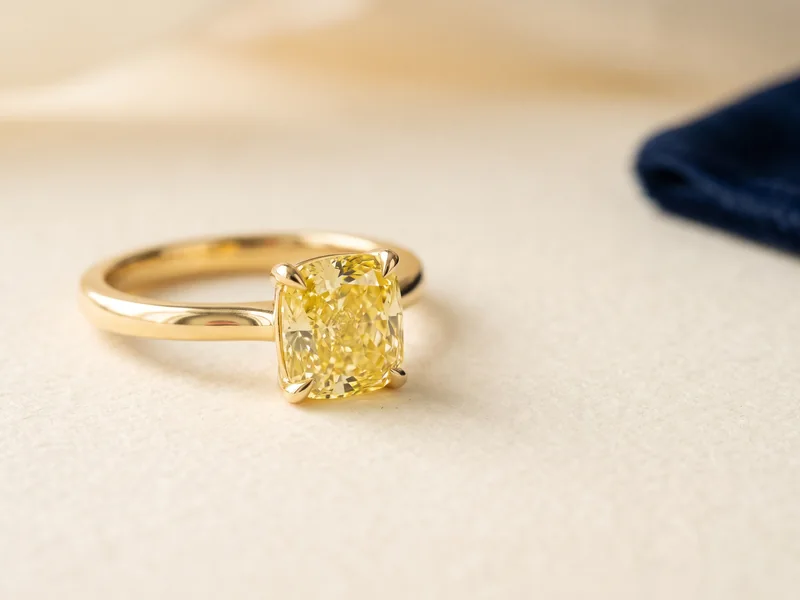
- Yellow: the most popular bright natural fancy colour, and the usual choice for a yellow diamond engagement ring. Fancy Intense and Fancy Vivid yellows read clearly as yellow from across a room.
- Champagne and cognac (brown): warm, soft and affordable. A champagne diamond engagement ring in rose or yellow gold has a vintage feel.
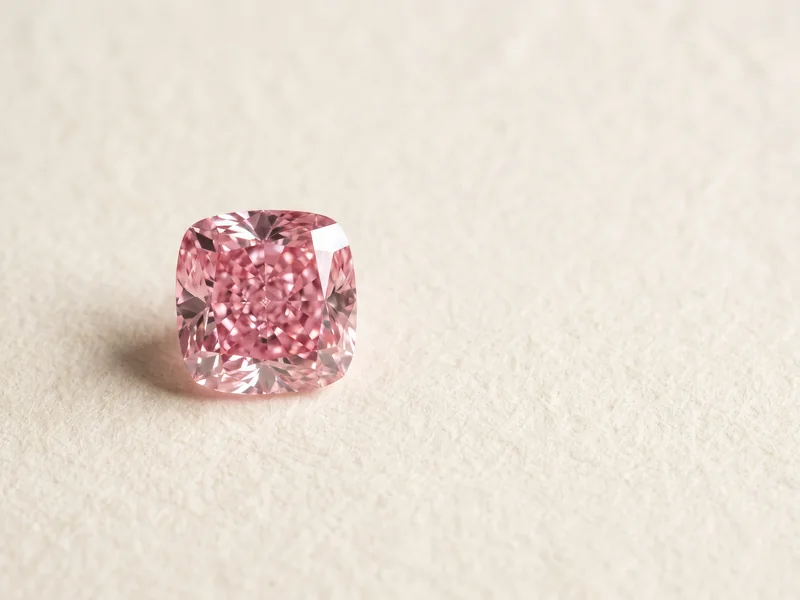
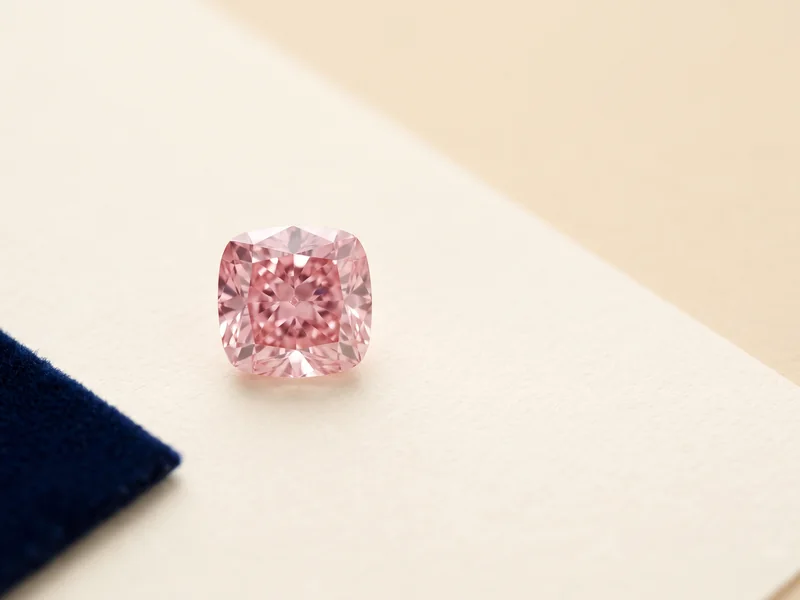
- Pink: natural pinks are rare and costly; lab-grown and treated pinks make a pink diamond engagement ring accessible. Check origin carefully.
- Blue: natural blues are among the rarest gems; most blue diamonds in engagement rings are lab-grown or treated.
- Green: natural greens are very rare and many are treated. Lab-grown greens are available.
- Red: natural red is the rarest diamond colour of all, with very few stones over a carat. Lab-grown reds give the look at a fraction of the cost.
- Black: usually a treated natural diamond with many fractures and inclusions. Opaque, so it relies on lustre rather than sparkle, and is less tough than a clear diamond.
- Salt-and-pepper: not a fancy colour but a heavily included white-to-grey diamond with black and white flecks. Every stone is unique; larger inclusions can reduce toughness.
If your partner is drawn to colour but the budget does not stretch to natural pink or blue, the honest options are a lab-grown diamond in that colour, a treated natural diamond, or a coloured gemstone such as sapphire (9 on the Mohs scale). All three wear well; they differ in rarity and price, not in whether they are 'real'.
Which diamond shapes show colour best?
A round brilliant is cut to return as much white light as possible, which can dilute body colour. That is why most fancy coloured diamonds are cut as radiants, cushions, ovals, pears and hearts. Their facet patterns let light travel further through the stone before it returns, deepening the colour you see face-up. A cutter working a pink or yellow crystal will often choose the shape and depth that give the strongest colour grade, even if it costs some brightness or weight.
Because the colour grade drives the price far more than sparkle, fancy coloured diamonds are often cut a little deeper than white diamonds of the same shape. The trade-off is face-up size: a deeper stone carries more weight underneath and looks smaller from above, so compare millimetre measurements, not just carats. GIA does not give fancy shapes a cut grade, and there is no single ideal proportion set; see judging cut quality when there is no GIA cut grade and why no single proportion chart fits every fancy shape.
Also check colour evenness. Some diamonds show colour zoning, where the colour sits in bands or patches. GIA notes whether colour distribution is even. Watch a video of the stone face-up and look for pale corners or a strong patch in one area.
What are the best settings and metals for fancy coloured diamond engagement rings?
The metal touching the diamond reflects into it, so the setting can strengthen or weaken the colour. The general rule is to frame a colour with a metal that echoes or flatters it, especially at the claws:
| Diamond colour | Metal that usually flatters | Why |
|---|---|---|
| Yellow | Yellow gold claws, with a platinum or white gold band if preferred | Yellow claws feed colour into the stone; a white band keeps a clean look |
| Champagne and cognac | Rose or yellow gold | Warm metals echo the warm tones |
| Pink and red | Rose gold or platinum | Rose gold deepens pink; platinum keeps it crisp |
| Blue | Platinum or white gold | Yellow metal can push blue towards green |
| Green | White gold, platinum or yellow gold | White metal keeps green clear; yellow warms it |
| Black | White gold, platinum or black rhodium plating | High contrast or an all-dark look |
A halo of white diamonds adds contrast and makes the centre look larger. With pale grades (Faint to Fancy Light), a halo of small diamonds in the same colour, or a coloured-metal setting, can strengthen the hue. Side stones work too: two small pink diamonds beside a white centre are a common way to use Argyle-sized pinks.
Security matters as much as colour. Black and salt-and-pepper diamonds have more internal fractures, so a full or half bezel (a rim of metal around the edge) protects them better than thin claws. Pears, hearts and marquises need a V-claw over each point. See metal pairings for each diamond colour and designing a secure setting for a coloured stone.
How much do fancy coloured diamond engagement rings cost?
Fancy colour prices cover a wider range than any other part of the diamond market. Hue matters first (red, blue and pink are at the top; brown and black at the bottom), then intensity, then origin, then carat, clarity and cut. Clarity matters less than in white diamonds, because strong colour hides small inclusions. The ranges below are loose stone prices only and move with the market:
| Diamond (loose) | Approximate price range (AUD) |
|---|---|
| Lab-grown pink, blue or yellow, 1 ct | about $1,500–$6,000 |
| Treated natural (irradiated or HPHT), 1 ct | about $2,000–$8,000 |
| Black (treated natural), 1 ct | about $500–$2,000 |
| Natural champagne or cognac, 1 ct | about $2,000–$7,000 |
| Natural Fancy Yellow, 1 ct | about $6,000–$15,000 |
| Natural Fancy Intense to Vivid Yellow, 1 ct | about $10,000–$40,000 |
| Natural pink, including Argyle | several thousand dollars even under 0.10 ct; far more per carat in larger sizes |
| Natural blue or red | usually priced individually; can reach six or seven figures per carat |
Natural and lab-grown fancy colours are both real diamond, but they sit in different markets: lab-grown costs much less and is easy to find in larger sizes, while natural colour is priced on rarity. Neither should be thought of as a financial asset. Our page on what pushes fancy colour prices up or down breaks down each factor.
Shop red diamonds: natural and lab-grown fancy colours
How do you choose a fancy coloured diamond? Step by step
- Decide on the hue first. Yellow, champagne, pink, blue, green or red sets the price range and the metal.
- Check the colour origin. Confirm on the report whether the colour is natural, treated or lab-grown, and what treatment if any.
- Read the full colour name. Note the intensity grade and any modifier; 'Fancy Intense Pink' and 'Fancy Intense Brownish Pink' are priced very differently.
- Look at the stone, not just the grade. Watch a face-up video in daylight and check for even colour and no zoning.
- Compare face-up size. Use millimetre measurements, since fancy colours are often cut deep.
- Ask for provenance paperwork. For Argyle or other named origins, match the certificate and inscription to the stone.
- Choose metal and setting together. Pick claw colour for the hue and a bezel or V-claws where the stone needs protection.
If you want to understand the grading in more depth before comparing stones, start with how GIA grades hue, tone and saturation.
Free consultation
Talk to a gemologist
Compare stones in person or online with Raj Sood, Graduate Gemologist (GIA), AJP (GIA).
Book a consultationShop this shape
FAQ
Common questions
Are coloured diamonds good for engagement rings?
Yes. Natural and lab-grown coloured diamonds have the same hardness as white diamonds (10 on the Mohs scale), so they suit everyday wear. Black and salt-and-pepper diamonds are less tough because of their inclusions and are safer in a bezel.
What is the rarest diamond colour?
Natural red is the rarest; natural blue, green, purple and pink are also very rare. GIA grades red only as Fancy Red because any lighter or weaker version is called pink.
Are lab-grown coloured diamonds real diamonds?
Yes. Lab-grown coloured diamonds are real diamond with the same chemistry, hardness and refractive index as natural stones. They must always be sold as lab-grown, and the grading report states it.
How can I tell if a coloured diamond has been treated?
You cannot tell by eye. A laboratory report such as GIA's Coloured Diamond Grading Report states the colour origin as natural or treated, usually with the method noted.
Are Argyle pink diamonds still available?
The Argyle mine closed in 2020, so no new rough is being mined, but previously cut stones are still sold. Ask for the original Argyle certificate or a matching inscription to confirm the origin.
What metal goes best with a yellow diamond engagement ring?
Yellow gold claws usually make a yellow diamond look richer, and many people pair them with a platinum or white gold band. Blue diamonds, by contrast, usually look best in white metal.

Ask a gemologist
Not sure which diamond to choose?
Raj Sood is a Graduate Gemologist (GIA) and master jeweller. Bring the stones you are considering, or send the reports, and he will tell you honestly which one is better and why.
Keep learning
Related guides
 Fancy Colour DiamondsHow Fancy Colour Diamonds Are Graded
 Lab-Grown DiamondsLab-Grown Fancy Colour Diamonds
 Fancy Colour DiamondsBest Settings and Metals for Coloured DiamondsFancy Colour DiamondsWhat Is a Fancy Vivid Diamond?
 Fancy Colour DiamondsWhat Drives Fancy Colour Diamond Prices
 Fancy Colour DiamondsFancy Colour Modifiers and OvertonesFancy Colour DiamondsFancy Colour Intensity Scale: Faint to Vivid
Explore more
More guides on this topic
Education