
Gemstones
Gemstone Carat vs Size: How Density Changes What a Carat Looks Like
A 1 carat ruby and a 1 carat aquamarine are not the same size, and the difference can surprise you at the counter. Here is how density links gemstone carat vs size, with millimetre charts and weight examples for the gems we work with most.
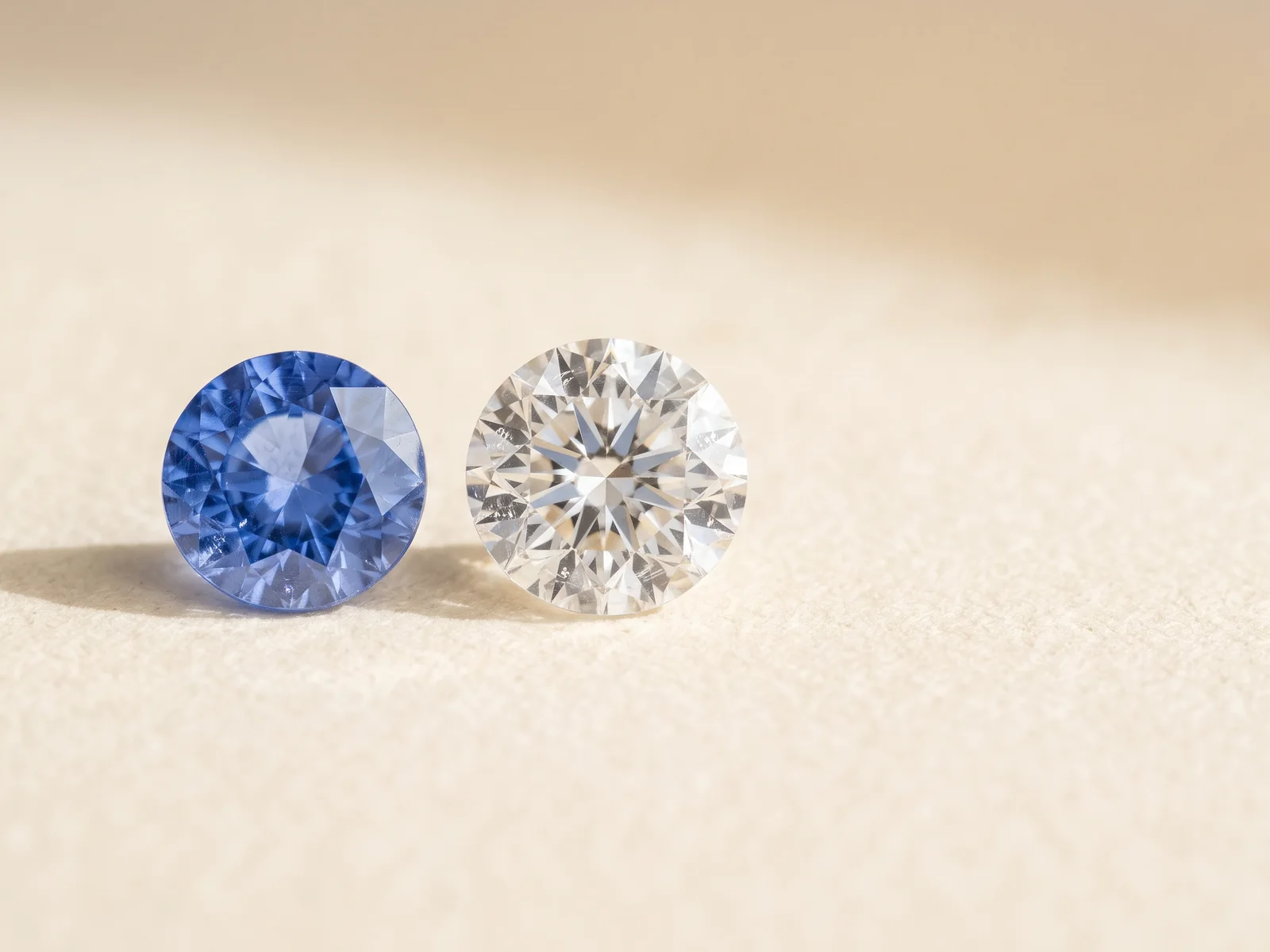
 Reviewed by Raj Sood, Graduate Gemologist (GIA), AJP (GIA)Master jeweller and Graduate Gemologist (GIA) · reviewed 4 November 2026
Quick answer
Gemstone carat vs size comes down to density. A carat is a weight (0.2 g), not a size, so a denser gem packs one carat into a smaller stone. A 1 ct sapphire (specific gravity 4.00) is noticeably smaller than a 1 ct emerald (2.72), which has about 47% more volume. Compare gems by millimetres, not carats.
What is the difference between gemstone carat vs size?
A carat is a unit of weight, not size. One carat (ct) is exactly 0.2 grams, and it is divided into 100 points, so a 0.50 ct stone is also called a 50-point stone. The carat is the same for diamonds, sapphires, emeralds and every other gem. If you want the diamond side of the story first, our page on how carat weight works for diamonds covers it in detail.
Size, on the other hand, is what you actually see: the length, width and depth of the stone in millimetres (mm). Because different gem materials have different densities, the same weight takes up a different amount of space. A heavy material such as corundum (ruby and sapphire) fits one carat into a small package. A light material such as beryl (emerald, aquamarine, morganite) or quartz (amethyst, citrine) needs a bigger stone to reach the same weight.
That is the whole idea behind gemstone carat vs size. Two stones can both be labelled "1 carat" and still look clearly different on the hand. When you browse our coloured gemstone collection, the millimetre measurements tell you far more about appearance than the carat figure does. Any term on this page you have not met before is explained in our plain-English jewellery glossary.
What is specific gravity, and why does it change gemstone size?
Gemmologists describe density as specific gravity (SG): how heavy a material is compared with the same volume of water. Water has an SG of 1.00. Diamond has an SG of about 3.52, so a piece of diamond weighs about 3.52 times as much as the same volume of water. Sapphire, at 4.00, is heavier again; emerald, at about 2.72, is lighter.
Because one carat is always 0.2 g, you can work out the volume of one carat of any gem by dividing 200 by its SG. The answer is in cubic millimetres (mm³). The higher the SG, the less room one carat takes up.
| Gem | Specific gravity (approx.) | Volume of 1 ct (mm³) | Compared with diamond |
|---|---|---|---|
| Cubic zirconia (synthetic) | 5.65–5.95 | about 34–35 | about 40% smaller |
| Zircon (natural) | 4.60–4.70 | about 43 | noticeably smaller |
| Almandine garnet | about 4.05 | about 49 | smaller |
| Ruby and sapphire | 4.00 | 50 | smaller |
| Spinel | 3.60 | about 56 | about the same |
| Diamond | 3.52 | about 57 | — |
| Topaz | 3.53 | about 57 | about the same |
| Tanzanite | 3.35 | about 60 | slightly larger |
| Peridot | 3.34 | about 60 | slightly larger |
| Moissanite (lab-created) | 3.22 | about 62 | slightly larger |
| Tourmaline | 3.06 | about 65 | larger |
| Emerald and aquamarine | 2.72 | about 74 | much larger |
| Amethyst and citrine (quartz) | 2.65 | about 75 | much larger |
| Opal | about 2.15 | about 93 | far larger |
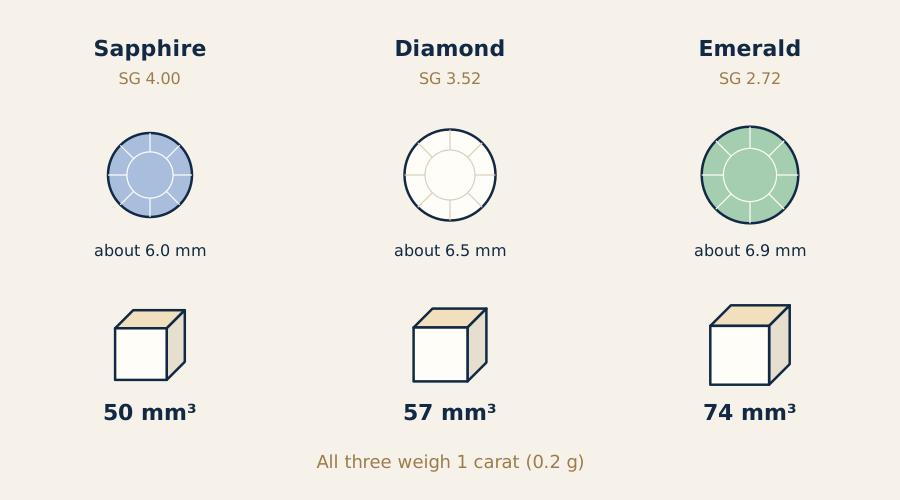
The size difference you see is smaller than the volume difference, because volume grows in three directions at once. A 1 ct emerald has about 47% more volume than a 1 ct sapphire, but if both were cut to the same proportions its diameter would only be about 14% wider, and its face-up area (the area you see from above) about 29% larger. That is still easy to see side by side, especially in a ring.
SG is also one of the tests gemmologists use to identify a stone. In hydrostatic weighing, the stone is weighed in air and then in water; SG equals the weight in air divided by the difference between the two. A stone that sinks or floats in heavy liquids of known density can be narrowed down the same way.
How big is a 1 carat gemstone? A gemstone size chart in mm
The chart below gives typical diameters for a 1 carat round in common gems. Coloured stones are usually cut deeper than diamonds (more on that below), so these figures are a little smaller than a straight density calculation would suggest. Treat them as typical ranges, not exact sizes: two 1 ct sapphires from different cutters can differ by half a millimetre or more.
| 1 ct round, typical cut | Approx. diameter | How it compares |
|---|---|---|
| Diamond (natural or lab-grown) | about 6.4–6.5 mm | The reference most people know |
| Ruby or sapphire | about 5.8–6.2 mm | Looks smaller than a 1 ct diamond |
| Almandine or rhodolite garnet | about 5.8–6.2 mm | Similar to sapphire |
| Spinel | about 6.1–6.4 mm | Close to diamond |
| Topaz | about 6.1–6.5 mm | Close to diamond |
| Tanzanite | about 6.3–6.7 mm | A touch larger than sapphire |
| Tourmaline | about 6.5–6.9 mm | Clearly larger than sapphire |
| Emerald or aquamarine | about 6.7–7.1 mm | Much larger than sapphire |
| Amethyst or citrine | about 6.8–7.2 mm | Among the largest per carat |
So a 1 carat sapphire size is closer to a 0.80–0.90 ct diamond in face-up appearance, while a 1 ct amethyst looks closer to a 1.25 ct diamond. For diamonds in other shapes, our millimetre-to-carat chart for every diamond shape gives the equivalent figures, and the guide to 1 carat diamonds shows how that reference stone sits on the hand.
Emerald carat size is the one that catches people out most often. Emerald is light for its volume, so a 1 ct emerald-cut emerald is a generous-looking stone, often around 7 × 5 mm. A sapphire of the same outline would weigh roughly 1.5 ct.
How much does the same size stone weigh in different gems?
Coloured gems are often cut to calibrated sizes: standard millimetre outlines such as 6 × 4 mm, 7 × 5 mm or 8 × 6 mm, so they drop straight into ready-made settings. Turn the question around, and you can see how much weight changes when the size stays fixed. The table below uses a 7 × 5 mm oval with a 3.5 mm depth (70% of the width) in each gem.
| 7 × 5 × 3.5 mm oval | Specific gravity | Approx. weight |
|---|---|---|
| Almandine garnet | about 4.05 | about 1.02 ct |
| Ruby or sapphire | 4.00 | about 1.01 ct |
| Spinel | 3.60 | about 0.91 ct |
| Topaz | 3.53 | about 0.89 ct |
| Tanzanite | 3.35 | about 0.84 ct |
| Peridot | 3.34 | about 0.84 ct |
| Tourmaline | 3.06 | about 0.77 ct |
| Emerald or aquamarine | 2.72 | about 0.69 ct |
| Amethyst | 2.65 | about 0.67 ct |
The same setting, the same look from above, and a weight range from about two-thirds of a carat to just over one carat. This matters when you compare prices. Gems are usually priced per carat, so a lighter material reaching a given size needs fewer carats, while a dense one needs more. It also matters for earrings: a pair of 6 mm sapphire studs carries more weight than 6 mm aquamarine studs, although they look the same size. Our stud earring sizes by carat page shows the same principle for diamonds.
Total carat weight on multi-stone pieces works the same way. A line bracelet of 3 mm sapphires carries noticeably more total weight than one of 3 mm amethysts of the same length. If you are planning one, check the stone count against our bracelet sizing advice first, because the length sets how many stones you need.
Not sure which one is right?
Send us the stones you are looking at and our gemologist will tell you which to choose and why.
Why are coloured gemstones cut deeper than diamonds?
Density is only half of gemstone carat vs size. The other half is cut, and coloured gems are cut to different priorities from diamonds. A diamond is cut mainly for brightness and sparkle, with tightly studied proportions; a well-cut round brilliant has a total depth of about 59–63%. Coloured stones are cut mainly for colour and to keep as much weight from the rough crystal as possible, so total depths of 65–80% are common.
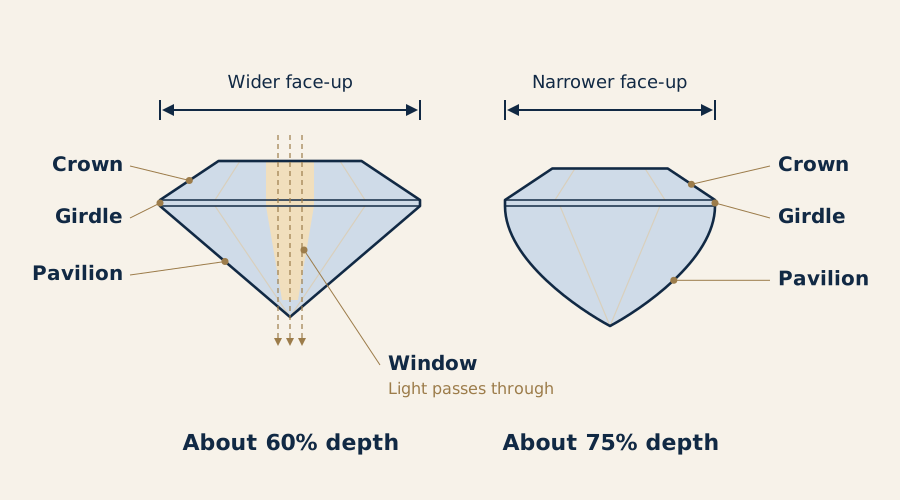
- Deep pavilion (belly): the lower part of the stone, the pavilion, is left full. This adds weight you cannot see from above, so the stone faces up smaller than its carat figure suggests.
- Shallow cut: the stone spreads wider for its weight but can show a window, a washed-out, see-through patch in the centre where light passes straight out the back.
- Colour depth: pale materials such as aquamarine are sometimes cut deeper to intensify colour; very dark sapphires may be cut shallower to lighten them.
- Native cutting: many stones are first cut near where they are mined, often to maximise weight. Some are later recut to better proportions, losing weight but gaining brightness.
Diamonds show the same effect on a smaller scale, which is why same-carat diamonds can look different sizes. With coloured gems the spread is wider, because proportions are far less standardised. Two 1 ct sapphires can differ by more than 0.5 mm in diameter purely because of depth.
How do diamond, lab-grown and simulant weights compare?
Laboratory-grown gems have the same chemistry and crystal structure as their natural counterparts, so they have essentially the same SG. A lab-grown diamond weighs the same as a natural diamond of identical size, and a lab-created sapphire weighs the same as a natural sapphire. Simulants, materials that imitate a gem but are something else, are a different story, and their weight is one of the easiest ways to spot them.
| Round about 6.5 mm | What it is | Specific gravity | Approx. weight |
|---|---|---|---|
| Natural diamond | Mined carbon | 3.52 | about 1.00 ct |
| Lab-grown diamond | Laboratory-grown carbon, real diamond | 3.52 | about 1.00 ct |
| Moissanite | Lab-created silicon carbide | 3.22 | about 0.88–0.92 ct |
| Cubic zirconia | Synthetic zirconium oxide | 5.65–5.95 | about 1.6–1.7 ct |
| White sapphire | Natural or lab-created corundum | 4.00 | about 1.15 ct, more if cut deeper |
| White topaz | Natural topaz | 3.53 | about 1.00 ct |
That is why moissanite is often described by "diamond equivalent weight", the weight a diamond of the same size would have, and why a cubic zirconia feels surprisingly heavy for its size. If you are comparing a lab-grown diamond with a simulant of the same outline, the millimetres are the fair comparison. Our page on choosing a 1 carat lab-grown diamond covers what to check beyond size.
Related guideLab-Grown Diamond Carat Sizes: 1 to 5 CaratsDiamond sizes scale the same predictable way, so if you are stepping up in weight, see what a 2 carat diamond measures or the advice on picking a 2 carat lab-grown stone.
How do you estimate a gemstone's carat weight from mm?
Gemmologists use a standard gemstone weight formula when a stone is already set and cannot be weighed. Multiply the measurements by the SG and a shape factor that allows for how much of the outline box the stone fills. The result is an estimate, usually within about 5–10% for a typically cut stone.
| Shape | Formula (mm) | Shape factor (approx.) |
|---|---|---|
| Round | diameter × diameter × depth × SG × factor | 0.0018 |
| Oval | average diameter² × depth × SG × factor | 0.0020 |
| Cushion or square | length × width × depth × SG × factor | 0.0022–0.0026 |
| Emerald cut (octagon) | length × width × depth × SG × factor | 0.0025 |
| Pear | length × width × depth × SG × factor | 0.0017–0.0018 |
Example 1: a round diamond 6.5 mm across and 3.9 mm deep. 6.5 × 6.5 × 3.9 × 3.52 × 0.0018 = about 1.04 ct, which matches the familiar 1 ct round brilliant.
Example 2: a round sapphire 6.0 mm across and 4.2 mm deep (70% depth). 6.0 × 6.0 × 4.2 × 4.00 × 0.0018 = about 1.09 ct. Smaller across than the diamond, but heavier, because of both density and depth.
Example 3: a 7 × 5 × 3.5 mm oval tanzanite. The average diameter is 6 mm, so 6 × 6 × 3.5 × 3.35 × 0.0020 = about 0.84 ct. The same outline in amethyst comes to about 0.67 ct.
Larger stones follow the same maths. If you are curious how far the numbers stretch, our pages on what a 3 carat diamond measures and the guide to 3 carat lab-grown diamonds apply it to bigger diamonds.
Gemstone carat vs size: which matters more when buying?
For appearance, size matters more. The millimetres decide how large the stone looks, whether it suits your hand and whether it fits a setting. Carat weight still matters for price, because most coloured gems are priced per carat and the price per carat usually rises with size. A few practical points:
- Rarity in larger sizes varies by gem. Amethyst, citrine, topaz, aquamarine and tourmaline are found in large clean crystals, so 5–10 ct stones are relatively accessible. Fine ruby, alexandrite and tsavorite garnet become rare above a few carats, so price per carat climbs steeply.
- Lighter gems look generous. A 3 ct aquamarine is a large stone; a 3 ct sapphire is much more compact.
- Watch the depth. A deep stone carries hidden weight you pay for but do not see. A very shallow one may show a window.
- Settings are made in millimetres. Claws, bezels and halos are built around the stone's measurements, not its weight.
- Pearls are different. They are usually sold by diameter in millimetres, not by carat.
Diamond buyers meet the same trade-off at bigger sizes, where small changes in depth hide or reveal a lot of weight; see 4 carat diamonds and how they measure up and 5 carat diamond sizes for those figures.
Browse natural gemstones
How to compare gemstones by carat and size: step by step
- Get the measurements. Ask for length, width and depth in millimetres, plus the carat weight, for every stone you are considering.
- Check the gem and whether it is natural or lab-created. This tells you the SG; natural and lab-created versions of the same gem share it.
- Work out the depth percentage. Divide depth by width. For coloured stones, about 60–80% is typical; much deeper hides weight, much shallower may window.
- Compare face-up size, not carats. Line stones up by length and width. Across different gems, a carat comparison will mislead you.
- Compare price per carat within the same gem. Then sense-check the total price against the size you actually see.
- Confirm it fits the setting. If the piece is custom or calibrated, make sure the millimetres match before you decide.
Free consultation
Talk to a gemologist
Compare stones in person or online with Raj Sood, Graduate Gemologist (GIA), AJP (GIA).
Book a consultationShop this shape
FAQ
Common questions
Why does a 1 carat sapphire look smaller than a 1 carat diamond?
Sapphire is denser than diamond, with a specific gravity of 4.00 against 3.52, so one carat takes up less space. Sapphires are also usually cut deeper, which puts more weight below the girdle where you cannot see it.
How many mm is a 1 carat emerald?
A 1 ct emerald-cut emerald is often around 7 × 5 mm, and a 1 ct round about 6.7–7.1 mm. Exact size depends on the cut and depth, so always check the measurements.
Do lab-created gemstones weigh the same as natural ones?
Yes, essentially. Lab-created sapphires and rubies, and lab-grown diamonds, have the same chemistry and specific gravity as their natural counterparts, so the same size gives the same weight. Lab-created emeralds can be very slightly lighter (SG about 2.65–2.70), but the difference is negligible in practice.
Is a gemstone carat the same as a gold carat?
No. A gemstone carat measures weight (0.2 g). A gold carat, written ct in Australia as in 18ct gold, measures purity in parts out of 24, so check the context.
Can you work out a gemstone's carat weight without removing it from the setting?
Yes, approximately. Multiply the measurements by the gem's specific gravity and a shape factor; for a round, diameter × diameter × depth × SG × 0.0018 gives an estimate usually within about 5–10%.
Which gemstones look biggest for their carat weight?
Light materials such as opal, quartz (amethyst and citrine), emerald and aquamarine look largest per carat. Dense materials such as cubic zirconia, zircon, garnet, ruby and sapphire look smallest.

Ask a gemologist
Not sure which diamond to choose?
Raj Sood is a Graduate Gemologist (GIA) and master jeweller. Bring the stones you are considering, or send the reports, and he will tell you honestly which one is better and why.
Keep learning
Related guides
 Diamond 4Cs & GradingDiamond Carat Weight
 Diamond 4Cs & GradingDiamond MM to Carat Size Chart (All Shapes)
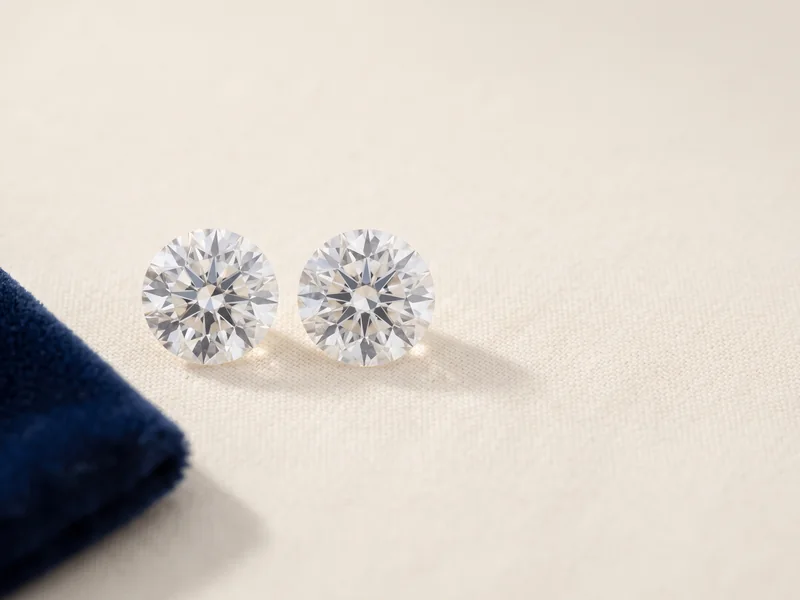 Diamond Anatomy & LightWhy Same-Carat Diamonds Can Look DifferentGemstonesGemstones | Coloured Gemstones, Birthstones and Custom Jewellery
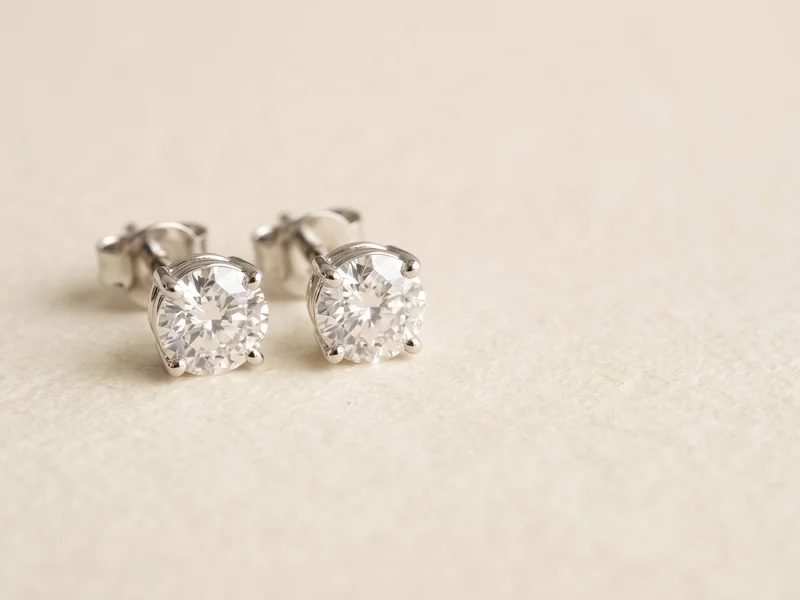 Jewellery TypesDiamond Stud Earring Sizes by Carat
 Jewellery TypesBracelet Size Guide
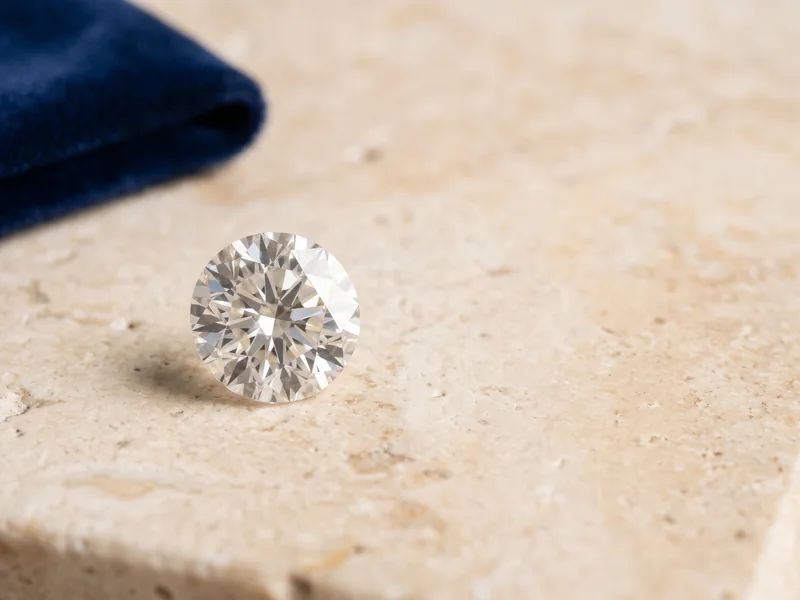 Lab-Grown DiamondsLab-Grown Diamond Carat Sizes: 1 to 5 Carats
 Diamond 4Cs & Grading5 Carat Diamonds
Explore more
More guides on this topic
Education