
- Education
- Natural Diamonds
- The Kimberley Process Explained: Conflict Diamonds, Certificates and Australia
Natural diamonds
The Kimberley Process Explained: Conflict Diamonds, Certificates and Australia
The Kimberley Process is the reason you rarely hear the phrase 'blood diamonds' at a jewellery counter today. It also has real gaps. Here is what it does, what it does not do, and what it means if you are choosing a natural diamond in Australia.

 Reviewed by Raj Sood, Graduate Gemologist (GIA), AJP (GIA)Master jeweller and Graduate Gemologist (GIA) · reviewed 4 November 2026
Quick answer
The Kimberley Process is an international certification scheme, running since 2003, that controls the trade in rough diamonds to keep conflict diamonds out of legal markets. Member countries must ship rough in sealed containers with a government certificate. It covers rough, not polished stones, and defines conflict narrowly, so it is a minimum standard, not proof of ethical sourcing.
What is the Kimberley Process?
The Kimberley Process Certification Scheme (usually shortened to KPCS or just the Kimberley Process) is an agreement between governments, the diamond industry and civil society groups. Its single job is to stop conflict diamonds entering the legitimate trade. It does this by controlling how rough diamonds (uncut stones straight from the mine) cross borders.
Under the scheme, a participating country may only export rough diamonds in tamper-resistant containers with a government-validated Kimberley Process certificate, and may only import rough from other participants that do the same. Trade in rough with non-participants is banned. Each country has to pass its own laws, keep records and report production and trade statistics, which the Kimberley Process publishes every year.
The scheme defines conflict diamonds as rough diamonds used by rebel movements or their allies to finance wars aimed at undermining legitimate governments. That wording matters, and we come back to it below. If you are new to how natural diamonds are mined, graded and sold, start with our complete guide to natural diamonds, and keep our plain-English jewellery glossary handy for any unfamiliar terms.
Why was the Kimberley Process created?
In the 1990s, rebel groups in several African countries paid for weapons with diamonds dug from alluvial deposits (gravels in riverbeds, which can be worked with shovels and sieves). In Sierra Leone the Revolutionary United Front controlled diamond fields through a civil war that ran from 1991 to 2002. In Angola, the UNITA movement sold diamonds worth billions of US dollars over the decade. Liberia and the Democratic Republic of the Congo were also caught up. These stones became known as blood diamonds.
Campaign groups such as Global Witness published reports linking the trade to the wars, and the United Nations placed sanctions on diamonds from rebel-held areas. Estimates at the time put conflict diamonds at roughly 4–15% of world supply, although figures varied widely. Diamond-producing countries in southern Africa, worried that the whole trade would be boycotted, called a meeting in Kimberley, South Africa, in May 2000.
| Year | What happened |
|---|---|
| 1991–2002 | Civil war in Sierra Leone, partly funded by diamonds |
| 1998 | UN sanctions on UNITA diamonds from Angola; early campaign reports on the trade |
| May 2000 | Producing countries, industry and campaigners meet in Kimberley, South Africa |
| Dec 2000 | UN General Assembly backs an international certification scheme |
| Nov 2002 | Interlaken Declaration sets out the scheme's rules |
| Jan 2003 | The Kimberley Process Certification Scheme comes into force |
| 2011 | Global Witness leaves the scheme over diamonds from Zimbabwe's Marange fields |
| 2013 | Central African Republic suspended after civil conflict |
| 2024 | G7 countries begin restricting Russian diamonds, outside the Kimberley Process |
Many of the famous diamonds whose histories predate any certificate were mined long before any of this existed, which is one reason old stones are treated a little differently, as we explain later.
Why is it named after Kimberley, and what does geology have to do with it?
The town of Kimberley in South Africa sits on one of the first diamond pipes ever recognised. After diamonds were found in the region in 1867, miners dug the 'Big Hole' by hand from 1871 until 1914, reaching roughly 215 metres deep. The rock they were digging gave its name to the whole field of diamond geology: kimberlite.
Natural diamonds form about 140–200 km below the surface, where carbon is squeezed under enormous pressure at temperatures above about 1,000 °C. Most are between 1 and 3.5 billion years old. They reach the surface in rare, fast volcanic eruptions that punch carrot-shaped pipes of kimberlite, or less often lamproite, up through the crust. Our page on how diamonds form deep in the mantle covers this journey in detail.
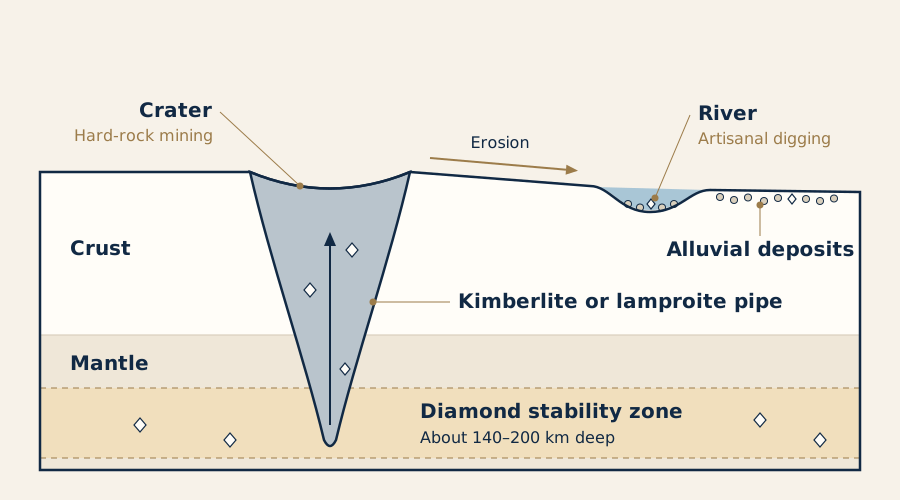
This geology explains why conflict diamonds were possible at all. Diamonds in a hard-rock pipe need industrial mining, which is hard to hide. But when a pipe erodes over millions of years, diamonds wash into rivers and spread across wide areas, where anyone with a sieve can recover them. Those alluvial fields, scattered and hard to police, were where most conflict diamonds came from.
Every diamond in the scheme is the same material: crystallised carbon, 10 on the Mohs hardness scale, with a refractive index of about 2.42. About 98% of natural diamonds are nitrogen-bearing Type Ia; the rest are explained in the Type Ia, Ib, IIa and IIb classification. For more on why diamond behaves the way it does, see what sets diamond apart from other gems.
How does a Kimberley Process certificate work?
The certificate follows a parcel of rough from one border to the next. In outline:
- At export: the exporting country's authority checks the parcel, seals it in a tamper-resistant container and issues a certificate with a unique number, the carat weight, the value and the country of origin or provenance.
- At import: the importing country checks the seal and certificate and confirms receipt back to the exporter's authority. Parcels without valid paperwork are seized.
- Within countries: governments must have internal controls over mining, buying and selling rough, and keep records.
- Reporting: each participant reports production and trade figures, and peer review visits check how countries apply the rules.
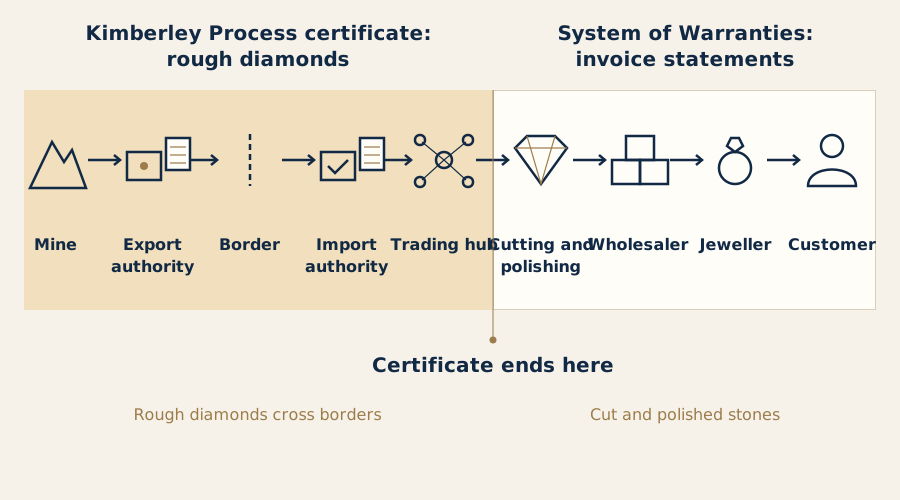
Once a rough diamond is cut and polished, it no longer travels with a Kimberley Process certificate. Instead, the trade uses the System of Warranties, run by the World Diamond Council. Sellers print a standard statement on invoices saying the diamonds come from legitimate sources not involved in funding conflict, in line with UN resolutions and national laws. Since 2018 the guidelines behind that statement also refer to human rights, labour rights and anti-money laundering standards. Each business in the chain is meant to pass the statement on, so a chain of custody (a record of who held the stone) builds up on paper.
Decisions inside the Kimberley Process are made by consensus, meaning every participant must agree. That keeps countries at the table but makes it hard to change the rules or act against a member, a point critics raise often.
Not sure which one is right?
Send us the stones you are looking at and our gemologist will tell you which to choose and why.
Kimberley Process facts and figures: which countries produce the most diamonds?
The scheme has about 60 participants representing more than 80 countries, because the European Union counts as one participant on behalf of all its members. Together they account for more than 99% of the world's rough diamond production. In recent years the world has produced roughly 110–120 million carats of rough a year, worth roughly US$12–16 billion at the mine.
| Country | Approx. annual rough production (recent years) | Notes |
|---|---|---|
| Russia | about 35–42 million ct | Largest by volume; now restricted by G7 and EU sanctions |
| Botswana | about 17–25 million ct | Among the largest by value |
| Canada | about 13–18 million ct | Strong origin-tracking programs |
| Democratic Republic of the Congo | about 9–15 million ct | Much of it small, lower-value and alluvial |
| Angola | about 8–14 million ct | Large alluvial and kimberlite fields |
| South Africa | about 4–10 million ct | Birthplace of kimberlite mining |
| Australia | under 1 million ct | Fell sharply after Argyle closed in 2020 |
Volume and value tell different stories. A country can produce many carats of small, brown or industrial-quality diamonds and still earn less than a country producing fewer, larger gem stones. Our guide to the world's main diamond mining countries goes through each region, and the page on Canadian diamonds and their origin-tracking programs shows how some producers now track stones well beyond what the Kimberley Process requires. Size also shapes the market: see how rarity climbs with carat weight.
How does the Kimberley Process work in Australia?
Australia has been a participant since the scheme began. Rough diamonds cannot be imported into or exported from Australia without a valid Kimberley Process certificate, under customs regulations, and the Australian Government acts as the national Kimberley Process authority. Polished diamonds imported for jewellery sit outside the certificate system, as they do everywhere else, and rely on the System of Warranties.
Australia's place in diamond history comes almost entirely from the Argyle mine in the East Kimberley region of Western Australia. (The shared name is a coincidence: Australia's Kimberley region was named after the same British colonial secretary, Lord Kimberley, as the South African town.) Argyle mined a lamproite pipe, which surprised geologists who had assumed big diamond deposits were always kimberlite. From the mid-1980s until it closed in 2020, Argyle produced more than 800 million carats, and during the 1990s it was the largest producer in the world by volume.
Most Argyle production was small brown diamonds, but it also supplied the large majority of the world's natural pink diamonds. Other Australian mines, such as Ellendale (known for yellow diamonds) in Western Australia and Merlin in the Northern Territory, were much smaller and have also closed. Read the story of Argyle and Australian diamond mining for the full history.
Related guideArgyle Mine and Australian DiamondsWhat are the criticisms of the Kimberley Process?
Most people in the trade agree the scheme cut the flow of rebel-funded diamonds sharply after 2003. The criticism is about what it was never designed to cover:
- Narrow definition: only diamonds funding rebels against governments count as conflict diamonds. Violence or abuse by a government, its army or private security is not covered. This came to a head over Zimbabwe's Marange fields, where human rights groups reported serious abuses from 2008, but exports were later approved.
- Rough only: certificates stop at the cutting stage. Once stones from different sources are mixed, cut and resold, the paper trail depends on industry warranties, not government checks.
- Consensus rule: any participant can block a decision. Proposals to widen the definition, or to discuss Russian diamonds after 2022, did not reach agreement.
- Enforcement gaps: smuggling across porous borders, and mixing of rough from different countries at trading hubs, can disguise where diamonds came from.
- No labour or environmental standards: child labour, unsafe artisanal mining and environmental damage fall outside the scheme.
| Kimberley Process | What it does not cover | |
|---|---|---|
| Product | Rough diamonds crossing borders | Cut and polished diamonds, finished jewellery |
| Definition of conflict | Rough funding rebel movements against governments | Abuses by governments, security forces or companies |
| Who checks | National governments, plus peer review | Independent audit of each mine or stone |
| Human and labour rights | Not part of the core rules | Covered only by separate industry and company standards |
| Environment | Not covered | Mine rehabilitation, water, land use |
| Lab-grown diamonds | Not covered | Lab-grown has its own disclosure rules |
Global Witness left the scheme in 2011, and the Canadian group IMPACT (formerly Partnership Africa Canada) left in 2017, both saying it had failed to reform. Others remain inside through the Civil Society Coalition, arguing it is better to push for change from within. For a buyer, the honest summary is that the Kimberley Process is a floor, not a ceiling. If a seller describes stones as responsibly sourced, it is fair to ask how; our page on what 'conflict-free' sourcing claims should involve sets out the questions.
Does the Kimberley Process apply to lab-grown diamonds?
No. The scheme covers natural rough diamonds only. Lab-grown diamonds (also called laboratory-grown diamonds) are real diamond, chemically and physically the same as natural, but they are grown in a factory using high pressure, high temperature (HPHT) presses or chemical vapour deposition (CVD) reactors, so there is no mine and no Kimberley Process certificate. Their sale is covered instead by disclosure rules: in Australia, consumer law requires a lab-grown diamond to be clearly described as lab-grown.
Because lab-grown and natural diamonds look identical to the eye, the trade relies on laboratory screening to keep them apart. HPHT is also used to improve the colour of some natural stones, which is a separate thing again; see HPHT-treated natural diamonds. For the practical side, our page on telling natural, lab-grown and simulant stones apart explains what testing can and cannot show.
Older diamonds are another case. A stone mined and cut before 2003 never had a Kimberley Process certificate, because the scheme did not exist. Antique and old-stock diamonds come with their own history and paperwork questions, and they involve no new rough entering the supply chain. The same is true of resetting a diamond you already own into a new ring.
What does the Kimberley Process mean when you buy a diamond?
In practice, any newly mined natural diamond sold through mainstream Australian jewellery channels should have entered the legitimate trade under the Kimberley Process at some point, and should be covered by warranty statements since. That is a meaningful protection against the specific blood-diamond trade of the 1990s. It does not, on its own, tell you the country of origin, how the mine treats its workers or its environmental record.
Some diamonds now come with more. Certain producers and labs offer origin reports or tracking that follows a stone from the mine to the polished diamond, and a few grading labs can confirm origin when the rough was submitted before cutting. These programs vary in what they check, so read what they actually claim. And keep the Kimberley Process separate from price: it tells you nothing about value, and our page on how natural diamond prices have moved over time explains why natural diamonds are best bought for love, not as a way to make money.
Browse natural diamonds
- Confirm natural or lab-grown. The grading report and invoice should state it clearly. The Kimberley Process only applies to natural diamonds.
- Check the grading report. Look for an independent lab such as GIA or IGI, and see whether any origin information is given.
- Ask about the warranty. The seller's supplier invoice should carry the World Diamond Council System of Warranties statement.
- Ask what is known about origin. Country of origin, mine, or tracking program, if any. 'Unknown' is a common, honest answer for mixed-source stones.
- Be specific about sourcing claims. If a stone is described as ethically or responsibly sourced, ask what standard or evidence sits behind that.
- Consider existing stones. An antique diamond or a family stone can be reset, which avoids the new-mining question altogether.
Free consultation
Talk to a gemologist
Compare stones in person or online with Raj Sood, Graduate Gemologist (GIA), AJP (GIA).
Book a consultationShop this shape
FAQ
Common questions
What is the Kimberley Process in simple terms?
It is an international scheme, in force since 2003, that requires rough diamonds to cross borders only with a government certificate. Its aim is to keep diamonds that fund rebel wars out of the legal trade.
Are blood diamonds still sold today?
Conflict diamonds as the scheme defines them are now a very small share of world supply. However, the definition is narrow, and human rights groups say abuses not covered by it still occur in some diamond fields.
Is Australia part of the Kimberley Process?
Yes. Australia has participated since the scheme began, and rough diamonds cannot be imported or exported without a valid Kimberley Process certificate.
Do polished diamonds come with a Kimberley Process certificate?
No. Certificates cover rough diamonds only. After cutting, the trade relies on the World Diamond Council System of Warranties statement printed on invoices.
Does the Kimberley Process apply to lab-grown diamonds?
No. Lab-grown diamonds are not mined, so they sit outside the scheme. They must be clearly disclosed as lab-grown under Australian consumer law.
Does a Kimberley Process diamond mean it is ethically sourced?
Not on its own. The scheme is a minimum standard against rebel-funded diamonds and does not cover labour conditions, government abuses or environmental impact, so ask what extra sourcing information is available.

Ask a gemologist
Not sure which diamond to choose?
Raj Sood is a Graduate Gemologist (GIA) and master jeweller. Bring the stones you are considering, or send the reports, and he will tell you honestly which one is better and why.
Keep learning
Related guides
 Natural DiamondsArgyle Mine and Australian Diamonds
 Natural DiamondsConflict-Free Diamonds – Responsible Sourcing at GemTrove
 Natural DiamondsWhere Diamonds Are MinedNatural DiamondsCanadian DiamondsNatural DiamondsNatural Diamonds Guide
 Natural DiamondsReusing a Family DiamondNatural DiamondsDiamond Types Ia, Ib, IIa and IIbNatural DiamondsThe World's Most Famous Diamonds
Explore more
More guides on this topic
Education