
- Education
- Natural Diamonds
- Where Are Diamonds Mined? Countries, Geology and the Australian Story
Natural diamonds
Where Are Diamonds Mined? Countries, Geology and the Australian Story
Knowing where diamonds are mined explains why natural diamonds are rare, why some regions are known for certain colours, and what a mine of origin can and cannot tell you before you buy.

 Reviewed by Raj Sood, Graduate Gemologist (GIA), AJP (GIA)Master jeweller and Graduate Gemologist (GIA) · reviewed 4 November 2026
Quick answer
Most natural diamonds are mined in Russia, Botswana, Canada, the Democratic Republic of the Congo, Angola and South Africa, with smaller output from about a dozen other countries. They come from ancient kimberlite or lamproite pipes and river or sea gravels. Australia's Argyle mine was once a major producer but closed in 2020.
Where are diamonds mined today?
Natural diamonds are mined commercially in roughly 20 countries, but a handful produce most of them. By weight, Russia is the largest producer, followed by Botswana, Canada and the Democratic Republic of the Congo (DRC). By value the order shifts, because Botswana's and Namibia's stones are, on average, larger and finer than the small, mostly industrial-grade diamonds that make up much of the DRC's output. Worldwide, mines recover somewhere around 110–120 million carats in a typical recent year, though the total moves with demand and mine closures.
A carat is a unit of weight (0.2 grams), not size, and most of those carats are small. Only part of the world's output is gem quality; the rest becomes abrasive grit and tool tips for cutting, drilling and polishing. If you are new to the topic, our complete guide to natural diamonds covers the basics, and any unfamiliar word on this page is explained in the plain-English jewellery glossary.
Where are diamonds found, in broad terms? Four main regions:
- Southern and central Africa: Botswana, the DRC, Angola, South Africa, Namibia, Zimbabwe, Lesotho, Sierra Leone and Tanzania.
- Russia: mostly the Sakha Republic (Yakutia) in Siberia, plus the Arkhangelsk region in the north-west.
- Canada: the Northwest Territories, below the Arctic Circle, around Lac de Gras.
- Smaller or historic producers: Australia, India, Brazil, Guyana and others, where mining is now small-scale or has stopped.
Why are diamonds only found in certain places?
Natural diamond is pure carbon crystallised under enormous heat and pressure. Most formed about 140–200 km below the surface, in the upper mantle, at roughly 900–1,300 °C and pressures of about 45,000–60,000 times the air pressure at sea level. Our page on how natural diamonds form deep in the mantle goes through the process in detail. Most natural diamonds are between about 1 and 3.5 billion years old, far older than the rocks they are mined from.
Diamonds can only survive at that depth where the mantle is cool and thick enough, which is under cratons: the oldest, most stable cores of the continents, generally more than 2.5 billion years old. That is why diamond mines cluster in places like the Kalahari craton (Botswana, South Africa), the Siberian craton, the Slave craton in northern Canada and the Kimberley region of Western Australia. Geologists searching for new mines start by mapping these ancient blocks.
The diamonds reached the surface inside rare volcanic rocks called kimberlite and lamproite. These magmas rise from great depth very quickly, picking up diamonds on the way, and blast out carrot-shaped pipes. Most pipes mined today erupted tens to hundreds of millions of years ago. Only a small share of known kimberlites carry diamonds at all, and fewer still carry enough to mine.
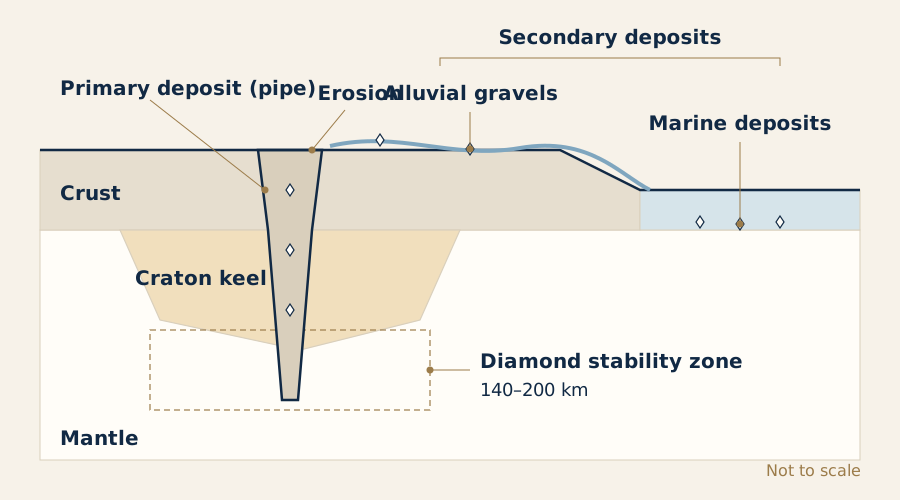
Geologists call the pipe itself a primary deposit. Over millions of years, weathering wears the top of a pipe away and rivers carry the loose diamonds downstream into gravels, forming secondary or alluvial deposits. Diamond is 10 on the Mohs hardness scale and survives this journey where weaker minerals break down, and flawed crystals tend to break on the way, so river and beach deposits often hold a higher share of gem-quality stones. It is one reason diamond is unusual among gems; see what makes diamond unlike any other gem.
Which countries mine the most diamonds?
Production figures change every year, so treat the table below as a rough guide to the main diamond producing countries rather than a ranking to quote.
| Country | Main mines or regions | Approx. carats a year | What stands out |
|---|---|---|---|
| Russia | Udachnaya, Jubilee, Nyurba (Yakutia); Arkhangelsk | about 35–42 million | Largest by volume; mostly one company, Alrosa |
| Botswana | Jwaneng, Orapa | about 17–25 million | Among the largest by value; mines run with the government |
| Canada | Ekati, Diavik, Gahcho Kué (Northwest Territories) | about 13–17 million | Mines opened from 1998 onwards |
| DR Congo | Kasai alluvial fields, Mbuji-Mayi | about 10–14 million | High volume, mostly small and industrial-grade |
| Angola | Catoca, Lulo | about 8–10 million | Catoca is one of the largest kimberlite mines |
| South Africa | Venetia, Cullinan | about 4–10 million | Where modern pipe mining began |
| Zimbabwe | Marange, Murowa | about 2–5 million | Output varies widely year to year |
| Namibia | Offshore marine fields, Orange River | about 2–2.5 million | Very high share of gem quality |
| Lesotho | Letšeng | under 1 million | Known for very large, high-value stones |
| Australia | Argyle (closed 2020) | near zero since 2020 | Once among the largest by volume |
So what is the largest diamond producing country? By carats, Russia, which mines roughly a third of the world's output. By value, Botswana and Russia usually trade the top spot. Since 2024, the G7 countries have restricted imports of Russian diamonds, which has pushed the trade to pay more attention to where stones come from.
Canada is the newest major producer, with mines in remote tundra that are reached by winter ice roads. Because the mines are modern and closely regulated, many stones are tracked from mine to polished diamond; our page on Canadian diamonds from the Northwest Territories explains how that works.
Where were diamonds first mined?
For well over 2,000 years, India was the world's only known source. Diamonds were washed from river gravels along the Krishna and other rivers in the south, and traded through the city of Golconda. Some of the world's most famous diamonds, including the Koh-i-Noor and the stone that became the Hope, are thought to be Indian. Our guide to the world's most famous diamonds traces where each one came from.
As the Indian gravels ran low, Brazil took over after diamonds were found in Minas Gerais in the 1720s. Then, in 1867, a child found a diamond near Hopetown in South Africa. Within a few years prospectors had found diamonds in the rock itself at Kimberley, and the hand-dug pit later called the Big Hole became the first great pipe mine. The rock was named kimberlite after the town. In 1905 the Premier (now Cullinan) mine produced the Cullinan, at about 3,106 carats rough the largest gem diamond ever found.
The 20th century added Siberia (the Mir pipe, 1955), Botswana (Orapa in 1967, then Jwaneng), Australia (Argyle, 1979) and Canada (Lac de Gras, 1991). If you own or are looking at older jewellery, the cut and age can hint at its source: many stones in antique and old-stock diamonds from the late 1800s were South African.
Not sure which one is right?
Send us the stones you are looking at and our gemologist will tell you which to choose and why.
Where are diamonds mined in Australia?
Today, almost none. Australia's big diamond story is the Argyle mine in the East Kimberley region of Western Australia. The pipe was discovered in 1979, alluvial mining started in 1983, and the main open pit followed. Argyle was unusual in two ways: the diamonds came from lamproite rather than kimberlite, and the ore was extraordinarily rich in carats. At its 1990s peak Argyle produced more than 30 million carats a year, about a third of world output by volume, and made Australia one of the largest diamond producers on earth.
Most Argyle diamonds were small and brown, sold under names like champagne and cognac. Its fame comes from the rest: Argyle supplied more than 90% of the world's pink diamonds, plus rare reds, blues and violets. After moving underground in 2013, the mine closed in November 2020, having produced more than 865 million carats. Our page on the full story of the Argyle mine covers the pink tenders and what has happened since.
Australia has had other mines too. Ellendale, also in the Kimberley, mined lamproite from 2002 until 2015 and was known for fancy yellow diamonds. Merlin in the Northern Territory operated briefly around 1999–2003. And alluvial diamonds were found in the New South Wales goldfields from the mid-1800s, with small workings around Copeton, Bingara and Inverell. Both the Kimberley region of Western Australia and the city of Kimberley in South Africa are named after the same British colonial secretary, Lord Kimberley, which is a coincidence rather than a link.
Related guideArgyle Mine and Australian DiamondsHow are diamonds mined?
How diamonds are mined depends on the deposit. Pipe mines move huge volumes of rock; alluvial and marine mining sift gravels that nature has already sorted.
| Method | Deposit | How it works | Examples |
|---|---|---|---|
| Open-pit | Primary (pipe) | Rock is blasted, trucked and crushed in a widening, deepening pit | Jwaneng, Orapa, Argyle (to 2013), Ekati |
| Underground | Primary (pipe) | Tunnels under the old pit; often block caving, where ore collapses under its own weight into collection points | Argyle (2013–2020), Cullinan, Diavik |
| Alluvial | Secondary (river gravels) | Gravels are dug and washed, by machine or by hand | DRC, Sierra Leone, historic India and Brazil |
| Marine | Secondary (sea floor) | Ships pump or crawl gravels from the sea bed | Namibia's Atlantic coast |
At the processing plant, ore is crushed and passed through dense-media separation (diamonds are heavy for their size), then X-ray machines detect diamonds by their fluorescence and blow them out with air jets. Many plants also use grease tables, since diamond sticks to grease while wet rock does not.
Grades are measured in carats per hundred tonnes (cpht). Many productive kimberlite mines sit somewhere around 10 to 150 cpht, which means moving tonnes of rock for every carat, and much of that carat weight is small or industrial. Large, clean rough is far rarer than small rough, which is why price climbs so steeply with size; see why large rough is so much rarer than small.
Does it matter where a diamond was mined?
For how a diamond looks, mostly no. A G colour, VS1 diamond from Botswana and one from Canada are graded on the same scales and look the same. Once a diamond is cut and polished, a gemmologist cannot reliably tell its country of origin by eye or with standard equipment.
Some regions do lean towards certain kinds of stone. Argyle produced pinks and browns; Lesotho's Letšeng and South Africa's Cullinan are known for large type IIa diamonds (very low in nitrogen, often exceptionally white); Cullinan also produced rare blue type IIb stones. Our page on diamond types Ia, Ib, IIa and IIb explains what those labels mean. Around 98% of natural diamonds are type Ia, wherever they are mined.
Where origin matters more is traceability. Different documents tell you different things:
| Document | What it tells you | What it does not tell you |
|---|---|---|
| Grading report (GIA, IGI and others) | Colour, clarity, cut, measurements, natural or lab-grown, known treatments | Usually nothing about the mine or country |
| Kimberley Process certificate | A rough parcel came from a member country and was not used to fund rebel wars | It travels with rough shipments, not your polished stone; labour and environment are outside its scope |
| Mine-of-origin or provenance report | The country or mine for that specific diamond | Only available for some diamonds, mostly from tracked mining programs |
| Argyle certificate | Argyle origin for certified pink and coloured stones, with a unique number | Only covers Argyle-certified stones |
Read more about what the Kimberley Process does and does not cover, and about how Canadian mine-of-origin tracking works. For the reports themselves, our page on how the main grading labs compare sets out which labs offer origin services. A report will also flag treatments that origin does not, such as HPHT-treated natural diamonds, where heat and pressure have been used to change a mined diamond's colour.
Lab-grown diamonds are not mined at all. They are real diamond, grown in a laboratory by the HPHT (high pressure, high temperature) or CVD (chemical vapour deposition) method, with much of the world's supply coming from China and India. They are graded much like natural diamonds, and the report always states that the stone is laboratory-grown. To see how GemTrove handles sourcing questions for natural stones, read GemTrove's approach to responsible sourcing.
Can you still buy an Argyle or Australian diamond?
Yes, but only from existing supply. No new Argyle diamonds have been mined since 2020, so Argyle stones now come from jewellers' and dealers' stock, estate pieces and private resale. Certified Argyle pinks are scarce and expensive; small Argyle champagne and white diamonds turn up more often and at more ordinary prices.
Scarcity does not make any diamond an investment. Retail prices include cutting, setting and the jeweller's costs, and resale prices are usually well below what you paid. Our page on how natural diamond prices have moved over time explains the pattern honestly. Choose a diamond because you love wearing it.
If you already have a diamond in the family, perhaps from an older Australian ring, it can often be reset. A worn claw setting can be rebuilt or the stone moved to a new design; see our guide to resetting a diamond you already own.
How do you buy a natural diamond with a known origin? Step by step
- Decide how much origin matters to you. For many people the grades and the look come first; for others, knowing the country or mine is part of the meaning.
- Ask what documentation exists. A grading report alone rarely states origin. Ask whether there is a mine-of-origin report, a provenance program or, for pinks, an Argyle certificate.
- Check the grading report. Confirm the diamond is natural, and look for any treatment, such as HPHT colour change.
- Match the inscription. If the girdle (the thin outer edge) is laser-inscribed, check the number under a loupe and look it up against the report.
- Look for the warranty statement. Natural diamond invoices in the trade usually carry a statement that the stones were bought through Kimberley Process channels.
- Judge the diamond itself. Origin does not change sparkle. Compare cut, colour, clarity and millimetre size as you would for any diamond; our guide to choosing a natural diamond walks through each grade.
Browse natural diamonds
Free consultation
Talk to a gemologist
Compare stones in person or online with Raj Sood, Graduate Gemologist (GIA), AJP (GIA).
Book a consultationShop this shape
FAQ
Common questions
Which country produces the most diamonds?
Russia mines the most by weight, roughly a third of world output. By value, Botswana and Russia usually lead, because Botswana's stones are on average larger and finer.
Are diamonds still mined in Australia?
Not in any meaningful amount. The Argyle mine in Western Australia closed in November 2020 and Ellendale closed in 2015, though exploration continues in several states.
Does a diamond grading report show where it was mined?
Usually not. Standard reports from labs such as GIA and IGI describe the grades and whether the stone is natural or lab-grown; origin only appears on special mine-of-origin reports or provenance programs.
Are African diamonds conflict diamonds?
Most African production comes from long-established mines in countries such as Botswana, Namibia and South Africa. Since 2003 the Kimberley Process has certified rough shipments against rebel-funded conflict, though it does not cover every ethical concern.
Are Canadian diamonds better quality?
No. They are graded on exactly the same scales as diamonds from anywhere else; what Canadian mine-of-origin tracking offers is traceability, not higher quality.
Where do lab-grown diamonds come from?
Lab-grown diamonds are not mined. They are grown in laboratories by the HPHT or CVD method, much of it in China and India, and are always disclosed as laboratory-grown on the report.

Ask a gemologist
Not sure which diamond to choose?
Raj Sood is a Graduate Gemologist (GIA) and master jeweller. Bring the stones you are considering, or send the reports, and he will tell you honestly which one is better and why.
Keep learning
Related guides
 Natural DiamondsArgyle Mine and Australian DiamondsNatural DiamondsCanadian Diamonds
 Natural DiamondsHow Are Natural Diamonds Formed?Natural DiamondsThe Kimberley Process ExplainedNatural DiamondsNatural Diamonds Guide
 Natural DiamondsReusing a Family DiamondNatural DiamondsThe World's Most Famous Diamonds
 Natural DiamondsConflict-Free Diamonds – Responsible Sourcing at GemTrove
Explore more
More guides on this topic
Education