
- Education
- Natural Diamonds
- The World's Most Famous Diamonds and What They Teach About Cut, Colour and Rarity
Natural diamonds
The World's Most Famous Diamonds and What They Teach About Cut, Colour and Rarity
Famous diamonds are more than royal trivia. Each one is a real-world lesson in the things that matter when you choose your own diamond: size, cut, colour, where it came from and what the grading report says.
 Reviewed by Raj Sood, Graduate Gemologist (GIA), AJP (GIA)Master jeweller and Graduate Gemologist (GIA) · reviewed 4 November 2026
Quick answer
The world's most famous diamonds include the Cullinan (3,106 carats rough, the largest gem diamond ever found), the Koh-i-Noor (105.6 ct), the blue Hope Diamond (45.52 ct), the Pink Star (59.60 ct) and the Taylor-Burton (69.42 ct). Each is famous for size, rare colour or history, and each teaches a lesson about rarity, cut, colour or provenance.
Which are the world's most famous diamonds?
A handful of diamonds are known by name around the world. Almost all are natural diamonds that are unusually large, unusually coloured, or tied to a royal family, a theft or a well-known love story. Most were found in only a few places: the old river gravels of southern India, the kimberlite pipes (volcanic rock columns that carry diamonds up from deep in the earth) of South Africa, and more recently Botswana and Western Australia. If you are new to the subject, our introduction to natural diamonds covers the basics first.
| Diamond | Weight and shape | Colour | Where found | Where it is now |
|---|---|---|---|---|
| Cullinan I (Great Star of Africa) | 530.2 ct pear | Colourless | Premier mine, South Africa, 1905 | Sovereign's Sceptre, British Crown Jewels |
| Cullinan II (Second Star of Africa) | 317.4 ct cushion | Colourless | Cut from the same rough | Imperial State Crown |
| Golden Jubilee | 545.67 ct cushion | Yellowish brown | Premier mine, 1985 | Thai royal collection |
| Koh-i-Noor | 105.6 ct oval brilliant | Colourless | India, probably the Golconda region | Crown of Queen Elizabeth The Queen Mother, Tower of London |
| Hope | 45.52 ct cushion | Fancy dark greyish blue | India, as part of the Tavernier Blue | Smithsonian Institution, Washington DC |
| Regent | about 140.6 ct cushion | Colourless | India, about 1698 | Louvre, Paris |
| Dresden Green | about 41 ct pear | Green | Probably India | Green Vault, Dresden |
| Pink Star | 59.60 ct oval | Fancy Vivid pink | South Africa, 1999 | Private owner, sold in 2017 |
| Tiffany Yellow | 128.54 ct cushion | Fancy yellow | Kimberley, South Africa, 1877 | Tiffany & Co. |
| Taylor-Burton | 69.42 ct pear | Colourless | Premier mine, 1966 | Private owner |
Each stone in the table illustrates one part of how diamonds are graded and valued. The sections below take them one lesson at a time: size and rarity, cut, colour, price and provenance. Where a term is unfamiliar, our plain-English glossary of jewellery terms has a short definition.
How big was the Cullinan, the largest diamond ever found?
The Cullinan was found on 26 January 1905 at the Premier mine near Pretoria in South Africa. It weighed 3,106 carats as rough (uncut) diamond. One carat is 0.2 grams, so that is about 621 grams, roughly the size of a fist. More than a century later it is still the largest gem-quality rough diamond ever found. The Transvaal colonial government bought it and presented it to King Edward VII in 1907.
In 1908 the Asscher firm in Amsterdam studied the crystal for weeks before cleaving it, which means splitting a diamond along one of its natural planes of weakness with a single sharp blow. The rough was divided and polished into nine major stones and 96 smaller brilliants. Cullinan I, a 530.2 carat pear with 74 facets, sits in the Sovereign's Sceptre. Cullinan II, a 317.4 carat cushion, is set in the front of the Imperial State Crown. Roughly two-thirds of the original weight was lost as the stones were shaped, which is normal: most rough diamonds lose around half their weight or more in cutting.
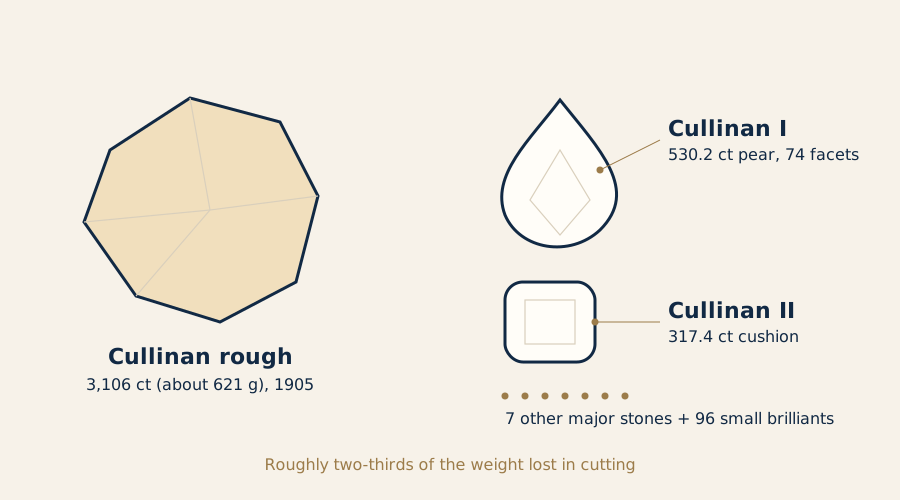
The lesson here is rarity by size. Large diamonds are not just a little rarer than small ones; they are dramatically rarer, and price per carat climbs steeply as weight goes up. Our page on how rarity climbs with carat weight shows why a 2 carat stone costs far more than two 1 carat stones of the same quality. Other giants have turned up since, including the 1,109 carat Lesedi La Rona (2015) and a stone of about 2,492 carats (2024), both from the Karowe mine in Botswana. See the mines producing diamonds today for where large stones still come from.
The Cullinan is also a Type IIa diamond, meaning it contains almost no nitrogen. Only about 1–2% of natural diamonds are Type IIa, yet many of the largest and clearest stones in history belong to this group. Research published in 2016 suggested that large, very pure Type IIa diamonds like the Cullinan grow unusually deep in the earth's mantle, perhaps 360–750 km down. Our guide to the nitrogen-based diamond types explains how the types are defined and tested.
Why was the Koh-i-Noor diamond recut?
The Koh-i-Noor (Persian for "mountain of light") has the longest recorded history of any well-known diamond. Reliable accounts trace it through Mughal, Persian, Afghan and Sikh rulers before the British East India Company took it in 1849, when it annexed the Punjab. It was presented to Queen Victoria in 1850 and put on show at the Great Exhibition in London in 1851.
The public was disappointed. The stone then weighed about 186 carats and was cut in an older Indian style that kept as much weight as possible, with a broad, fairly flat shape and irregular facets. Under gaslight it looked dull compared with what visitors expected. In 1852 a cutter from the Amsterdam firm Coster recut it in London into a 105.6 carat oval brilliant. That is a loss of about 43% of its weight, traded for more brightness and a more regular outline.
This is the clearest historical lesson in cut. Weight is what you pay for, but cut is what turns that weight into light. Diamond has a refractive index of about 2.42, which means it bends light strongly, but only well-planned facet angles send that light back up through the top of the stone. The same trade-off shows up in antique and old-stock diamonds, such as old mine and Old European cuts. They were cut by eye for candlelight, with chunkier facets and deeper bodies, and many people today love them exactly as they are.
The Regent diamond, now in the Louvre, tells a similar story: a rough of about 410 carats found in India around 1698 took roughly two years to cut into a cushion of about 140.6 carats. If you are deciding whether to recut an old stone of your own, our page on reusing or resetting a family diamond sets out the options.
Why is the Hope Diamond blue?
The Hope Diamond's history starts with a larger blue stone of about 112 old carats that the French merchant Jean-Baptiste Tavernier sold to Louis XIV in 1668. It was recut into the "French Blue", stolen during the French Revolution in 1792, and surfaced in London in 1812 as a smaller stone. It later passed through the Hope family, Cartier and the American socialite Evalyn Walsh McLean, before jeweller Harry Winston gave it to the Smithsonian in 1958. The famous "curse" was largely spread in the early 1900s and historians treat it as legend.
Its colour comes from tiny amounts of boron trapped in the crystal as it grew. Boron-bearing diamonds are called Type IIb, and they are extremely rare, commonly estimated at well under 1% of natural diamonds. Type IIb diamonds also conduct electricity, which most diamonds do not. The Hope shows another rare trait: after exposure to short-wave ultraviolet light it glows orange-red for several seconds, an effect called phosphorescence. Our page on how trace elements get trapped as diamonds form explains where elements like boron and nitrogen come from.
The lesson is that colour always has a cause, and the cause matters. Natural blue diamonds like the Hope are coloured by boron. Some natural diamonds are treated after mining to change or improve their colour, and that must be disclosed; see HPHT-treated natural diamonds for how heat-and-pressure treatment works. Laboratory-grown blue diamonds also exist, grown with boron added; they are real diamond and must always be described as lab-grown. A grading report from an independent lab tells you which of these you are looking at.
Related guideDiamond Types Ia, Ib, IIa and IIbNot sure which one is right?
Send us the stones you are looking at and our gemologist will tell you which to choose and why.
What do famous pink, green and yellow diamonds teach about colour?
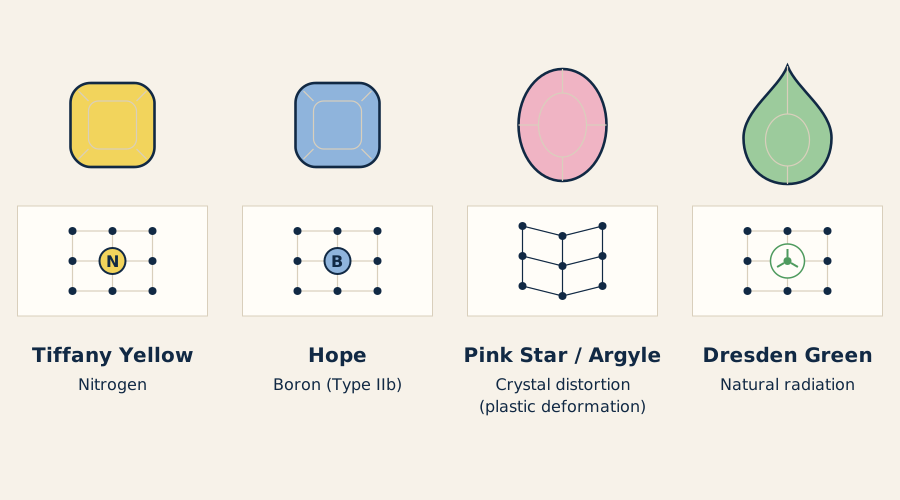
Coloured diamonds are graded differently from white ones. Instead of D to Z, they are graded by how strong the colour is, with terms such as Fancy Light, Fancy, Fancy Intense, Fancy Vivid, Fancy Deep and Fancy Dark. The more saturated and even the colour, the rarer the stone. Four famous diamonds show four different causes of colour:
- Yellow (Tiffany Yellow): nitrogen atoms in the crystal absorb blue light. The 287 carat rough found near Kimberley in 1877 was cut to 128.54 carats with 82 facets, planned to concentrate colour rather than maximise weight.
- Blue (Hope): boron, as described above.
- Pink and red (Pink Star, Argyle pinks): no trace element at all. The colour comes from distortion of the crystal structure under enormous pressure, called plastic deformation.
- Green (Dresden Green): long exposure to natural radiation in the earth, which disturbs the crystal and creates green colour.
The Pink Star is a 59.60 carat oval graded Fancy Vivid pink and Internally Flawless, cut from a 132.5 carat rough mined in South Africa in 1999. The Moussaieff Red, at 5.11 carats, is the largest known diamond graded Fancy Red. Its small size shows how rare true red is: a 5 carat colourless diamond is unusual, but a 5 carat red is almost unheard of.
Australia has its own chapter. The Argyle mine in the Kimberley region of Western Australia produced most of the world's pink diamonds before it closed in 2020, and its best stones were sold each year through an invitation-only tender. Our page on Australia's Argyle mine and its pink diamonds covers what made them distinctive.
The Dresden Green, about 41 carats and held in Dresden's Green Vault since the 1700s, has helped gemmologists study how natural radiation colour differs from colour created by irradiation in a laboratory. It is a reminder that a green diamond's origin can only be confirmed with laboratory testing. For why diamond suits such intense colour so well, with its hardness of 10 on the Mohs scale and strong light return, see what sets diamond apart from other gems.
Which famous diamonds are linked to love stories?
Some diamonds became famous because of who wore them. The Taylor-Burton was cut from a 241 carat rough found at the Premier mine in 1966 and polished into a 69.42 carat pear. Cartier bought it at auction in 1969 for about US$1.05 million, then a record for a diamond, and the actor Richard Burton bought it from Cartier for Elizabeth Taylor soon after. A year earlier Burton had given her a 33.19 carat Asscher cut (a square step cut with cut corners), later known as the Elizabeth Taylor Diamond, which she wore almost every day.
The Tiffany Yellow has been worn in public by only a handful of women, including Audrey Hepburn in 1961 publicity photos for Breakfast at Tiffany's. Stones like these did a lot to popularise particular shapes. The pear and the Asscher cut both saw renewed interest after their famous owners wore them.
The lesson is that shape is personal. There is no correct shape, only proportions that suit a particular shape. A pear, for example, usually looks balanced at a length-to-width ratio of about 1.45–1.75, and an Asscher looks most like itself close to square, around 1.00–1.05.
How much are famous diamonds worth?
Most famous diamonds will never be sold. The Cullinan stones and the Koh-i-Noor belong to the British Crown, the Hope belongs to the Smithsonian and the Regent to the Louvre, so they have no market price. A few famous stones have sold publicly, and those results show what drives value at the very top end.
| Diamond | Sale | Price (USD) | Approximate AUD at the time |
|---|---|---|---|
| Pink Star, 59.60 ct Fancy Vivid pink | Sotheby's Hong Kong, 2017 | about US$71.2 million | roughly AUD 90–95 million |
| Oppenheimer Blue, 14.62 ct Fancy Vivid blue | Christie's Geneva, 2016 | about US$57.5 million | roughly AUD 75–80 million |
| Lesedi La Rona, 1,109 ct rough | Private sale, 2017 | about US$53 million | roughly AUD 65–75 million |
| Taylor-Burton, 69.42 ct colourless | Auction, 1969 | about US$1.05 million | roughly AUD 0.9–1 million |
Look at what those prices reward. The Oppenheimer Blue weighs about a quarter of the Pink Star and sold for not far below it, because intense natural blue is so rare. Colour intensity, size, clarity, cut and a documented history all add up. Our guide to the factors that set a diamond's price explains how the same factors work on everyday stones, just at very different scales.
Auction records are not a guide to how ordinary diamonds behave over time. A diamond bought from a retailer usually resells for well below what was paid, and prices for natural diamonds have both risen and fallen over the decades. Our page on how natural diamond prices have moved over the decades gives the longer view. Choose a diamond because you love it and want to wear it.
Browse natural diamonds
Do famous diamonds have a troubled history?
Many of them do. The Koh-i-Noor was taken as a spoil of war, and governments in India, Pakistan and Afghanistan have all claimed it at various times. The Cullinan was mined in colonial-era South Africa, where mine labour was harsh and poorly paid, and some South Africans have called for its return. Gemmologists use the word provenance for a diamond's documented ownership history, and for famous stones that history includes uncomfortable chapters alongside the royal ones.
In the 1990s the trade faced a modern version of the same problem: rough diamonds from Sierra Leone, Angola and elsewhere funded civil wars. That led to the Kimberley Process Certification Scheme in 2003, which tracks rough diamond shipments between member countries. It has real limits, though, because its definition of a conflict diamond is narrow. Our page on what the Kimberley Process does and doesn't cover sets them out.
Today, buyers who care about origin can ask for stones with a documented mine of origin, such as diamonds mined in Canada's Northwest Territories, which often come with tracking from mine to polished stone. You can read how we think about sourcing on our page about responsible diamond sourcing at GemTrove.
What can famous diamonds teach you about choosing your own?
You are unlikely to be offered a 500 carat stone, but the same rules that shaped the famous diamonds apply to a 0.50 carat engagement diamond. This table links each famous stone to the thing it teaches and what to check on your own diamond.
| Famous diamond | What it teaches | What to check on your own diamond |
|---|---|---|
| Cullinan | Rarity rises steeply with size | Price jumps at 1.00, 1.50 and 2.00 ct; compare face-up millimetres, not just carats |
| Koh-i-Noor and Regent | Cut turns weight into light; recutting costs weight | Cut grade for rounds, or proportions, polish and symmetry for fancy shapes |
| Hope | Colour has a cause and can be treated | The report states natural colour, any treatment, or lab-grown origin |
| Pink Star and Argyle pinks | Fancy colour is graded by intensity | Colour grade wording (Fancy, Intense, Vivid) and how evenly the colour spreads |
| Dresden Green | Colour origin needs laboratory testing | An independent report from a lab such as GIA for any coloured diamond |
| Cullinan and Koh-i-Noor | Type IIa purity | Some reports note Type IIa; it can also flag stones worth checking for treatment |
| Taylor-Burton | Shape is personal | Length-to-width ratio for the shape, such as 1.45–1.75 for a pear |
Famous stones also show that diamonds outlive their settings. The Cullinan stones have been moved between crowns and brooches, and the Koh-i-Noor has been set in several crowns. An inherited diamond can be reset in the same way, keeping the stone and its story while giving it a new design.
How do you check your own diamond's story? Step by step
- Get the grading report. Confirm the weight, measurements, colour, clarity and cut, and whether the diamond is natural or lab-grown.
- Verify the report number. Enter it on the grading lab's website and check the details match the stone and any laser inscription on its girdle (the thin outer edge).
- Check the colour origin. For any coloured diamond, make sure the report says whether the colour is natural or treated.
- Note the diamond type if stated. Type IIa or IIb on a report is unusual and worth understanding before you buy.
- Ask about origin. Where it is documented, ask for the mine or country of origin and any tracking paperwork.
- Keep a record. Store the report, a valuation, photos and any family history together, for insurance and for whoever wears the diamond next.
Free consultation
Talk to a gemologist
Compare stones in person or online with Raj Sood, Graduate Gemologist (GIA), AJP (GIA).
Book a consultationShop this shape
FAQ
Common questions
What is the most famous diamond in the world?
Most lists put the Hope Diamond, the Koh-i-Noor and the Cullinan at the top. The Hope is known for its rare blue colour, the Koh-i-Noor for its long and disputed history, and the Cullinan for being the largest gem diamond ever found.
What is the largest diamond ever found?
The Cullinan, found in South Africa in 1905, weighed 3,106 carats as rough and is still the largest gem-quality diamond ever found. The largest stone cut from it, Cullinan I, weighs 530.2 carats.
Is the Hope Diamond really cursed?
No. The curse story was largely spread in the early 1900s, and historians treat it as legend. The Hope has been on public display at the Smithsonian since 1958.
Who owns the Koh-i-Noor diamond?
It is part of the British Crown Jewels, set in the crown of Queen Elizabeth The Queen Mother at the Tower of London. India, Pakistan and Afghanistan have each claimed it at different times.
What is the most expensive diamond ever sold at auction?
The Pink Star, a 59.60 carat Fancy Vivid pink, sold at Sotheby's Hong Kong in 2017 for about US$71.2 million. It is the highest price publicly recorded for a diamond at auction.
Are there famous Australian diamonds?
Yes. The Argyle mine in Western Australia produced most of the world's pink diamonds before it closed in 2020, and its rarest pinks and reds were sold through an annual tender. Many are now in private collections.

Ask a gemologist
Not sure which diamond to choose?
Raj Sood is a Graduate Gemologist (GIA) and master jeweller. Bring the stones you are considering, or send the reports, and he will tell you honestly which one is better and why.
Keep learning
Related guides
 Natural DiamondsDiamond Types Ia, Ib, IIa and IIb
 Natural DiamondsArgyle Mine and Australian Diamonds
 Natural DiamondsOld-Stock and Antique DiamondsNatural DiamondsNatural Diamond Rarity by SizeNatural DiamondsNatural Diamonds GuideNatural DiamondsThe Kimberley Process ExplainedNatural DiamondsCanadian DiamondsNatural DiamondsReusing a Family Diamond
Explore more
More guides on this topic
Education