
- Education
- Natural Diamonds
- Diamond Types Ia, Ib, IIa and IIb: What They Are and What They Mean
Natural Diamonds
Diamond Types Ia, Ib, IIa and IIb: What They Are and What They Mean
Diamond types Ia, Ib, IIa and IIb are how gemmologists sort diamonds by the trace atoms inside them. The type explains a diamond's colour, how laboratories test it and why famous stones such as the Hope and the Cullinan look the way they do.
 Reviewed by Raj Sood, Graduate Gemologist (GIA), AJP (GIA)Master jeweller and Graduate Gemologist (GIA) · reviewed 4 November 2026
Quick answer
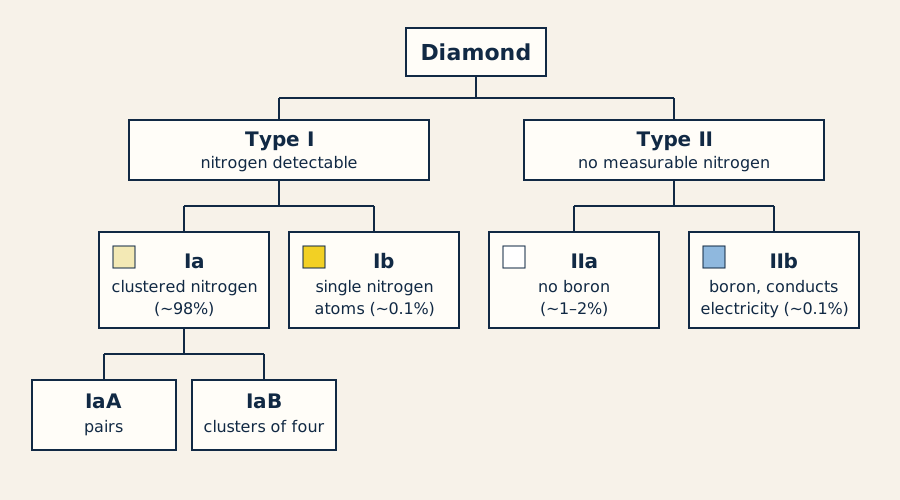
Diamond types Ia, Ib, IIa and IIb sort diamonds by trace impurities. Type Ia (about 98% of natural diamonds) holds clustered nitrogen; Ib holds scattered nitrogen and looks intensely yellow; IIa has almost no nitrogen and is often exceptionally colourless; IIb contains boron, which turns it blue. Type affects colour and testing, not hardness or sparkle.
What are diamond types Ia, Ib, IIa and IIb?
Diamond is carbon, but almost no natural diamond is pure carbon. While a crystal grows deep in the Earth, a few stray atoms of other elements, mainly nitrogen and, very rarely, boron, take the place of carbon in the lattice (the repeating framework of atoms that makes up the crystal). Scientists sort diamonds into four main types according to whether nitrogen is present, how its atoms are arranged, and whether boron is there instead.
- Type Ia: nitrogen grouped in clusters. About 98% of natural diamonds. Colourless to pale yellow, sometimes brown.
- Type Ib: nitrogen as single, scattered atoms. Roughly 0.1% of natural diamonds. Usually a strong yellow to orange-yellow.
- Type IIa: no nitrogen detectable by standard infrared testing. About 1–2%. Often exceptionally colourless, but also brown or pink.
- Type IIb: no measurable nitrogen, but a trace of boron. Around 0.1% or less. Blue to grey, and the only natural diamond that conducts electricity.
The system began as a puzzle about light. In 1934 British researchers Robertson, Fox and Martin measured how diamonds absorb ultraviolet and infrared light. Most stones blocked ultraviolet below about 300 nanometres and showed strong infrared absorption; they called these Type I. A small group let ultraviolet through to about 225 nanometres and lacked those infrared bands; these became Type II. In 1959 Kaiser and Bond showed that nitrogen was the cause. Blue, electrically conductive diamonds were described in the 1950s and became Type IIb, and in the 1960s researchers separated Type Ib from Type Ia. Today laboratories use FTIR spectroscopy (Fourier-transform infrared), which reads the infrared fingerprint of each impurity in seconds.
Type is not a grade. It sits alongside the 4Cs (cut, colour, clarity and carat) rather than replacing them, and you cannot see it with a loupe. If you are new to the subject, our wider natural diamonds guide covers the basics, and what sets diamond apart from every other gem explains the properties all four types share: 10 on the Mohs hardness scale, a refractive index of about 2.42 and a density of about 3.52.
What is a Type Ia diamond?
Nitrogen is the most common impurity in natural diamonds because it is plentiful in the mantle and its atoms are almost the same size as carbon. It usually enters a growing crystal as single atoms. Over millions to billions of years at mantle temperatures of roughly 1,000–1,300 °C, those atoms slowly migrate, pair up and then gather into larger clusters. This is called nitrogen aggregation, and a diamond whose nitrogen has aggregated is Type Ia. Most natural diamonds are somewhere between about 1 and 3.5 billion years old, so most have had ample time. Our guide to how diamonds grow under heat and pressure in the mantle explains the depths and timescales involved.
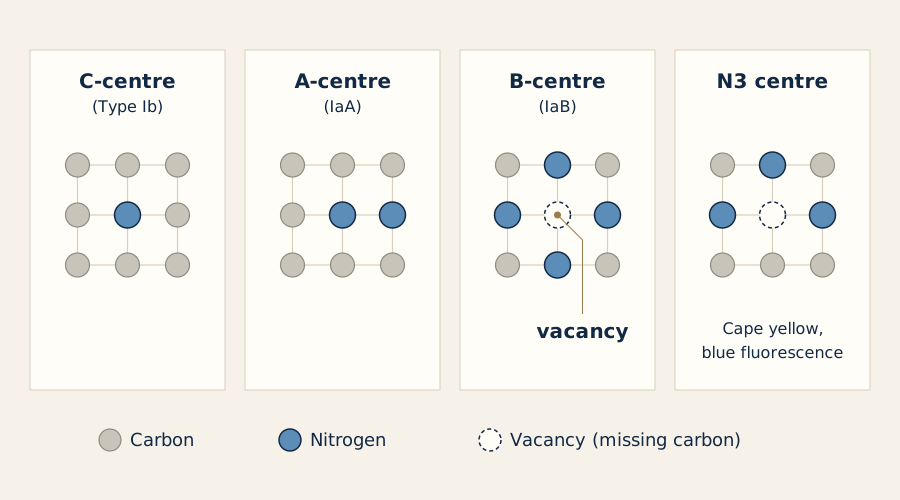
| Subtype or centre | Arrangement | Effect on colour |
|---|---|---|
| IaA (A-centre) | Two nitrogen atoms side by side | No visible colour on its own |
| IaB (B-centre) | Four nitrogen atoms around a vacancy (a missing carbon atom) | No visible colour; a sign of very long storage in the mantle |
| N3 centre | Three nitrogen atoms around a vacancy, in small amounts | Absorbs violet-blue light, giving pale 'Cape' yellow; causes blue fluorescence |
| IaAB | A mix of A and B centres | The most common natural diamond of all |
Type Ia diamonds can hold a lot of nitrogen, from tens to a few thousand parts per million (ppm), yet most of it is invisible because A and B centres do not absorb visible light. The faint yellow tint measured on the D-to-Z colour scale usually comes from small numbers of N3 centres, nicknamed 'Cape' after the diamonds of South Africa's Cape Province. The same centres cause the blue glow that roughly a quarter to a third of gem diamonds show under ultraviolet light.
Because Type Ia is the everyday diamond, almost every stone in a family ring or in antique and old-stock diamond jewellery will be Type Ia. That is no mark against them: Type Ia includes plenty of D, E and F colour diamonds.
Why are Type Ib diamonds so yellow?
In a Type Ib diamond the nitrogen never aggregated. It stays as single atoms, each replacing one carbon, known as C-centres or substitutional nitrogen. Single nitrogen absorbs strongly in the blue and violet, so even tens of ppm can produce a saturated yellow to orange-yellow, the colour the trade calls canary. Atom for atom, it colours a stone far more strongly than the clustered nitrogen in Type Ia.
Natural Type Ib is rare, around 0.1% of diamonds, because it needs a crystal that was stored relatively briefly or at cooler temperatures before an eruption carried it to the surface. Most natural Type Ib diamonds are actually mixed, with Ib zones alongside IaA. Strong yellows like these are graded on GIA's fancy colour scale, from Fancy Light to Fancy Vivid, rather than D-to-Z.
There is a lab-grown twist. Diamonds grown by the HPHT method (high pressure, high temperature) are usually Type Ib as grown, which is why early laboratory-grown diamonds were yellow. Growers now add nitrogen 'getters' to make colourless HPHT lab-grown diamonds, which are then Type IIa. Type alone never tells you whether a diamond is natural; that takes a laboratory.
What is the difference between Type IIa and Type IIb diamonds?
Type II diamonds contain so little nitrogen that standard infrared testing cannot detect it, generally below a few ppm. What separates IIa from IIb is boron.
Type IIa is chemically the purest diamond. With nothing to absorb light, a IIa can be completely colourless, and many D-colour stones are IIa. Without nitrogen it also conducts heat better than any other material at room temperature, around 2,000–2,200 watts per metre-kelvin, roughly five times copper. Purity does not always mean whiteness, though. Many IIa diamonds are brown from plastic deformation (the lattice being bent and sheared under stress in the Earth), and related distortion produces pink. The historic Golconda diamonds of India, prized for their watery transparency, are typically Type IIa.
IIa crystals also tend to come big. A 2016 study by GIA scientists found that many large, inclusion-poor IIa diamonds, nicknamed CLIPPIR diamonds, formed far deeper than ordinary diamonds, roughly 360–750 km down, and carry tiny metallic iron-nickel inclusions. Our page on Type IIa diamonds in depth goes further, and how rarity climbs with carat weight puts those sizes in context.
There is a catch for buyers: brown Type IIa diamonds respond well to HPHT treatment, which can remove the brown and leave a colourless or pink stone. Since the late 1990s laboratories have screened colourless IIa diamonds closely for this; see HPHT-treated natural diamonds and how they are disclosed.
Type IIb contains a trace of boron, usually under 1 ppm and rarely more than a few. Boron absorbs red and infrared light, so the stone looks blue to grey-blue. Each boron atom has one fewer electron than carbon, which makes the diamond a semiconductor: Type IIb is the only natural diamond that conducts electricity. Many IIb stones also phosphoresce, usually glowing blue to blue-green, and in some stones such as the Hope red to orange, for a few seconds after ultraviolet light is switched off. A 2018 study found that blue diamonds also form super-deep, at 660 km or more. The Cullinan mine in South Africa is the most famous modern source.
Related guideType IIa Diamonds ExplainedNot sure which one is right?
Send us the stones you are looking at and our gemologist will tell you which to choose and why.
How common are diamond types Ia, Ib, IIa and IIb?
Here are the four types side by side. The shares are widely quoted approximations across natural diamonds; individual mines vary a great deal.
| Type Ia | Type Ib | Type IIa | Type IIb | |
|---|---|---|---|---|
| Key impurity | Clustered nitrogen | Single nitrogen atoms | None measurable | Boron |
| Nitrogen level | Tens to thousands of ppm | Up to a few hundred ppm | Below a few ppm | Below a few ppm |
| Share of natural diamonds | about 98% | about 0.1% | about 1–2% | about 0.1% or less |
| Typical colours | Colourless to Cape yellow; brown | Intense yellow to orange | Colourless, brown, pink | Blue to grey |
| UV fluorescence | Often blue | Usually weak or none | Usually weak or none | Usually none; may phosphoresce |
| Conducts electricity | No | No | No | Yes |
| Famous example | Most diamonds in everyday jewellery | Some rare intense canary yellows | Cullinan, Koh-i-Noor | Hope Diamond |
Many diamonds are really mixtures: a Type IaAB diamond with a few Ib zones, or a IIa with a faint nitrogen-rich core. Laboratories classify by the dominant pattern of nitrogen in diamonds of this kind, and specialist reports can list more than one type.
What diamond types did Argyle and Australia produce?
Australia has a bigger place in this story than most people realise. The Argyle mine in the East Kimberley of Western Australia began production in 1985 and closed in November 2020, producing more than 800 million carats. For much of the 1990s it was the world's largest producer by volume. Unusually, it mined a lamproite pipe rather than the kimberlite that hosts most diamond deposits. The full story is in our page on the Argyle mine and Australia's diamond history.
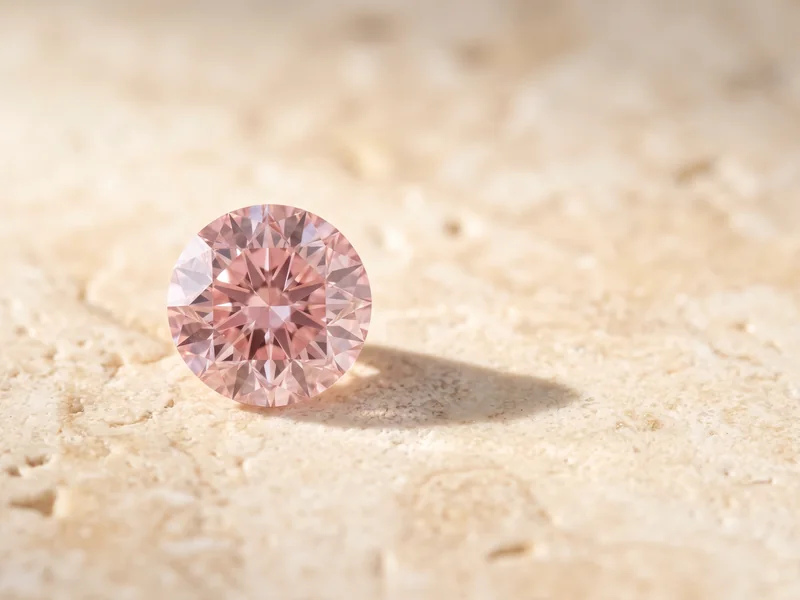
Argyle's diamonds were overwhelmingly Type Ia, often with a high share of B-centre nitrogen, which points to very long storage in the mantle. Most were brown, coloured by plastic deformation, and Argyle marketed them on its own champagne-to-cognac scale. Its famous pinks surprise many people: GIA research found most Argyle pinks are Type Ia with relatively low nitrogen, not Type IIa, with the colour concentrated in thin graining lines (bands of deformation) visible under magnification. A minority are Type IIa.
Elsewhere in the Kimberley, the Ellendale mine was known for fancy yellow diamonds until it closed in the mid-2010s, and small alluvial diamond finds in New South Wales go back to the 1850s. For how Australia compares with Botswana, Russia and southern Africa, see where the world's diamonds are mined today, and for a northern hemisphere comparison, diamonds from Canada's Arctic mines.
Which famous diamonds are Type IIa or Type IIb?
Because Type IIa crystals can grow very large and very clean, they dominate lists of the biggest diamonds ever found. Blue Type IIb stones appear on the lists of the most celebrated coloured diamonds.
| Diamond | Weight | Type | Note |
|---|---|---|---|
| Cullinan (rough) | about 3,106 ct | IIa | Found in 1905 at the Premier (now Cullinan) mine, South Africa; cut into the Cullinan I (about 530 ct) and other stones |
| Lesedi La Rona (rough) | about 1,109 ct | IIa | Found in 2015 at the Karowe mine, Botswana |
| Koh-i-Noor | about 105.6 ct | IIa | Historic Indian diamond, now in the British Crown Jewels |
| Dresden Green | about 41 ct | IIa | Green from natural radiation exposure, not nitrogen |
| Hope Diamond | about 45.5 ct | IIb | Deep greyish blue with strong red phosphorescence |
| Oppenheimer Blue | about 14.6 ct | IIb | Sold at auction in Geneva in 2016 |
Most famous yellows, such as the Tiffany Yellow (about 128.5 ct), are nitrogen-bearing Type I stones. You can read the stories behind many of these stones in famous diamonds and the history behind them.
How do labs test diamond type, and can lab-grown diamonds be Type IIa?
Type cannot be judged by eye. Laboratories use FTIR spectroscopy to read the nitrogen and boron signatures, often backed by ultraviolet imaging such as the DiamondView instrument, which shows the growth pattern of the crystal. Natural diamonds show the octahedral (eight-sided) growth zones of mantle crystals; laboratory-grown diamonds show the cube-and-octahedron patterns of HPHT growth or the layered striations of CVD growth.
That matters because lab-grown diamonds are real diamond with their own typical types:
- CVD lab-grown (chemical vapour deposition, grown layer by layer from a carbon-rich gas): almost always Type IIa; Type IIb if boron is added to make blue.
- HPHT lab-grown: Type Ib as grown when nitrogen is present (yellow); Type IIa when nitrogen is removed (colourless); Type IIb with boron (blue).
- Natural: any of the four types, but about 98% Type Ia.
Because nearly all colourless lab-grown diamonds are Type IIa, a colourless natural Type IIa gets extra screening. Being IIa does not mean a diamond is lab-grown, and it does not mean it is natural. Only a full laboratory report confirms which it is.
Handheld testers have limits too. A thermal tester passes all four types, since every diamond conducts heat well. A combined tester that also checks electrical conductivity to pick out moissanite can wrongly flag a natural Type IIb blue diamond, because both conduct electricity.
Is a Type IIa diamond better, and does type matter when you buy?
For most people choosing an engagement ring or a pair of studs, type is background knowledge rather than a buying criterion. All four types have the same hardness, the same refractive index and the same brilliance when cut equally well. A D-colour Type Ia and a D-colour Type IIa look the same; the colour grade, not the type, describes what you see.
- Colour: type explains the colour. Pinks, blues and canary yellows come from specific types, so the report's statement of colour origin (natural or treated) matters more than the type label.
- Treatment: brown Type IIa and some Type Ia diamonds can be HPHT-treated. A natural diamond's report should state any treatment.
- Natural or lab-grown: type helps laboratories screen, but the report, not the type, tells you the origin.
- Price: a type note on its own does not set a price. At the very top of the auction market, large colourless IIa stones attract collector interest, but that is no promise of future value; see how natural diamond prices have behaved over the years.
- Origin: type does not tell you which mine or country a diamond came from. Supply-chain paperwork does; see the Kimberley Process certification scheme and how GemTrove approaches responsible sourcing.
For natural diamonds, the cut, colour, clarity and carat on the report still decide how a stone looks on the hand. Type is the extra layer of science that explains why it looks that way.
Browse natural diamonds
How do you find out what type your diamond is? Step by step
- Check the existing report. Some GIA and other laboratory reports note 'Type IIa' or 'Type IIb' in the comments, and coloured diamond reports often mention type.
- Decide whether it matters to you. Most colourless diamonds will be Type Ia, and the answer changes nothing about how the stone looks or wears.
- Ask a gemmological laboratory. GIA offers a diamond type classification service, and some other labs include type on advanced reports. Check that the testing is done by FTIR spectroscopy.
- Have the stone tested loose if you can. Mounted diamonds can often be tested, but some settings block the infrared beam.
- Read the origin and treatment lines. Confirm whether the diamond is natural or lab-grown and whether any HPHT or other treatment is disclosed.
- Keep the paperwork with the piece. Store the report with the jewellery for insurance, valuation and any future resetting.
If you are planning to reset an heirloom, testing is easy to arrange at the same time. Our guide to giving a family diamond a new setting explains the process, and the GemTrove jewellery glossary defines any term here you want to revisit.
Free consultation
Talk to a gemologist
Compare stones in person or online with Raj Sood, Graduate Gemologist (GIA), AJP (GIA).
Book a consultationShop this shape
FAQ
Common questions
What is the rarest diamond type?
Type Ib and Type IIb are the rarest, each around 0.1% of natural diamonds or less. Pure Type Ib is rarer still, because most natural Type Ib diamonds also contain some Type IaA nitrogen.
Is a Type IIa diamond better than a Type Ia diamond?
Not in any way you can see. Both have the same hardness and sparkle, and a colourless Ia and IIa with the same grades look identical. Type IIa is chemically purer, but the 4Cs decide how a diamond looks.
Are Argyle pink diamonds Type IIa?
Mostly not. GIA research found most Argyle pinks are Type Ia with relatively low nitrogen, coloured by plastic deformation in the crystal; only a minority are Type IIa.
Can lab-grown diamonds be Type IIa?
Yes. Nearly all colourless lab-grown diamonds are Type IIa, whether grown by CVD or HPHT, which is why natural Type IIa diamonds are screened carefully. A laboratory report confirms whether a stone is natural or lab-grown.
Why did my blue diamond test as moissanite?
Natural Type IIb blue diamonds conduct electricity because of boron, and so does moissanite. Testers that check electrical conductivity can confuse the two, so a laboratory test is needed.
Does a GIA report show the diamond type?
Sometimes. GIA may note Type IIa or IIb in the comments, especially for coloured diamonds, and it offers a separate diamond type classification service on request.

Ask a gemologist
Not sure which diamond to choose?
Raj Sood is a Graduate Gemologist (GIA) and master jeweller. Bring the stones you are considering, or send the reports, and he will tell you honestly which one is better and why.
Keep learning
Related guides
 Lab-Grown DiamondsType IIa Diamonds Explained
 Natural DiamondsArgyle Mine and Australian Diamonds
 Natural DiamondsHow Are Natural Diamonds Formed?
 Natural DiamondsHPHT Natural DiamondsNatural DiamondsNatural Diamonds GuideNatural DiamondsCanadian DiamondsNatural DiamondsWhat Makes a Diamond Special?Natural DiamondsConflict-Free Diamonds – Responsible Sourcing at GemTrove
Explore more
More guides on this topic
Education