
- Education
- Natural Diamonds
- Old-Stock and Antique Diamonds: History, Old Cuts and Antique Ring Restoration
Natural diamonds
Old-Stock and Antique Diamonds: History, Old Cuts and Antique Ring Restoration
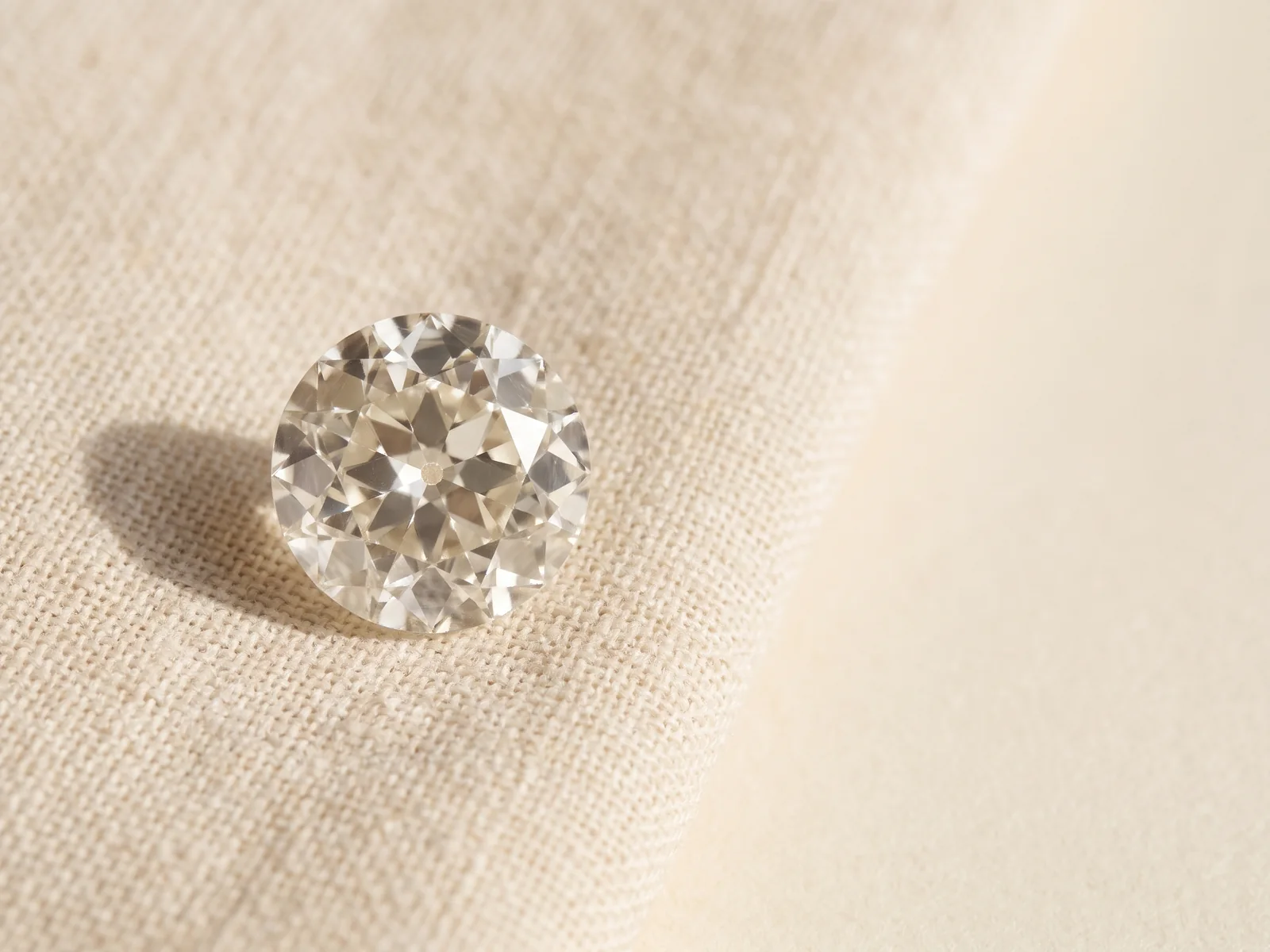
An antique diamond was cut by hand, by eye and often for candlelight. Knowing how it was made, how to judge it and how antique ring restoration works helps you keep what makes it special.
 Reviewed by Raj Sood, Graduate Gemologist (GIA), AJP (GIA)Master jeweller and Graduate Gemologist (GIA) · reviewed 4 November 2026
Quick answer
Antique diamonds are natural diamonds cut before about the 1930s, by hand, as old mine, Old European or rose cuts. Old-stock diamonds are older stones re-entering the market from estates, dealers or remodelled jewellery. They are gradable diamonds; buy on condition and cut, not age, and have any antique ring restoration done by a jeweller who preserves original work.
What are old-stock and antique diamonds?
An antique diamond is a natural diamond cut in an older style, usually before the modern round brilliant took over in the 1930s and 1940s. In the jewellery trade, 'antique' normally means a piece around 100 years old or more, and 'vintage' means roughly 20 to 100 years old. These are loose conventions, not legal definitions, so always ask a seller what they mean by the word.
Old-stock is a looser term again. It can mean diamonds that have sat in a dealer's inventory for decades, stones that have come back to market from estates and deceased jewellers' collections, or diamonds removed from old jewellery during a remodel. Some old-stock diamonds are antique cuts; others are perfectly ordinary modern stones that are simply not newly mined. Either way, they are all natural diamonds: gem-quality lab-grown diamonds only became widely available in the 2000s, so a genuinely old stone cannot be laboratory-grown. Our complete guide to natural diamonds covers how they form and how they are graded.
Chemically, an antique diamond is the same as a newly mined one: carbon, 10 on the Mohs hardness scale, with a refractive index of about 2.42. Old stones also fall into the same scientific groups as new ones, and many of the most prized old Indian diamonds were the rare, very pure kind explained in our page on diamond types Ia, Ib, IIa and IIb. Any unfamiliar word on this page is also defined in the GemTrove jewellery glossary.
How were antique diamonds cut and where did they come from?
Until the early 1700s almost every diamond came from India, especially the alluvial (river gravel) deposits traded through Golconda. Brazil became the main source from the 1720s. Then, from 1867, finds in South Africa, soon centred on Kimberley, changed the scale of the trade completely, and South African rough fed most of the late Victorian and Edwardian diamonds you see in antique rings today. Our overview of where diamonds are mined around the world traces how those sources shifted.
Cutting technology shaped the look of each era. Early cutters polished stones on a wheel coated with diamond dust and oil, and they rounded the outline (called bruting) by rubbing one diamond against another by hand. The aim was to keep as much weight as possible from the rough, so stones were cut deep, with small tables and chunky outlines. In the late 1800s mechanical bruting machines appeared, and in the early 1900s powered diamond saws made it practical to split rough into two more symmetrical pieces. In 1919 Marcel Tolkowsky published the calculations that led towards the modern round brilliant.
Many of history's celebrated stones, such as the Koh-i-Noor and the Hope, were cut and recut through these centuries; their stories are told in the world's most famous diamonds. For a closer look at the styles themselves, see our guide to old mine, Old European and rose cuts.
How do old mine, Old European and rose cuts differ from modern diamonds?
The three antique cuts you will meet most often are the old mine, the Old European and the rose. Each was designed for the light of its day: candles and gas lamps, where a deep stone with broad flashes of colour looked livelier than a crisp, bright modern cut.
| Rose cut | Old mine cut | Old European cut | Modern round brilliant | |
|---|---|---|---|---|
| Main era | About 1500s–1800s | About 1700s–late 1800s | About 1880s–1930s | 1930s onwards |
| Outline | Round, oval or pear, flat base | Cushion (squarish with rounded corners) | Round, hand-bruted | Precisely round |
| Facets | Usually 3–24, all on the dome | 58 (with culet) | 58 (with culet) | 57 or 58 |
| Table | None (domed top) | Small, often under 50% | Small, often under 50% | About 53–58% |
| Culet | None | Large, visible face-up | Open, often visible | Pointed or very small |
| Look | Soft, glassy flashes | Broad, chunky flashes | Broad flashes with more brightness | Fine, bright, even sparkle |
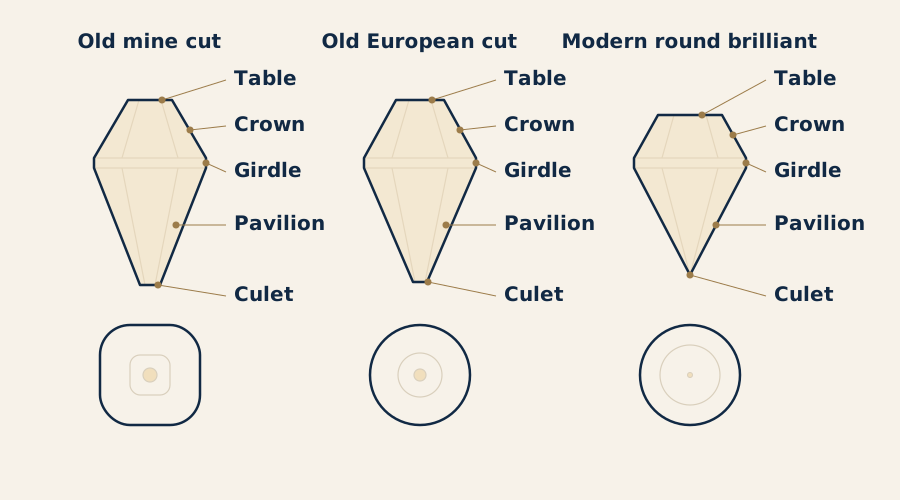
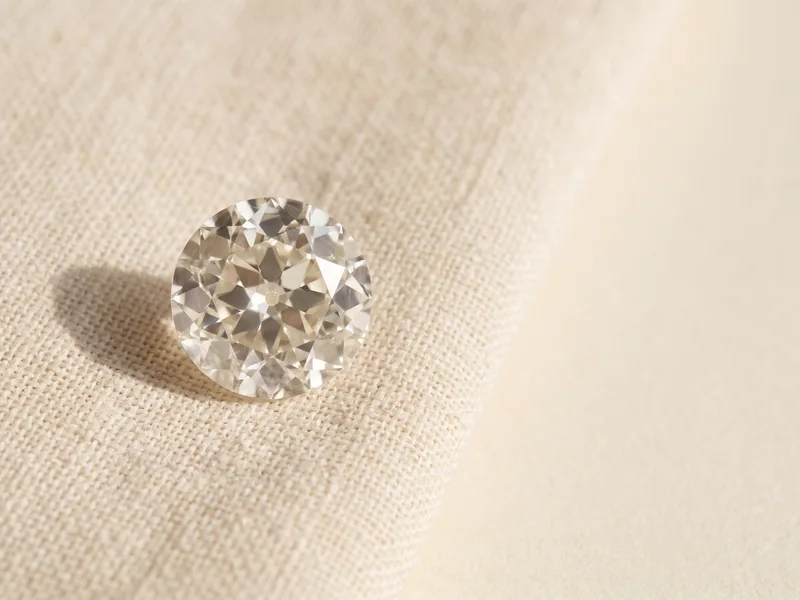
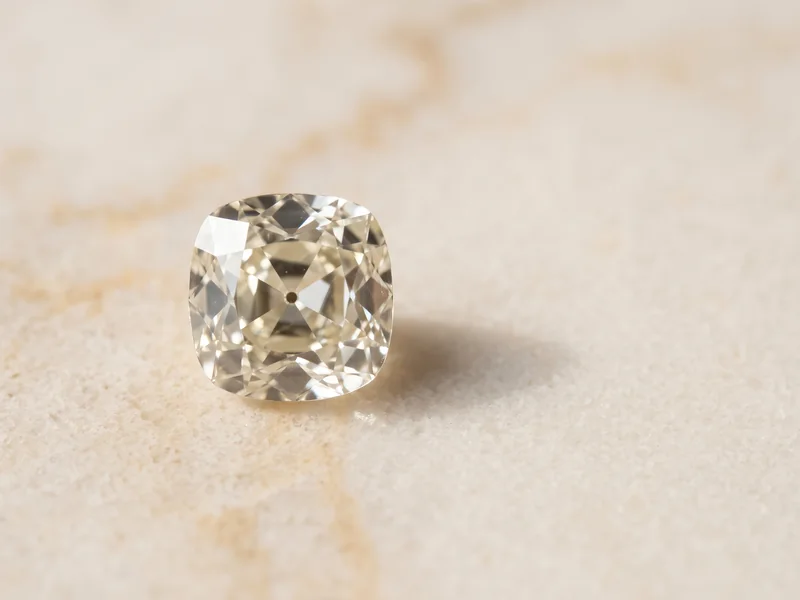
The culet is the small flat facet at the bottom point of the stone. On old cuts it is often large enough to see face-up as a small circle in the centre, which is part of their character, not a flaw. The old mine cut diamond is the ancestor of today's cushion; our old mine vs modern cushion comparison shows how they differ. The Old European cut diamond is the direct forerunner of the modern round, and how a round brilliant differs from an Old European sets them side by side.
Related guideAntique Diamond Cuts: Old Mine, Old European and RoseWhat part has Australia played in the diamond story?
Diamonds were found in Australia in the mid-1800s, mostly as small alluvial stones turned up by gold and tin miners in New South Wales, around districts such as Bingara and Copeton. These finds were modest, and almost all the diamonds in Australian antique jewellery were imported, mainly from South Africa through London.
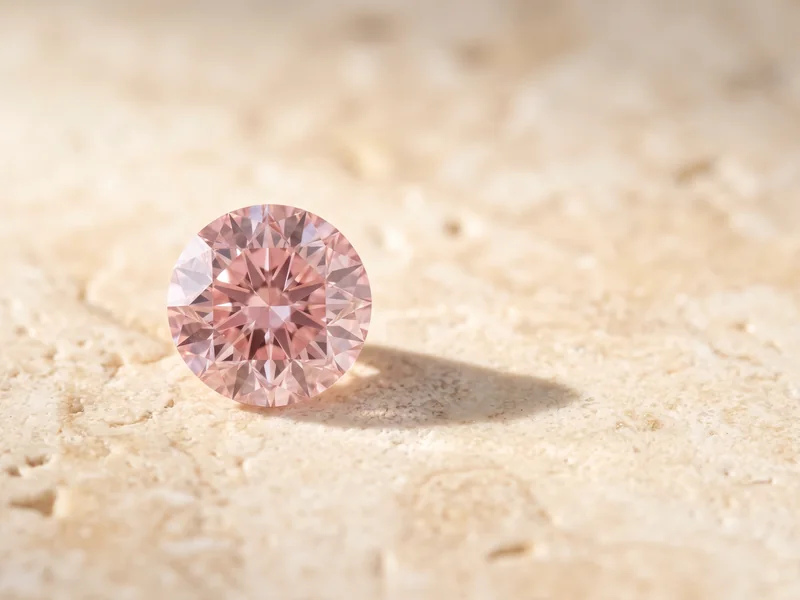
That changed with the Argyle mine in the east Kimberley region of Western Australia. Diamonds were discovered there in 1979, production began in the 1980s, and for years it was one of the world's largest producers by volume, famous for brown, champagne and rare pink diamonds. Argyle closed in November 2020. Because no new rough is coming from it, every Argyle diamond now on the market is, in a sense, old stock: these stones are not antique, but supply is fixed. The full history is in our page on the Argyle mine and Australian diamonds.
Other modern sources, such as the Northwest Territories mines described in our guide to Canadian diamonds, also post-date antique jewellery by many decades. If someone tells you an antique ring holds an Argyle or Canadian stone, it has almost certainly been reset or replaced at some point.
Not sure which one is right?
Send us the stones you are looking at and our gemologist will tell you which to choose and why.
How can you tell the age of an antique ring?
A diamond rarely carries a date, but the ring around it often gives strong clues. Jewellers read the metal, the construction and the cut together, because any one of them can be misleading on its own.
| Era (approximate) | Typical metals | Typical diamonds | Construction clues |
|---|---|---|---|
| Georgian, 1714–1837 | Silver over gold, high-carat gold | Rose cuts, early old mine cuts | Closed backs, foil behind the stones, handmade collets |
| Victorian, 1837–1901 | Gold, silver-topped gold, 15ct and 18ct | Old mine cuts, rose cuts | Cluster and gypsy settings, carved shoulders |
| Edwardian, about 1901–1915 | Platinum, platinum-topped gold | Old mine and early Old European cuts | Fine milgrain (beaded edges), lace-like pierced work |
| Art Deco, 1920s–1930s | Platinum, white gold | Old European cuts, early modern rounds, calibré coloured stones | Geometric outlines, step-cut accents |
Hallmarks help too. Older British and Australian pieces are often stamped 9ct, 15ct or 18ct, and platinum may be marked PLAT. The 15 carat standard was common in Victorian and Edwardian jewellery and is rarely made today, so a 15ct stamp usually points to an older piece. A maker's mark can sometimes be traced to a specific workshop. Be aware that marks can be worn, added later or missing, and many antique rings were resized or repaired with newer gold.
Are antique diamonds graded the same way as modern diamonds?
Colour, clarity and carat weight are graded on exactly the same scales. Cut is the difference. Grading labs generally describe old stones by their cutting style, for example 'Old European brilliant' or 'old mine brilliant', and a modern cut grade such as Excellent may not be given, because the proportions were never meant to match today's ideals. That means you judge the cut by eye: an even pattern of flashes, a culet that sits centred and an outline that does not look lopsided.
Antique diamonds often fall lower on the colour scale, commonly around J to M, because much of the rough available had a warm tint, and that warm glow looked lovely in candlelight. Clarity varies widely. What matters most for an old stone is condition:
- Chips and nicks along the girdle (the thin outer edge), often from a century of knocks.
- Abraded facet edges, where the sharp junctions between facets have worn slightly rounded.
- Recutting, where a later cutter has re-polished the stone towards a modern shape, reducing weight and changing its character.
- Ill-fitting replacements, where a newer stone has been set into an older mount.
Most antique diamonds were mined long before the Kimberley Process began in 2003, so their mine of origin can rarely be documented. How the Kimberley Process works explains what that scheme covers and what it does not.
Are antique diamonds worth it?
Worth it depends on what you value. Antique diamonds should not be bought with the aim of making money, and their resale price, like any diamond's, is usually well below what you paid at retail. What you are paying for is a look that cannot be fully repeated: hand-cut facets, a softer, flashier sparkle and, often, a story. The price is set by the same things as any natural diamond (carat, colour, clarity and the quality of the cut within its style) plus condition and demand for that particular cut.
Demand for old cuts has grown, and some cutters now produce new diamonds in old mine and Old European styles. These can be newly mined natural diamonds or lab-grown diamonds. Both are legitimate choices, but a reproduction should be described as new, and a lab-grown stone must be disclosed as lab-grown. A grading report from a lab such as GIA or IGI will state whether a diamond is natural or laboratory-grown; it cannot tell you how old the cut is, which is where an experienced gemmologist's eye helps.
Browse natural diamonds
What does antique ring restoration involve?
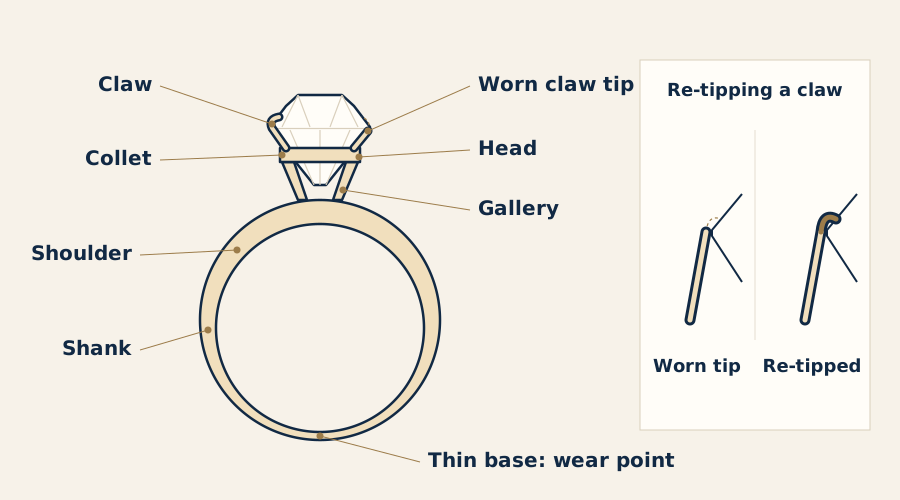
Antique ring restoration means repairing an old ring so it is safe to wear, while keeping as much of the original metal, design and stones as possible. It is different from remodelling, where the ring becomes something new. Typical restoration work includes:
- Re-tipping: adding new metal to the tips of worn claws so they hold the stone securely again.
- Re-shanking: replacing a thin, worn section of the band (the shank) at the base of the ring.
- Resizing: carefully adding or removing metal; older pieces with pierced galleries or stones around the band need more care.
- Rebuilding collets and milgrain: restoring worn rims and beaded edges by hand.
- Replacing missing stones: ideally with old-cut stones that match the originals in colour and style.
- Removing old repairs: some old repairs used lead solder, which must be removed before the ring is heated or it can damage the gold.
| Job | What it fixes | Approximate cost (AUD) |
|---|---|---|
| Re-tip claws | Worn claw tips | about $40–$100 per claw |
| Resize | Ring too big or small | about $80–$300 |
| Re-shank | Thin, cracked band | about $250–$800 |
| Rebuild a collet or head | Worn or broken setting | about $300–$1,200 |
These are broad ranges only; platinum, intricate work and matching old stones all add cost. Cleaning also needs care: closed-back and foil-backed Georgian settings should not be soaked, and ultrasonic cleaners can loosen worn stones or worsen fractures. If a stone needs a new home, see our advice on settings that suit an old mine diamond.
Should you restore, reset or remodel an antique ring?
Not every old ring should be restored as it is. Some are too worn, too fragile for daily wear or simply not to your taste. The choice usually comes down to three paths:
| Option | What happens | Suits |
|---|---|---|
| Restore | Repair the original ring, keeping its design | Rings with intact original work and sentimental value as they are |
| Reset | Move the original diamonds into a new, stronger mount in a similar style | Worn or fragile mounts holding good stones |
| Remodel | Use the stones, and sometimes the metal, in a new design | Inherited pieces you love for their stones, not their style |
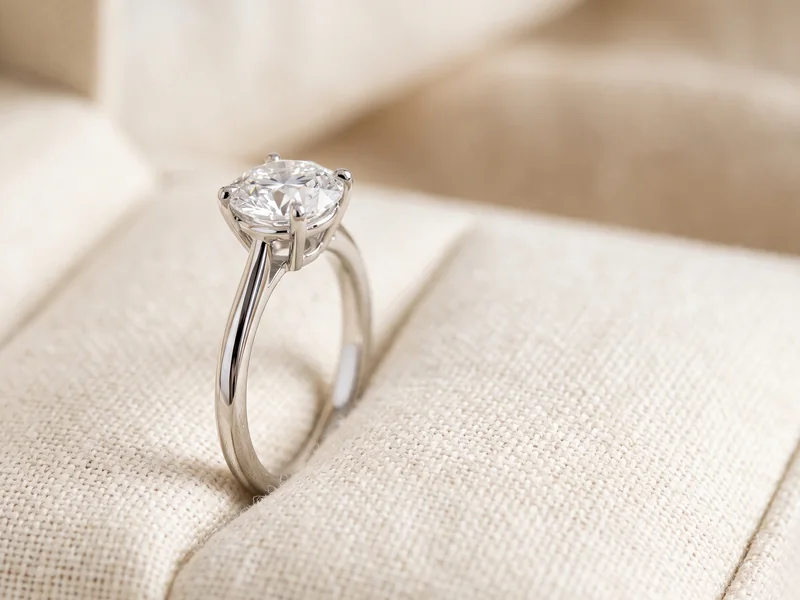
Recutting an antique diamond into a modern round is also possible, but it loses weight and erases the hand-cut character, so most gemmologists only suggest it for badly chipped stones. If you are leaning towards a new design, our guide on turning an old ring into a modern engagement ring walks through the process, and vintage-inspired engagement rings with old-world detail shows how old-cut stones can be set with milgrain, filigree and engraving in a new, sturdy mount.
How to approach antique ring restoration: step by step
- Stop wearing it if anything moves. A loose stone or a claw that catches on fabric is a warning sign.
- Have it assessed. Ask a gemmologist to check each stone under magnification, test the metal and note old repairs or lead solder.
- Photograph and record. Keep photos and a written description of the stones and condition before work starts.
- Decide what matters. Choose between restoring, resetting or remodelling, based on wear, daily use and sentiment.
- Ask for a written quote. It should list each job, the metals and any replacement stones, natural or lab-grown.
- Get a grading report if needed. For a significant stone, an independent report helps with insurance and future valuation.
- Plan the upkeep. Have claws checked every year or so, and clean gently with warm water, mild soap and a soft brush unless the setting is closed-back.
Free consultation
Talk to a gemologist
Compare stones in person or online with Raj Sood, Graduate Gemologist (GIA), AJP (GIA).
Book a consultationShop this shape
FAQ
Common questions
What is the difference between an antique and a vintage ring?
In the trade, antique usually means around 100 years old or more, and vintage means roughly 20 to 100 years old. The terms are conventions rather than legal definitions, so ask how a seller is using them.
Can antique diamonds be lab-grown?
A genuinely antique diamond cannot be lab-grown, because gem-quality lab-grown diamonds only became widely available in the 2000s. New diamonds, including lab-grown ones, are cut in antique styles, and these must be disclosed as new and, where relevant, as lab-grown.
Is it safe to resize an antique ring?
Usually, if it is done by a jeweller experienced with old pieces. Rings with stones set around the band, pierced galleries or old lead-solder repairs need extra care or a different approach.
How much does antique ring restoration cost in Australia?
Simple jobs such as re-tipping claws may cost about AUD $40–$100 per claw, while re-shanking or rebuilding a setting can run to several hundred dollars or more. The metal, the detail and any replacement stones decide the final price.
Should I recut an old mine or Old European diamond?
Most gemmologists advise against it unless the stone is badly chipped. Recutting loses weight and removes the hand-cut character that makes the diamond distinctive.
Do antique diamonds hold their value?
Not reliably. Resale prices for diamonds, antique or modern, are usually well below retail, so buy an antique diamond because you love its look and history.

Ask a gemologist
Not sure which diamond to choose?
Raj Sood is a Graduate Gemologist (GIA) and master jeweller. Bring the stones you are considering, or send the reports, and he will tell you honestly which one is better and why.
Keep learning
Related guides
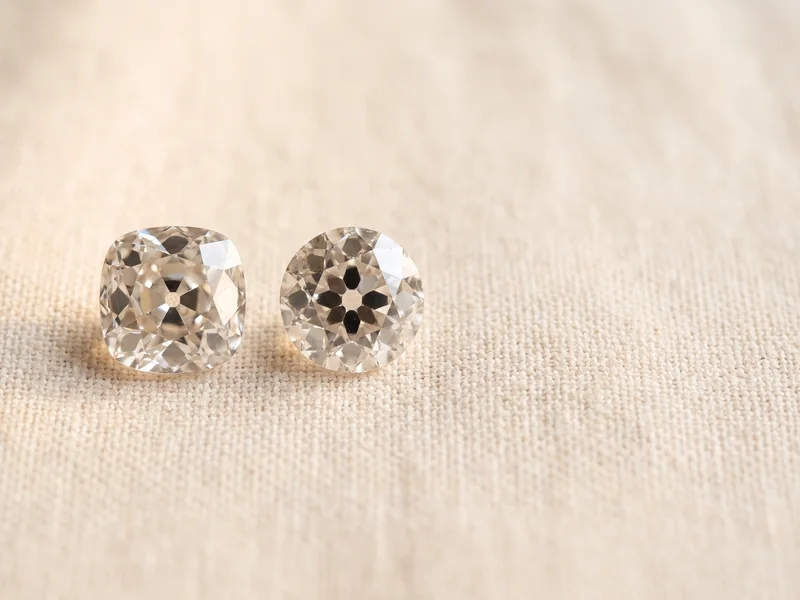 Diamond ShapesAntique Diamond Cuts: Old Mine, Old European and Rose
 Diamond ShapesOld European Cut Diamonds
 Care, Repairs & RemodellingHow to Redesign an Old Ring Into a Modern Engagement Ring
 Natural DiamondsArgyle Mine and Australian DiamondsNatural DiamondsNatural Diamonds Guide
 Diamond ShapesOld Mine Cut DiamondsEngagement Rings & SettingsBest Settings for Old Mine Diamonds
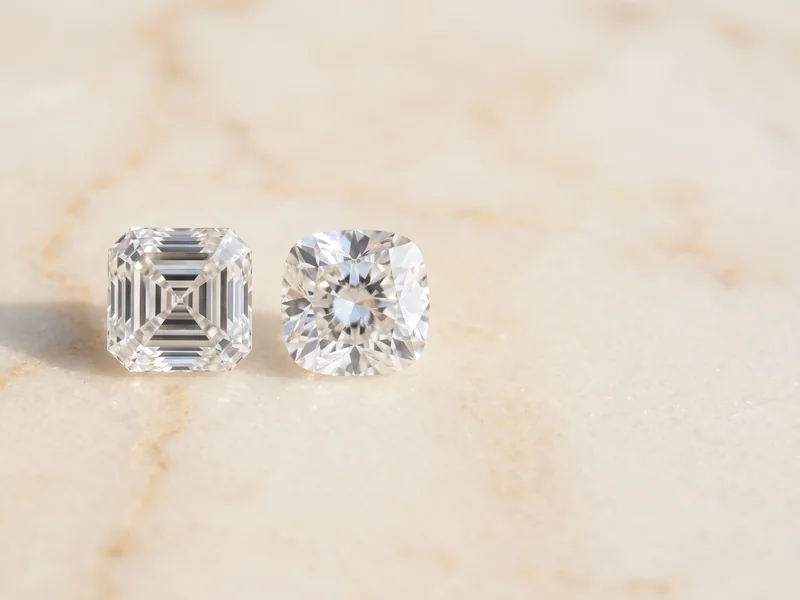 Diamond ShapesOld Mine vs Cushion Cut Diamonds
Explore more
More guides on this topic
Education