
- Education
- Natural Diamonds
- Natural Diamond Value Over Time: Geology, History, Argyle and What It Means for You
Natural Diamonds
Natural Diamond Value Over Time: Geology, History, Argyle and What It Means for You
Natural diamond value over time is one of the most misunderstood parts of buying a diamond. Here is what the geology, the history and Australia's Argyle story tell you, and what they mean for the price you pay and the value you keep.
 Reviewed by Raj Sood, Graduate Gemologist (GIA), AJP (GIA)Master jeweller and Graduate Gemologist (GIA) · reviewed 4 November 2026
Quick answer
Natural diamonds are billions of years old, but their market value is set by people, not geology. Retail prices have risen in dollar terms over decades, with falls around 1980, 2008, 2015 and 2023–24. Resale value is usually well below the purchase price, so treat a natural diamond as something to wear and keep, not a way to make money.
What does natural diamond value over time actually mean?
When people ask whether diamonds hold their value, they are usually mixing up several different numbers. A diamond does not have one value. It has a price in a shop, a cost to replace it if it is lost, a price between traders and a price a buyer will pay you if you sell it. Those numbers can be thousands of dollars apart for the same stone, and they move in different ways over the years.
- Retail price: what you pay a jeweller today, including cutting, grading, setting, staff and the shop's margin.
- Replacement value: what it would cost to buy an equivalent diamond new, usually the figure on an insurance valuation.
- Wholesale price: what jewellers and dealers pay each other for loose stones, often tracked by trade price lists quoted in US dollars.
- Resale value: what a dealer, pawnbroker, auction house or private buyer will actually pay you for a second-hand diamond.
The physical diamond barely changes over a lifetime. What changes is the market around it. If you are new to the topic, our complete guide to natural diamonds covers the basics, and how carat, colour, clarity and cut set a diamond's price explains why two stones of the same weight can differ so much. Any unfamiliar term below is defined in our A–Z jewellery glossary.
How old are natural diamonds, and how do they form?
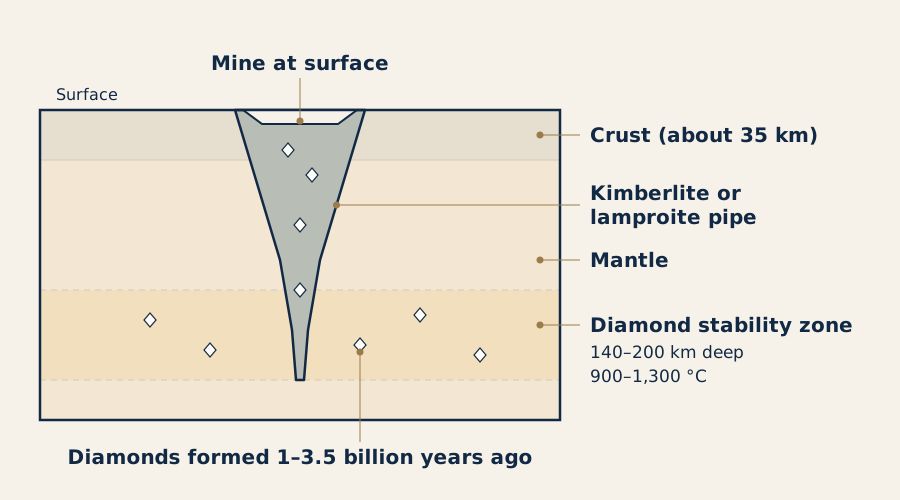
Most natural diamonds crystallised between about 1 and 3.5 billion years ago, roughly 140–200 kilometres below the surface, in the Earth's mantle (the thick layer beneath the crust). There, temperatures of about 900–1,300 °C and enormous pressure squeeze carbon atoms into the tight cubic structure that makes diamond the hardest natural material, 10 on the Mohs scale, with a refractive index of about 2.42.
Diamonds reach the surface inside rare, deep volcanic eruptions. The rock that carries them is usually kimberlite, named after Kimberley in South Africa, or, less often, lamproite, the rock at Australia's Argyle mine. These eruptions are ancient; no diamond-bearing eruption has happened in recorded history. Our page on how natural diamonds form deep in the mantle goes through each stage.
That journey leaves fingerprints. Natural diamonds often show growth patterns, mineral inclusions and clustered nitrogen that laboratory-grown stones usually do not. Sometimes a cutter leaves a small patch of the original crystal skin on the finished stone to save weight. You can read about these in naturals left on a diamond's girdle and indented naturals that dip below the surface. They are evidence of a natural origin, but on their own they do not make a diamond worth more.
How did natural diamonds become so valuable?
For most of history, diamonds were extremely scarce. India was the main source for well over a thousand years, then Brazil from the 1720s. The picture changed in 1867, when a diamond was found near the Orange River in South Africa, followed by the rush to Kimberley. Suddenly there were far more diamonds than the old market could absorb, and prices were at risk of collapsing.
| Period | What happened | Effect on value |
|---|---|---|
| Before 1700s | India (including the Golconda region) is the main source | Diamonds are rare and held mostly by royalty |
| 1720s | Diamonds found in Brazil | Supply grows; India's dominance fades |
| 1867–1871 | Discoveries in South Africa, rush to Kimberley | Huge new supply threatens prices |
| 1888 | De Beers Consolidated Mines formed | One company begins controlling most rough supply |
| 1947 | 'A Diamond Is Forever' advertising line introduced | Diamond engagement rings become a strong custom |
| 1979–1985 | Argyle discovered and brought into production in WA | Australia becomes a major source by volume |
| 1990s | Canada's first diamond mine, Ekati, opens in the Northwest Territories (1998) | More supply outside southern Africa and Russia |
| Around 2000 | De Beers moves away from stockpiling to control prices | Prices become more exposed to market swings |
| 2020 | Argyle closes | The main source of pink diamonds ends |
For most of the 20th century, De Beers and its selling organisation handled a large share of the world's rough (uncut) diamonds, often quoted at around 80–90%. By holding back stock when demand was weak, it kept prices steady. That is why many people grew up believing diamond prices only go up. Once that system loosened around 2000, prices began to rise and fall more like other goods.
What role did Argyle play in Australia's diamond story?
The Argyle mine in the East Kimberley region of Western Australia was found in 1979 and began producing in the early 1980s, first from alluvial deposits and then from the open pit, later moving underground. Over its life it produced more than 865 million carats, at times more diamonds by volume than any other mine in the world.
Most of Argyle's output was small and brown, much of it suited to industrial use or lower-priced jewellery. Rather than treat brown as a fault, Argyle marketed it with a champagne and cognac colour scale, graded C1 (lightest) to C7 (deepest). That changed how many people saw brown diamonds.
Argyle is best known for its pink diamonds. They were a tiny fraction of production, yet the mine supplied the large majority of the world's pinks, often quoted at around 90%. The finest were sold each year through an invitation-only tender. Since the mine closed in November 2020, results for top Argyle pinks have been widely reported as strong, but these are rare collector stones sold in very small numbers. They tell you nothing about how an ordinary colourless diamond will behave.
Australia had other diamond mines too: Ellendale in the West Kimberley produced fancy yellow diamonds until about 2015, and Merlin in the Northern Territory operated briefly around 2000. Today Australia is not a significant producer, so most natural diamonds sold here are mined in places such as Botswana, Russia, Canada and South Africa.
Not sure which one is right?
Send us the stones you are looking at and our gemologist will tell you which to choose and why.
Has natural diamond value over time gone up or down?
Both. Over several decades, retail prices for natural diamonds have generally risen in dollar terms, but not smoothly and not always faster than inflation. There have been clear falls along the way:
| When | What happened | What prices did |
|---|---|---|
| Late 1970s to 1980 | Speculators bought top-grade diamonds hoping to resell at a profit | Prices of top stones spiked, then fell sharply from 1980 |
| 2008–2009 | Global financial crisis | Rough and polished prices dropped, then recovered |
| 2015–2016 | Excess stock in the middle of the trade | Rough prices fell; many cutters cut back |
| 2022 | Strong post-pandemic demand | Prices reached a high point |
| 2023–2024 | Weaker demand and wider use of lab-grown diamonds | Natural prices fell noticeably, especially for smaller and mid-range stones |
The 1980 episode is the clearest lesson. Top-colour, flawless one-carat stones were bid up to extraordinary levels and lost a large part of that value within a couple of years. Ordinary jewellery diamonds were far less affected, but people who bought diamonds purely to sell later lost money.
Two less obvious factors matter for Australians. First, diamonds are traded internationally in US dollars, so the Australian price moves with the exchange rate. A falling Australian dollar can lift local prices even when world prices are flat. Second, size changes everything. Larger natural diamonds are far rarer, so price per carat jumps at weights such as 0.50, 1.00, 1.50 and 2.00 carats, and very large, top-quality stones have historically been steadier than small ones.
Related guideNatural Diamond Rarity by SizeFor how the price climbs as stones get bigger, see why natural diamonds get rarer, and pricier, as they grow.
Do natural diamonds hold their value when you resell?
Usually not in the way people hope. A natural diamond keeps a real resale market, but the price a buyer offers is normally well below what you paid at retail. The gap covers the retailer's costs, the buyer's need to resell at a profit and the fact that second-hand stones compete with plenty of new ones. As a broad guide, offers for second-hand diamond jewellery often land somewhere around 20–50% of the original retail price, depending on the stone, the report and who is buying.
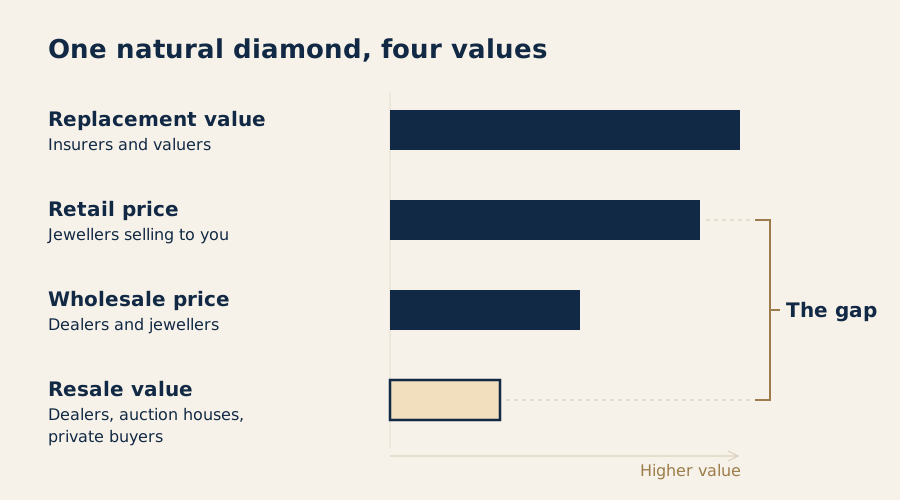
| Type of value | Who uses it | Typical level compared with retail |
|---|---|---|
| Retail price | Jewellers selling to you | The benchmark |
| Replacement value | Insurers and valuers | Often at or above retail, as it includes setting and current prices |
| Wholesale price | Dealers and jewellers | Below retail |
| Resale value | Dealers, auction houses, private buyers | Usually well below retail |
This is why an insurance valuation can say one figure while a dealer offers you much less. Neither is wrong; they answer different questions. Our guide to replacement value versus resale value explains how valuations are prepared and why you should update them every few years.
How have lab-grown diamonds changed natural diamond value?
Lab-grown diamonds are real diamond, with the same chemistry, hardness and sparkle as natural stones, grown in weeks in a laboratory instead of over billions of years underground. As production has grown, their retail prices have fallen sharply, and many buyers who once would have chosen a smaller natural diamond now choose a larger lab-grown one. That has put pressure on prices of smaller and mid-range natural diamonds.
| Natural diamond | Lab-grown diamond | |
|---|---|---|
| Origin | Formed in the mantle, mined | Grown by HPHT or CVD in a laboratory |
| Age | About 1–3.5 billion years | Weeks to months |
| Hardness / refractive index | Mohs 10 / about 2.42 | Mohs 10 / about 2.42 |
| Supply | Finite; set by mining | Can be increased as needed |
| 1 ct G–H VS, approx. retail (AUD) | about $6,000–$15,000 | about $800–$2,500 |
| Price trend in recent years | Ups and downs; fell in 2023–24 | Falling steadily |
| Second-hand market | Established, but below retail | Limited and uncertain |
The natural premium comes from rarity and origin, not from looks. You cannot tell the two apart by eye, and a basic tester cannot either; see whether a handheld diamond tester can spot lab-grown and the instruments laboratories use to confirm origin. For a full side-by-side, read lab-grown versus natural diamonds compared, and for the wider gem picture, the difference between natural, synthetic and simulant gems.
Browse natural diamonds
Why does a grading report matter for a natural diamond's long-term value?
If you ever sell, insure or pass on a natural diamond, the first thing anyone asks for is the grading report. A report from an independent laboratory such as GIA or IGI records the measurements, colour, clarity and cut, and states that the diamond is natural. Without one, a buyer has to pay for testing or will simply offer less.
The report also discloses treatments, which affect value a great deal. Some natural diamonds are put through high-pressure, high-temperature processing to improve their colour; this is covered in HPHT-treated natural diamonds. Others are laser-drilled or fracture-filled to hide inclusions. A treated natural diamond is still natural, but it is normally worth less than an untreated stone of the same grades.
Reports for natural and lab-grown stones look similar but say different things; how natural and lab-grown reports differ shows what to look for, and a line-by-line walk through an IGI natural report decodes each field. Keep the original report with the ring, and a copy somewhere separate.
What happens to a natural diamond over generations?
Physically, very little. A natural diamond does not fade, cloud or wear out. It can chip if a thin edge takes a hard knock, and it can look dull when skin oils and soap build up underneath, but a clean and a check of the claws usually brings it back. A chip can often be removed by re-polishing, at the cost of a small amount of weight.
That durability is where a natural diamond keeps its value for most families: not as a price on a screen, but as a stone that can be reset again and again. A diamond from a grandparent's ring can move into a new engagement ring, a pendant or a pair of earrings, keeping its history while the setting changes with the times.
How should you weigh value when buying a natural diamond? Step by step
If you are deciding between natural and lab-grown, or between gemstones, natural and lab-grown options for engagement rings sets out the trade-offs. Then work through these steps.
- Decide why you want natural. Rarity, age and origin are good reasons. Expecting it to make money is not.
- Get an independent report. Make sure it confirms natural origin and lists any treatment.
- Compare prices across grades. Small drops in colour or clarity can save a lot without a visible difference.
- Ask about resale and replacement. Understand both numbers before you commit.
- Insure it at replacement value. Get a written valuation and update it every two to three years.
- Keep the paperwork together. Report, valuation and receipt make any future sale, claim or remodel far easier.
Free consultation
Talk to a gemologist
Compare stones in person or online with Raj Sood, Graduate Gemologist (GIA), AJP (GIA).
Book a consultationShop this shape
FAQ
Common questions
Do natural diamonds hold their value?
They keep a real second-hand market, unlike most lab-grown stones, but resale offers are usually well below the retail price you paid. Large, top-quality stones with good reports tend to fare better than small ones.
Is a natural diamond worth the money if I might sell it one day?
A natural diamond is not a reliable way to make money. Prices rise and fall, selling costs are high and resale offers are usually below retail, so it is better bought to wear and keep.
Why is my insurance valuation higher than what a dealer offers?
An insurance valuation states replacement value, the cost of buying an equivalent piece new. A dealer offers resale value, which allows for their costs and profit, so it is almost always lower.
Did Argyle's closure make all diamonds more valuable?
No. The closure affected rare pink diamonds most, because Argyle supplied most of the world's pinks. Colourless diamonds come from many other mines, so their prices were not driven by Argyle closing.
Have lab-grown diamonds lowered natural diamond prices?
They are one of several factors. Lab-grown diamonds have drawn some buyers away from smaller natural stones, and natural prices fell in 2023–24 alongside weaker demand.
Does an old natural diamond lose quality over time?
No. A natural diamond does not fade or wear out, though it can chip on a hard knock and needs cleaning to look its best. Chips can often be re-polished.

Ask a gemologist
Not sure which diamond to choose?
Raj Sood is a Graduate Gemologist (GIA) and master jeweller. Bring the stones you are considering, or send the reports, and he will tell you honestly which one is better and why.
Keep learning
Related guides
 Certificates & ValuationsReplacement Value vs Resale Value in Jewellery
 Diamond 4Cs & GradingWhat Determines a Diamond's Value
 Lab-Grown DiamondsLab-Grown Diamonds vs Natural DiamondsNatural DiamondsHow Are Natural Diamonds Formed?Natural DiamondsNatural Diamonds Guide
 Natural DiamondsNatural Diamond Rarity by Size
 Natural DiamondsHPHT Natural Diamonds
 Diamond 4Cs & GradingIndented Naturals in Diamonds
Explore more
More guides on this topic
Education