
- Education
- Natural Diamonds
- Reusing a Family Diamond: Testing, Old Cuts, Recutting and New Settings
Natural diamonds
Reusing a Family Diamond: Testing, Old Cuts, Recutting and New Settings
Reusing a family diamond keeps a stone with real history in your life, but old diamonds come with old cuts, hidden wear and, sometimes, surprises. Here is how a gemmologist checks an inherited stone before it goes into new jewellery.
 Reviewed by Raj Sood, Graduate Gemologist (GIA), AJP (GIA)Master jeweller and Graduate Gemologist (GIA) · reviewed 4 November 2026
Quick answer
Reusing a family diamond means taking a stone from an inherited or old piece and setting it into new jewellery. First have it tested to confirm it is natural diamond, check it for chips and wear, then decide whether to keep its original cut or repolish it, and choose a setting built around its proportions.
What does reusing a family diamond involve?
Reusing a family diamond usually means taking the centre stone, and sometimes the smaller stones, out of an inherited piece and setting them into something new: an engagement ring, a pendant, a pair of studs or a ring for the next generation. It is also called resetting or remodelling. The diamond itself does not change unless you choose to have it repolished or recut; only the metal around it is new.
Most diamonds in family jewellery are natural, formed deep in the Earth's mantle at roughly 150–200 km down and carried up by volcanic eruptions in rock called kimberlite. Our guide to how natural diamonds form underground explains the geology, and the broader guide to natural diamonds covers grading, origin and price. A stone that has already survived decades of wear is usually a sound candidate for a second life, but it still needs checking first.
The process has four parts: confirm what the stone is, assess its cut and condition, decide whether to leave it as it is or repolish it, and design a setting that suits its proportions. Each step is covered below, with the numbers a gemmologist looks at.
Is my inherited diamond real, and is it natural?
Before anything is designed, the stone should be tested. Family stories are not always accurate, and a stone can be swapped during an old repair without anyone noticing. Common look-alikes in older jewellery include glass (paste), white sapphire, white zircon, synthetic spinel and, from the late 1970s, cubic zirconia. From the late 1990s, lab-created moissanite also appears.
| Material | Refractive index | Mohs hardness | Quick clue under a loupe |
|---|---|---|---|
| Diamond (natural or lab-grown) | about 2.42 | 10 | Sharp facet edges, single (not doubled) back facets |
| Moissanite (lab-created) | about 2.65–2.69 | about 9.25 | Doubled facet edges seen through the top |
| Cubic zirconia | about 2.15–2.18 | about 8–8.5 | Rounded, worn facet edges on older stones |
| White sapphire | about 1.76–1.77 | 9 | Less sparkle, glassy look |
| Glass (paste) | about 1.5–1.7 | about 5–6 | Scratched, rounded edges; sometimes gas bubbles |
A basic thermal tester separates diamond from glass, cubic zirconia and sapphire because diamond carries heat away very quickly. Moissanite also conducts heat well, so a combined thermal and electrical tester or a check for doubled facets is needed. These handheld tests confirm diamond, but they cannot tell natural from lab-grown.
Separating natural from laboratory-grown diamond needs spectroscopy and ultraviolet imaging, done by a gemmological lab or with dedicated screening equipment. A piece made before gem-quality lab-grown diamonds became common in jewellery is very likely to hold a natural stone, but later repairs and replacements mean it is worth confirming. Labs also look at the diamond's type, a classification based on nitrogen and boron content; around 98% of natural diamonds are Type Ia, as explained in our page on diamond types Ia, Ib, IIa and IIb.
Testing can also pick up treatments. Some natural diamonds sold from the late 1990s onwards had their colour improved by high pressure, high temperature processing; see how HPHT treatment changes natural diamonds. Others were laser drilled or fracture filled to hide inclusions. None of this makes a family stone worthless, but it does affect how it should be cleaned, set and valued. For what makes the material itself unusual, read why diamond behaves so differently from other gems.
How can you tell an old European cut diamond from a modern one?
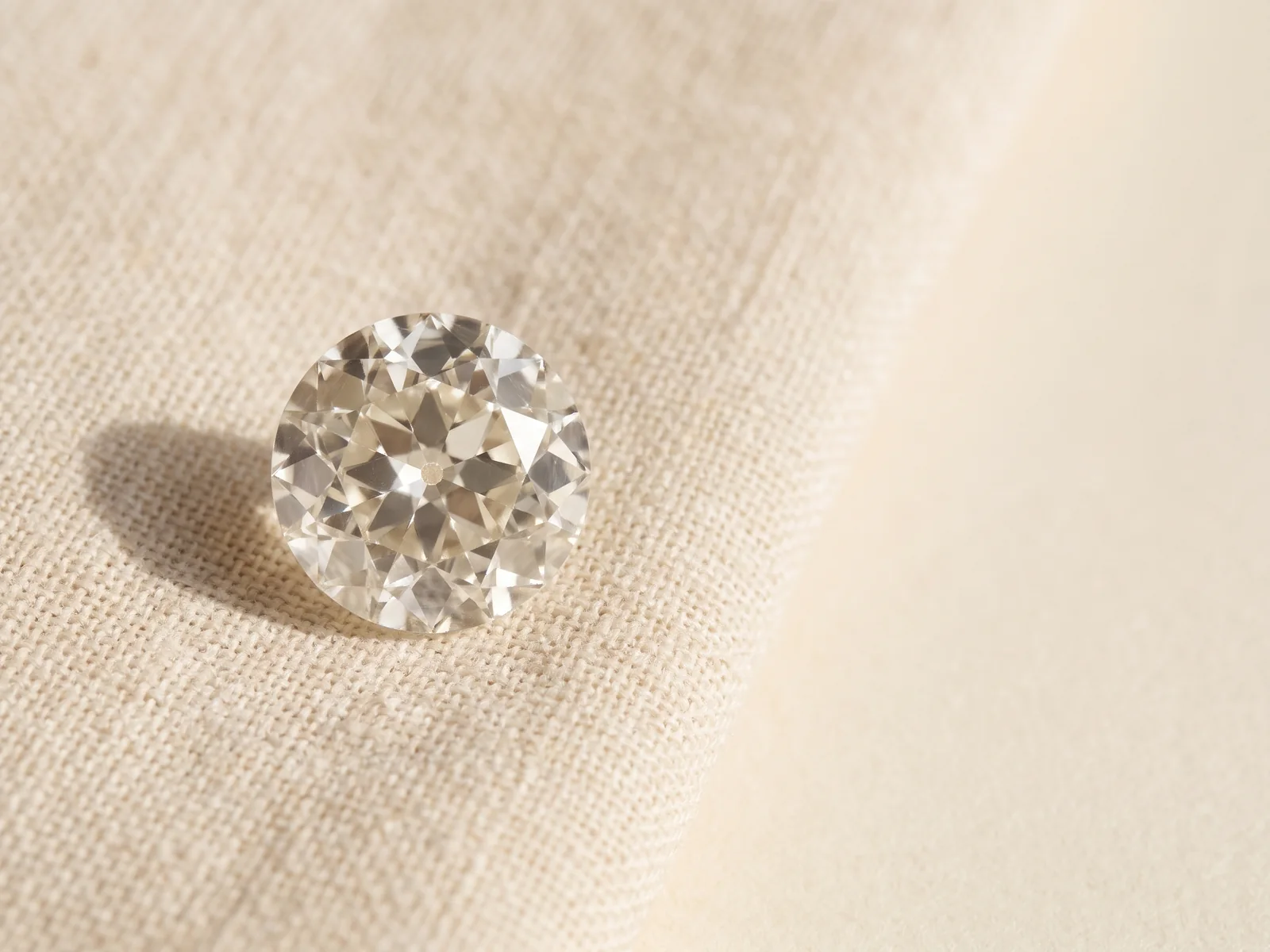
Many inherited diamonds were cut before the modern round brilliant became standard in the middle of the 20th century. Older cuts were shaped by hand and by eye, to keep as much weight as possible from the rough and to sparkle under candlelight and gaslight. They look different from modern stones: softer, with broader flashes of light rather than fine pinpoint sparkle.
| Cut | Roughly when | Key features |
|---|---|---|
| Rose cut | 1500s–early 1900s | Flat base, domed top of triangular facets, no pavilion |
| Old mine cut | 1700s–late 1800s | Squarish cushion outline, high crown, small table, large open culet |
| Old European cut | about 1870s–1930s | Round outline, high crown, small table, open culet, chunky flashes |
| Transitional cut | about 1930s–1950s | Round, flatter crown, larger table, smaller culet |
| Single cut | many eras, small stones | Only 17–18 facets; common as small accent stones |
| Modern round brilliant | mid-1900s onward | 57–58 facets, table about 53–60%, pointed or very small culet |
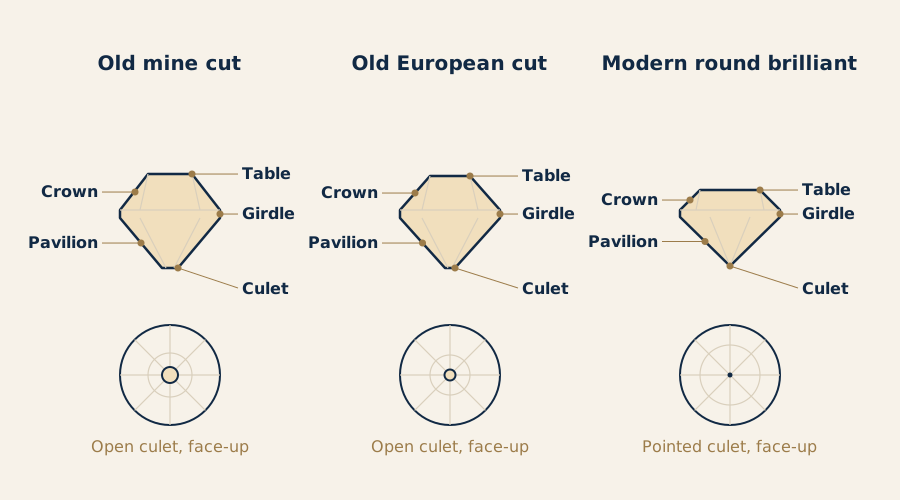
The quickest clue is the culet, the tiny facet at the base of the stone. Look straight down through the table: if you see a small circle or octagon in the centre, the stone has an open culet, which points to an old mine or Old European cut. Many of the stones in our story of famous diamonds and their histories were cut in these older styles, and the glossary of jewellery terms explains crown, table, girdle and pavilion if they are new to you.
Related guideOld-Stock and Antique DiamondsOld cuts are not a flaw. Many people now seek them out for their character, and they cannot be made again in quite the same way from old rough. Our page on antique and old-stock diamonds goes into how they are graded and why their colour often sits in the warmer J–M range.
What condition problems should you check before resetting a family diamond?
Diamond is the hardest natural material, 10 on the Mohs scale, but hardness is resistance to scratching, not to knocks. A diamond can still chip along its cleavage planes, natural lines of weakness in the crystal. After decades on a hand, old stones often show:
- Girdle chips: small nicks around the edge, often hidden under the old claws.
- Facet abrasion: fine wear on facet edges, which looks like whitish lines and dulls sparkle slightly.
- Surface-reaching feathers: small cracks that can grow if the stone is knocked or heated during repair.
- Worn culet or point damage: on pear, marquise and older cushion shapes.
- Ingrained dirt: decades of soap and skin oil under the stone can make it look greyer than it is until cleaned.
Every one of these should be noted before the stone is unset, so there is a record of its condition. It also matters for the jeweller: a diamond with a large feather is set with less pressure, and a fracture-filled stone must not be heated or put in an ultrasonic cleaner, because the filling can be damaged.
Not sure which one is right?
Send us the stones you are looking at and our gemologist will tell you which to choose and why.
Should you recut an old family diamond?
There are three choices: leave the stone as it is, repolish it (remove chips and abrasion with minimal loss) or recut it to modern proportions. Recutting an old diamond can increase brightness, but it always reduces weight, and it removes the antique character that many families value.
| Option | Typical weight loss | What changes | Suits |
|---|---|---|---|
| Leave as it is | None | Nothing; history kept | Sound stones, antique-style designs |
| Repolish chips or abrasion | Often a few points (0.01–0.05 ct) | Surface damage removed; cut style kept | Chipped or worn stones |
| Full recut to modern round | Often 10–25%, sometimes more | More modern sparkle; old cut lost | Badly damaged or very deep stones |
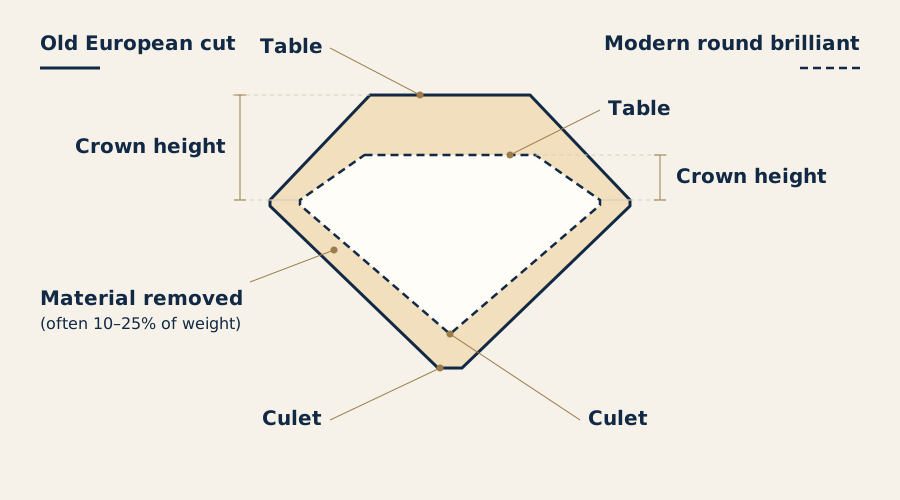
Weight loss matters because natural diamond prices jump at round numbers such as 0.50, 1.00 and 2.00 carat, and larger natural stones are much rarer, as our page on how rarity rises with carat weight shows. A 1.05 ct Old European cut recut to 0.90 ct may look brighter, but it is no longer a one-carat stone. Cutting also carries a small risk: a diamond with large internal feathers can break on the wheel, which a cutter assesses beforehand.
Costs vary with size and the work involved. As a broad guide, a minor repolish of a small chip may cost roughly AUD $150–$600, and a full recut of a one-carat stone roughly AUD $500–$2,000 or more. A cutter should give a written estimate of the finished weight before any work starts.
How do you reset a family diamond into a new ring?
A setting for an old stone is built around its measurements, not the other way round. Old mine and Old European cuts usually have taller crowns and deeper total depths than modern stones, and their girdles can be thick or uneven. That affects the design in several ways:
- Height: a deeper stone needs a taller head, or a setting designed so the culet does not touch the finger.
- Claw seats: each claw is cut to the stone's actual girdle, which may vary in thickness around the edge.
- Bezel settings: a thin rim of metal around the stone protects a worn or chipped girdle and suits the soft look of old cuts.
- Metal colour: old stones often sit in the J–M colour range, and yellow or rose gold can make that warmth look intentional, while platinum or white gold will show it more.
- Accent stones: small old single cut or rose cut diamonds from the same piece can be reused around the centre, or matched with new natural diamonds.
For a family diamond engagement ring, a CAD (computer-aided design) model lets you see the stone's exact proportions in the new ring before any metal is cast. That is particularly useful when reusing a grandmother's diamond, because the setting has to fit one specific stone.
Can the old gold from an inherited diamond ring be reused?
Often, yes, but with care. Old gold is rarely one clean alloy. A ring that has been resized or repaired several times contains solder, which is a slightly different alloy, and older white gold was often made with nickel, which some people react to. Melting mixed old pieces together gives a metal of uncertain carat (purity) and quality.
Jewellers usually handle this in one of two ways. The old metal can be refined back to pure gold and then made into a fresh alloy of known carat, such as 18ct (75% gold) or 9ct (37.5% gold), or it can be weighed and credited against new metal. Some families keep a small piece of the original band, for example inside a new ring or in a matching pendant, so a visible part of the old piece stays with the stone.
Platinum is handled in a similar way. Most platinum jewellery is stamped 950 (95% platinum), and older pieces may use different alloys, so the same refining question applies.
What is an inherited diamond worth, and do you need a valuation?
Valuing an inherited diamond depends on why you need the figure. An insurance valuation states replacement value: what it would cost to replace the piece new at retail. That number is usually much higher than what you would receive if you sold it. Estates and family law matters need a market value instead, which our guide to valuations for estates and family law explains.
| Valuation type | What it measures | When you need it |
|---|---|---|
| Insurance (replacement) | Cost to replace with a similar new item | After resetting, to insure the new piece |
| Market value | Price between a willing buyer and seller | Estates, probate, family law, dividing heirlooms |
| Resale or offer | What a trader would pay today | If you are thinking of selling instead |
A family diamond's worth to you is mostly sentimental, and it should not be thought of as a financial investment. Prices for natural diamonds have risen and fallen over the decades, as our article on how natural diamond prices have moved over the years sets out.
Origin is usually unknown for older stones. The Kimberley Process certification scheme only began in 2003, so stones bought earlier rarely have paperwork; see what the Kimberley Process does and does not cover. For Australian families, there is a real chance an older champagne, cognac or pink diamond came from the Argyle mine in Western Australia, which produced from 1983 until it closed in 2020. Proving it needs documents or an inscription; our page on Argyle and Australia's diamond history explains what to look for.
Diamonds from other regions turn up in family pieces too. Our overview of the world's main diamond-producing countries covers Africa, Russia and India, and Canadian diamonds and their origin tracking shows how newer mines began documenting where stones came from.
Reusing a family diamond vs buying new: how do they compare?
Some people reuse the family stone as it is, some add it to new diamonds, and some keep the heirloom intact and buy a new stone. Here is how the options differ.
| Family diamond (reset) | New natural diamond | New lab-grown diamond | |
|---|---|---|---|
| What it is | Natural diamond, usually | Natural diamond, mined | Real diamond grown in a laboratory |
| Main cost | New setting and any repolish | Stone plus setting | Stone plus setting, stone costs much less than natural |
| Cut style | Often old mine, Old European or transitional | Usually modern | Usually modern |
| Grading report | Often none; can be graded | Usually supplied | Usually supplied |
| Origin information | Rarely known | Varies by supplier and mine | Grown in a lab; grower may be stated |
| Family history | Yes | No | No |
Reusing the stone means your main cost is the setting. As a rough guide, a new 18ct gold solitaire setting made for an existing stone might cost about AUD $1,500–$5,000, depending on design, metal weight and accent stones. If you are buying new stones to sit beside a family diamond, our page on how responsible sourcing works for newly mined diamonds explains the questions to ask.
Browse natural diamonds
How to go about reusing a family diamond, step by step
- Gather the piece and its history. Bring the whole item, plus any old receipts, valuations or reports.
- Have the stone tested. Confirm it is diamond, whether it is natural or lab-grown, and whether it has been treated.
- Record its condition. Note chips, abrasion and feathers, and get the measurements in millimetres and an estimated or actual carat weight.
- Decide on the cut. Leave it, repolish it or recut it, with a written estimate of finished weight before any cutting.
- Design around the stone. Use the real measurements, ideally in a CAD model, and choose a metal colour that suits its colour grade.
- Decide about the old metal. Refine it into a known alloy, credit it against new metal or keep a piece as it is.
- Value and insure the finished piece. Get a new insurance valuation once the stone is reset.
Free consultation
Talk to a gemologist
Compare stones in person or online with Raj Sood, Graduate Gemologist (GIA), AJP (GIA).
Book a consultationShop this shape
FAQ
Common questions
Can I reset my grandmother's diamond into an engagement ring?
Yes. Once the stone is tested and checked for damage, a setting can be designed around its exact measurements. Old cuts often need a taller head or a bezel to suit their deeper proportions.
Will resetting damage an old diamond?
Unsetting and resetting is routine and rarely harms a sound diamond. The risk is higher for stones with large feathers or fracture filling, which is why condition is checked and recorded first.
How do I know if my inherited diamond is real?
A jeweller can confirm diamond with thermal and electrical testers and a loupe check for doubled facets. Telling natural from lab-grown diamond needs lab equipment such as spectroscopy and ultraviolet imaging.
Is it worth recutting an old European cut diamond?
Usually only if it is badly chipped or very poorly proportioned. A full recut often loses 10–25% of the weight and removes the antique character, while a light repolish keeps both.
Do I need a valuation before resetting a family diamond?
It helps to have the stone's condition and details recorded before work starts. After resetting, get an insurance valuation for the new piece; estates and family law matters need a separate market value.
Can old family diamonds be mixed with new ones?
Yes. Small old stones can be reused as accents, or new natural diamonds can be colour-matched to the old centre stone. Old cuts often sit in warmer colours, so matching is done by eye as well as by grade.

Ask a gemologist
Not sure which diamond to choose?
Raj Sood is a Graduate Gemologist (GIA) and master jeweller. Bring the stones you are considering, or send the reports, and he will tell you honestly which one is better and why.
Keep learning
Related guides
 Natural DiamondsOld-Stock and Antique Diamonds
 Certificates & ValuationsJewellery Valuations for Estates and Family LawNatural DiamondsNatural Diamonds Guide
 Natural DiamondsNatural Diamond Value Over TimeNatural DiamondsCanadian DiamondsNatural DiamondsWhat Makes a Diamond Special?
 Natural DiamondsConflict-Free Diamonds – Responsible Sourcing at GemTroveNatural DiamondsDiamond Types Ia, Ib, IIa and IIb
Explore more
More guides on this topic
Education