
Gemstones
Gemstone Clarity Types I, II and III: What Each Means for Your Stone
Gemstone clarity types explain why an included emerald can be a fine stone while the same inclusions in an aquamarine would be a fault. Knowing the type of your gem tells you what clarity is normal, what to accept and what to question.
 Reviewed by Raj Sood, Graduate Gemologist (GIA), AJP (GIA)Master jeweller and Graduate Gemologist (GIA) · reviewed 4 November 2026
Quick answer
Gemstone clarity types are GIA's three groups for coloured stones, based on how included each gem usually grows. Type I gems, such as aquamarine, topaz and tanzanite, are often eye-clean. Type II gems, such as sapphire, ruby, garnet and peridot, usually show small inclusions. Type III gems, such as emerald and pink tourmaline, are almost always visibly included.
What are gemstone clarity types?
Clarity describes the internal features (called inclusions) and surface marks (called blemishes) inside and on a gem. With diamonds, every stone is judged against one scale. Coloured gemstones are different: some species almost always grow clean, while others almost never do. To make fair comparisons, the Gemological Institute of America (GIA) sorts coloured gems into three clarity types, based on how included that species typically is when it comes out of the ground.
- Type I: gems that usually grow with few or no eye-visible inclusions. Buyers expect them to be eye-clean.
- Type II: gems that usually grow with some inclusions. Many fine stones are eye-clean, but inclusions under magnification are normal.
- Type III: gems that almost always grow with inclusions, often visible to the unaided eye. A clean stone is the rare exception.
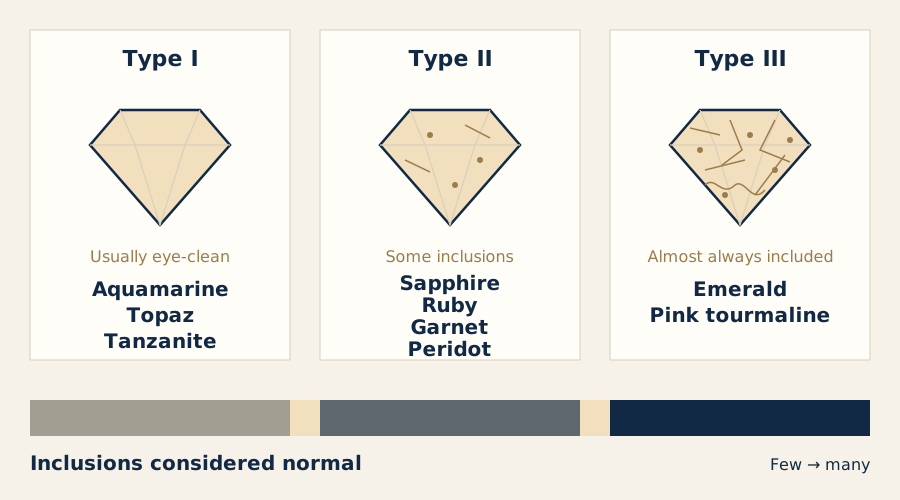
The type is a starting point, not a grade. It tells you what is normal for the species, so you can then judge whether a particular stone is better or worse than average. If you are new to coloured stones, our coloured gemstone guides introduce each species. If you already know diamonds, it helps to compare this system with the diamond clarity scale from FL to I3, and any unfamiliar word on this page is explained in our plain-English glossary of jewellery terms.
Why do some gemstones grow cleaner than others?
Clarity type comes down to geology. Every gem crystal grows from a hot fluid or melt deep underground, and anything trapped while it grows becomes an inclusion: tiny crystals of other minerals, droplets of liquid, gas bubbles, or cracks that heal over with fluid. How clean a species tends to be depends on where it forms and how steady the conditions are.
- Aquamarine and topaz often grow in pegmatites, coarse-grained rock pockets where crystals have space and time to grow large and clean. Crystals weighing many kilograms are known.
- Sapphire and ruby grow in metamorphic and volcanic settings rich in other elements. Titanium can separate out as fine needles of rutile, which gemmologists call silk.
- Emerald needs chromium or vanadium to turn beryl green, and those elements are usually found in rocks that are under strain. The crystals grow amid shifting pressure, so they fracture and trap fluids as they form.
Inclusions are not all bad. They are the fingerprints a gemmologist uses to tell a natural stone from a lab-created one, and sometimes to suggest a likely origin. Silk in sapphire softens and spreads light, and when it is dense and well aligned it produces the six-rayed star of a star sapphire, an effect called asterism.
Which gemstones are Type I, and what clarity should you expect?
Type I gems are the ones where a buyer can reasonably expect an eye-clean gemstone: no inclusions visible face-up at a normal viewing distance of about 25 cm. Because clean material is plentiful, an eye-visible inclusion in a Type I stone lowers its value noticeably, and you should not need to accept one in a ring centre stone.
| Type I gem | Mohs hardness | Refractive index | Typical inclusions |
|---|---|---|---|
| Aquamarine | 7.5–8 | 1.57–1.58 | Fine parallel liquid tubes ("rain"), fingerprints |
| Morganite | 7.5–8 | 1.58–1.59 | Liquid tubes, small fingerprints |
| Topaz (incl. blue topaz) | 8 | 1.61–1.63 | Liquid and gas cavities; cleavage cracks |
| Tanzanite | 6–7 | 1.69–1.70 | Few; occasional crystals or small fractures |
| Blue zircon | 6–7.5 | 1.92–1.98 | Rarely included; strong facet doubling |
| Citrine and smoky quartz | 7 | 1.54–1.55 | Few; occasional fingerprints |
| Chrysoberyl | 8.5 | 1.74–1.75 | Fine silk or fingerprints in some stones |
Two notes on durability. Topaz has perfect cleavage, meaning it can split cleanly along one direction if struck hard, so even a flawless topaz deserves a protective setting. Tanzanite is softer at about 6–7 on the Mohs scale, so it scratches and chips more easily than aquamarine; a clean tanzanite is normal, but it still suits earrings and pendants better than a daily-wear ring.
Which gemstones are Type II, and are their inclusions a problem?
Type II gems usually contain some inclusions, and a trained eye with a 10× loupe (a small hand magnifier) will normally find them. Many stones are still eye-clean, and small inclusions are accepted as part of the gem. This is a broad group and includes some of the most popular gems for engagement and dress rings.
| Type II gem | Mohs hardness | Refractive index | Characteristic inclusions |
|---|---|---|---|
| Sapphire | 9 | 1.76–1.77 | Rutile silk, fingerprints, small crystals, colour zoning |
| Ruby | 9 | 1.76–1.77 | Silk, fingerprints, crystals; glass filling in some treated stones |
| Spinel | 8 | 1.71–1.72 | Small octahedral crystals, often in rows |
| Garnet (most varieties) | 6.5–7.5 | 1.71–1.89 | Needles, crystals; "horsetail" fibres in demantoid |
| Peridot | 6.5–7 | 1.65–1.69 | Disc-shaped "lily pad" inclusions |
| Amethyst | 7 | 1.54–1.55 | Colour zoning, fingerprints, striped patterns |
| Alexandrite | 8.5 | 1.74–1.76 | Fingerprints, needles, crystals |
| Green tourmaline | 7–7.5 | 1.62–1.64 | Liquid-filled fractures, growth tubes |
With Type II stones, ask where the inclusion sits and what it is. Fine silk spread evenly through a sapphire is usually harmless and may even soften the colour pleasantly. A fingerprint (a healed fracture that looks like a fingerprint pattern) deep inside is generally stable. A crack that reaches the surface near the girdle (the outer edge) or a corner is a different matter, because that is where claws apply pressure and knocks land.
Heat treatment, routine for sapphire and ruby, can dissolve some silk and improve clarity and colour. It is stable and widely accepted, but it should still be disclosed. Lead-glass filled ruby is another story: glass is forced into heavy fractures, and the filling can be damaged by heat, jewellery cleaning acids or even lemon juice. These stones must be disclosed, and they are priced very differently from untreated or heated ruby.
Not sure which one is right?
Send us the stones you are looking at and our gemologist will tell you which to choose and why.
Why are emeralds Type III, and is emerald clarity a dealbreaker?
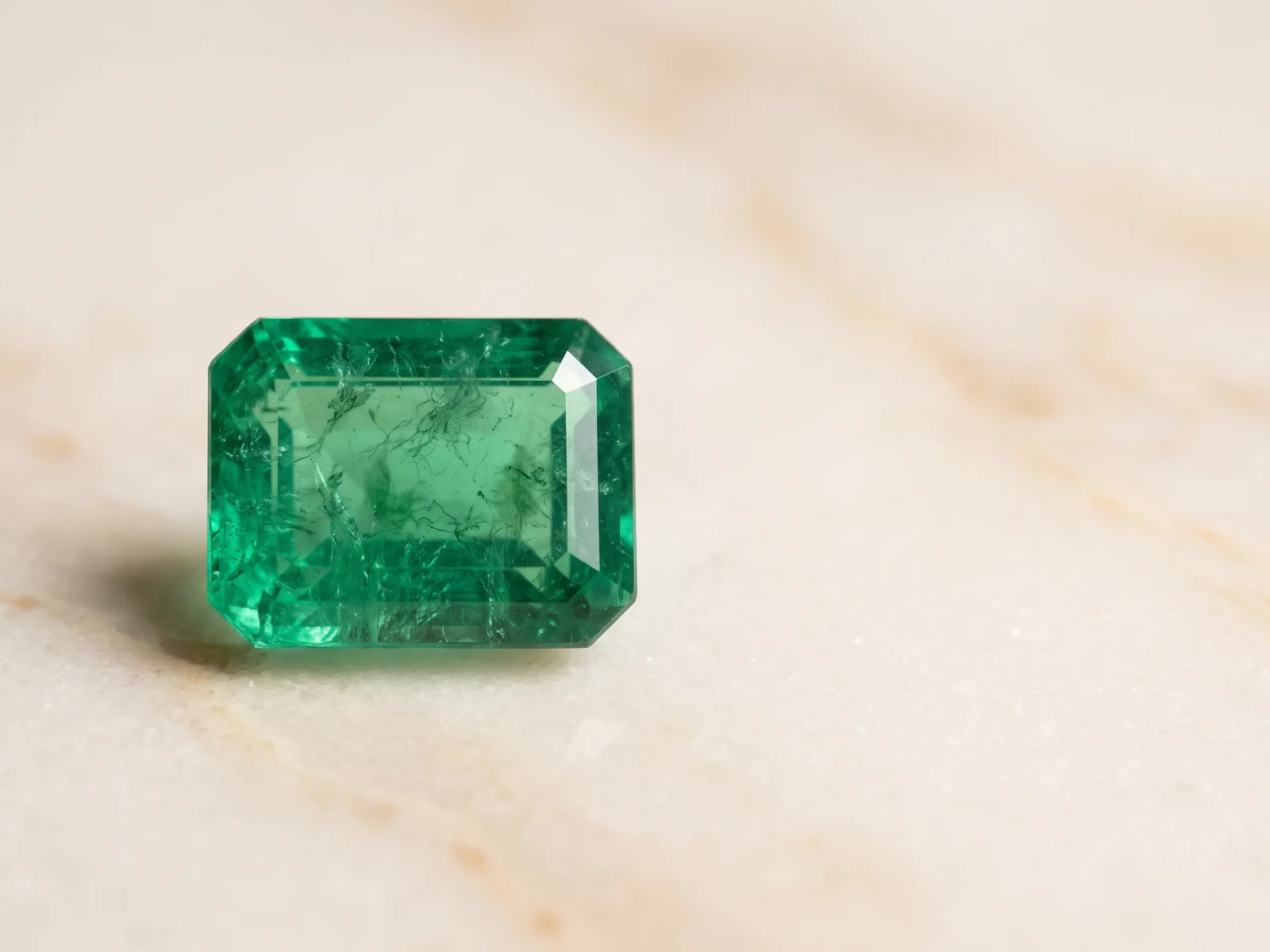
Emerald is the classic Type III gem. Nearly every natural emerald contains inclusions you can see with the unaided eye, often fractures, tiny crystals and fluid pockets. The trade calls this the jardin, French for garden, because under magnification it can look like moss or foliage. Colombian emeralds sometimes show three-phase inclusions: a cavity holding liquid, a gas bubble and a tiny salt crystal together.
Because inclusions are expected, emerald clarity is judged more generously than sapphire or aquamarine. Colour matters most. A rich green emerald with a visible but even jardin can be worth more than a paler, cleaner stone, and a truly eye-clean natural emerald of good colour is rare and priced accordingly. Other Type III gems include red and pink tourmaline (rubellite), watermelon tourmaline and red beryl.
Most emeralds are also fracture filled: oil (traditionally cedarwood oil) or a resin is soaked into surface-reaching fractures so they show less. This is a long-standing, accepted practice, but the degree should be disclosed, often as none, minor, moderate or significant on a laboratory report. Fillers can dry out or be pulled out by heat, steam or ultrasonic cleaning, which is why emeralds sometimes look more included after years of wear and may need re-oiling.
Related guideCleaning Gemstones by TypeHow is coloured gemstone clarity graded within each type?
GIA's coloured stone grading uses familiar-sounding grades (VVS, VS, SI1, SI2, I1, I2, I3), but the description behind each grade changes with the clarity type. A VS Type III emerald can show inclusions you would never accept in a VS aquamarine. Coloured stones are graded mainly face-up by eye, with the loupe used to describe what is seen.
| Grade | Type I (e.g. aquamarine) | Type II (e.g. sapphire) | Type III (e.g. emerald) |
|---|---|---|---|
| VVS | Minute inclusions, hard to see at 10×; eye-clean | Minute inclusions, fairly easy to see at 10×; eye-clean | Minor inclusions, easy to see at 10×; usually eye-clean |
| VS | Minor inclusions at 10×; usually eye-clean | Minor inclusions easy to see at 10×; may be just visible to the eye | Noticeable inclusions; often visible to the eye |
| SI1–SI2 | Noticeable at 10×; may be visible to the eye | Noticeable at 10×; visible to the eye | Prominent inclusions, clearly visible |
| I1–I3 | Inclusions affect appearance; at I3, durability | Inclusions affect appearance; at I3, durability | Inclusions affect appearance; at I3, durability |
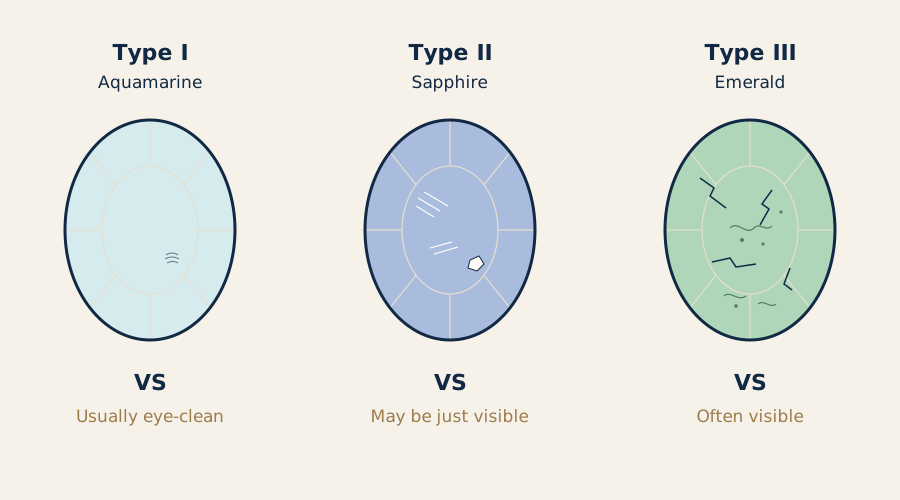
The letters echo the diamond scale, but the meaning does not carry across. A VVS1 diamond or a VVS2 diamond has inclusions so small that a skilled grader struggles to find them at 10×. Diamond grades such as VS1 clarity and the popular VS2 grade are defined by strict magnified visibility, while SI2 diamonds, which may or may not be eye-clean, and included I1 to I3 diamonds mark the point where inclusions become visible. Coloured stone clarity is looser and always read through the lens of the gem's type.
How does gemstone vs diamond clarity compare?
| Diamond | Coloured gemstone | |
|---|---|---|
| Scale | FL to I3, 11 grades | VVS to I3, interpreted by clarity type |
| How it is judged | Strictly at 10× magnification | Mainly face-up by eye; 10× used to describe |
| Same standard for all stones? | Yes | No: Type I, II and III have different expectations |
| On lab reports | Clarity grade standard | Often not graded; treatments and origin noted instead |
| What drives value most | Cut, colour, clarity and carat together | Colour first, then clarity relative to type |
| Laboratory-grown versions | Lab-grown diamonds graded on the same scale | Lab-created gems often cleaner than natural |
For diamonds, paying for top clarity is a choice; few people can see the difference between flawless and internally flawless diamonds and a good VS stone, which is why we discuss whether VVS clarity is worth the extra cost separately. For coloured stones, clarity is weighed against colour. An aquamarine with superb colour and one small visible inclusion may still appeal, but most buyers will prefer a clean Type I stone because clean material is readily available.
Laboratory-grown diamonds follow the diamond scale, and our page on typical clarity in lab-grown diamonds explains the patterns there. Coloured stones made in a laboratory are covered in the next section.
Do lab-created gemstones have inclusions?
Lab-created (synthetic) gemstones have the same chemistry and hardness as their natural counterparts: a lab-created sapphire is still corundum at 9 on the Mohs scale. Because they grow under controlled conditions, they are usually much cleaner than natural stones, and clarity type expectations do not really apply to them. An emerald that is almost perfectly clean is a reason to confirm whether it is natural or lab-created.
- Flame-fusion lab-created ruby and sapphire can show curved growth lines and round gas bubbles under magnification, quite unlike natural straight colour bands.
- Flux-grown lab-created gems can contain wispy flux residue that resembles a natural fingerprint.
- Hydrothermal lab-created emerald may show chevron-shaped growth patterns and fewer fractures than natural emerald.
Neither natural nor lab-created stones are fake; they are simply different in origin, rarity and price. Lab-created stones cost much less and offer high clarity, while natural stones carry the inclusions and rarity of something formed in the earth. A reputable seller should always state which you are looking at, and a laboratory report can confirm it.
Browse natural gemstones
Does clarity type affect cleaning, setting and everyday wear?
It does, because the inclusions common to each type change how a stone handles heat, vibration and knocks. Type I stones are generally easy to care for, though topaz's cleavage and tanzanite's softness still call for care. Type II stones vary: heated sapphire handles most cleaning, while glass-filled ruby does not. Type III stones, especially oiled emeralds, are the most sensitive.
- Ultrasonic and steam cleaners: avoid for emerald, glass-filled ruby, tanzanite and any stone with surface-reaching fractures. See how to clean each gemstone safely.
- Rings: choose protective claws or a bezel for Type III stones and for any stone with an inclusion near the edge.
- Earrings and pendants: lower risk of knocks, so they suit softer or more included stones; pair them with secure earring backs and chain styles suited to pendants.
- Men's pieces: signet rings and cufflinks and other men's jewellery take knocks, so tougher Type I and II gems are the practical choice.
How to use gemstone clarity types when you choose a stone: step by step
- Confirm what the stone is. Check the species and whether it is natural or lab-created on the report or listing.
- Find its clarity type. Type I, II or III sets your expectation of what is normal.
- Look face-up by eye. View the stone at about 25 cm in daylight-type light; for Type I, expect eye-clean.
- Locate the inclusions. Use a 10× loupe or a magnified video, and note whether anything reaches the surface near the girdle or a corner.
- Ask about treatments. Heat, oil, resin and glass filling all affect clarity, care and value, and should be disclosed.
- Weigh colour against clarity. For Type II and III gems, a stone with better colour and a small inclusion may be preferable to a paler clean one.
- Match the stone to the piece. Put more included or softer gems in earrings or pendants, or choose a protective ring setting.
Once you know the type, comparing stones becomes much simpler: you compare each gem with others of its own species, not with a diamond. Our natural gemstone overview covers each species in more depth.
Free consultation
Talk to a gemologist
Compare stones in person or online with Raj Sood, Graduate Gemologist (GIA), AJP (GIA).
Book a consultationShop this shape
FAQ
Common questions
What are the three gemstone clarity types?
Type I gems usually grow eye-clean, Type II gems usually show some inclusions, and Type III gems are almost always visibly included. The system comes from GIA and helps set fair expectations for each species.
Is emerald a Type III gemstone?
Yes. Natural emeralds almost always contain visible inclusions, known as the jardin, so clarity is judged generously and colour matters most. Most are also fracture filled with oil or resin, which should be disclosed.
Is sapphire Type I or Type II?
Sapphire and ruby are Type II. Fine stones are often eye-clean, but silk, fingerprints or small crystals under magnification are normal.
Should an aquamarine be eye-clean?
Generally yes. Aquamarine is a Type I gem and clean material is widely available, so an eye-visible inclusion is usually a fault that lowers value.
Do gemstone clarity grades mean the same as diamond grades?
No. The letters look similar, but coloured stone grades are judged mainly by eye and interpreted by clarity type, while diamond grades follow a strict standard at 10× magnification.
Why is my lab-created gemstone so clean?
Lab-created gems grow in controlled conditions, so they usually have far fewer inclusions than natural stones. Tiny growth lines or gas bubbles under magnification can help a gemmologist identify them.

Ask a gemologist
Not sure which diamond to choose?
Raj Sood is a Graduate Gemologist (GIA) and master jeweller. Bring the stones you are considering, or send the reports, and he will tell you honestly which one is better and why.
Keep learning
Related guides
 Diamond 4Cs & GradingUnderstanding Diamond Clarity Grades: FL to I3 Explained
 Care, Repairs & RemodellingCleaning Gemstones by TypeGemstonesGemstones | Coloured Gemstones, Birthstones and Custom Jewellery
 Diamond 4Cs & GradingI1 to I3 Clarity Diamonds
 Diamond 4Cs & GradingVS2 Clarity Diamonds
 Diamond 4Cs & GradingVS1 Clarity DiamondsDiamond 4Cs & GradingVVS2 Clarity DiamondsDiamond 4Cs & GradingVVS1 Clarity Diamonds
Explore more
More guides on this topic
Education