
- Education
- Lab-Grown Diamonds
- Buying a Lab-Grown Diamond Online vs in a Showroom: An Australian Guide
Lab-Grown Diamonds
Buying a Lab-Grown Diamond Online vs in a Showroom: An Australian Guide
Lab-grown diamonds are sold everywhere now, from websites to suburban showrooms. Here is a straight comparison of buying a lab-grown diamond online vs in a showroom, from a Melbourne jeweller that sells both natural and lab-grown stones.
 Reviewed by Raj Sood, Graduate Gemologist (GIA), AJP (GIA)Master jeweller and Graduate Gemologist (GIA) · reviewed 4 November 2026
Quick answer
Buying a lab-grown diamond online gives you the widest choice and easy price comparison; a showroom lets you see sparkle, colour and size in real light before you pay. Either way, insist on an IGI or GIA report you can verify, a 360° video or in-person look, clear return terms and written disclosure that the stone is laboratory-grown.
What changes when you buy a lab-grown diamond online vs in a showroom?
A lab-grown diamond is real diamond: carbon crystallised in the same cubic structure as a mined stone, with the same hardness (10 on the Mohs scale) and the same refractive index (about 2.42, which is what bends light into sparkle). The main difference is where and how it formed. If that is new to you, read why lab-grown diamonds are real diamond first, or start with our complete guide to lab-grown diamonds.
Because lab-grown stones are produced in large numbers and graded to the same scales, they suit online selling well. Thousands of very similar stones sit in wholesale databases, each with a report number, measurements and often a video. That is the core difference between the two ways of buying: online you choose from data and images; in a showroom you choose with your own eyes, usually from a smaller selection.
It is also worth knowing that many 'online' stones and 'showroom' stones come from the same supplier lists. A jeweller with a showroom can often call in a stone you first saw on a website, and plenty of online sellers have a viewing room. So the useful question is less 'where?' and more 'how much can I check before the money leaves my account?'
- Choice: online lists can run to tens of thousands of stones; a showroom might hold dozens.
- Seeing: a screen shows magnified video in controlled lighting; a showroom shows the stone at real size, in your hand.
- Price: online sellers often have lower overheads, but the gap is not automatic once setting, service and returns are counted.
- Advice: a showroom gives you a person to question face to face; online advice is by chat, phone or video call.
- Returns and rights: the law is the same for Australian sellers either way, but change-of-mind returns are a store policy, not a legal right.
What are the pros and cons of buying a lab-grown diamond online?
The strengths of buying a lab-grown diamond online are real. You can filter by shape, carat, colour, clarity, cut and price in seconds, compare stones side by side on paper, and take your time without anyone watching. For a buyer who already understands the 4Cs, that is efficient. If you have not settled on a shape yet, our overview of the main diamond shapes helps you narrow the filters before you start scrolling.
- Wide choice: easy to find unusual sizes, fancy shapes or a specific ratio.
- Transparent data: report numbers and measurements are usually listed up front.
- Price comparison: you can see what similar stones cost across several sellers.
- No pressure: you browse at midnight in your pyjamas if you like.
The weaknesses come from not seeing the stone. Two diamonds with identical reports can look different: one may have a faint brownish or greyish tint, a bow-tie (a dark band across the middle of fancy shapes), or a cloud of tiny inclusions that makes it look slightly hazy. These differences partly trace back to growth. Stones grown by CVD (chemical vapour deposition, built up layer by layer from carbon-rich gas) and HPHT (high pressure, high temperature, grown in a press) can show different tints and internal patterns; our page on how CVD and HPHT diamonds are grown explains why.
- Images can mislead: videos are magnified and lit for effect, so inclusions can look larger and tints can disappear.
- Stock may be virtual: the seller may not hold the stone, so delivery takes longer and the listing can vanish.
- Returns cost time: insured shipping, inspection and refund processing can take weeks.
- Setting is guesswork: it is hard to judge how a 1 ct stone looks on your hand from a screen.
What does a showroom tell you that a screen can't?
In a showroom you see the stone at its true size, which matters more than most people expect. A 1 ct round is about 6.4 mm across; on a screen it fills the frame, and in person some buyers find it smaller, others larger, than they imagined. Shape changes that impression too, as our comparison of shapes that face up largest for their weight shows. You can also put two or three stones side by side on a white grading tray, which is the quickest way to see differences in brightness and colour that a report cannot describe.
You can look through a loupe (a 10× magnifier, the standard for clarity grading) and then put it down and look with your naked eye at normal distance, which is how the ring will actually be seen. Ask to see the stone under daylight-style light and under ordinary room light, not only under bright spotlights, which flatter every diamond. Seeing stones in hand also makes judging cut quality in a lab-grown stone and how lab-grown colour grades work far more concrete.
Showrooms have downsides too. The selection on hand is smaller, lighting can be chosen to impress, opening hours are limited and some people feel pressure to decide on the day. A good showroom should be happy for you to leave, think and come back, and should give you the report number to check at home.
Is a lab-grown diamond cheaper online vs in a showroom?
Often a little, but not always, and the headline price is only part of the cost. Lab-grown prices have fallen a long way in recent years and still move month to month, so treat these as broad, approximate ranges for loose round stones with an excellent cut grade, G–H colour and VS clarity.
| Round lab-grown, G–H, VS | Online-only sellers (approx. AUD) | Showroom jewellers (approx. AUD) |
|---|---|---|
| 0.50 ct (about 5.1 mm) | about $300–$900 | about $400–$1,200 |
| 1.00 ct (about 6.4 mm) | about $700–$2,000 | about $1,000–$3,000 |
| 1.50 ct (about 7.3 mm) | about $1,000–$3,000 | about $1,500–$4,000 |
| 2.00 ct (about 8.1 mm) | about $1,500–$4,500 | about $2,000–$6,000 |
The ranges overlap because the stone itself matters more than the channel. Cut quality, exact colour and clarity, whether the stone is as-grown or treated after growth, and the grading lab all move the price, and so does shape: our page on how price per carat varies by shape sets out the pattern. A natural diamond of the same grades still typically costs several times more; see lab-grown and natural diamonds compared for that side of the decision.
When comparing quotes, add up what each price includes:
- Setting and labour: is the stone loose, or set in a finished ring?
- Resizing: free, charged, or impossible for some band designs.
- Servicing: claw checks, cleaning and re-polishing over the years.
- Valuation: an insurance valuation document, if you need one.
- Delivery and returns: insured shipping, and who pays it if you send the stone back.
- Import costs: GST and possible duty or fees on stones shipped from overseas (see below).
Not sure which one is right?
Send us the stones you are looking at and our gemologist will tell you which to choose and why.
How do you read a lab-grown diamond grading report?
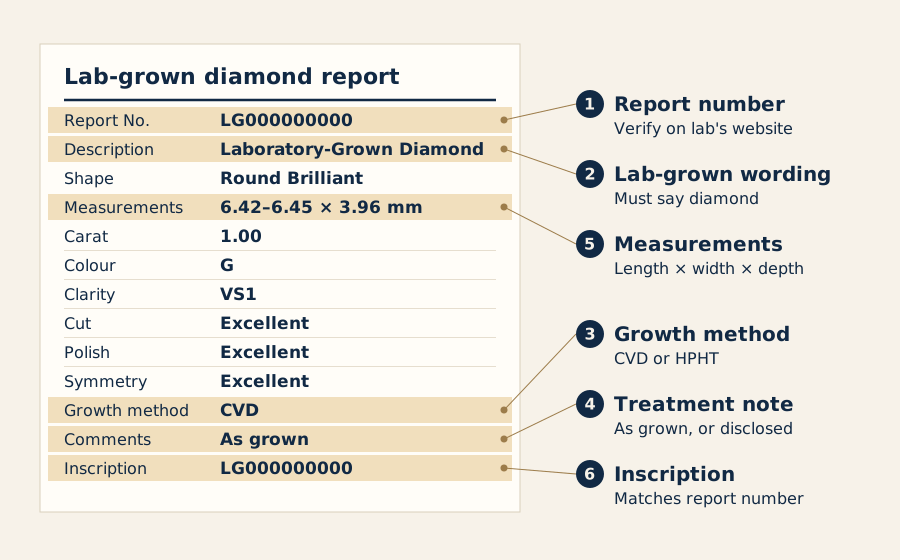
The grading report is the single most important document whether you buy online or in person. Most lab-grown diamonds sold in Australia are graded by IGI (International Gemological Institute), and some by GIA (Gemological Institute of America). Every report has a number you can type into the lab's own website; the result should match the listing exactly. If it does not, or the seller will not give you the number, walk away.
| Report field | What it tells you | What to check |
|---|---|---|
| Report number | Unique ID for this stone | Verify it on the lab's website; match it to the laser inscription |
| Description | Should say laboratory-grown diamond | No vague wording such as 'created stone' without the word diamond |
| Growth method | CVD or HPHT | Useful context for possible tints and inclusions |
| Post-growth treatment | 'As grown', or a note that treatment was used | Treatment is common and not a fault, but it must be disclosed |
| Measurements | Length × width × depth in mm | Face-up size; for fancy shapes, work out the ratio |
| Colour and clarity | Grades such as G, VS1 | Compare with the listing and the video |
| Cut, polish, symmetry | Excellent, Very Good and so on | Cut grade is given for rounds; judge fancy shapes by proportions |
| Inscription | Text laser-engraved on the girdle | Should include the report number and a lab-grown mark |
Many CVD stones are treated after growth (often with HPHT) to remove a brownish tint, and some HPHT stones show a faint blue or grey tone. Neither makes the stone fake; they simply affect how it looks, which is why colour tints in CVD and HPHT stones are worth understanding before you rely on a letter grade. If the growth terms are unfamiliar, our explainer on what CVD and HPHT growth means covers them in plain language.
GIA has announced changes to how it describes lab-grown diamonds, moving away from the traditional D–Z colour and clarity letters towards broader descriptive categories. If you are comparing a GIA report with an IGI report, read what each one actually states rather than assuming the grades line up.
What are your rights under Australian Consumer Law?
When you buy from an Australian business, the Australian Consumer Law (ACL) applies in the same way online and in a showroom. Its consumer guarantees mean the jewellery must be of acceptable quality, fit for its purpose and match its description. If a stone described as G colour, VS1 on a matching report turns out to be something else, that is a failure to match the description, and you are entitled to a remedy. For a major failure, you can choose a refund or replacement.
The ACL also bans misleading or deceptive conduct. A seller must not mislead you about whether a diamond is natural or lab-grown, about treatments, or about the grades. Clear disclosure of 'lab-grown' or 'laboratory-grown' on the listing, the invoice and the report is what you should expect.
What the ACL does not give you is a right to return something because you changed your mind. Change-of-mind returns, including the popular 30-day return windows offered online, are store policies. Read them before you pay: how many days, whether a resized or engraved ring can be returned, who pays the insured postage, and whether the refund is cash or store credit.
Buying from an overseas website adds risk. Getting a remedy from a business in another country is much harder in practice, returns need insured international shipping, and the price can change with the exchange rate. Imports also attract GST: for goods valued at AUD 1,000 or less the overseas seller is meant to collect 10% GST at checkout, and above that the parcel is processed at the border, where import GST and possibly duty and fees apply. Our list of questions worth asking any jeweller includes the ones that matter most for returns and disclosure.
How do you judge a lab-grown diamond from a video, and check it on arrival?
A 360° video is the closest thing to holding the stone, but it needs reading carefully. Most are filmed magnified, under bright, even lighting, on a turntable. That makes small inclusions look larger than they will to your eye, and it can hide a faint tint.
- Watch the middle: look for a dark area that stays put as the stone turns. A flickering pattern of light and dark is normal; a fixed dark patch is not.
- Look at the edges: a hazy or milky look across the whole stone can mean tiny clouds that a report grades lightly.
- Check colour from the side: if the video shows the profile, tint is easier to see there than face-up.
- Ask for a real-size view: a photo beside a ruler or coin, or a video at lower magnification.
- Ask who filmed it: a seller's own video of a stone in hand is more useful than a stock supplier clip.
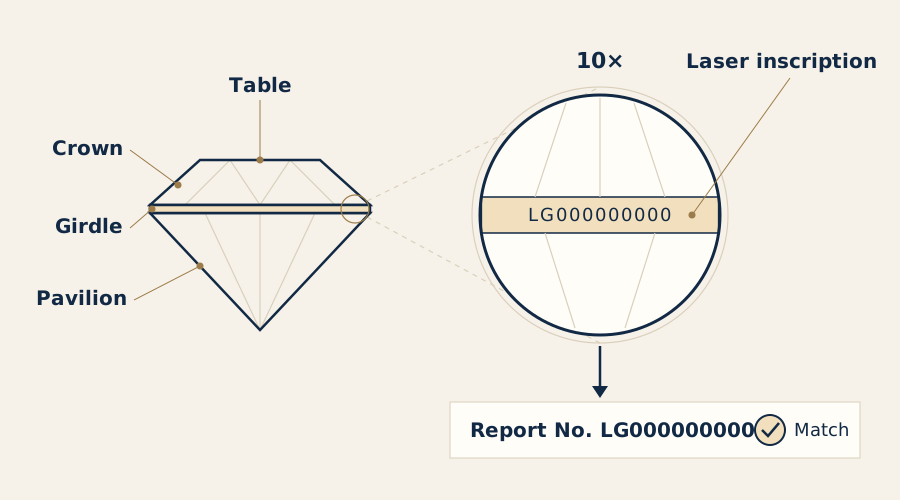
When the stone arrives, or when you collect it from a showroom, check it is the same stone. Under a loupe you can usually read the laser inscription on the girdle (the thin outer edge), and it should match the report number. A jeweller can also test that it is diamond and not a simulant (a different material that only imitates diamond). Cubic zirconia (Mohs 8–8.5, refractive index about 2.15) and moissanite (Mohs 9.25, about 2.65) are the usual suspects; our page on how a lab-grown diamond differs from cubic zirconia explains the differences. For fancy shapes, compare the measured ratio with what you expected, using our notes on cut grades for lab-grown rounds and fancy shapes.
Online or showroom: which suits you?
| Factor | Buying online | Buying in a showroom |
|---|---|---|
| Choice | Very wide, including rare sizes and shapes | Smaller, but stones can often be called in |
| Seeing the stone | Magnified video and photos | Real size, real light, side by side |
| Price | Often lower on the stone itself | Can be higher, often includes more service |
| Advice | Chat, phone or video call | Face to face, with a loupe in hand |
| Speed | A few days to a few weeks | Same day for stock; longer for called-in stones |
| Returns | Store policy, often 14–30 days, shipping needed | Store policy; easier to inspect before paying |
| Legal rights (Australian seller) | ACL consumer guarantees apply | ACL consumer guarantees apply |
| Main risk | Stone looks different from the video | Choosing under flattering light or pressure |
Online tends to suit buyers who know what they want, are comfortable reading reports and are buying a loose stone or a simple design. A showroom suits buyers who want to see size on the hand, compare a few stones in person, or have a ring made. Many people do both: research online, then view a shortlist in person. The same pattern applies to the whole ring, which we cover in buying a whole engagement ring online or in store.
Related guideBuying an Engagement Ring Online vs In-StoreThe setting is where in-person help usually earns its keep. Claw height, band width, how the ring sits against a wedding band and how secure the stone is all depend on workmanship you cannot see in a product photo. If you are having a ring made around your lab-grown stone, these are the facts about how GemTrove does it:
How do you buy a lab-grown diamond safely? Step by step
- Learn the basics. Read up on the 4Cs and lab-grown diamond basics so the report makes sense.
- Set a budget for the whole piece. Stone, setting, resizing and any import costs, in AUD.
- Shortlist by report. Choose shape, size range and grades; prefer IGI or GIA reports that state the growth method and any treatment.
- Verify every report number on the lab's website and check it matches the listing.
- Look properly. View in a showroom or ask for a 360° video plus a daylight, real-size view.
- Ask your questions in writing. Use a printable list of questions for the seller covering returns, resizing and servicing.
- Read the return policy before you pay, including who pays insured postage and what voids a return.
- Pay in a traceable way and keep the invoice, which should name the stone as laboratory-grown and quote the report number.
- Check on arrival. Match the girdle inscription to the report and have the stone tested if you have any doubt.
- Insure it. Get a valuation and add the piece to your insurance. Any unfamiliar word is in our jewellery glossary.
Browse lab-grown diamonds
If you are still weighing up lab-grown against mined, our page on the price gap between lab-grown and natural stones sets out the differences in cost, rarity and resale without the sales talk.
Free consultation
Talk to a gemologist
Compare stones in person or online with Raj Sood, Graduate Gemologist (GIA), AJP (GIA).
Book a consultationShop this shape
FAQ
Common questions
Is it safe to buy a lab-grown diamond online in Australia?
It can be, if the stone has an IGI or GIA report you can verify, the seller is an Australian business you can contact, and the return policy is clear in writing. Australian Consumer Law guarantees apply to online purchases from Australian sellers.
Are lab-grown diamonds cheaper online than in a showroom?
Often a little on the stone itself, but not always. Compare the total, including setting, resizing, servicing, insured shipping and any import GST, rather than the headline price.
Can I return a lab-grown diamond if I change my mind?
Only if the seller's policy allows it; change-of-mind returns are not a legal right in Australia. Resized, engraved or custom-made pieces are often excluded, so check before you pay.
How do I know a lab-grown diamond matches its report?
Look at the girdle under a 10× loupe: most graded lab-grown diamonds carry a laser inscription with the report number. Enter that number on the lab's website and check the measurements and grades match.
Do I pay GST on a lab-grown diamond bought from overseas?
Yes. On goods valued at AUD 1,000 or less the overseas seller should collect 10% GST at checkout; above that, import GST and possibly duty and fees are charged when the parcel enters Australia.
Should a lab-grown diamond come with a grading report?
For anything around half a carat or more, yes. An independent report from a lab such as IGI or GIA states that the stone is laboratory-grown, its grades, measurements and growth method, and gives you something to check the stone against.

Ask a gemologist
Not sure which diamond to choose?
Raj Sood is a Graduate Gemologist (GIA) and master jeweller. Bring the stones you are considering, or send the reports, and he will tell you honestly which one is better and why.
Keep learning
Related guides
 Lab-Grown DiamondsQuestions to Ask a Jeweller Before Buying a Lab-Grown Diamond
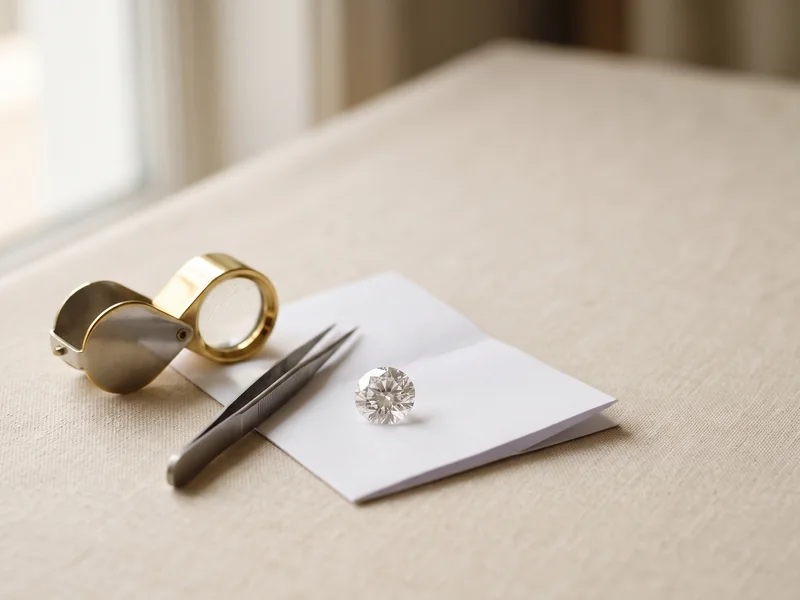 Buying Knowledge & Custom ProcessBuying an Engagement Ring Online vs In-Store
 Lab-Grown DiamondsLab-Grown Diamond Cut Quality
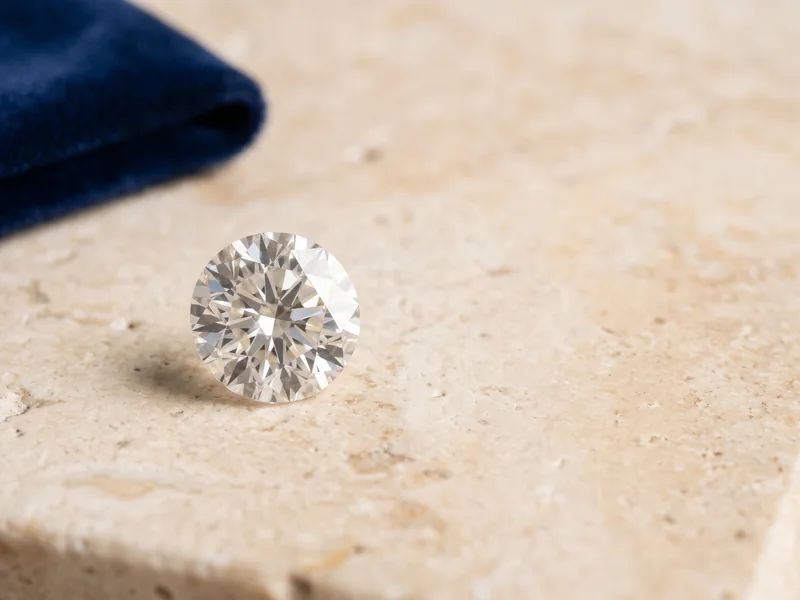 Lab-Grown DiamondsAre Lab-Grown Diamonds Real Diamonds
 Lab-Grown DiamondsHow Are Lab-Grown Diamonds Manufactured?Lab-Grown DiamondsLab-Grown Diamond Colour Grades
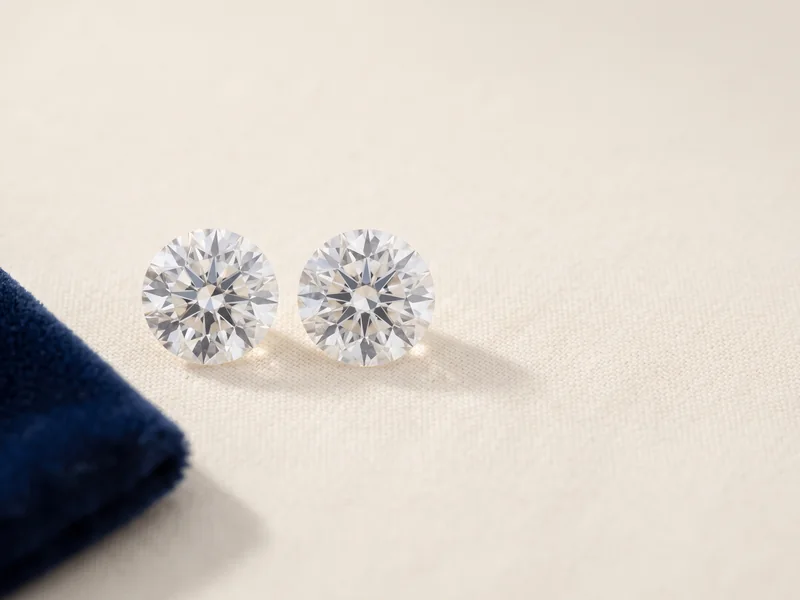 Lab-Grown DiamondsLab-Grown Diamonds vs Natural Diamonds
Explore more
More guides on this topic
Education