
- Education
- Buying Knowledge & Custom Process
- Buying an Engagement Ring Online vs In-Store in Australia
Buying Knowledge & Custom Process
Buying an Engagement Ring Online vs In-Store in Australia
Whether you buy an engagement ring online or in a showroom changes more than the experience. It changes your returns, your tax, your insurance and how well you can judge the stone. Here is how each option works under Australian rules.
 Reviewed by Raj Sood, Graduate Gemologist (GIA), AJP (GIA)Master jeweller and Graduate Gemologist (GIA) · reviewed 4 November 2026
Quick answer
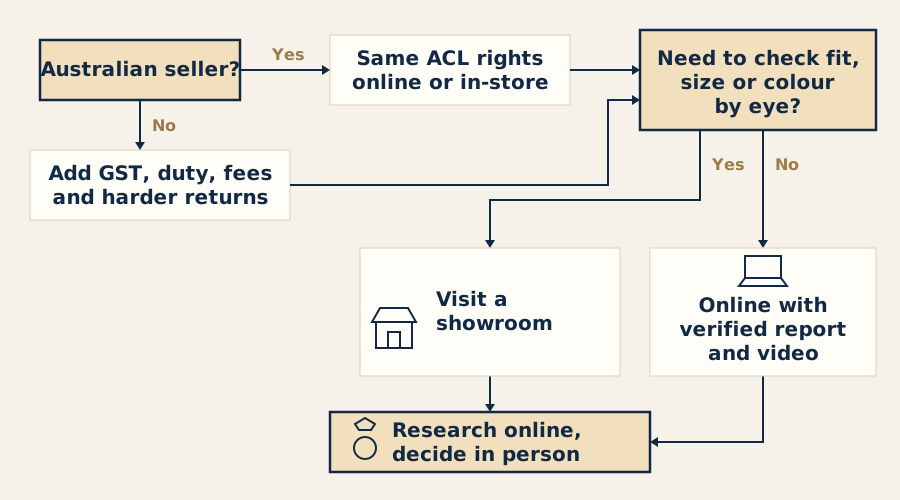
Buying an engagement ring online gives you wider choice and easy price comparison. Buying in-store lets you see the diamond, check the fit and ask questions. From an Australian business, both carry the same Australian Consumer Law rights. Overseas sites add GST, possible duty and harder returns, so many people research online and decide in person.
Should you buy an engagement ring online or in-store?
There is no single right answer. The choice comes down to three things: what you need to see with your own eyes, how confident you are reading a grading report, and who you are buying from. A diamond on a screen and a diamond in your hand are the same diamond. What changes is how much you can check before you pay, and what happens if something goes wrong afterwards.
If you are starting from scratch, our complete engagement ring buying guide takes you through the decisions in order. It also pays to read up on setting a realistic engagement ring budget before you look at a single stone, because a budget makes both online filters and showroom conversations far easier.
| Online | In-store | |
|---|---|---|
| Range | Thousands of loose diamonds and settings in one place | Limited to what the store holds, plus what it can call in |
| Seeing the stone | Photos, 360° videos and the grading report | Under real light, beside other stones, on your hand |
| Ring size and fit | You supply a size; fit is checked after delivery | Sized and tried on before you commit |
| Price comparison | Easy to compare similar stones side by side | Harder, unless you bring your research with you |
| Legal rights (Australian seller) | Australian Consumer Law applies in full | Australian Consumer Law applies in full |
| Change of mind | Only if the seller's policy allows it | Only if the seller's policy allows it |
| Delivery risk | Courier transit, signature and insurance to check | None; you walk out with it |
| After-sales | Resizing and repairs may mean posting the ring | Resizing, cleaning and repairs handed over the counter |
Notice that the legal protection row is identical. The bigger divide is not online versus in-store; it is Australian business versus overseas business, which affects GST, returns and how easy it is to enforce your rights. Any unfamiliar words in this guide, such as girdle, claw or grading report, are explained in our plain-English jewellery glossary.
What are the advantages of buying an engagement ring online?
Online shopping suits people who like to research and compare. The main advantages are real ones:
- Range: online inventories list far more loose diamonds than any single store can keep in a safe, across every shape, colour and clarity grade.
- Transparent comparison: you can line up ten 1 carat ovals by price, colour, clarity and measurements in a few minutes.
- Detail: a good listing shows the grading report, the millimetre measurements and a 360° video, which is more information than a quick look across a counter.
- Time and privacy: you can browse at midnight and keep a surprise proposal a secret.
- Lab-grown choice: laboratory-grown diamonds are widely listed online, often in larger sizes than a store holds in stock.
The weaknesses are just as real. Photos are taken under bright studio light and often edited, screens shift colour, and you cannot feel how high a setting sits or how a band feels against the next finger. Returning an item means insured postage both ways. Lab-grown diamonds raise a few extra questions of their own, which we cover in the lab-grown version of the online vs showroom question.
The biggest risk online is not fraud but overload: too many filters and too many near-identical stones. Our guide to building a shortlist without drowning in filters shows how to narrow thousands of listings to three or four you can genuinely compare.
What can you only judge when you see a ring in person?
Some things a screen simply cannot tell you. In a showroom you can check:
- Fit and comfort: how the band feels, whether the setting catches on clothing and whether the ring sits straight.
- Scale on the hand: a 7 mm stone can look large on a size J finger and modest on a size R. Finger width changes everything.
- Setting height: a tall cathedral setting shows more of the stone but knocks more often; low settings are practical but sit closer to the finger.
- Colour in real light: how an H colour looks in daylight next to a G, and how yellow or rose gold warms a stone.
- Sparkle pattern: how the stone behaves as your hand moves, which a looped video only partly shows.
Ring size matters more than people expect. Australia uses letter sizes (like the UK), not the numbers used in the US, so a size bought from an American site needs converting. Our guide to Australian letter ring sizes explains how to measure properly. Resizing a plain solitaire is usually simple, but eternity bands, tension settings and some pavé designs can only be resized a little, or not at all.
If you are proposing as a surprise and cannot get a size, two common approaches are buying a loose diamond first and setting it later, or using a stand-in proposal ring until you can design the real thing together. Plenty of couples now skip the surprise entirely; see our thoughts on choosing the ring as a couple.
What are your rights when you buy an engagement ring online in Australia?
The Australian Consumer Law (ACL) is the national law that protects consumers. It gives you automatic rights called consumer guarantees whenever you buy from an Australian business, whether you click a button or hand over a card in a shop. Goods must be of acceptable quality, match their description, and be fit for any purpose you made known. For a ring, that means the stone must match its grading report, the metal must be what was stated, and claws should not fail under normal wear.
A business cannot sign these rights away. A sign saying no refunds does not cancel them. What the ACL does not give you is a right to change your mind. There is no automatic cooling-off period for online shopping in Australia. Any change-of-mind return is a voluntary store policy, so read it before you buy.
| Situation | What you are generally entitled to |
|---|---|
| Major failure (stone not as described, metal not as stated, serious defect) | Your choice of refund or replacement |
| Minor failure (a loose claw, a small finishing fault) | The business can choose to repair, replace or refund within a reasonable time |
| Change of mind on a ready-made ring | Only what the store's own returns policy offers |
| Wrong size that you supplied | Not a fault; resizing is usually at your cost or under store policy |
| Custom-made ring built to your design | Change-of-mind returns are rarely offered; faults are still covered |
| Damage from an accident or wear | Not covered by the ACL; this is what insurance is for |
Before you pay, ask for the returns policy, the warranty terms and what is excluded, in writing. For lab-grown stones, also ask about any buy-back or upgrade policy; these are voluntary and vary a lot. Our lists of questions worth asking any jeweller about a lab-grown stone and what lab-grown diamonds are worth on resale help you get clear answers.
Pay with a credit card where you can. If a seller fails to deliver or the goods are not as described, your bank's chargeback process (a disputed card payment) is an extra layer of protection that bank transfers and cryptocurrency do not offer.
Not sure which one is right?
Send us the stones you are looking at and our gemologist will tell you which to choose and why.
Is it cheaper to buy an engagement ring from an overseas website?
The headline price on an overseas site is rarely the price you end up paying. Australia charges 10% GST on most imported goods, and the way it is collected depends on the value.
| Cost | Order up to A$1,000 | Order over A$1,000 |
|---|---|---|
| GST | 10%, charged at checkout by sellers registered for Australian GST | 10%, collected before the parcel is released, on the value plus shipping and insurance |
| Customs duty | Generally not charged at this value | Loose diamonds generally duty-free; set jewellery up to 5% unless a free trade agreement applies |
| Processing charges | Usually none | A government import processing charge, roughly A$50–$200 |
| Courier brokerage | Usually none | Often an extra clearance fee from the courier |
| Currency and card fees | Foreign transaction fees, commonly about 2–3% | Foreign transaction fees, commonly about 2–3% |
Returns are where overseas purchases really cost you. Sending a valuable ring back internationally needs insured courier postage, customs paperwork and patience, and getting the import GST back on a returned item is slow and not always possible. Resizing, claw re-tipping and repairs then have to be done by a local jeweller who did not make the ring and may charge more to work on it.
Rights are harder to enforce too. An overseas business selling to Australians may still have obligations under Australian law, but chasing a refund from a company in another country is a different matter from walking into a shop in your own city. For loose stones specifically, our comparison of buying a loose diamond overseas versus at home runs through the numbers in more detail.
Related guideBuying a Diamond Overseas vs in AustraliaCan you claim the GST back on a ring with the Tourist Refund Scheme?
The Tourist Refund Scheme (TRS) lets travellers leaving Australia claim back the GST on goods bought here and taken with them. It is the part of this topic most guides skip, and it matters for overseas visitors buying a ring in Australia. The main conditions are:
- You spend A$300 or more (including GST) with a single business that has an ABN. Several invoices from the same business can be added together.
- You bought the goods within 60 days before you depart.
- You have the original tax invoice showing the business, the item and the price.
- You carry the ring in your hand luggage or wear it, and can show it to officers.
- You claim at the TRS facility in the international departure area after passport control, no later than about 30 minutes before departure. You can enter your details in advance through the official TRS app to save time.
The refund is the GST component, which is 1/11 of the price. On an A$8,800 ring, that is A$800. It can be paid to a credit card or an Australian bank account.
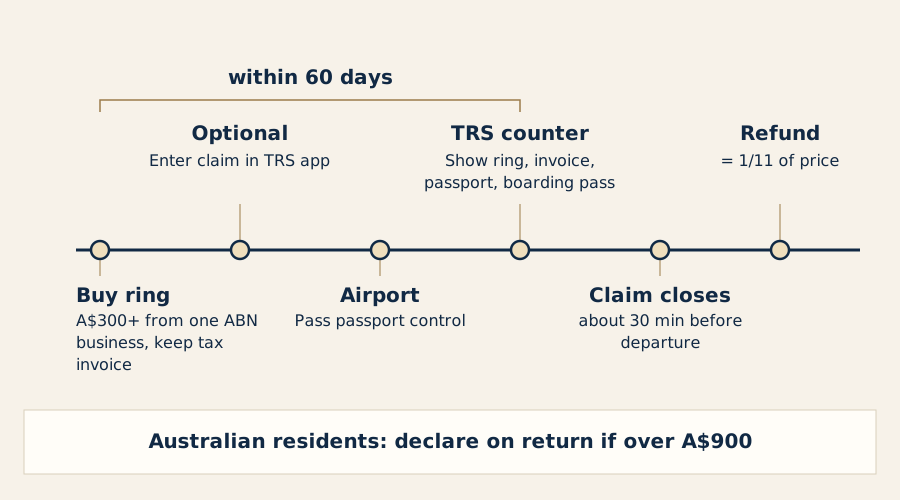
The catch for Australian residents: you can technically make a TRS claim, but when you come home the ring counts as goods you are bringing back. If its value is above your duty-free passenger concession (A$900 for adults), you must declare it and the GST becomes payable again. In practice, TRS helps visitors and people moving overseas; it is not a way for residents to save on a ring they will wear at home. If an overseas buyer has a ring posted directly to an overseas address, it is an export and GST is generally not charged in the first place.
How should you insure an engagement ring in Australia?
Insurance is the same question whether you buy online or in-store, but online purchases add one more step: the trip from the seller to your door. Ask who carries the risk in transit. A reputable seller insures the parcel until it is signed for and will not leave it at the door. Open it on camera if you like, and check the ring against the invoice straight away.
Once it is yours, you generally have three options:
| Option | How it works | Watch for |
|---|---|---|
| Home contents (unspecified) | Jewellery is covered as part of your general contents | A low per-item limit, often only a few thousand dollars or less; may not cover loss outside the home |
| Home contents (specified item) | You list the ring and its value on the policy for an extra premium | Whether it covers accidental loss away from home and overseas |
| Standalone jewellery insurance | A policy just for jewellery, often worldwide | Whether it pays agreed value, replacement or cash; who chooses the replacement jeweller |
Insurers usually want a valuation: a written document describing the ring, its stone, metal and weight, with a replacement value. This is different from the receipt. Valuations are commonly priced at roughly A$100–$250 and are worth updating every few years as metal and diamond prices move. Keep a copy of the grading report and a few clear photos with it.
Good habits reduce claims in the first place: take the ring off for the gym and gardening, and give it its own soft compartment rather than a jumble in a drawer. Our guide to storing your ring safely between wears covers the practical side.
How do you check a diamond you can only see on screen?
Buying a diamond online is safe when you can tie three things together: the stone, the report and the seller. Work through these checks:
- Verify the report. Enter the report number on the grading lab's website (GIA, IGI and others offer this) and confirm the shape, carat weight, measurements, colour and clarity match the listing.
- Check natural or lab-grown. The report states whether the diamond is natural or laboratory-grown. A lab-grown stone must always be described as lab-grown.
- Match the inscription. Many graded diamonds carry a tiny laser inscription of the report number on the girdle (the thin outer edge). Ask for a magnified photo of it.
- Watch real video. A 360° video shows how the stone behaves; a handheld video in normal light shows how it really looks. Knowing what a good tweezer video shows helps you spot dark areas and inclusions.
- Compare like with like. Put your final two stones next to each other on measurements and grades, as in our guide to comparing two diamonds side by side.
None of this replaces understanding what the grades mean. If cut, colour and clarity still feel abstract, start with the four Cs explained in our diamond buying guide, then come back to your shortlist.
Can you research online and finish in a showroom?
This is what many Australian couples end up doing, and it combines the strengths of both. You use the internet to learn, set a budget and shortlist stones, then book a showroom appointment to see them, try settings on and confirm your size. Bring your shortlist with report numbers; a good jeweller can call in specific stones for you to compare in person.
The hybrid approach suits custom work in particular. A custom ring starts with a conversation and a sketch or 3D design, which is far easier to refine face to face or on a video call than through a checkout page. Our guides on custom versus ready-made rings and how handmade and CAD-designed rings differ explain the trade-offs, and writing a clear design brief shows you how to turn ideas and screenshots into something a jeweller can build.
Whether you shop online or in person, compare natural and lab-grown stones on the same terms: report, measurements and how they look, not just the price. Lab-grown diamonds cost much less than natural diamonds of the same size and grades; natural diamonds are rarer. Both are real diamond.
Browse natural and lab-grown diamonds
How to buy an engagement ring online safely: step by step
- Set your budget and decide on natural or lab-grown before you start filtering.
- Check the seller. Confirm an Australian ABN, a physical address, a phone number and clear returns, warranty and resizing policies in writing.
- Get the ring size right. Measure in Australian letter sizes, ideally with a jeweller's sizer, at the end of the day when fingers are slightly larger.
- Verify the stone. Look up the report number on the lab's website and ask for a video showing the girdle inscription.
- Compare the final two. Line up measurements, grades and real-light videos side by side, or view them in a showroom.
- Pay safely. Use a credit card, keep the tax invoice and avoid bank transfers to sellers you cannot verify.
- Plan delivery. Insured courier, signature on delivery, and check the ring against the invoice as soon as it arrives.
- Insure it from the day you receive it, with a valuation and a copy of the report.
Allow enough time. A ready-made ring can arrive within days, but a custom design, casting, setting and any resizing take longer. Our breakdown of how long each stage of making a ring takes helps you work backwards from a proposal date.
Free consultation
Talk to a gemologist
Compare stones in person or online with Raj Sood, Graduate Gemologist (GIA), AJP (GIA).
Book a consultationShop this shape
FAQ
Common questions
Is it safe to buy an engagement ring online?
It can be, if you buy from a verifiable Australian business, check the grading report on the lab's website and pay by credit card. The main risks are fit, colour that differs from photos, and insured delivery, so check the returns and resizing policies first.
Do I get the same consumer rights online as in a store?
Yes, when the seller is an Australian business. The Australian Consumer Law guarantees apply equally online and in-store, but neither gives you an automatic right to change your mind.
Do I pay GST on an engagement ring bought overseas?
Generally yes. Rings up to A$1,000 usually have 10% GST added at checkout, while rings over A$1,000 have GST, possibly duty and processing fees collected before the parcel is released.
Can I claim the Tourist Refund Scheme on a ring?
Yes, if you spend A$300 or more with one business within 60 days of leaving Australia and carry or wear the ring on departure. Australian residents who bring it back must declare it if it exceeds their A$900 duty-free concession, and GST is then payable.
What if the ring I ordered online doesn't fit?
A wrong size you supplied is not a fault under consumer law, so resizing depends on the store's policy and usually costs something. Plain solitaires resize easily; eternity bands and some pavé designs may not.
Should I get my engagement ring insured straight away?
Yes. Arrange cover from the day you receive it, using a valuation and the grading report, and check whether your policy covers loss away from home and overseas.

Ask a gemologist
Not sure which diamond to choose?
Raj Sood is a Graduate Gemologist (GIA) and master jeweller. Bring the stones you are considering, or send the reports, and he will tell you honestly which one is better and why.
Keep learning
Related guides
 Buying Knowledge & Custom ProcessBuying a Diamond Overseas vs in Australia
 Lab-Grown DiamondsBuying a Lab-Grown Diamond Online vs in a Showroom
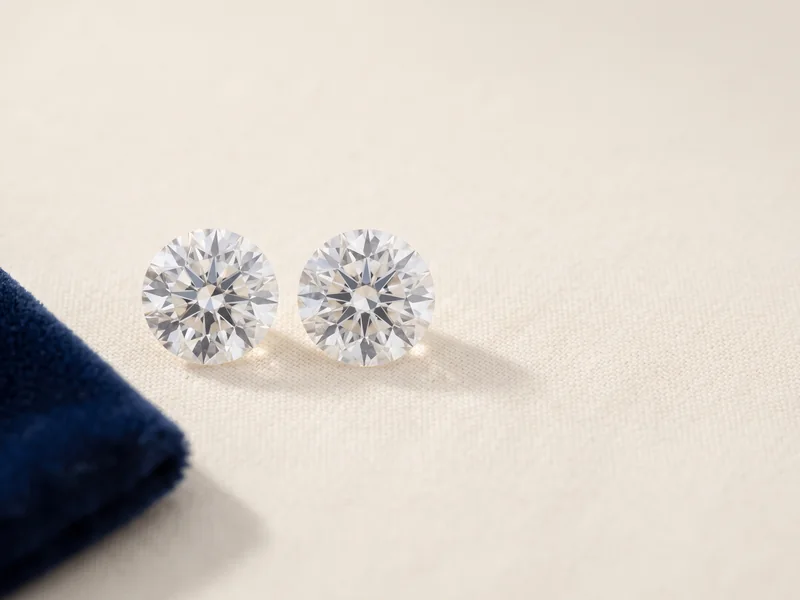 Buying Knowledge & Custom ProcessHow to Compare Two Diamonds Side by SideBuying Knowledge & Custom ProcessDiamond Buying Guide
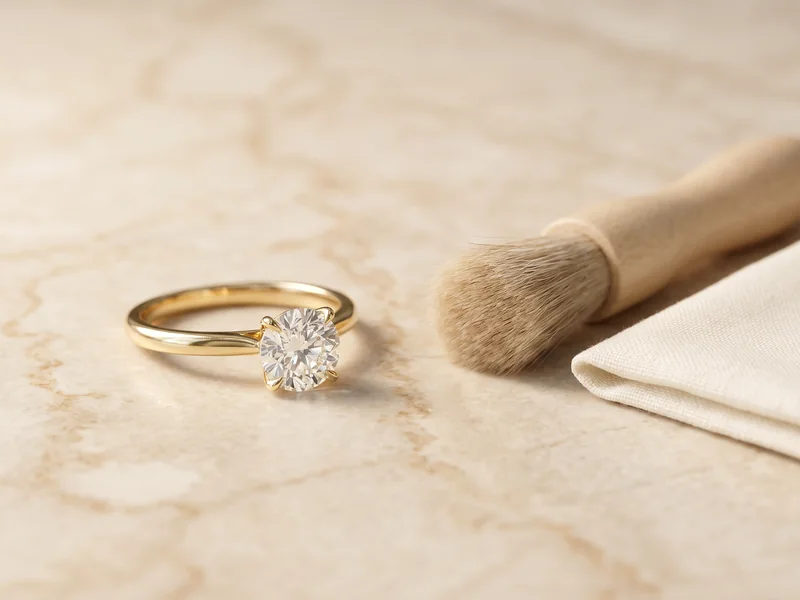 Care, Repairs & RemodellingHow to Store Jewellery
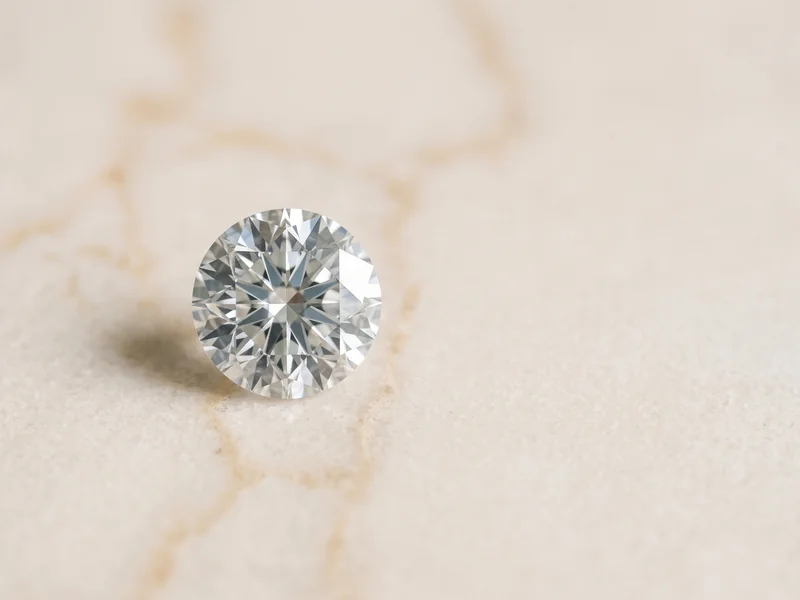 Lab-Grown DiamondsQuestions to Ask a Jeweller Before Buying a Lab-Grown Diamond
 Lab-Grown DiamondsLab-Grown Diamond Resale Value: Questions to Ask Before Buying
Explore more
More guides on this topic
Education