
- Education
- Lab-Grown Diamonds
- Questions to Ask Before Buying a Lab-Grown Diamond in Australia
Lab-Grown Diamonds
Questions to Ask Before Buying a Lab-Grown Diamond in Australia
Lab-grown diamonds are real diamond at a much lower price, but the details that separate a good purchase from a disappointing one are easy to miss. These are the questions to ask before buying a lab-grown diamond, and the answers a straight-talking jeweller should give you.
 Reviewed by Raj Sood, Graduate Gemologist (GIA), AJP (GIA)Master jeweller and Graduate Gemologist (GIA) · reviewed 4 November 2026
Quick answer
Before buying a lab-grown diamond, ask: which lab graded it (IGI or GIA) and can I see the report; is it CVD or HPHT grown; has it been treated after growth; is the girdle laser-inscribed; what are the cut proportions; what is the price per carat in AUD; and what returns, warranty and upgrade terms apply?
What are the key questions to ask before buying a lab-grown diamond?
Lab-grown diamonds have changed the Australian engagement ring market in only a few years. A 1 carat lab-grown diamond now costs a fraction of a natural one, and there are thousands to choose from online and in stores. That choice is good news, but it also leaves more room for vague descriptions, thin paperwork and prices that are hard to compare. At GemTrove we sell both natural and lab-grown diamonds, so the aim of this guide is not to push you either way. It is to give you the questions we would ask if we were standing on your side of the counter.
If you are still deciding whether lab-grown suits you, start with our complete guide to lab-grown diamonds. Any term you have not met before, from girdle to pavilion, is explained in our plain-English jewellery glossary. And if you are weighing up where to shop, our comparison of buying online or in a showroom covers what each can and cannot show you.
| Question to ask | What a straight answer sounds like | Red flag |
|---|---|---|
| Is this diamond natural or lab-grown? | It is lab-grown, and it says so on the report and the invoice | Vague words such as 'created' or a brand name, with nothing in writing |
| Which lab graded it? | IGI or GIA, and here is the report number | Only an in-house 'certificate' from the seller |
| Is the report number inscribed on the girdle? | Yes, and you can see it under a loupe | No inscription and no explanation |
| Was it grown by CVD or HPHT, and was it treated after growth? | CVD or HPHT, any post-growth treatment disclosed, and the report notes it | 'It doesn't matter' or 'we don't know' |
| What are the cut proportions? | Table, depth, angles and cut grade, from the report | Only carat and colour are mentioned |
| What is the total price? | An itemised AUD price including GST, stone and setting | A price that shifts once you show interest |
| What are the returns, warranty and resizing terms? | Clear terms, in writing, before you pay | Verbal promises only |
| Will you buy it back or offer an upgrade? | An honest answer about resale and any written upgrade policy | Claims that the stone will 'hold its value' |
The rest of this guide takes each question in turn: why it matters, what a good answer looks like, and what to do if you do not get one.
Is a lab-grown diamond real, and will the jeweller disclose it clearly?
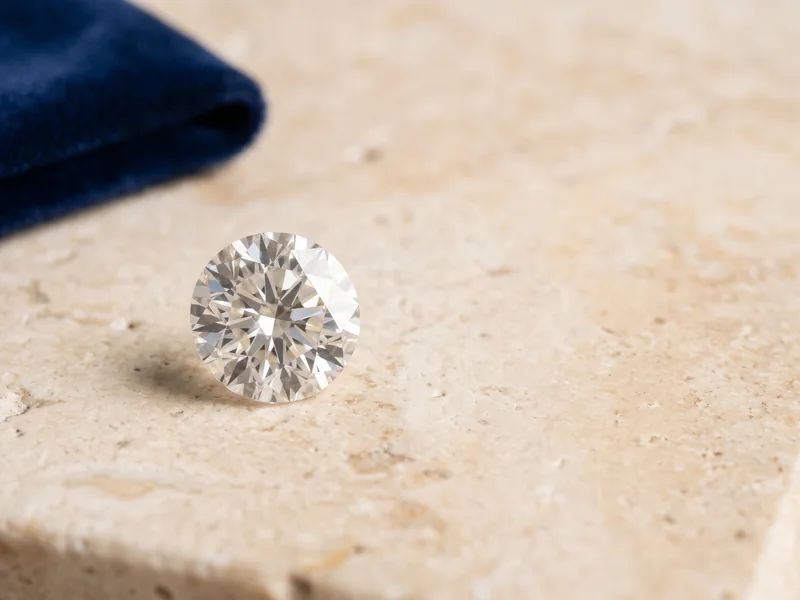
A lab-grown diamond is real diamond: carbon atoms locked in the same cubic crystal structure as a mined stone. It has the same hardness (10 on the Mohs scale), the same refractive index (about 2.42, a measure of how strongly it bends light) and the same fire. It is not a simulant, which is a different material made to look like diamond. Our page on why lab-grown diamonds are real diamond explains the science in more depth.
| Property | Lab-grown diamond | Natural diamond | Moissanite (lab-created) | Cubic zirconia (synthetic) |
|---|---|---|---|---|
| Material | Carbon (diamond) | Carbon (diamond) | Silicon carbide | Zirconium dioxide |
| Mohs hardness | 10 | 10 | about 9.25 | about 8–8.5 |
| Refractive index | about 2.42 | about 2.42 | about 2.65–2.69 | about 2.15–2.18 |
| How it forms | Grown in weeks in a laboratory | Formed deep in the earth, typically 1 to 3.5 billion years ago | Grown in a laboratory | Grown in a laboratory |
| Typical paperwork | IGI or GIA laboratory-grown diamond report | GIA, IGI or similar diamond report | Usually none from a diamond lab | Usually none |
| Called a diamond? | Yes, always with 'lab-grown' or 'laboratory-grown' | Yes | No | No |
Because lab-grown and natural diamonds look the same, even to a trained eye with a loupe, disclosure is everything. Ask that the invoice says 'laboratory-grown diamond' or 'lab-grown diamond', not just 'diamond', and that it records the report number. Words like 'created', 'cultured' or a trade name on their own are not clear enough. Under the Australian Consumer Law (ACL), a business must not engage in misleading or deceptive conduct, and that includes leaving out information that changes what you think you are buying.
It is also worth knowing that the handheld thermal 'diamond testers' used in many shops only confirm a stone is diamond; they read lab-grown and natural the same. Telling the two apart takes laboratory screening equipment, such as spectroscopy and ultraviolet imaging, which is why an independent report matters so much. For the basics of laboratory-grown diamond, including how it compares with natural on price and rarity, see our main guide.
What questions to ask about the grading report before buying a lab-grown diamond?
Ask first who issued the report. An independent grading report comes from a laboratory that does not sell the stone. IGI (International Gemological Institute) grades a large share of the lab-grown diamonds sold in Australia, and GIA (Gemological Institute of America) grades them too. An in-house 'certificate' written by the seller is not the same thing; it is the seller's opinion of its own product.
When you have the report in front of you, check these lines:
- Origin statement: the report should say clearly that the stone is laboratory-grown, usually in the title and again in the comments.
- Growth method: many reports state CVD or HPHT.
- Post-growth treatment: a comment such as 'indications of post-growth treatment' tells you the colour was improved after growing.
- Measurements and carat weight: to two decimal places; these let you match the paper to the stone.
- Colour, clarity and cut: plus polish, symmetry and fluorescence.
- Inscription: the report number, often with 'LG' or 'LAB GROWN', laser-inscribed on the girdle (the thin outer edge).
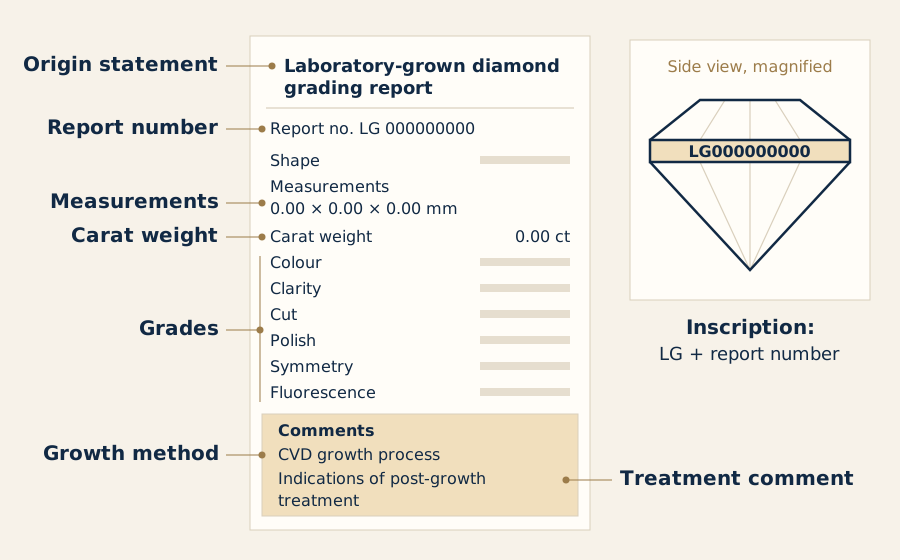
A laser inscription is microscopic writing on the girdle, invisible without magnification and harmless to the stone. Both IGI and GIA let you enter the report number on their websites and see the original record. If the online weight and measurements match the stone in front of you, the paperwork belongs to that diamond.
One more point: labs do not all use identical wording, and GIA's format for lab-grown reports has changed over the years. Compare stones graded by the same lab where you can, and ask the jeweller to explain any grade or comment you do not understand, including the growth processes named on the report.
Does it matter if a lab-grown diamond is CVD or HPHT?
There are two ways to grow a diamond. HPHT (high pressure, high temperature) copies the conditions deep in the earth: a small diamond seed sits in molten metal at roughly 5–6 gigapascals of pressure and about 1,300–1,600 °C, and carbon crystallises onto it. CVD (chemical vapour deposition) works at low pressure: a carbon-rich gas, usually methane with hydrogen, is broken down in a chamber at roughly 700–1,200 °C, and carbon settles on flat diamond seed plates layer by layer. Our guide to how CVD and HPHT diamonds are grown goes through each method step by step.
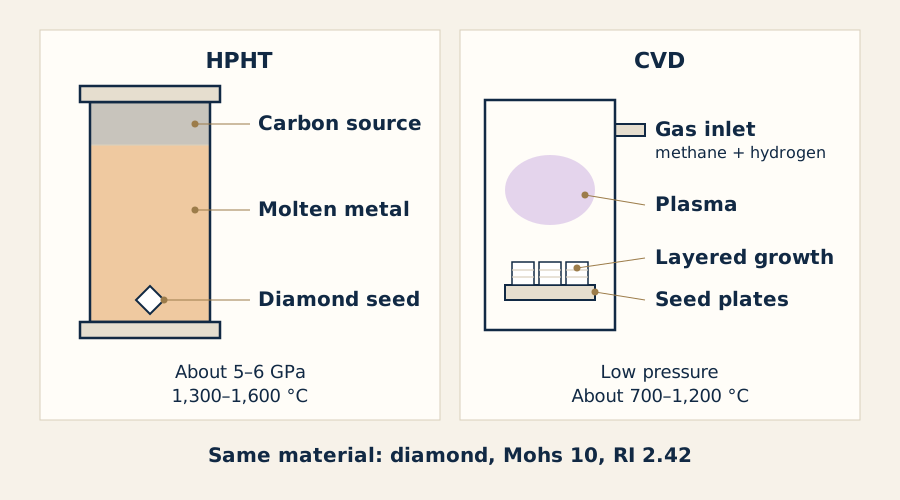
Neither method makes a better diamond on its own. What matters is the finished stone. HPHT diamonds can contain tiny metallic inclusions from the molten metal, and some are faintly magnetic. CVD diamonds can show a brownish tint or internal strain as they come out of the reactor, which is why many are given a post-growth treatment, usually an HPHT anneal, to improve their colour. That treatment is permanent and normal, but it should be disclosed.
- Was it grown by CVD or HPHT?
- Was it treated after growth, and does the report say so?
- Are there any metallic inclusions, and where are they?
- Does it show strong fluorescence or a glow after UV light is switched off (phosphorescence)? This rarely affects everyday looks, but you should know.
Whichever method was used, it is the same diamond material either way; the growth method simply helps explain what you see under magnification.
Not sure which one is right?
Send us the stones you are looking at and our gemologist will tell you which to choose and why.
How do you check the cut quality of a lab-grown diamond?
Cut decides how much light a diamond returns to your eye, and it varies more than many people expect in lab-grown stones. Because lab-grown rough costs less, some stones are cut quickly to keep as much weight as possible, leaving them deep, dark in the centre or with thick girdles. Ask for the proportions, not just the grades. For a round brilliant, typical well-cut ranges look like this:
- Table (the large top facet): about 54–58% of the width.
- Total depth: about 59–62.5%.
- Crown angle: about 34–35°; pavilion angle: about 40.6–41°.
- Girdle: thin to medium, not very thick.
- Culet (the bottom point): none or very small.
IGI and GIA give an overall cut grade only for round brilliants. For fancy shapes such as ovals, pears and emeralds you judge cut from the length-to-width ratio, depth, symmetry and, above all, how the stone looks in a video or in person; our overview of every diamond shape sets out what to look for in each. Our guide to cut quality in lab-grown diamonds shows good and poor examples side by side.
Smaller stones need their own questions. Diamonds under about 0.20 carat, used as accents, in studs or in bracelets, are often not individually graded. Ask whether every small stone is lab-grown or natural (mixing the two must be disclosed), what colour and clarity range they fall in, and how closely pairs are matched. Our page on small lab-grown stones in earrings and tennis bracelets covers matching in detail.
How much should a lab-grown diamond cost in Australia?
Lab-grown prices have fallen a long way over the past several years, and they still move quickly. That makes price the question where comparing like with like matters most: same shape, carat, colour, clarity, cut and lab. The ranges below are approximate retail prices for loose round diamonds and are a starting point only.
| Round, G–H colour, VS clarity | Lab-grown (approx. AUD) | Natural (approx. AUD) |
|---|---|---|
| 0.50 ct | about $400–$1,200 | about $1,800–$4,000 |
| 1.00 ct | about $800–$2,500 | about $6,000–$15,000 |
| 2.00 ct | about $2,000–$6,000 | about $20,000–$55,000 |
Ask for an itemised quote: the stone, the setting, any side stones and any resizing or engraving. Australian retailers must show a single total price that includes GST, so the figure you are quoted should be the figure you pay. If two lab-grown stones with the same grades differ widely in price, ask why. The answer is usually cut quality, the lab, or a premium for a brand name. Shape matters too: rounds generally cost more per carat than fancy shapes, as our page on price differences between diamond shapes shows.
The harder question is what the diamond is worth later. Because lab-grown diamonds can be produced in quantity and prices keep falling, resale value is low, and many jewellers will not buy them back at all. That does not make a lab-grown diamond a poor choice; it means you should buy it because you like it at today's price, not expecting to get money back. Our guide to what lab-grown diamonds are worth if you sell goes into trade-ins and upgrade policies.
Related guideLab-Grown Diamond Resale Value: Questions to Ask Before BuyingBrowse lab-grown diamonds
Are sustainability claims about lab-grown diamonds backed up?
Lab-grown diamonds are often marketed on environmental grounds, but growing a diamond uses a great deal of electricity, and the real impact depends on where the power comes from. A stone grown on a coal-heavy grid and one grown with renewable power are very different stories. Natural diamond mining has its own impacts, so neither choice is automatically impact-free.
Under the ACL, environmental claims must be true and able to be backed up, and the ACCC (Australian Competition and Consumer Commission) has published guidance for businesses on making them. If a seller makes a sustainability claim, it is fair to ask:
- Where was this diamond grown, and by which producer?
- What energy source does that producer use, and is there evidence?
- Is there third-party certification, and can I see it in writing?
- Does the claim apply to this specific stone, or to the brand in general?
If the answers are vague, treat the claim with caution. Our page of questions to test sustainability claims goes further into certifications and what they actually cover.
What should you ask about lab-grown diamond returns, warranty and the setting?
Under the Australian Consumer Law you have automatic rights when you buy jewellery: it must be of acceptable quality, match its description and be fit for any purpose you made known. If a lab-grown diamond turns out not to be what the invoice says, those rights apply regardless of any store policy. A change-of-mind return, though, is not required by law; it is up to each business. Online sellers often offer a return window to make up for not seeing the stone in person, and our guide to return windows for online and showroom purchases compares the usual terms. Ask about:
- Returns: how many days, in what condition, and whether custom or resized pieces are excluded.
- Warranty: what the store covers on the setting, such as claw checks, re-tipping and loose stones.
- Resizing: whether the first resize is included and how far the ring can be sized.
- Valuation: whether an insurance valuation is provided, and that it states the diamond is lab-grown.
- Upgrades: any trade-in or upgrade policy, written on the invoice.
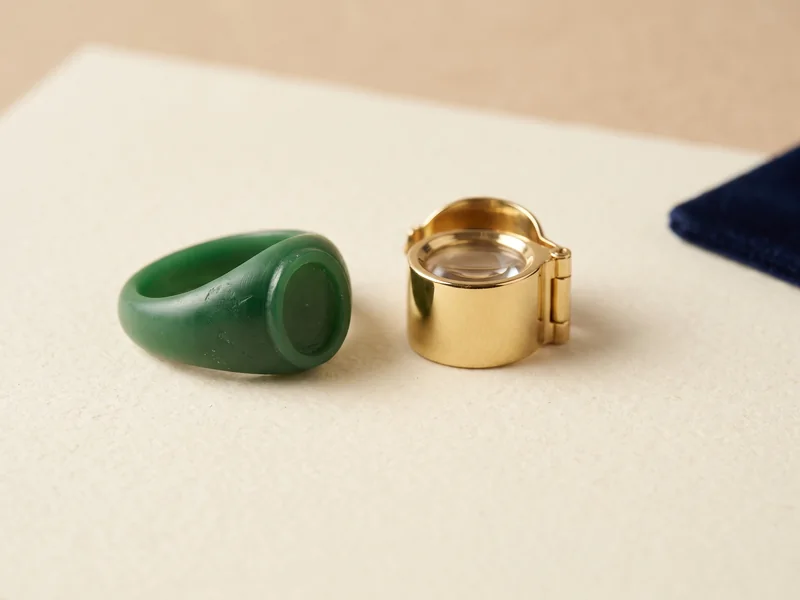
If the diamond is going into a custom ring, there is a second set of questions about design, timing and sign-off. Our list of questions for a custom engagement ring covers them, including whether you will see a wax or resin model of the ring before it is cast. For earrings or a bracelet, check how matched pairs and bracelet stones are selected and set.
How to ask the right questions before buying a lab-grown diamond, step by step
- Set your brief first. Decide shape, a carat range and a total budget, so you can compare stones on equal terms.
- Ask for the report. Confirm it is from an independent lab such as IGI or GIA and states laboratory-grown.
- Verify it. Enter the report number on the lab's website and check that weight and measurements match.
- See the inscription. Look at the girdle under a loupe and match the number to the report.
- Ask about growth and treatment. CVD or HPHT, and any post-growth treatment noted in the comments.
- Check the cut. Ask for table, depth and angles, and view the stone in person or on a 360° video.
- Get the price in writing. An itemised AUD total including GST, setting and any extras.
- Confirm the terms. Returns, warranty, resizing and upgrade policy on the invoice, which should say 'laboratory-grown diamond' with the report number.
Take this list with you, and do not be shy about using it. A good jeweller will be glad you asked. If a word on the report is unfamiliar, look up any unfamiliar grading term in our glossary, and if the cut numbers are the sticking point, our page on cut grades and proportions for lab-grown stones will help you compare.
Free consultation
Talk to a gemologist
Compare stones in person or online with Raj Sood, Graduate Gemologist (GIA), AJP (GIA).
Book a consultationShop this shape
FAQ
Common questions
Do lab-grown diamonds come with a certificate?
Most lab-grown diamonds over about 0.30 carat come with an independent grading report, usually from IGI or GIA. Ask for it before you buy, and check that it states the stone is laboratory-grown and matches the laser inscription on the girdle.
Can a jeweller tell a lab-grown diamond from a natural one?
Not by eye or with a loupe. Telling them apart needs laboratory screening equipment such as spectroscopy and ultraviolet imaging; basic thermal testers read both as diamond.
Should I choose a CVD or HPHT lab-grown diamond?
Neither method is better on its own. Judge the finished stone on its report grades, cut and appearance, and ask whether it was treated after growth.
Do lab-grown diamonds hold their value?
No. Lab-grown prices have fallen steadily and resale value is low, so buy one because you like it at today's price rather than expecting money back later.
Is an IGI or a GIA report more reliable for a lab-grown diamond?
Both are long-established independent labs. Their wording and grading formats differ, so compare stones graded by the same lab where you can.
Can I return a lab-grown diamond if I change my mind?
Change-of-mind returns are a store policy, not a legal right in Australia, so ask for the terms in writing before you pay. Your automatic rights under the Australian Consumer Law apply if the stone is faulty or not as described.

Ask a gemologist
Not sure which diamond to choose?
Raj Sood is a Graduate Gemologist (GIA) and master jeweller. Bring the stones you are considering, or send the reports, and he will tell you honestly which one is better and why.
Keep learning
Related guides
 Lab-Grown DiamondsLab-Grown Diamond Resale Value: Questions to Ask Before Buying
 Lab-Grown DiamondsLab-Grown Diamond Cut QualityLab-Grown DiamondsBuying a Lab-Grown Diamond Online vs in a ShowroomLab-Grown DiamondsAre Lab-Grown Diamonds More Sustainable? Questions to Ask
 Buying Knowledge & Custom ProcessQuestions to Ask Before Ordering a Custom Engagement RingLab-Grown DiamondsHow Are Lab-Grown Diamonds Manufactured?
 Lab-Grown DiamondsAre Lab-Grown Diamonds Real Diamonds
Explore more
More guides on this topic
Education