
- Education
- Gemstones
- Can Every Gemstone Go in an Ultrasonic Cleaner? A Guide to Which Gemstones Are Safe
Gemstones
Can Every Gemstone Go in an Ultrasonic Cleaner? A Guide to Which Gemstones Are Safe
An ultrasonic cleaner can make a diamond ring look new in a few minutes, and it can crack an emerald in the same cycle. Here is which gemstones can safely go in, which cannot, and why hardness alone will not tell you.
 Reviewed by Raj Sood, Graduate Gemologist (GIA), AJP (GIA)Master jeweller and Graduate Gemologist (GIA) · reviewed 4 November 2026
Quick answer
No. An ultrasonic cleaner is usually safe for diamonds, rubies and sapphires that are untreated or heat-treated only, and for most spinel and chrysoberyl. Never put emerald, opal, pearl, turquoise, amber, coral or any fracture-filled, oiled, dyed or coated gemstones in one, and avoid topaz, tanzanite, peridot and moonstone. Warm soapy water and a soft brush suit every stone.
How does an ultrasonic cleaner work?
An ultrasonic cleaner is a small stainless-steel tank filled with water and a little detergent. A transducer (a part that turns electrical energy into vibration) under the tank shakes the liquid at ultrasonic frequencies, far above what you can hear. Home units usually run at about 40 kHz, and jewellery models generally sit somewhere between 20 and 45 kHz.
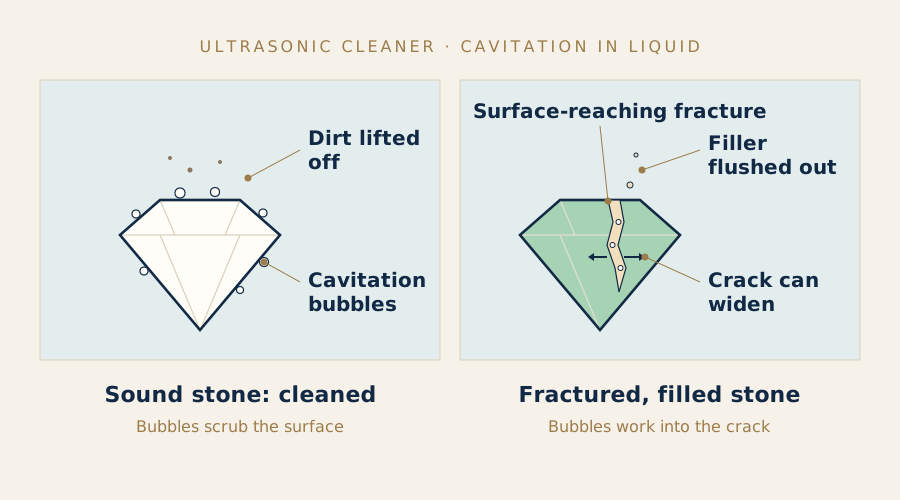
That vibration creates millions of microscopic bubbles that form and collapse many thousands of times a second. This is called cavitation. Each collapsing bubble releases a tiny jet of energy that knocks dirt, hand cream, soap film and skin oil off every surface it touches, including the underside of a stone and the gaps behind claws where a toothbrush cannot reach. Many units also heat the water, often to somewhere around 40–60 °C, which softens greasy build-up.
Jewellers use ultrasonic cleaners every day because they work so well on diamonds and hard, tough coloured stones. The catch is that cavitation does not know the difference between grime and a weak point. If a stone has a crack that reaches the surface, a filler in its fractures or a natural plane of weakness, the same energy works on that too. If any of the terms in this guide are new to you, our plain-English jewellery glossary explains them.
Why can an ultrasonic cleaner damage some gemstones?
Damage almost never comes from the vibration being too strong for a sound, solid stone. It comes from something about that particular stone, its treatment or its setting. These are the seven things a gemmologist checks before a piece goes in the tank:
- Surface-reaching fractures: cavitation bubbles form inside the crack and can widen it. Emerald, tourmaline and aquamarine often have these.
- Liquid inclusions: tiny pockets of fluid trapped inside the stone when it grew. Vibration and heat can make the fluid expand and crack the stone from the inside.
- Fillers and oils: oil, resin or glass used to hide fractures can be shaken or heated out, leaving the fractures suddenly visible.
- Cleavage: a flat plane along which some crystals split cleanly. Topaz, moonstone and tanzanite all have it, and a sharp jolt can start a split.
- Porosity: stones with tiny open pores, such as turquoise, absorb detergent and dirty water and can change colour.
- Organic or water-bearing gems: pearl, coral, amber and opal are soft, layered or contain water, and react badly to vibration and heat.
- Coatings, dyes and glue: surface coatings rub off, dyes leach out, and the adhesive in doublets, triplets and pearl cups can fail.
The same gem species can be safe in one piece and unsafe in another. A clean, untreated sapphire is a very different proposition from a sapphire whose fractures have been filled with glass. That is why it pays to know exactly what you own before you clean it, and why our care notes for each individual gemstone separate treated and untreated material.
Related guideGemstone Care by StoneWhich gemstones are safe in an ultrasonic cleaner?
This table brings together hardness (resistance to scratching, on the Mohs scale of 1 to 10), toughness (resistance to chipping and breaking) and what actually happens in an ultrasonic tank. It assumes the stone is sound and securely set. "Usually safe" never means always safe.
| Gemstone | Mohs hardness | Toughness | Ultrasonic cleaner? | Main reason |
|---|---|---|---|---|
| Diamond (natural or lab-grown) | 10 | Good (has cleavage) | Usually safe | Avoid if fracture-filled or heavily included |
| Ruby and sapphire | 9 | Excellent | Usually safe | Untreated or heat-only; never glass-filled |
| Lab-created ruby and sapphire | 9 | Excellent | Usually safe | Same material as natural corundum |
| Moissanite | 9.25 | Good | Usually safe | Check the setting first |
| Chrysoberyl and alexandrite | 8.5 | Excellent | Usually safe | Avoid if fractured |
| Spinel | 8 | Good | Usually safe | Avoid if fracture-filled |
| Cubic zirconia | 8–8.5 | Good | Usually safe | Check the setting first |
| Garnet | 6.5–7.5 | Fair to good | Usually safe | Avoid demantoid and fractured stones |
| Amethyst and citrine (quartz) | 7 | Good | Usually safe | Not if dyed or fracture-filled |
| Aquamarine and morganite | 7.5–8 | Good | Caution | Avoid with fractures or liquid inclusions |
| Jadeite and nephrite jade | 6–7 | Exceptional | Untreated only | Never polymer-impregnated or dyed jade |
| Zircon | 6–7.5 | Brittle edges | Caution, ask first | Facet edges chip; heat can affect colour |
| Tourmaline | 7–7.5 | Fair | Not recommended | Fractures and liquid inclusions common |
| Topaz | 8 | Poor | Not recommended | Perfect cleavage; coatings can strip |
| Tanzanite | 6–7 | Fair | Not recommended | Cleavage and heat sensitivity |
| Peridot | 6.5–7 | Fair | Not recommended | Fractures; sensitive to heat |
| Moonstone | 6–6.5 | Poor | Not recommended | Two directions of cleavage |
| Emerald | 7.5–8 | Poor to fair | Never | Oil or resin in fractures |
| Opal | 5.5–6.5 | Poor to fair | Never | Contains water; doublets are glued |
| Pearl | 2.5–4.5 | Fair to good | Never | Organic layers and drill hole |
| Turquoise, lapis lazuli, malachite | 3.5–6 | Variable | Never | Porous, often dyed or stabilised |
| Amber and coral | 2–4 | Poor | Never | Organic, soft and heat sensitive |
The short version: diamond and corundum (the mineral family of ruby and sapphire) are the stones most often cleaned ultrasonically, which is one reason our guide to sapphire, one of the toughest coloured stones recommends it so often for everyday rings. At the other end, emerald is almost always treated with oil or resin, so it stays out of the tank no matter how hard it is; read why emeralds need gentle handling before cleaning one.
Does hardness decide which gemstones can go in an ultrasonic cleaner?
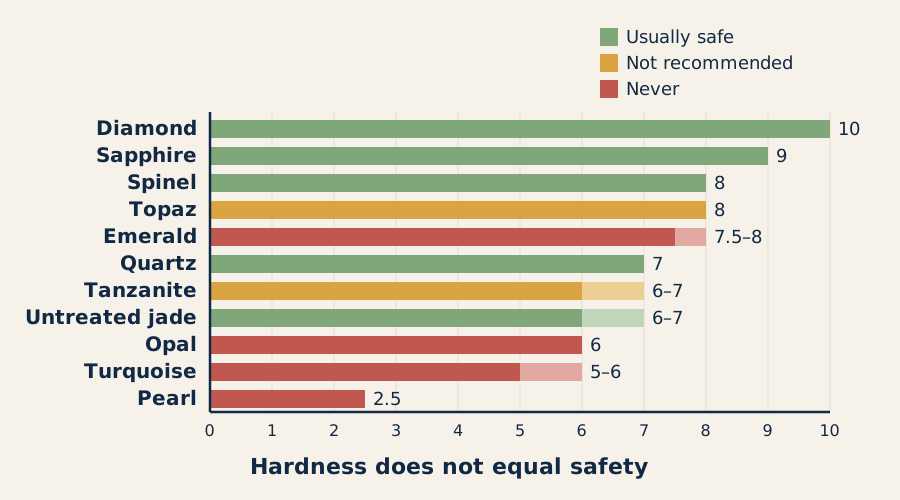
Not on its own. Hardness only tells you how easily a stone scratches. Ultrasonic safety depends on three separate properties, and a stone needs all three to be good:
- Hardness: resistance to scratching. Diamond is 10, sapphire 9, quartz 7, opal about 6, pearl as low as 2.5.
- Toughness: resistance to chipping and breaking. Jade is exceptionally tough despite a hardness of only 6–7, while topaz is hard (8) but splits easily.
- Stability: resistance to heat, vibration, chemicals and light. Treatments, fluid inclusions and water content all lower stability.
Emerald shows the difference clearly. At 7.5–8 on the Mohs scale it is harder than quartz, yet it is a definite no for ultrasonic cleaning, because nearly every emerald has fractures and most have been filled with oil or resin. Topaz is the same story for a different reason: perfect cleavage means a sharp jolt can split it cleanly across. Jade is the opposite case: modest hardness, but its interlocking fibrous or grainy structure makes untreated jadeite and nephrite very hard to break.
For the full numbers on each stone, our Mohs hardness explained stone by stone lists hardness, toughness and cleavage side by side.
Not sure which one is right?
Send us the stones you are looking at and our gemologist will tell you which to choose and why.
How do gemstone treatments affect ultrasonic cleaning?
Most coloured gemstones on the market have been treated in some way, and treatment is often the deciding factor. Heat treatment alone, common in sapphire, ruby, tanzanite and citrine, is generally stable. Treatments that add a material to the stone are a different matter.
| Treatment | Commonly found in | Ultrasonic cleaner? |
|---|---|---|
| Heating only | Sapphire, ruby, citrine, aquamarine | Usually fine if the stone itself is safe |
| Oil or resin filling | Emerald, some ruby | Never: filler can be shaken or heated out |
| Lead-glass filling | Low-cost ruby, some sapphire | Never: glass can crack or etch |
| Fracture filling | Some diamonds | Avoid: filler can cloud or leak |
| Dyeing | Jade, quartz, lapis, pearl, coral | Avoid: dye can leach out |
| Polymer impregnation or stabilising | Jade (B-jade), turquoise, opal | Avoid: polymer can loosen or discolour |
| Surface coating | Mystic topaz, some quartz | Never: coating can strip |
| Irradiation | Blue topaz | Colour is stable, but topaz cleavage still rules it out |
Oil and resin filling deserve a special mention because they are so common in emerald; our page on how emerald oiling and resin filling work explains what the different levels of treatment mean for care.
Lab-grown and lab-created stones follow the same rules as the natural material, because they are the same material. A lab-grown diamond can take the same ultrasonic cycle as a natural diamond of the same clarity, and lab-created sapphire and ruby are as tough as natural corundum. Imitations are different: glass, plastic and composite stones can chip, cloud or come unglued, so if you are not sure what a stone is, have it identified before cleaning.
A reputable grading report or receipt should state treatments. For pieces without paperwork, a gemmologist can usually identify oils, glass filling and dyes under magnification, and our definitions of each gem treatment explain what the report wording means.
What about Australian opal, sapphire and pearls?
Three of the gems Australia is known for sit at very different points on the cleaning chart, and two of them should never go near an ultrasonic tank.
Opal, Australia's national gemstone, comes from fields such as Lightning Ridge in New South Wales (black opal), Coober Pedy in South Australia and the boulder opal fields of western Queensland. Precious opal contains water within its structure, commonly somewhere around 3–10%, and sudden changes in temperature or vibration can cause crazing, a network of fine cracks. Opal doublets and triplets (thin slices of opal glued to a backing, with a clear cap on triplets) add another risk: the glue can let go and water can seep between the layers. Clean opal only with a damp soft cloth.
Sapphire is the opposite. Australian sapphires from the Anakie fields in central Queensland and the New England district around Inverell and Glen Innes in New South Wales are known for deep blues, greens, yellows and parti colours (two or more colours in one stone). Many are heat-treated, which is stable, so a sound, securely set Australian sapphire is usually fine in an ultrasonic cleaner. See our guide to Australian sapphires from Queensland and New England for more on colour and origin.
South Sea pearls from the waters off Broome in Western Australia are grown by the Pinctada maxima oyster and are prized for their thick nacre (the layered material that gives a pearl its lustre). Nacre is soft, around 2.5–4.5 on the Mohs scale, and it absorbs water through the drill hole, which can weaken the silk thread and the cement in pearl cups. Wipe pearls with a soft damp cloth after wearing and never put them in an ultrasonic cleaner.
Pink diamonds from the Argyle mine in Western Australia, which closed in 2020, often show internal graining, and some carry small inclusions. A sound Argyle pink can usually be cleaned like any diamond, but because these stones are irreplaceable, most jewellers clean them by hand.
Can an ultrasonic cleaner loosen stones in a ring?
Yes, and this is the most common way an ultrasonic cleaner causes a problem in everyday jewellery. The vibration does not bend sound claws, but it does shake loose a stone that is already held by a worn, lifted or cracked claw. People sometimes find a diamond sitting in the bottom of the basket and assume the cleaner caused it, when the claw had been failing for months.
- Claw settings: the tips wear thin over years of contact with clothes, benches and steering wheels, especially on rings worn daily on the left-hand ring finger.
- Pavé and micro-pavé: tiny stones held by small beads of metal can drop out if a bead has worn.
- Tension settings: the stone is held by pressure alone, so any loss of tension shows up quickly.
- Glued settings: pearl cups, inlay and some fashion pieces rely on adhesive that vibration and heat can weaken.
- Bent bands: a ring that has been squeezed out of shape puts uneven pressure on the setting; our guide on why a ring band can bend out of round explains how this loosens stones.
Pointed stones deserve a closer look, because the claw at each tip takes the most knocks. Check the V-claw at the tip of a pear shape, the claws at both ends of a marquise and the claw protecting the point of a heart shape before any ultrasonic cycle. A worn claw at a point can let the stone shift, and a point that is exposed is also the part most likely to chip.
Before any ultrasonic clean, hold the ring to your ear and tap it gently, or shake it lightly. A faint rattle or click means a stone is loose. Look at each claw from the side to check it still sits over the stone. For a closer look at how each setting style grips a gem, see how claw, bezel and pavé settings hold a stone. Many jewellers suggest a professional check of claws every 6–12 months for rings worn daily.
Which gemstones are easiest to keep clean in an everyday ring?
If easy cleaning matters to you, choose a stone that is hard, tough and stable. For a ring worn every day, the practical shortlist is diamond (natural or lab-grown), sapphire, ruby, spinel and chrysoberyl, ideally untreated or heat-treated only. All of them handle a short ultrasonic cycle when sound and well set, as well as warm soapy water and a brush. The cut makes little difference to the cleaning method itself: whether the stone is round, oval or pear, what matters is the soundness of the stone and the condition of the claws.
Stones such as emerald, opal, morganite and tanzanite are all worn in rings, but they need more careful daily handling and hand-cleaning only. A bezel setting that rims and shields a softer stone helps protect them from knocks. If you are weighing up colour against everyday practicality, our page on engagement rings set with coloured gemstones compares the main choices, and the hardness and toughness ratings for everyday rings show which stones cope with knocks.
You can also see the range of natural stones, with their treatments disclosed, in our collection of coloured gemstones and birthstones.
Browse natural gemstones
How do you clean gemstone jewellery without an ultrasonic cleaner?
For almost every gemstone, including the ones that must never go in an ultrasonic tank, the safest method is also the simplest:
- Warm, not hot, water with a few drops of mild dishwashing liquid.
- A soft toothbrush to work gently under the stone and around claws. Skip the brush on pearls and opal; use a soft cloth.
- Rinse in clean warm water, with the sink plug in.
- Dry with a lint-free cloth and let the piece air-dry fully before storing.
- Avoid steam cleaners, bleach, chlorine, ammonia, vinegar and lemon juice, and never soak pearls, opal, turquoise or emerald.
Steam cleaners are a separate risk to ultrasonic cleaners: the sudden heat can crack stones with liquid inclusions and damage almost everything on the 'never' list. Stone-by-stone instructions for soaking times, brushes and what to avoid are in our stone-by-stone cleaning instructions.
How to use an ultrasonic cleaner on gemstones: step by step
- Identify every stone in the piece, including small accent stones, and check the report or receipt for treatments. If any stone is on the 'never' list, hand-clean the whole piece.
- Check the setting. Shake or tap the piece near your ear, and look at each claw from the side. If anything moves, stop and have it repaired first.
- Fill the tank with warm water and a few drops of mild detergent or the manufacturer's jewellery solution.
- Use the basket and keep pieces apart so they cannot knock or scratch each other. Diamond scratches every other gem.
- Run a short cycle of about 2–3 minutes. Leave the heater off unless the piece is diamond or corundum only.
- Rinse and inspect under clean warm water, then check again that every stone is tight.
- Dry gently with a lint-free cloth. Never plunge a warm stone into cold water.
Free consultation
Talk to a gemologist
Compare stones in person or online with Raj Sood, Graduate Gemologist (GIA), AJP (GIA).
Book a consultationShop this shape
FAQ
Common questions
Can you put sapphires in an ultrasonic cleaner?
Usually, yes, if the sapphire is untreated or heat-treated only and has no large surface-reaching fractures. Avoid ultrasonic cleaning for glass-filled or fracture-filled sapphire, and always check the setting first.
Can emeralds go in an ultrasonic cleaner?
No. Nearly all emeralds have fractures, and most are treated with oil or resin that vibration and heat can remove, making the fractures visible or even widening them. Clean emeralds with lukewarm soapy water and a soft brush.
Is an ultrasonic cleaner safe for opal?
No. Opal contains water and can craze with vibration or temperature changes, and doublets and triplets can come unglued. Wipe opal with a damp soft cloth only.
Can pearls go in an ultrasonic cleaner?
No. Pearls are soft and organic, and vibration and water can damage the nacre, the silk thread and the glue in pearl cups. Wipe them with a damp cloth after wearing.
Are lab-grown diamonds safe in an ultrasonic cleaner?
Generally yes. A lab-grown diamond is real diamond, so it follows the same rules as a natural diamond: fine if sound and securely set, but avoid it if the stone is fracture-filled or heavily included.
How often should you use an ultrasonic cleaner on jewellery?
For a diamond or sapphire ring worn daily, a short clean every few weeks is plenty. More important is a regular check of the claws, because the cleaner can shake out a stone from a worn setting.

Ask a gemologist
Not sure which diamond to choose?
Raj Sood is a Graduate Gemologist (GIA) and master jeweller. Bring the stones you are considering, or send the reports, and he will tell you honestly which one is better and why.
Keep learning
Related guides
 GemstonesGemstone Care by Stone
 GemstonesGemstone Hardness Guide
 GemstonesEmerald Gemstone
 Engagement Rings & SettingsDiamond & Gemstone Setting GuideGemstonesGemstones | Coloured Gemstones, Birthstones and Custom JewelleryEngagement Rings & SettingsWhich Finger Does an Engagement Ring Go On?
 Care, Repairs & RemodellingWhy Rings Go Out of Round
 GemstonesEngagement Rings with Colour, Meaning and Personal Gemstone Choice
Explore more
More guides on this topic
Education