
- Education
- Engagement Rings & Settings
- Which Finger Does an Engagement Ring Go On? Left Hand, Band Order and History
Engagement Rings & Settings
Which Finger Does an Engagement Ring Go On? Left Hand, Band Order and History
Which finger does an engagement ring go on, and why? The answer is simple in Australia, but the history, the order with your wedding band and the customs elsewhere are worth knowing before the ring is made.
 Reviewed by Raj Sood, Graduate Gemologist (GIA), AJP (GIA)Master jeweller and Graduate Gemologist (GIA) · reviewed 4 November 2026
Quick answer
In Australia, an engagement ring goes on the fourth finger of the left hand, between the middle and little fingers, usually called the ring finger. After the wedding, most people wear the wedding band first, closest to the hand, with the engagement ring above it. Many cultures, including parts of Europe and India, use the right hand instead.
Which finger does an engagement ring go on?
In Australia, New Zealand, the UK, the US and Canada, the engagement ring goes on the fourth finger of the left hand: the one between your middle finger and your little finger. If you count the thumb as the first finger, it is the fourth. Some older English books do not count the thumb and call it the 'third finger', but it is the same finger. Most people simply call it the ring finger.
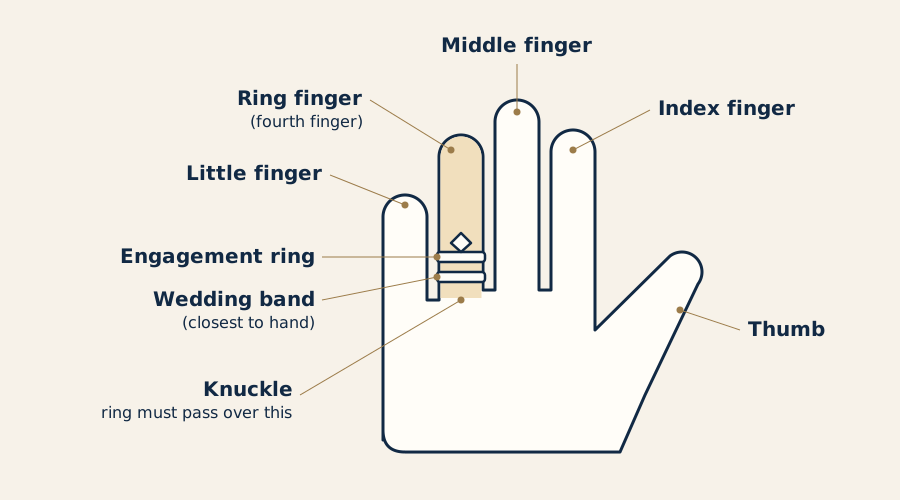
The custom is the same whoever wears the ring, and it applies to couples of any gender. What changes from person to person is the finger itself. On most ring fingers the knuckle is noticeably wider than the base, so a ring has to slide over the knuckle and then sit snugly behind it without spinning. That one fact shapes most of the practical advice below, from sizing to how two rings sit side by side.
The parts of a ring that actually touch the finger are the shank (the band that circles the finger) and the underside of the setting. You can see where each part sits in our guide to the parts of an engagement ring, from shank to head, and any unfamiliar term in this article is explained in our A–Z jewellery glossary.
Why is the engagement ring worn on the left hand?
The reason you will hear most often is the vena amoris, Latin for 'vein of love': the belief that a vein ran directly from the fourth finger of the left hand to the heart. The Roman writer Aulus Gellius, in the 2nd century AD, passed on an older claim that Egyptian anatomists had found a nerve linking that finger to the heart. The Latin phrase itself became popular much later, in English writing on marriage law in the 1600s.
Anatomically, it is not true. Every finger has a similar network of veins, and none runs straight to the heart. But the story is old, it is romantic, and it fixed the left ring finger in place for centuries. Our page on the long story of the wedding ring traces how the Roman custom carried through to Christian ceremonies.
There are practical reasons too. About nine in ten people are right-handed, so the left hand does less heavy work and a ring there takes fewer knocks. In the English-speaking world the custom was set in writing by the Book of Common Prayer of 1549, which tells the groom to place the ring on 'the fourth finger of the woman's left hand'. Australian weddings inherited that tradition.
The diamond engagement ring is much newer than the finger it sits on. The example usually quoted is the diamond ring Archduke Maximilian of Austria gave Mary of Burgundy in 1477, and diamond engagement rings only became common for ordinary couples in the 20th century. Read more about how engagement rings developed from Roman betrothal rings.
Related guideHistory of Engagement RingsDoes the engagement ring go on before or after the wedding band?
The most common order in Australia is wedding band first, at the base of the finger, with the engagement ring above it (towards the fingertip). The usual explanation is that the band, the ring given during the ceremony, sits closest to the heart. On the wedding day, many people move the engagement ring to the right ring finger before the ceremony so the band can go straight on, then move the engagement ring back on top afterwards.
| Arrangement | How it is worn | Why people choose it |
|---|---|---|
| Band first (most common) | Wedding band at the base, engagement ring above | Band closest to the hand; the stone sits on top |
| Engagement ring first | Engagement ring at the base, band above | The band acts as a guard that stops the ring sliding off |
| Band either side | Engagement ring between two bands | A fuller stack, often added at an anniversary |
| Split hands | Engagement ring on the right, band on the left | Comfort, work, or two rings that do not sit well together |
| Soldered pair | Both rings joined permanently at the base | Stops them twisting and rubbing against each other |
There is a long history behind the second option. In antique rings that come into the workshop, we often see a keeper ring (also called a guard ring): a band that Victorian and Edwardian women wore above a thin wedding ring to hold it in place. The order you choose is personal; what matters is that the two rings are designed to sit together.
Two rings worn side by side rub against each other every day, and softer metals wear faster where they touch. A band with a rounded inner edge slides on more easily and sits better against the ring beside it; our guide to how a comfort-fit band feels different on the finger explains the profile. Where the band meets the setting also depends on the under-gallery, the metalwork beneath the stone, which decides whether a straight band can sit flush.
Which finger does an engagement ring go on in other countries?
Australia is a multicultural country, and many families carry customs from elsewhere. The ring finger is fairly universal; the hand is not. In much of Central and Eastern Europe, and in Eastern Orthodox churches, the right hand is used, at least for the wedding ring.
| Country or tradition | Engagement ring | Wedding ring |
|---|---|---|
| Australia, New Zealand, UK, US, Canada | Left ring finger | Left ring finger, usually below the engagement ring |
| Germany, Austria, Norway | Often the left ring finger | Often the right ring finger |
| Russia, Ukraine, Serbia (Orthodox) | Often the right hand | Right ring finger |
| Greece (Orthodox) | Left hand, moved at the wedding | Right ring finger |
| Netherlands | Varies | Often left for Catholics, right for Protestants |
| Jewish ceremony | Varies | Placed on the right index finger during the ceremony, often moved to the left ring finger afterwards |
| India | Varies by community and region | Varies; many married Hindu women also wear toe rings (bichiya or metti) |
Treat this table as a starting point, not a rule. Customs shift between families, regions and generations, and plenty of couples blend traditions, for example an engagement ring on the left hand in Australia and a right-hand band for a ceremony overseas. If you are planning a ring for a partner with a different background, it is worth asking which hand their family expects before the ring is sized, because the dominant hand is often a little larger.
Not sure which one is right?
Send us the stones you are looking at and our gemologist will tell you which to choose and why.
Can you wear an engagement ring on the right hand?
Yes. There is no rule that says an engagement ring must be on the left, and many people move it for good reasons:
- Left-handed people sometimes prefer the ring on the hand that does less work.
- Work: nurses, chefs, tradies and anyone who wears gloves may swap hands or take the ring off at work.
- Swelling: pregnancy, heat or arthritis can make one hand more comfortable than the other for a while.
- Culture or faith: as the table above shows, the right hand is the norm in many traditions.
- Heirlooms: some people wear a grandmother's ring on the right hand and their own engagement ring on the left.
Be aware that a ring on the right hand can be read differently in Australia. A ring on the right ring finger is often taken as a dress ring or a symbol of something else; see what a right-hand ring usually signals. If the ring marks a commitment before an engagement, our page on how promise rings differ from engagement rings covers that custom and which hand people choose.
Whichever hand you use, a ring worn every day collects soap, sunscreen and hand cream behind the stone, which dulls its sparkle. Diamond (10 on the Mohs hardness scale) and sapphire (9) cope well with daily wear and most cleaning. Softer or more fragile stones, such as emerald (7.5–8), opal (5.5–6.5) and pearl (2.5–4.5), need more care; check which gemstones are safe in an ultrasonic cleaner before you clean a ring at home.
Which finger do men wear an engagement ring on?
In Australia, men who wear an engagement ring usually wear it on the same finger: the fourth finger of the left hand. Some men wear one band from engagement through to the wedding; others wear an engagement ring and add a wedding band, or swap one for the other on the day.
Men's rings tend to be wider, often 5–8 mm compared with 2–3 mm for many women's shanks, and a wide band feels tighter than a narrow one of the same size because it covers more of the finger. As a rough guide, a band of 6 mm or more often needs about half a size larger. Our guide to men's engagement ring styles and widths goes through metals, profiles and set stones.
What ring size is your ring finger?
Australia uses letter sizes (A to Z, then Z+1 and up), close to the UK system. Each full letter adds roughly 0.4 mm to the inside diameter, or about 1.25 mm to the circumference. Many women's ring fingers fall somewhere between J and P, and many men's between Q and V, but there is no such thing as a standard finger.
| Australian size | Inside diameter (approx.) | Inside circumference (approx.) |
|---|---|---|
| J | 15.3 mm | 48.1 mm |
| L | 16.1 mm | 50.6 mm |
| N | 16.9 mm | 53.1 mm |
| P | 17.7 mm | 55.6 mm |
| R | 18.5 mm | 58.1 mm |
| T | 19.4 mm | 60.9 mm |
| V | 20.2 mm | 63.5 mm |
Fingers change size through the day and with temperature. They are smallest when cold and largest when warm, and the dominant hand is often slightly larger. Measure the ring finger of the hand you will actually wear it on, and check that the ring slides over the knuckle with a little resistance and does not spin once it is on.
Sizing a ring up and down several times weakens the shank over the years, and a thin band can slowly bend into an oval from everyday pressure. Our page on why a thin shank slowly goes out of round explains what causes it and how a jeweller corrects it. Getting the size right first time saves the ring from that wear.
How does an engagement ring look on the ring finger?
The ring finger is usually about 15–20 mm wide at the base, so the stone's millimetre size matters more than its carat weight. A 1 carat round brilliant measures about 6.4–6.5 mm across and covers roughly a third of an average finger's width. The same stone looks larger on a slim finger and smaller on a broad one.
Elongated shapes such as ovals, pears and marquises draw the eye along the finger and can make it look longer; wider shapes such as cushions and rounds suit longer fingers. Our guide to which diamond shapes suit small hands or long fingers goes through each option, and our comparison of shapes that look largest for their carat weight shows the face-up sizes side by side.
Band width changes the picture too. A fine 1.8–2.2 mm shank makes the centre stone look bigger by contrast, while a 3 mm or wider band looks bolder and is sturdier for daily wear.
How do you make an engagement ring and wedding band sit together?
If you plan to wear both rings on the same finger, design them together. The key measurements are the height of the setting above the finger and the shape of the metal beneath the stone. A low setting with a wide gallery (the metal structure under the stone) can stop a straight band from sitting flush and leave a gap. A taller setting lets a straight band slide underneath.
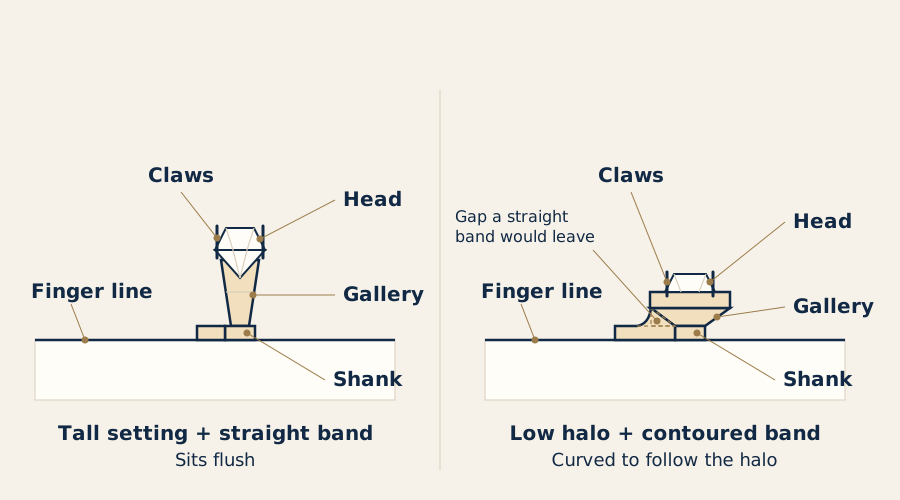
Halos and wide heads are the usual culprits. Double halo rings spread wider at the base, so most are paired with a contoured band, a band curved to follow the outline of the engagement ring. Antique and antique-style designs raise their own questions: many Art Deco engagement rings from the 1920s and 1930s have wide, flat-topped heads and engraved shoulders, and the bands made to sit beside them were often shaped to match. For the full range of options, see our guide to engagement ring setting styles.
Create your ring or choose a ring setting
How to wear your engagement ring: step by step
- Choose the hand. In Australia it is the left ring finger; check whether family, faith or work suggests the right hand instead.
- Measure that finger. Size it warm, late in the day, on two separate days, on the hand you will wear it on.
- Check the knuckle. The ring should slide over with slight resistance and not spin at the base of the finger.
- Plan the band now. Decide on the stacking order and whether you need a straight or contoured band before the engagement ring is made.
- On the wedding day, move the engagement ring to the right ring finger before the ceremony so the band can go on first.
- After the ceremony, put the engagement ring back on the left ring finger, above the band (or in your chosen order).
- Look after both rings. Clean them regularly and have the claws and shanks checked every 6–12 months, as rings worn together rub and wear.
Free consultation
Talk to a gemologist
Compare stones in person or online with Raj Sood, Graduate Gemologist (GIA), AJP (GIA).
Book a consultationShop this shape
FAQ
Common questions
Which finger does an engagement ring go on in Australia?
The fourth finger of the left hand, between the middle and little fingers. It is usually called the ring finger.
Does the engagement ring or wedding band go on first?
Most Australians wear the wedding band first, closest to the hand, with the engagement ring above it. Some prefer the reverse so the band acts as a guard; both are fine.
Why is the engagement ring worn on the left hand?
The tradition comes from the old belief in the vena amoris, a vein supposedly running from the left ring finger to the heart. It is not anatomically true, but the custom was set in English weddings by the 1549 Book of Common Prayer.
What does an engagement ring on the right hand mean?
In many countries, including Germany, Russia and Greece, the right hand is the traditional hand for wedding rings. In Australia a right-hand ring is often read as a dress ring, so some people wear their engagement ring on the left to avoid confusion.
Where do you put the engagement ring during the wedding ceremony?
Many people move it to the right ring finger before the ceremony so the wedding band can go straight onto the left ring finger. Afterwards the engagement ring moves back, usually above the band.
Do men wear engagement rings on the same finger?
Yes. In Australia men usually wear an engagement ring on the left ring finger too, often in a wider band that may need about half a size larger.

Ask a gemologist
Not sure which diamond to choose?
Raj Sood is a Graduate Gemologist (GIA) and master jeweller. Bring the stones you are considering, or send the reports, and he will tell you honestly which one is better and why.
Keep learning
Related guides
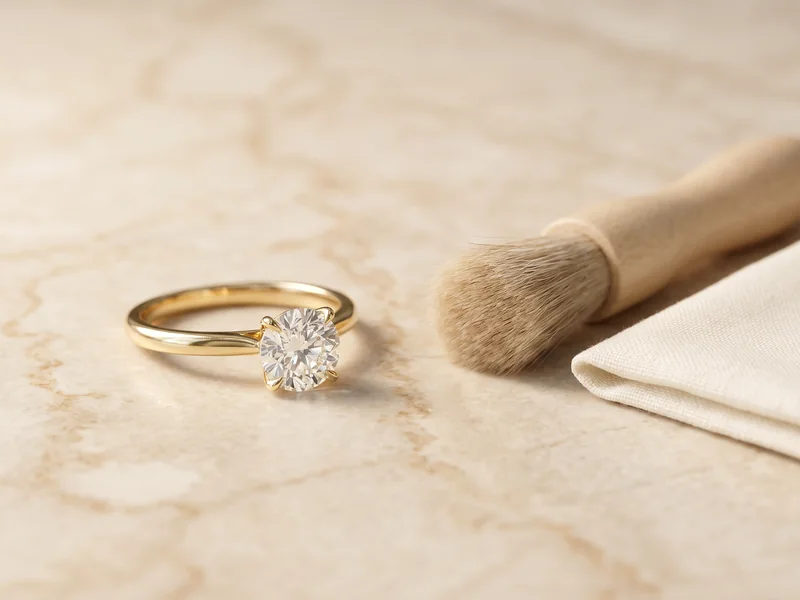
 Engagement Rings & SettingsEngagement Ring Anatomy
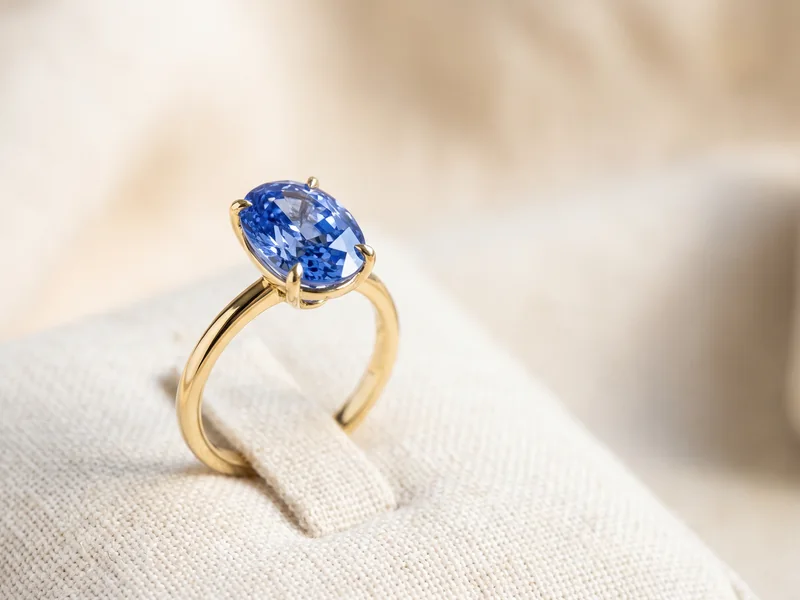
 Engagement Rings & SettingsHistory of Engagement Rings
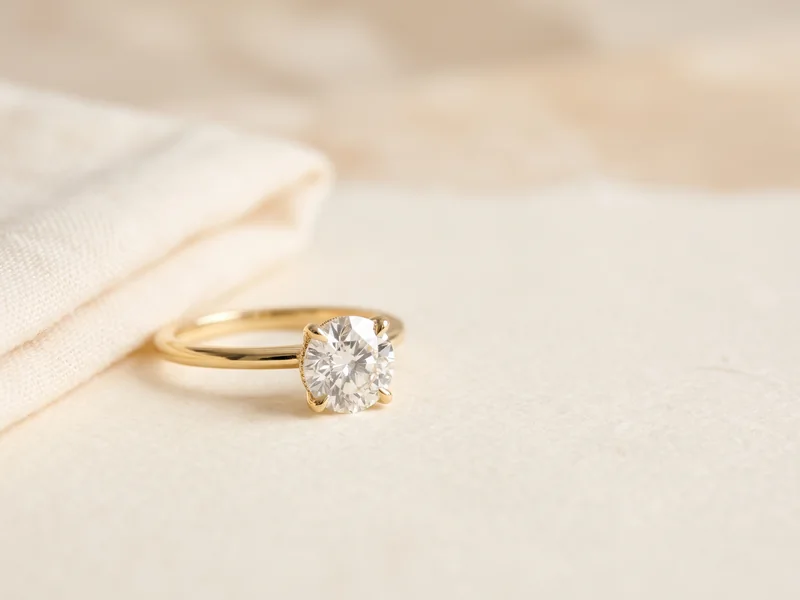
 Engagement Rings & SettingsRight-Hand Rings ExplainedEngagement Rings & SettingsEngagement Ring Setting Styles Guide
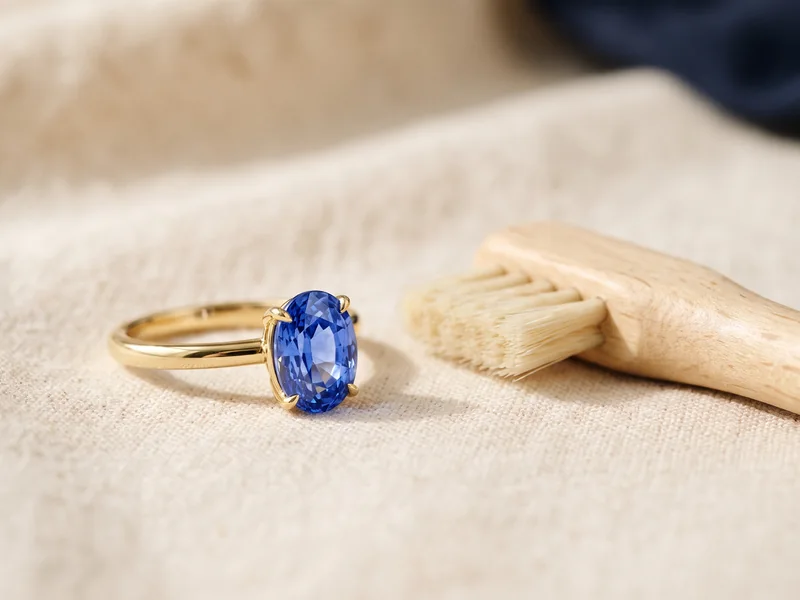
 Engagement Rings & SettingsComfort-Fit Engagement Rings: What Changes on the Finger?
 GemstonesCan Every Gemstone Go in an Ultrasonic Cleaner?
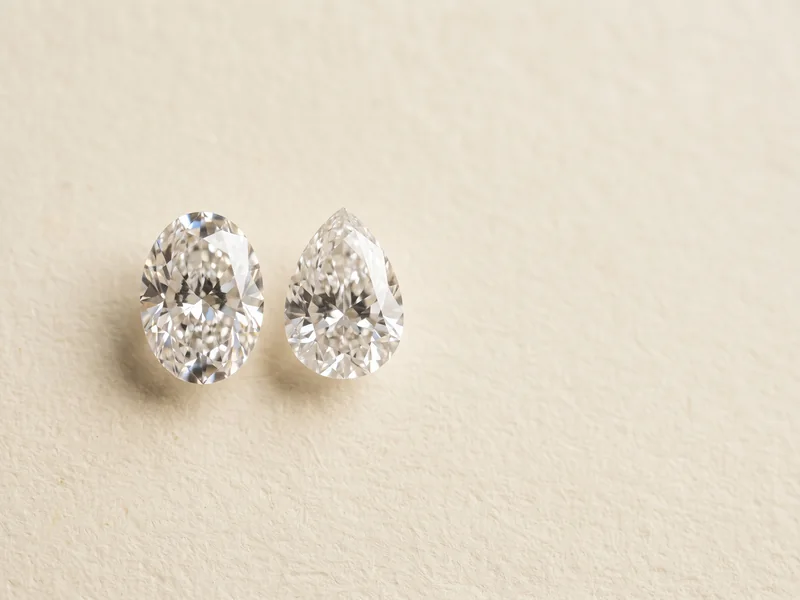 Diamond ShapesBest Diamond Shapes for Small Hands and Long Fingers
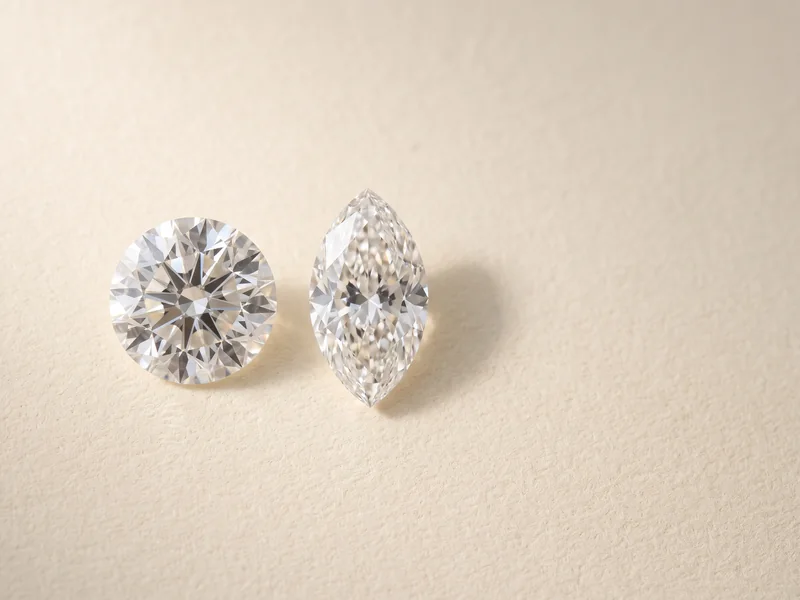 Diamond ShapesWhich Diamond Shape Looks Biggest per Carat
Explore more
More guides on this topic
Education