
Gemstones
Black Opal Guide: Colour, Value, Treatments and Ring Care
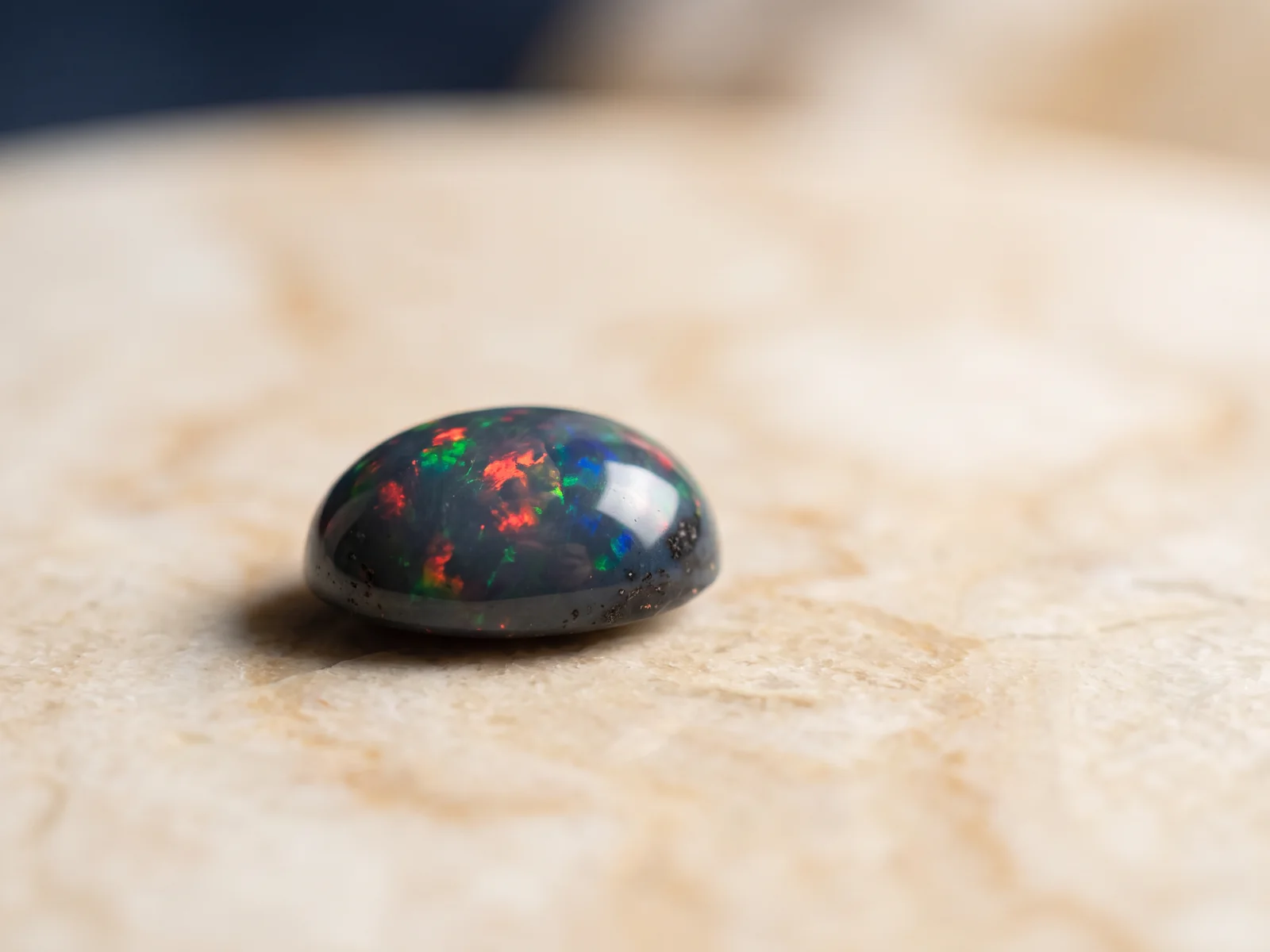
Black opal is Australia's own gem and one of the hardest stones to value, because no two look alike. Here is how a gemmologist judges a black opal, what it is worth, how to spot doublets and treatments, and how to wear it safely.
 Reviewed by Raj Sood, Graduate Gemologist (GIA), AJP (GIA)Master jeweller and Graduate Gemologist (GIA) · reviewed 4 November 2026
Quick answer
Black opal is natural precious opal with a dark body tone (N1–N4 on the Australian scale) that makes its play-of-colour look especially vivid. Most comes from Lightning Ridge, NSW. It is 5.5–6.5 on the Mohs scale and only fair in toughness, so choose a protective bezel setting, check for doublets or treatments, and avoid heat and knocks.
What is black opal?
Black opal is precious opal with a dark body tone, meaning the background colour of the stone, which ranges from dark grey to jet black. Against that dark base, the flashes of spectral colour, called play-of-colour, look brighter and more saturated than they do in a pale stone. That contrast is the whole appeal, and it is why gem-quality black opal is the most valued member of the opal family. It is one of the coloured gemstones we cover in depth, and one of the few that Australia supplies to the world almost on its own.
Opal is hydrated silica, SiO2·nH2O, usually holding about 3–10% water by weight. Unlike sapphire or diamond, it has no crystal structure; it is amorphous (non-crystalline). Our page on how opal's chemistry compares with diamond, sapphire and other gems sets the formulas side by side.
Precious opal is built from microscopic silica spheres, roughly 150–350 nanometres across, stacked in an orderly grid. Light passing between them is diffracted, which means split into its separate colours, a little like the rainbow on the back of a CD. The size of the spheres decides which colours appear: smaller spheres give blue and violet, larger ones can produce orange and red. Because the larger spheres needed for red are less common, red play-of-colour is the rarest.
Opal without play-of-colour is called common opal or, in the Australian trade, potch. Black potch is often the natural backing layer of a Lightning Ridge stone, and it is what gives a solid black opal its dark base. Opal's refractive index is low, about 1.45, so it has a soft, glowing lustre rather than the sharp sparkle of a faceted gem. Its specific gravity is about 2.1, noticeably lighter in the hand than quartz. Any term here you have not met is explained in our plain-English jewellery glossary.
What colours does black opal come in?
Two separate things describe the colour of a black opal: the body tone underneath, and the play-of-colour on top. The Australian opal trade grades body tone on a scale from N1 (jet black) to N9 (very light), viewed face-up on the top of the stone, not through the back.
| Black opal body tone | Trade name | How it looks |
|---|---|---|
| N1–N2 | Black opal | Jet black to very dark; strongest contrast |
| N3–N4 | Black opal | Dark charcoal; still reads as black in most light |
| N5–N6 | Dark opal (semi-black) | Mid to dark grey; colours slightly softer |
| N7–N9 | Light or white opal | Pale grey to milky white |
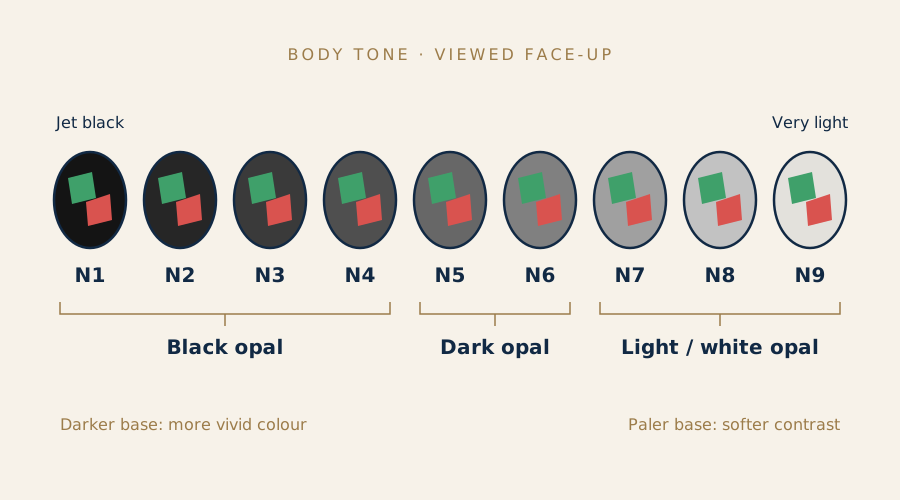
A stone at N5 or N6 is usually sold as dark or semi-black opal, and should be priced below a true N1–N3 stone with the same colours. At the pale end of the scale you are into white opal with its milky, light body tone. There is also black crystal opal: a dark stone that is translucent, so you can see colour from within as well as on the surface. Our guide to transparent and semi-transparent crystal opal explains how that changes the look.
Play-of-colour can show any spectral colour. In rough order of rarity, from most to least: red, orange, yellow, green, blue and violet. A stone showing red across most angles is far rarer than one showing blue and green. The arrangement of the colour, called the pattern, matters just as much:
- Harlequin: distinct, roughly square patches like a mosaic. The rarest and most sought-after pattern.
- Broad flash: large sheets of colour that switch on and off as the stone moves.
- Rolling flash: a band of colour that rolls across the face as you tilt it.
- Pinfire: many tiny points of colour; attractive but usually valued lower.
- Floral, ribbon and Chinese writing: named patterns with organic shapes, lines or script-like strokes.
Where does black opal come from?
Almost all the world's fine black opal comes from Lightning Ridge, in northern New South Wales near the Queensland border. Commercial mining there dates from the early 1900s. The opal forms as small nodules, known locally as nobbies, in a layer of claystone inside the sedimentary rocks of the Great Artesian Basin. Miners sink shafts or use open cuts to reach that layer, and most nobbies are either potch or show little colour; gem black opal is a small part of what comes out of the ground.
Opal was proclaimed Australia's national gemstone in 1993. Other Australian fields produce different opal: Coober Pedy and Andamooka in South Australia are known mainly for white and crystal opal, and Mintabie, also in South Australia, produced some dark and semi-black opal. Our guide to Australia's main opal fields, from Lightning Ridge to Coober Pedy covers each one.
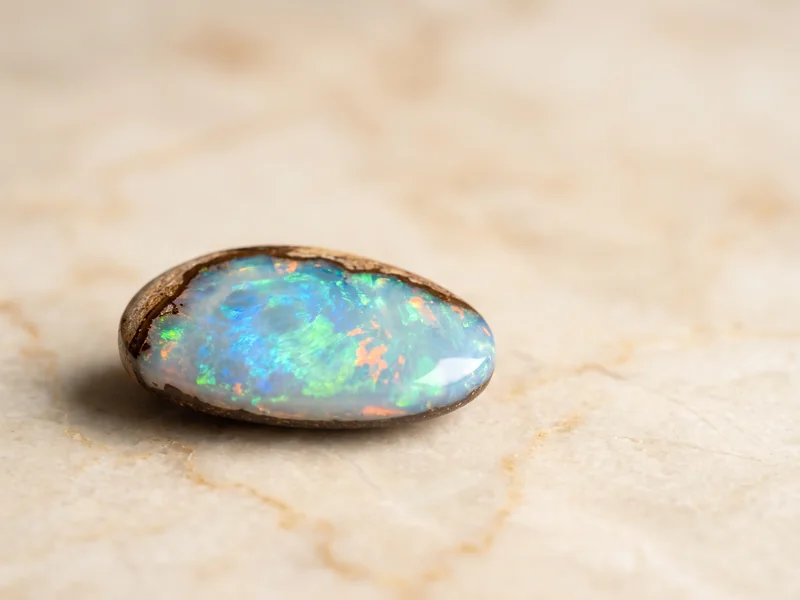
Western Queensland produces Queensland boulder opal, which forms in ironstone. Its dark brown ironstone backing can make it look like black opal face-up, but it is a separate type and should be sold under its own name. Outside Australia, some natural dark opal has come from Ethiopia, Honduras and Mexico, but a lot of the dark Ethiopian opal on the market has been smoke-treated to darken it, which we cover further down.
How does black opal compare with other opal types?
Every opal type looks different and is valued differently. This table puts black opal beside the other main types you will see for sale.
| Opal type | Body tone | Transparency | Main source | Relative value |
|---|---|---|---|---|
| Black opal | N1–N4 dark | Opaque to translucent | Lightning Ridge, NSW | Highest for fine stones |
| Dark (semi-black) opal | N5–N6 grey | Opaque to translucent | Lightning Ridge, Mintabie | Below black opal |
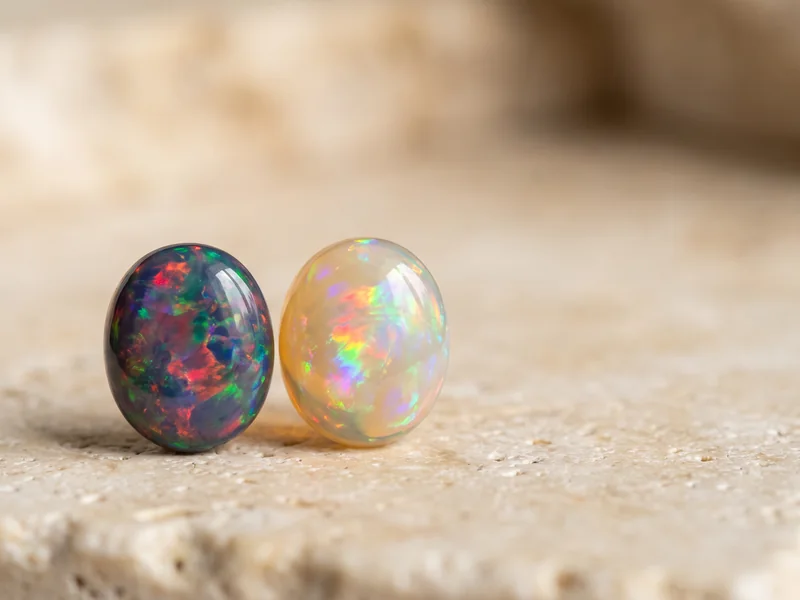
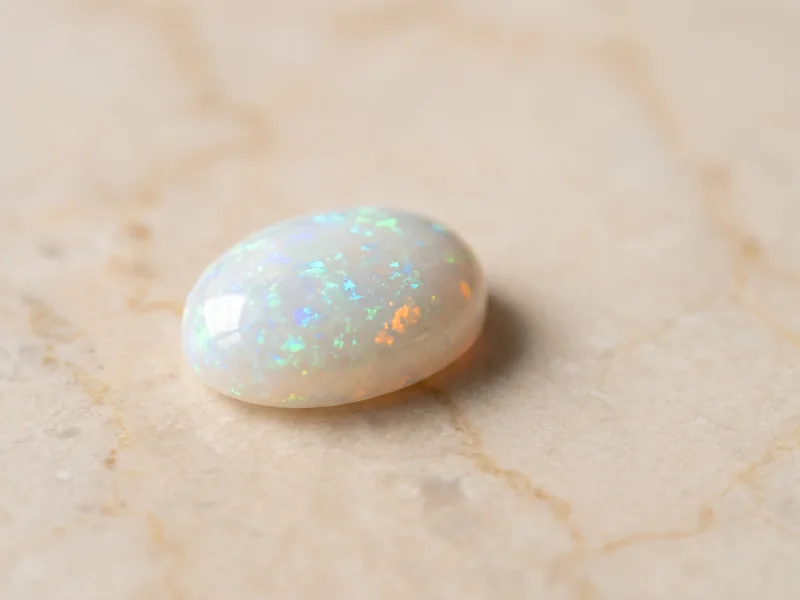
| White opal | N7–N9 light | Opaque to translucent | Coober Pedy, Andamooka | Usually lower |
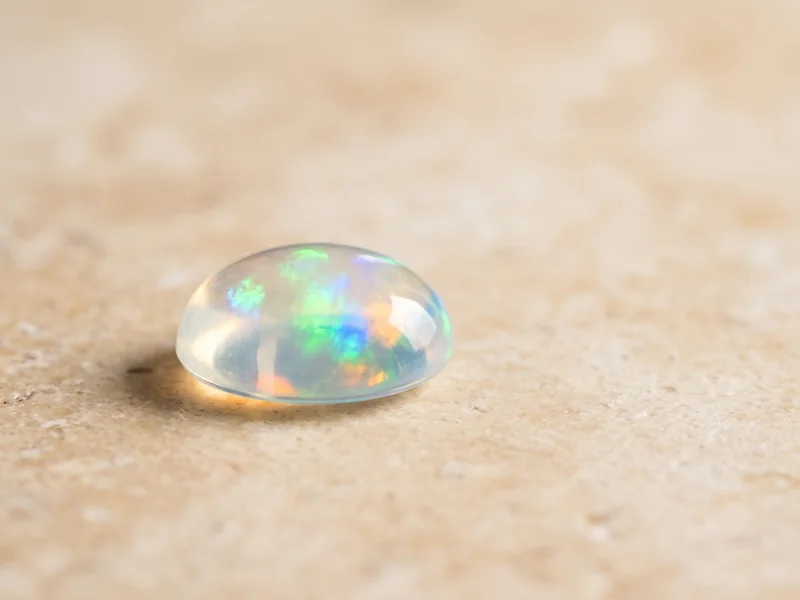
| Crystal opal | Any, see-through | Transparent to translucent | Most Australian fields | Can be high if bright |
| Boulder opal | Dark, from ironstone | Opaque | Western Queensland | High for bright solid stones |
| Ethiopian (Welo) opal | Mostly light | Translucent | Ethiopia | Usually lower per carat |
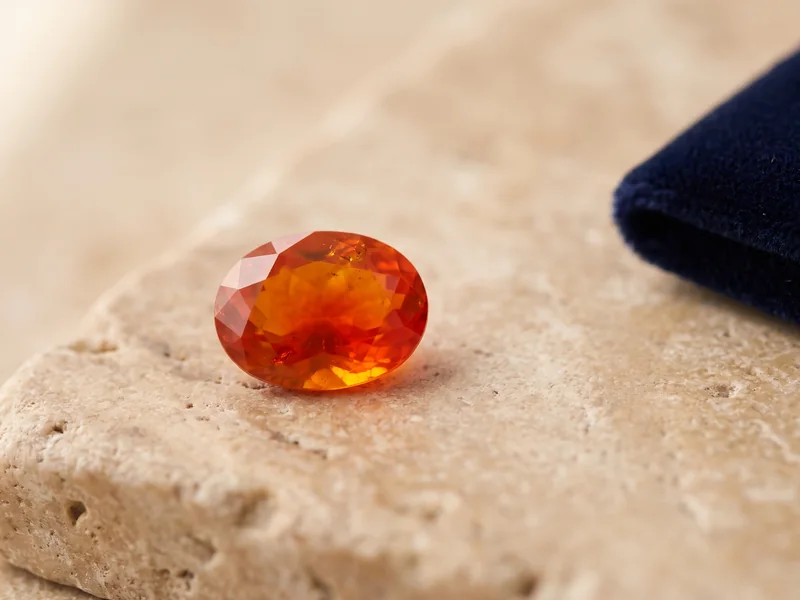
| Fire opal | Yellow, orange, red body | Transparent to translucent | Mexico | Valued for body colour |
The biggest practical difference for a wearer is stability. Most Lightning Ridge black opal is a sedimentary opal with a good record of staying stable once cut. Much Ethiopian Welo opal is hydrophane, meaning it soaks up water and can temporarily turn clear or lose colour when wet. Our comparison of Australian opal types against Ethiopian opal goes into this in detail. Mexican fire opal is different again: it is prized for its orange body colour, and play-of-colour is a bonus rather than the point.
Not sure which one is right?
Send us the stones you are looking at and our gemologist will tell you which to choose and why.
What affects black opal value and price in Australia?
Opal is not graded on a single standard scale the way diamonds are, so every black opal is valued stone by stone. Dealers and valuers weigh these factors, roughly in this order:
- Body tone: N1–N2 is worth more than N4, and a dark opal at N5–N6 sits a clear step lower.
- Brightness: how intensely the colour glows. A dull stone with lots of colour is worth less than a bright one with less.
- Colour: red is the rarest, then orange; blue-green stones are the most common.
- Pattern: harlequin and broad flash rank highest; pinfire is usually lower.
- Directionality: a good stone shows colour from most angles. If it only lights up when tilted one way, it is directional and worth less.
- Faults: crazing (fine surface cracks), sand or potch lines, windows (dead patches with no colour) and inclusions all reduce value.
- Cut and size: a smooth, even dome, good thickness and a pleasing outline add value; carat weight multiplies everything.
Small dark specks of potch or ironstone in an opal are judged mainly on how they look and where they sit, which is quite different from how gemmologists assess black inclusions in a diamond. A speck near the edge of an opal may barely matter; one in the centre of the face is a fault.
| Solid black opal quality | Approximate price per carat (AUD) |
|---|---|
| Dark or N4 body tone, dull or pinfire colour | about $50–$300 |
| Good black, bright blue and green | about $300–$2,000 |
| Bright multicolour with orange or some red | about $2,000–$8,000 |
| Exceptional red harlequin or broad flash on N1 | about $8,000 to well over $20,000 |
These are broad ranges only; black opal prices vary more than almost any other gem, and two stones of the same weight can differ tenfold. Doublets and triplets cost a small fraction of a solid stone. Choose a black opal because you love how it looks, and ask for a written description of body tone, brightness and pattern so you know what you paid for.
Are black opals treated? Doublets, triplets and lab-created opal
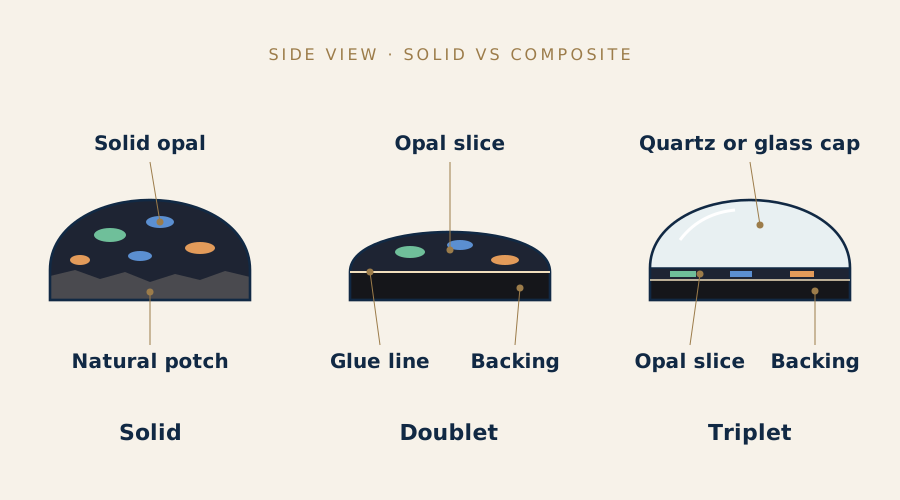
A solid black opal is opal all the way through, sometimes with natural potch at the back. Because black opal is valuable and thin seams are common, the trade also makes composite stones, which are legitimate when they are disclosed:
| Type | How it is made | How to spot it | Water |
|---|---|---|---|
| Solid opal | One piece of natural opal | Side view shows opal or natural potch with an irregular join | Generally fine to wipe or rinse |
| Doublet | Thin slice of opal glued to a dark backing (potch, ironstone, glass or plastic) | A perfectly straight, flat dark line around the side | Avoid soaking; glue can lift |
| Triplet | Doublet with a clear quartz or glass dome on top | Glassy look, three layers visible from the side | Never soak; can fog or separate |
Other treatments make lighter opal look black. Smoke treatment darkens porous opal, mainly Ethiopian, with carbon that sits near the surface, so a scratch or chip can show a paler colour beneath. Sugar-acid treatment deposits carbon in porous matrix opal, mainly from Andamooka. Dyeing and resin or polymer impregnation are also used. Any treatment should be disclosed when you buy.
Lab-created opal, also called synthetic opal, has been made since the 1970s; the best known is Gilson. It is real opal-type silica grown in a laboratory, and it must always be sold as lab-created or synthetic, never simply as opal. Under magnification it often shows a columnar or "lizard skin" pattern within each colour patch. Imitations such as glass or plastic opalite are not opal at all; plastic feels warm and noticeably light for its size.
Is black opal good for an engagement ring?
Black opal can be worn in a ring, but it needs more care than most gems. It is 5.5–6.5 on the Mohs scale, and ordinary household dust contains quartz at 7, so everyday wiping and contact slowly dull the polish. Its toughness, meaning resistance to chipping and cracking, is fair to poor, and opal can crack from a sharp knock or a sudden change in temperature. Here is how it compares with other ring stones:
| Gem | Mohs hardness | Toughness | Everyday ring? |
|---|---|---|---|
| Diamond (including black diamond) | 10 | Good (can cleave on a hard knock; heavily included black diamonds chip more easily) | Yes |
| Sapphire | 9 | Excellent | Yes |
| Amethyst, citrine, ametrine (quartz) | 7 | Good | Yes, with some care |
| Solid black opal | 5.5–6.5 | Fair to poor | With a protective setting and care |
| Opal triplet | About 7 with a quartz cap (lower for glass or plastic) | Poor at the glue layer | Occasional wear only |
If you want a purple or golden stone that copes with more wear, amethyst, a quartz at 7 on the Mohs scale, golden citrine and ametrine, the two-toned mix of both are all harder than opal. For a dark stone that will take daily knocks, black diamonds offer a far harder alternative, though they look completely different, with no play-of-colour.
If you have your heart set on a black opal ring, the setting does most of the protecting:
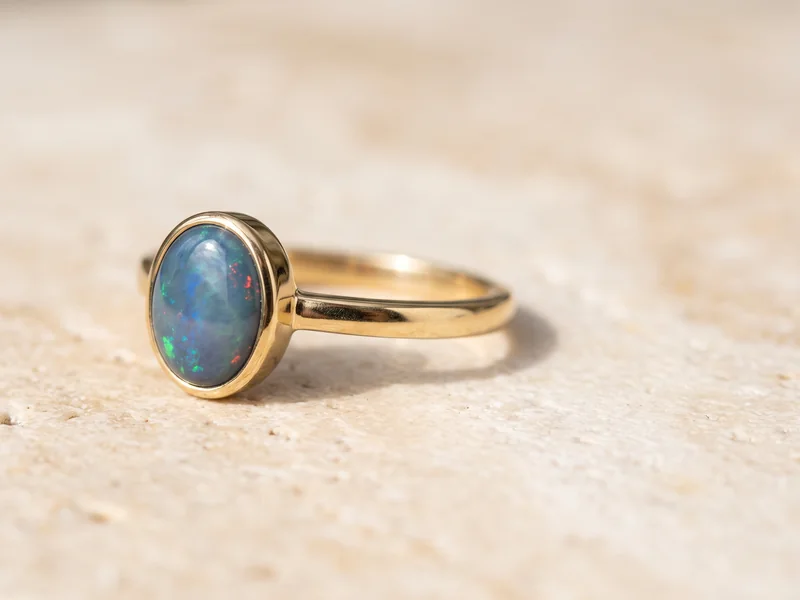
- Full bezel: a rim of metal around the whole edge. The most protective choice and the one most opal cutters recommend.
- Low profile: keep the stone close to the finger so it is less exposed to knocks.
- Halo: a ring of diamonds around the opal adds contrast and shields the girdle (the outer edge).
- Claws: possible for occasional-wear rings, but each claw must sit carefully so it does not put pressure on the opal.
- Pendants and earrings: take far less wear than rings, so they suit black opal very well.
Our guide to opal engagement rings and everyday wear covers settings, band styles and what to expect over the years in more detail.
How do you care for black opal jewellery?
Solid black opal from Lightning Ridge is generally stable, and a little care keeps it looking its best for decades:
- Cleaning: warm water, a drop of mild soap and a soft cloth or very soft brush. Rinse and dry straight away.
- Never use ultrasonic cleaners, steam cleaners, bleach or harsh chemicals; heat and vibration can crack opal.
- Doublets and triplets: wipe only with a damp cloth; never soak them, or the glue can fail and the stone can fog.
- Temperature: avoid sudden changes, such as hot water after a cold day, saunas and leaving jewellery on a sunny dashboard.
- Take it off for the gym, gardening, cleaning, swimming and anything with hard knocks.
- Storage: keep it separate in a soft pouch so harder gems and metal do not scratch it.
- Repolishing: a scratched or dull solid opal can usually be repolished by an opal cutter, losing only a tiny amount of weight.
Opal is also one of the two birthstones for October, which makes black opal a popular birthday gift. See our guide to opal and tourmaline as the October birthstones if you are weighing up the two.
How do you choose a black opal? Step by step
Whether you are buying a loose stone or a finished piece, the checks are the same. Ask whether the stone is natural or lab-created, solid or composite, and whether it has been treated, and expect a clear written answer.
Shop natural gemstones
- Confirm what it is. Natural solid opal, doublet, triplet or lab-created opal, and whether any treatment has been used.
- Check the body tone. Look at the face of the stone; true black opal is N1–N4. Ask for the N grade in writing.
- Judge brightness and colour. View it in daylight and under a single lamp. Bright colour beats lots of dull colour.
- Turn it through 360°. Make sure the colour shows from most angles and note the pattern.
- Look for faults. Use a loupe to check for crazing, windows, sand and potch lines across the face.
- Check the side profile. A straight, even join line suggests a doublet; a natural potch backing is irregular.
- Plan the setting. Choose a bezel or protective halo for a ring, and decide how often it will be worn before you commit.
Free consultation
Talk to a gemologist
Compare stones in person or online with Raj Sood, Graduate Gemologist (GIA), AJP (GIA).
Book a consultationShop this shape
FAQ
Common questions
What makes a black opal black?
Its dark body tone, graded N1–N4 on the Australian scale. The colour comes from the opal itself and its natural potch, not from the play-of-colour, which sits on top of that dark base.
Is black opal good for an engagement ring?
It can be, with care. Black opal is 5.5–6.5 on the Mohs scale and only fair in toughness, so a full bezel or protective halo, a low profile and taking it off for hard work all help it last.
Why is black opal so expensive?
Fine black opal comes almost entirely from one field, Lightning Ridge, and only a small share of what is mined shows bright colour on a dark base. Stones with red play-of-colour and a harlequin pattern are especially rare.
What is the difference between a black opal doublet and triplet?
A doublet is a thin slice of opal glued to a dark backing. A triplet adds a clear quartz or glass dome on top. Both cost much less than solid opal and should not be soaked in water.
Can black opal get wet?
Solid Lightning Ridge black opal can be rinsed and wiped with warm soapy water, but avoid long soaking, heat and chemicals. Doublets and triplets should only be wiped with a damp cloth.
Is lab-created black opal real opal?
Lab-created opal, such as Gilson, is made of silica like natural opal, but it is grown in a laboratory and must always be sold as lab-created or synthetic. Under magnification it often shows a columnar or lizard-skin pattern.

Ask a gemologist
Not sure which diamond to choose?
Raj Sood is a Graduate Gemologist (GIA) and master jeweller. Bring the stones you are considering, or send the reports, and he will tell you honestly which one is better and why.
Keep learning
Related guides
 GemstonesCrystal Opal
 GemstonesBoulder Opal
 GemstonesAustralian Opal Fields: Lightning Ridge, Coober Pedy and Queensland BoulderGemstonesAustralian Opal Engagement Rings: Wearability and CareGemstonesGemstones | Coloured Gemstones, Birthstones and Custom Jewellery
 GemstonesAustralian Opal Types Compared
 GemstonesFire Opal
 GemstonesWhite Opal
Explore more
More guides on this topic
Education