
Gemstones
Gemstone Care by Stone: How to Clean, Wear and Store Each Gem
Good gemstone care is not one routine for every stone. The cleaning that makes a sapphire sparkle can crack an opal or dry out an emerald, so here is what each gem can and cannot handle.
 Reviewed by Raj Sood, Graduate Gemologist (GIA), AJP (GIA)Master jeweller and Graduate Gemologist (GIA) · reviewed 4 November 2026
Quick answer
Gemstone care depends on three things: hardness, toughness and stability. Hard, tough stones such as diamond, sapphire, ruby and spinel handle warm soapy water and, if untreated, usually an ultrasonic cleaner. Emerald, opal, pearl, tanzanite and treated stones need gentle hand-washing only, no ultrasonic or steam, and protection from heat, chemicals and knocks.
What does gemstone care depend on?
Every gemstone has its own physical make-up, so the right gemstone care for a sapphire can be exactly the wrong thing for an emerald or an opal. When a gemmologist decides how to clean or repair a stone, three properties come first:
- Hardness: how well a stone resists scratching, measured on the Mohs scale from 1 (talc) to 10 (diamond). Household dust contains quartz, which sits at 7, so any gem softer than 7 slowly loses its polish with everyday wiping and wear.
- Toughness: how well a stone resists chipping and breaking. This is not the same as hardness. Jade is only about 6–7 on the Mohs scale but is extremely tough, while topaz is 8 but can split cleanly along its cleavage (a plane of weakness in the crystal) from one hard knock.
- Stability: how a stone reacts to heat, light, chemicals and sudden temperature changes. Some gems fade in strong sun, some crack under thermal shock, and many treatments break down in heat or acid.
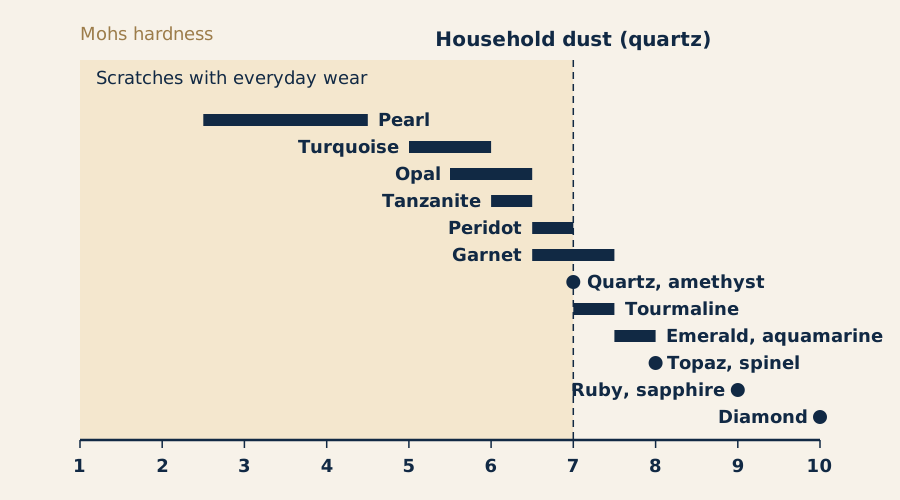
Hardness gets the most attention, and our full gemstone hardness guide covers the scale stone by stone. For rings worn every day, toughness and setting matter just as much, which is why we wrote a separate page on which stones survive daily wear in a ring. If a term here is new to you, our jewellery glossary of gem and setting terms explains it, and the coloured gemstones overview introduces each gem in more detail.
Gemstone care chart: how should you clean each stone?
This chart sums up the care rules for the stones we see most often at the bench. Treat it as a starting point: a treatment, a heavy inclusion or an old repair can make a normally sturdy stone fragile.
| Stone | Mohs hardness | Toughness | Ultrasonic | Steam | Main risk |
|---|---|---|---|---|---|
| Diamond (natural or lab-grown) | 10 | Good, but can cleave | Usually safe | Usually safe | Chips on thin edges; fracture-filled stones need gentle care |
| Ruby and sapphire | 9 | Excellent | Safe if untreated or heat-treated only | Usually safe | Glass-filled rubies damaged by heat and acids |
| Spinel | 8 | Good | Usually safe | Usually safe | Very few in normal wear |
| Topaz (including blue) | 8 | Poor (perfect cleavage) | Not recommended | No | Splits from a hard knock |
| Emerald | 7.5–8 | Poor to fair | Never | Never | Oil or resin in fissures dries out or leaks |
| Aquamarine and morganite | 7.5–8 | Good | Only if clean and inclusion-free | Not recommended | Heavily included stones can crack |
| Tourmaline | 7–7.5 | Fair | Not recommended | No | Heat and existing fractures |
| Amethyst and citrine | 7 | Good | Usually safe | Not recommended | Colour fading with long sun or heat |
| Garnet | 6.5–7.5 | Fair to good | Usually safe (not demantoid) | Not recommended | Sudden temperature change |
| Peridot | 6.5–7 | Fair | Not recommended | No | Acids, heat and scratching |
| Tanzanite | 6–6.5 | Fair to poor | Never | Never | Cleavage and thermal shock |
| Opal | 5.5–6.5 | Poor to fair | Never | Never | Crazing; doublet and triplet layers lifting |
| Turquoise | 5–6 | Fair | Never | Never | Porous; absorbs oils, perfume and detergent |
| Pearl | 2.5–4.5 | Fair to good | Never | Never | Acids, cosmetics, dryness and scratching |
Lab-created gems have the same chemistry and hardness as their natural counterparts, so a lab-created sapphire is cared for like a natural sapphire, and a lab-grown diamond like a natural diamond. The difference usually comes from what is inside: natural stones are more likely to carry fractures or treatments, which change the rules.
How do you clean diamonds, sapphires, rubies and spinel?
These are the low-maintenance stones. Diamond, natural or lab-grown, attracts skin oil and hand cream, so it dulls quickly but cleans up just as quickly. A soak in warm water with a drop of mild dishwashing liquid, a gentle scrub under the stone with a soft toothbrush and a rinse will bring back most of the brightness. Ruby and sapphire, both forms of the mineral corundum, are 9 on the Mohs scale and very tough, which is why they suit everyday rings so well.
The exception is treatment. Most sapphires and rubies are heated, which is stable and does not affect care. But some lower-priced rubies are fracture-filled with lead glass, meaning cracks have been filled with glass to improve clarity. That glass can be etched by acids as mild as lemon juice, damaged by an ultrasonic cleaner and cloudy or broken by a jeweller's torch. Some diffusion-treated sapphires have colour concentrated near the surface, so recutting or heavy repolishing can remove it. Our guide to how common gemstone treatments work explains what to look for on a report.
Spinel, at 8 on the Mohs scale with no cleavage and few treatments, is one of the easiest coloured stones to live with, which is part of the case for spinel as an engagement stone. Untreated spinel, diamond and corundum can usually go in an ultrasonic cleaner, but check the setting first: vibration can loosen a stone held by worn claws.
How do you clean an emerald ring without damaging it?
Emerald is 7.5–8 on the Mohs scale, but it is the most delicate of the hard gems because nearly every natural emerald has inclusions and small surface-reaching fissures. To improve clarity, most emeralds are oiled: the fissures are filled with cedarwood oil or a resin. That filling is what makes emerald care different.
- Do: wash in lukewarm (not hot) water with mild soap, brush gently and pat dry.
- Do not: use an ultrasonic cleaner, steam, hot water or solvents. They can push out or dissolve the oil and make fissures suddenly more visible.
- Do not: leave an emerald ring on while gardening, cleaning with chemicals or doing heavy lifting; a sharp knock can open an existing fissure.
- Re-oiling: if an emerald looks drier or more included than it used to, a gem professional can usually re-oil it. This is a known, routine process, not a sign the stone was misrepresented.
Emerald's relatives in the beryl family, aquamarine and morganite, are far less included and usually untreated apart from heating, so they handle normal wear much better. Emerald cuts with cut corners, or a protective setting such as a bezel, also help protect the stone's edges.
Not sure which one is right?
Send us the stones you are looking at and our gemologist will tell you which to choose and why.
Do gemstones fade in sunlight or heat?
A few gems are not fully colour-stable. The best-known is amethyst: prolonged strong sunlight or heat can slowly pale its purple, which is why it is wise not to leave amethyst jewellery on a sunny windowsill or in a hot car. Our page on why amethyst can fade and how to prevent it covers this in detail. Kunzite is even more light-sensitive and is often called an evening stone for that reason.
Other stones are stable in colour but sensitive to temperature change or knocks:
- Blue topaz: almost always irradiated and heated to create its colour. The colour is stable in normal wear, but topaz's perfect cleavage means it can split from a hard knock, so avoid ultrasonic and steam. See blue topaz treatment and care.
- Tanzanite: 6–6.5 on the Mohs scale, with one direction of perfect cleavage. Sudden temperature changes, such as hot water followed by cold, can cause thermal shock cracks.
- Peridot: 6.5–7, and sensitive to acids and to heat during repairs, so tell your jeweller it is peridot before any work.
- Opal: covered below, but also reacts badly to sudden temperature change.
How do you care for opal and pearl jewellery?
Opal and pearl are the two gems most likely to be damaged by well-meant cleaning. Opal is 5.5–6.5 on the Mohs scale and contains water in its structure, typically a few per cent and sometimes more. Sudden temperature changes or prolonged dry heat can cause crazing, a network of fine surface cracks. Solid opal can be wiped with a damp cloth and mild soap, but doublets and triplets (thin slices of opal glued to a backing, with a clear quartz or glass cap on triplets) should never be soaked, because water can seep into the glue line and make the layers cloudy or lift.
Because Australia produces most of the world's precious opal, we get asked about opal rings constantly. They can be worn daily with care and a protective setting; our guide to Australian opal engagement ring wearability sets out what that involves.
Pearls are organic, built from layers of nacre (calcium carbonate and protein) and only 2.5–4.5 on the Mohs scale. Perfume, hairspray, sunscreen, sweat and anything acidic will slowly dull their lustre. The rule is last on, first off: put pearls on after cosmetics and take them off before you exercise or swim. Wipe them with a soft damp cloth after wearing, store them flat so the silk does not stretch, and have strands restrung when the thread looks loose or discoloured. Our page on pearl care and restringing explains knotting and how often restringing is usually needed.
Can you put gemstones in an ultrasonic cleaner or steamer?
An ultrasonic cleaner vibrates a liquid at high frequency, shaking dirt loose from under settings. A steamer blasts hot, high-pressure steam. Both work well on sturdy stones and can do real damage to fragile or treated ones. Here is how the common cleaning methods compare:
| Method | Generally fine for | Avoid for |
|---|---|---|
| Warm water, mild soap, soft brush | Almost every gem, including most coloured stones | Pearl, turquoise and opal doublets (wipe only) |
| Ultrasonic cleaner | Untreated diamond, sapphire, ruby and spinel in secure settings | Emerald, opal, pearl, tanzanite, topaz, turquoise, any fracture-filled or included stone |
| Steam cleaner | Diamond, sapphire, ruby and spinel | Emerald, opal, pearl, tanzanite, topaz, peridot, tourmaline, amethyst |
| Commercial jewellery dip | Diamonds and hard stones if the label allows | Pearl, opal, turquoise, emerald and treated stones |
| Polishing cloth (metal only) | Metal surfaces around any stone | Rubbing directly on pearl or soft gems |
Even on a safe stone, ultrasonic vibration can shake loose a stone held by worn claws, and small pavé stones are the first to go. Our page on ultrasonic cleaner safety stone by stone goes into the exceptions.
Related guideCan Every Gemstone Go in an Ultrasonic Cleaner?How do settings and ring styles affect gemstone care?
Most stones are not lost because they break; they are lost because the metal holding them wears. Claws thin with years of contact, and a knock can bend one just enough to let a stone rattle. If you can hear a faint click when you tap the ring, or a stone moves when you press it, stop wearing it and have it looked at. Our guide to checking and tightening loose stones explains what a jeweller does, and the guide to how each setting style holds a stone shows which settings protect soft or brittle gems.
Mixed-stone rings need extra thought, because the care routine has to suit the most delicate stone in the piece. A sapphire centre with emerald accents should be cleaned as an emerald ring. The same applies to side-stone ring designs and three-stone engagement rings, and especially to the two-stone toi et moi style, where diamond can sit right against a softer gem; see pairing two different stones in a toi et moi.
If a setting is worn beyond repair or you want to remodel, the stones can be measured and the ring captured digitally first; our page on scanning a ring before CAD remodelling explains the process. For a full routine covering both stone and metal, read our engagement ring care routine.
How should you store gemstone jewellery, and which stones suit everyday wear?
Harder stones scratch softer ones, so a jewellery box where everything is jumbled together is where a lot of quiet damage happens. Diamond will scratch every other gem, and sapphire will scratch almost everything except diamond. Practical storage rules:
- Keep each piece in its own soft pouch or compartment.
- Store pearls flat and away from airtight plastic, which can trap moisture or dry them out depending on conditions.
- Keep opals and amethyst out of direct sun and away from heaters.
- Take rings off before the gym, gardening, cleaning or swimming; chlorine can attack gold alloys and the solder joints in settings.
- Do not leave rings on the edge of a basin; most losses start with a slip down the drain.
If you are choosing a stone and want the least fuss, sapphire, ruby and spinel are the most forgiving coloured gems for daily wear, with garnet and aquamarine close behind for careful wearers. Emerald, opal, tanzanite and pearl can still be worn often, but they suit protective settings and an owner happy to take them off for rough tasks. Our guide to choosing a coloured gemstone engagement ring weighs colour, meaning and durability together.
Browse natural gemstones
How do you clean gemstone jewellery at home? Step by step
- Identify the stones. Check every stone in the piece, including accents, and whether any are treated, filled, doublets or pearls.
- Plug the sink. Clean over a bowl or a closed drain, never an open plughole.
- Mix a gentle bath. Lukewarm water and a few drops of mild dishwashing liquid. No bleach, ammonia, vinegar or toothpaste.
- Soak or wipe. Hard, untreated stones can soak for 10–20 minutes. Emerald, tanzanite and solid opal get a short dip; pearls, turquoise and opal doublets only a damp cloth.
- Brush gently. Use a soft toothbrush under the stone, where oil and soap build up, without levering the claws.
- Rinse and dry. Rinse in water of the same temperature to avoid thermal shock, then pat dry with a lint-free cloth.
- Check the setting. Look and listen for any movement, and book a professional check every 6–12 months.
Free consultation
Talk to a gemologist
Compare stones in person or online with Raj Sood, Graduate Gemologist (GIA), AJP (GIA).
Book a consultationShop this shape
FAQ
Common questions
How do you clean gemstones without damaging them?
Use lukewarm water, a few drops of mild dishwashing liquid and a soft toothbrush, then rinse and pat dry. This is safe for almost every gem; pearls, turquoise and opal doublets should only be wiped with a damp cloth.
Can you put gemstones in an ultrasonic cleaner?
Only some. Untreated diamond, sapphire, ruby and spinel in secure settings usually can, but emerald, opal, pearl, tanzanite, topaz, turquoise and any fracture-filled stone should never go in one.
Do gemstones fade in sunlight?
Most do not, but amethyst and kunzite can slowly pale with long exposure to strong sun or heat. Store them out of direct light and avoid leaving them in hot cars.
How often should gemstone rings be checked by a jeweller?
Every 6–12 months is a sensible interval for rings worn daily. Claws wear gradually, and catching a thin or bent claw early is far easier than replacing a lost stone.
Can I wear my gemstone ring in the shower or pool?
It is better not to. Soap leaves a dulling film, chlorine can damage gold alloys, and water and temperature changes are hard on opal, emerald and pearl.
Do lab-created gemstones need different care from natural ones?
Not usually. A lab-created sapphire or a lab-grown diamond has the same hardness and chemistry as the natural stone, and is often freer of fractures and fillings, so it follows the same care rules or slightly easier ones.
Terms in this guide

Ask a gemologist
Not sure which diamond to choose?
Raj Sood is a Graduate Gemologist (GIA) and master jeweller. Bring the stones you are considering, or send the reports, and he will tell you honestly which one is better and why.
Keep learning
Related guides
 GemstonesCan Every Gemstone Go in an Ultrasonic Cleaner?
 GemstonesGemstone Hardness Guide
 GemstonesTreated vs Untreated Gemstones
 GemstonesGemstone Durability for Everyday RingsGemstonesGemstones | Coloured Gemstones, Birthstones and Custom Jewellery
 Care, Repairs & RemodellingEngagement Ring Care GuideCare, Repairs & RemodellingLoose Stones and Stone Tightening
 Engagement Rings & SettingsSide-Stone Engagement Rings
Explore more
More guides on this topic
Education