
Gemstones
Boulder Opal Guide: Colour, Origins, Value and Ring Wear
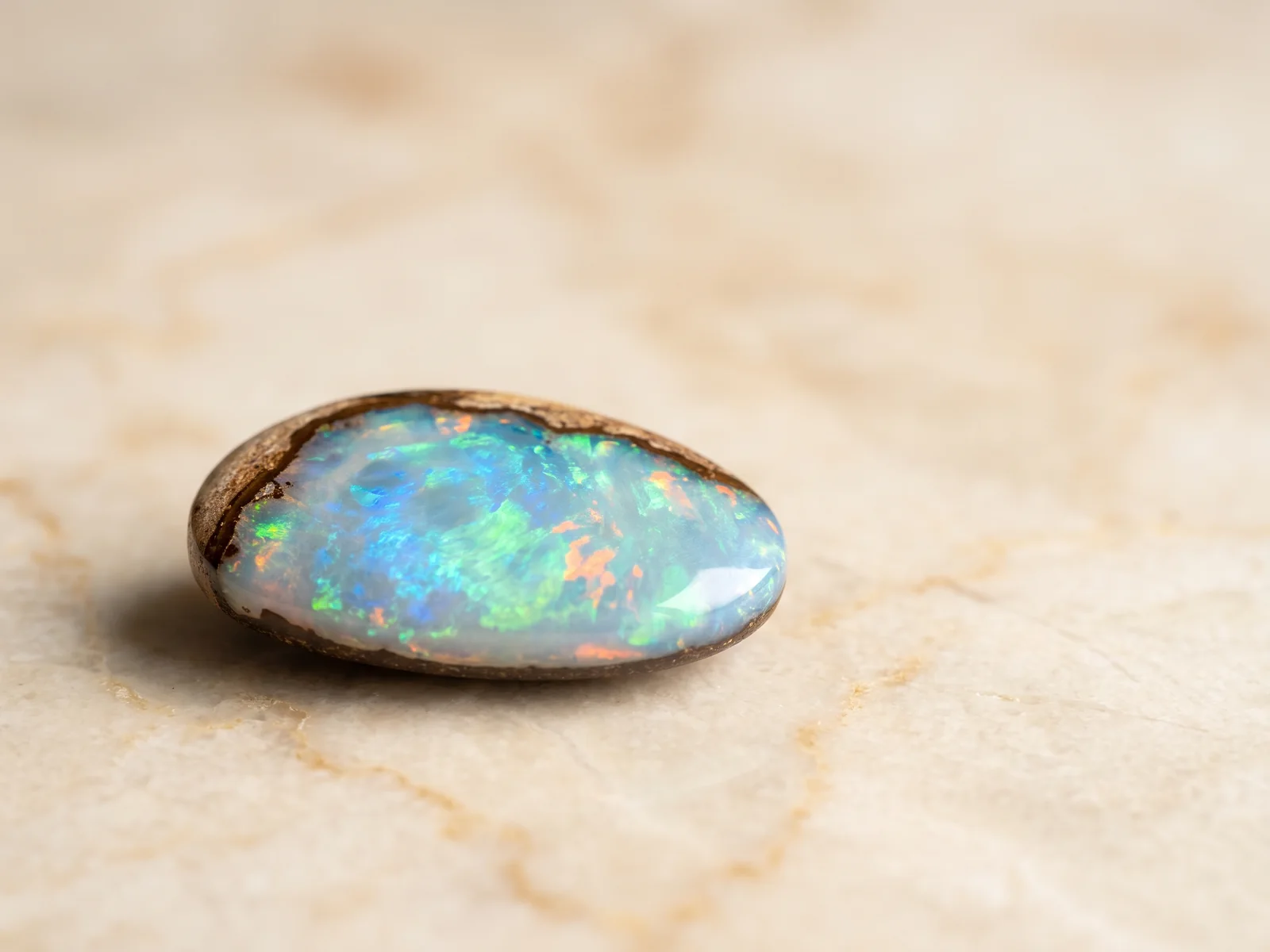
Boulder opal is Queensland's own opal, cut with its ironstone host rock still on the back. Here is how to judge its colour, tell it from a doublet, understand the price and decide whether it will survive life on your hand.
 Reviewed by Raj Sood, Graduate Gemologist (GIA), AJP (GIA)Master jeweller and Graduate Gemologist (GIA) · reviewed 4 November 2026
Quick answer
Boulder opal is natural precious opal that forms in thin seams inside ironstone boulders in western Queensland. It is cut with its dark ironstone backing left on, which makes the colour look vivid. It rates 5.5–6.5 on the Mohs scale, so it suits pendants, earrings and carefully worn rings in a protective bezel setting.
What is boulder opal?
Boulder opal is precious opal that formed inside ironstone, a brown, iron-rich sedimentary rock, in the opal fields of western Queensland. The opal usually sits in thin seams or cracks, often only a millimetre or two thick. Instead of grinding the ironstone away, the cutter follows the seam and leaves the host rock on the back. That natural dark backing is what makes a boulder opal's colour look so strong. It is one of several Australian opal types covered in our guide to coloured gemstones, and the best-known type routinely sold still attached to the rock it grew in.
Play-of-colour is the flashing spectral colour that defines precious opal, and it is different from ordinary body colour. Opal is hydrated silica (SiO2·nH2O) and typically holds about 3–10% water. Under an electron microscope, precious opal is made of tiny silica spheres, roughly 150–300 nanometres across, stacked in an orderly grid. Light diffracts through the gaps between them and splits into colours. Larger spheres can produce red; smaller spheres can only produce blue and violet, which is why red is the rarest flash. Our page on the chemistry of opal compared with diamond, sapphire and other gems explains how this differs from crystalline stones.
Opal is amorphous, meaning it has no crystal structure. So it has no cleavage, a single refractive index of about 1.45 and a specific gravity of around 2.15. Ironstone is much denser, so a boulder opal often feels heavier in the hand than a solid opal of the same size. If any of these terms are new, our plain-English jewellery glossary has short definitions.
What colours does boulder opal come in?
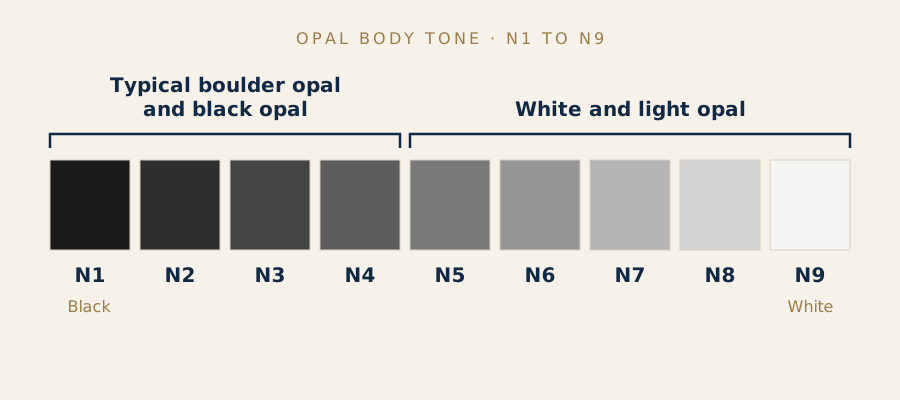
Two things decide how a boulder opal looks: its body tone (how dark or light the background is) and its play-of-colour (the flashes on top). The Australian opal trade describes body tone on a scale from N1 (black) to N9 (white). Because the opal layer is thin and the ironstone shows through, most boulder opal faces up dark, around N1–N4, which is the same visual effect that makes Lightning Ridge black opal so sought after. Thicker seams, or seams with a pale opal layer, can face up lighter.
Play-of-colour can show any spectral colour. In rough order of rarity:
- Red: the rarest and most valued flash, especially across the whole face.
- Orange and yellow: less common than green, and they lift the price noticeably.
- Green: common in bright boulder opal and very attractive on a dark tone.
- Blue and violet: the most common flashes; a stone showing only blue usually sits at the commercial end.
The pattern matters too. Common names include pinfire (tiny points of colour), broad flash (large sheets that switch on and off as the stone moves), rolling flash (a band of colour that sweeps across the face), harlequin (a rare mosaic of angular patches) and ribbon or floral patterns. Boulder opal also often shows lines of ironstone running through the face. These are natural and give each stone a one-off look, though a clean face usually costs more.
What is the difference between boulder opal and boulder matrix opal?
Queensland produces several related materials, and the names are worth knowing because they price very differently:
- Boulder opal: a distinct seam or layer of precious opal on ironstone, cut so the opal forms the face and the ironstone the back.
- Boulder matrix opal: opal spread through the pores and fine cracks of the ironstone itself, so colour and rock are mixed together across the face. It looks like a painting in brown and colour.
- Yowah nuts: small, walnut-sized ironstone concretions from the Yowah field, sometimes with a kernel of opal in the centre. They are often cut in half to reveal it.
- Koroit opal: from the Koroit field near Yowah, known for intricate swirls and patterns of opal through the ironstone.
- Split pairs: a boulder split along the seam gives two mirror-image halves, which are often set as matching earrings or cufflinks.
Boulder matrix is natural and untreated, and it should not be confused with Andamooka matrix opal from South Australia, which is a porous material often treated with sugar and acid to darken it. That treatment must be disclosed.
Where is Queensland boulder opal found?
Queensland boulder opal comes from a belt of opal-bearing country that runs roughly from the Winton district in the north to near the New South Wales border in the south, a distance of around 1,000 kilometres. Well-known fields include Winton, Opalton, Jundah, Quilpie, Eromanga, Yowah and Koroit. The opal sits in deeply weathered sediments, where silica-rich water seeped into cracks in ironstone boulders and slowly set as opal. Geologists still debate exactly when and how quickly it formed.
Most boulder opal is mined from open cuts with excavators rather than the narrow shafts used at Lightning Ridge, and miners often have to split many boulders to find one with a usable seam. For a side-by-side look at each region, see our page on Lightning Ridge, Coober Pedy and the Queensland boulder fields. Opal was proclaimed Australia's national gemstone in 1993, and Australia still supplies most of the world's precious opal, although Ethiopia has become a significant source. Our comparison of how Australian opal types compare with Ethiopian opal covers the differences in stability and price.
Not sure which one is right?
Send us the stones you are looking at and our gemologist will tell you which to choose and why.
How does boulder opal compare with black opal and other opals?
| Opal type | Main source | Body tone | Backing | Typical cut | Relative price |
|---|---|---|---|---|---|
| Boulder opal | Western Queensland | Mostly dark (N1–N4) | Natural ironstone | Free-form, often flat or wavy | Moderate to high |
| Black opal | Lightning Ridge, NSW | Dark (N1–N4) | None; solid opal with dark potch | Solid cabochon | Highest for top stones |
| White opal | Coober Pedy, SA | Light (N5–N9) | None | Solid cabochon | Lower to moderate |
| Crystal opal | Several Australian fields | Transparent to translucent | None | Solid cabochon | Moderate |
| Fire opal | Mainly Mexico | Transparent yellow to red body colour | None | Faceted or cabochon | Low to moderate |
| Ethiopian (Welo) opal | Ethiopia | Mostly light | None | Cabochon | Low to moderate |
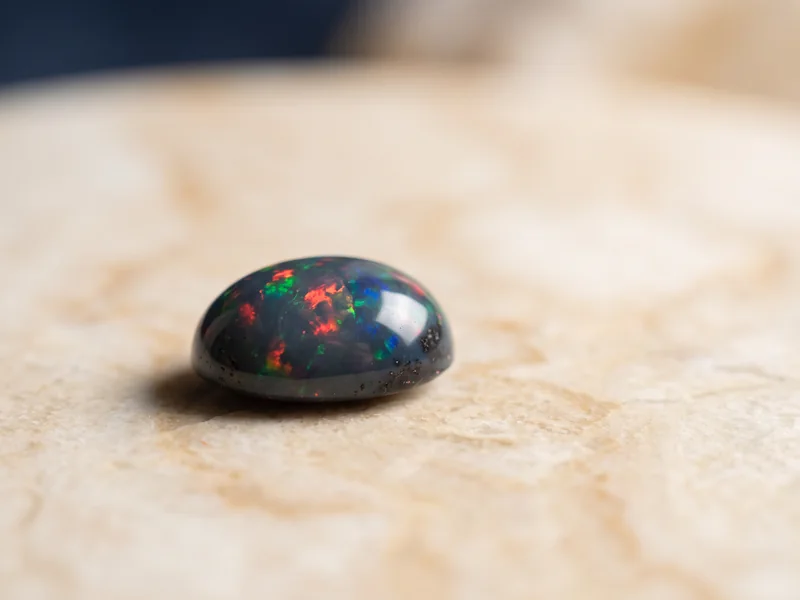
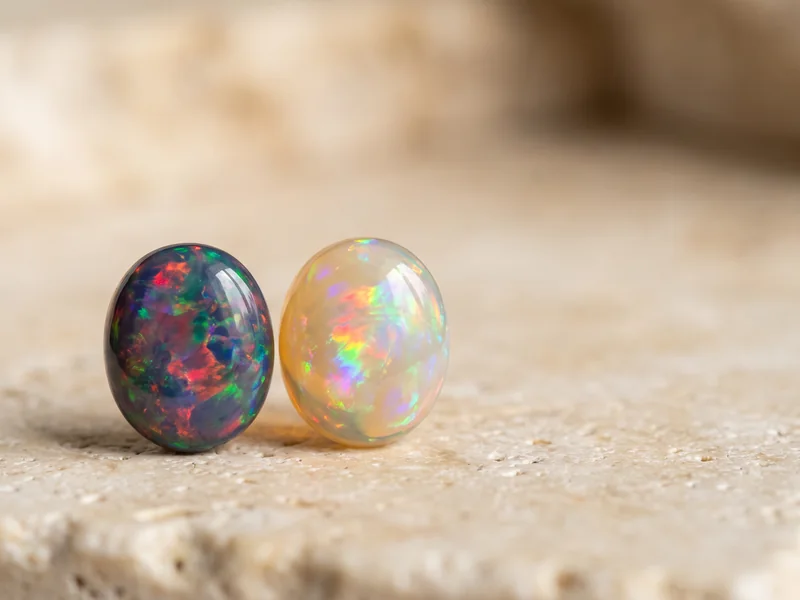
The closest comparison is boulder opal vs black opal. Both face up dark and show vivid colour, but black opal is solid opal throughout, with a dark opal layer called potch (opal without play-of-colour) behind the colour bar. Boulder gets the same effect from ironstone. A solid black opal can be cut into a neat symmetrical dome; boulder opal is usually cut free-form to keep as much of the thin seam as possible, so you see more baroque shapes.
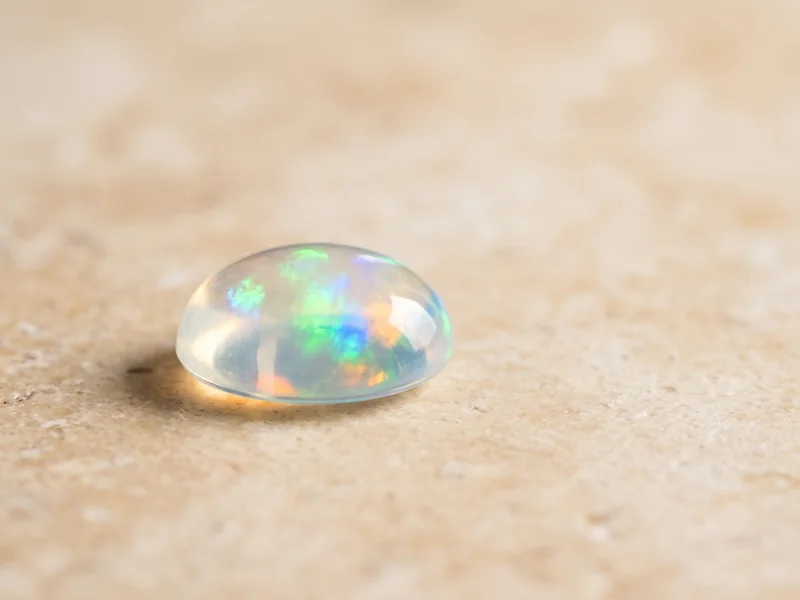
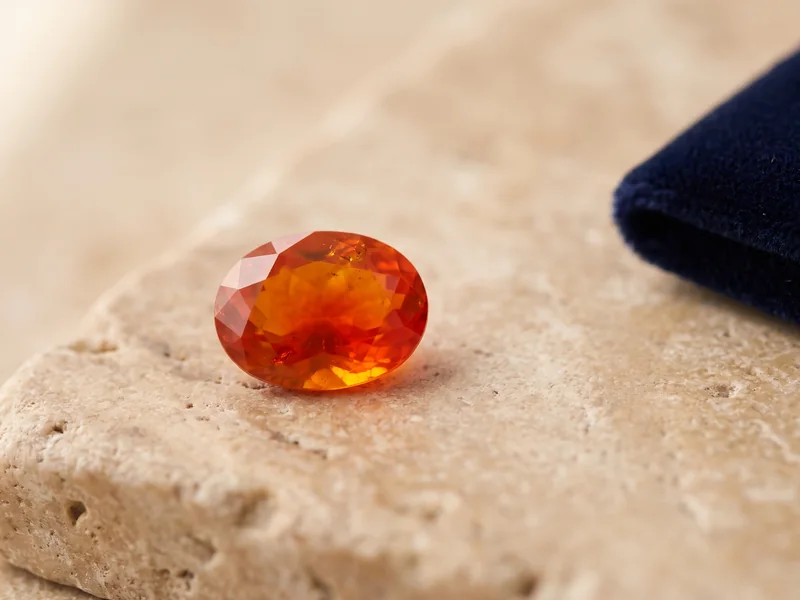
Lighter Australian opals look very different. Milky white opal from Coober Pedy has a pale body that softens its colours, while transparent crystal opal lets light pass through for a glowing, three-dimensional effect. Mexican fire opal is valued mainly for its orange to red body colour and may show little or no play-of-colour at all.
Is boulder opal hard enough for a ring?
Two separate properties matter. Hardness, measured on the Mohs scale, is resistance to scratching. Toughness is resistance to chipping and cracking. Boulder opal is 5.5–6.5 in hardness, which is softer than quartz (7), the main mineral in household dust and sand. Over years of wear, that dust will dull a polished opal surface. Here is how it sits against other ring stones:
| Gemstone | Mohs hardness | Toughness | Everyday ring? |
|---|---|---|---|
| Diamond | 10 | Good (can cleave) | Yes |
| Moissanite | 9.25 | Excellent | Yes |
| Sapphire | 9 | Excellent | Yes |
| Chrysoberyl | 8.5 | Excellent | Yes |
| Iolite | 7–7.5 | Fair (cleavage) | With care |
| Kunzite | 6.5–7 | Poor (perfect cleavage) | Occasional wear |
| Boulder opal | 5.5–6.5 | Fair; ironstone backing adds support | With care, protective setting |
| Solid black or white opal | 5.5–6.5 | Fair to poor | Occasional wear |
| Lapis lazuli | 5–5.5 | Fair | Occasional wear |
The ironstone backing gives boulder opal a real advantage over a thin solid opal: it acts like a built-in support plate, so the stone is less likely to snap under pressure. Queensland boulder opal also has a reputation for being stable, meaning it rarely crazes (develops a network of fine surface cracks) as some opal from other sources can. It is still a soft stone. If you want colour that shrugs off daily knocks, moissanite, chrysoberyl and its cat's-eye variety or sapphire are far harder. Softer or more fragile choices such as violet-blue iolite, pink kunzite and deep blue lapis lazuli need the same kind of care as opal.
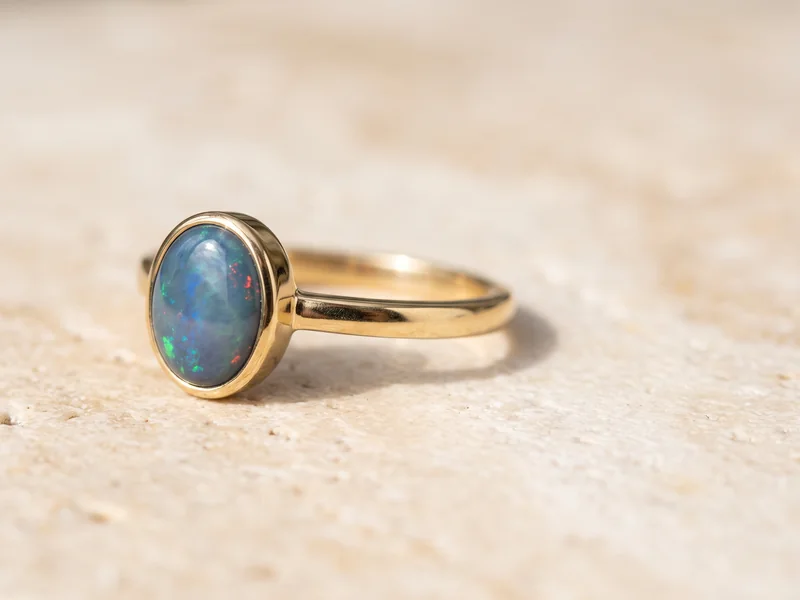
For a boulder opal ring or boulder opal engagement ring, choose a full bezel (a rim of metal around the whole edge) or a raised rim with a low profile, so the face sits slightly below the metal. Avoid thin, exposed edges and claws that leave the sides open. Take it off for gardening, the gym, cleaning and the beach. A worn surface can usually be re-polished by a jeweller, though that removes a little opal from what may be a thin seam. Our guide to opal engagement ring wearability goes further into daily-wear choices.
Related guideAustralian Opal Engagement Rings: Wearability and CareIs boulder opal natural or treated?
True boulder opal is natural: the ironstone backing grew with the opal and is not glued on. It is rarely treated, though cracks may occasionally be filled with resin or oil, which should be disclosed. The more common risk is an assembled stone or an imitation described loosely enough to confuse a buyer:
- Doublet: a thin slice of opal glued to a backing of black potch, ironstone, glass or plastic. Ironstone-backed doublets can look very like boulder opal from the front.
- Triplet: a doublet with a clear quartz or glass dome glued on top to protect the thin opal and magnify the colour.
- Lab-created opal: also called synthetic opal, grown in a laboratory (for example, Gilson-type material). It has a real opal structure but did not form in the ground.
- Imitations: plastic, resin and glass products that copy the look of opal but are not opal at all.
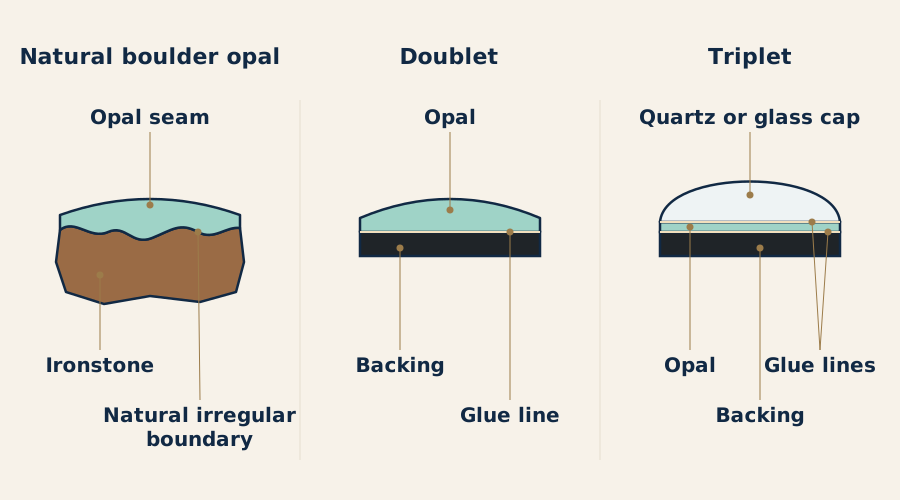
A gemmologist separates these mainly by eye and magnification. In natural boulder opal, the boundary between opal and ironstone is wavy and uneven, and the back often shows raw ironstone texture or small patches of colour. A doublet shows a perfectly flat join and a uniformly smooth, often black back. A triplet looks glassy, with colour that seems to sit under a lens, and the top may feel cooler and harder. Lab-created opal tends to show a regular mosaic pattern, sometimes described as lizard skin or chicken wire, when magnified face-on, and a columnar structure when viewed from the side. Plastic imitations are noticeably light and can be indented with a pin, a test only a lab should try.
Under Australian opal nomenclature, doublets, triplets and lab-created opal must be described as such. A seller should be happy to note on the receipt or valuation that a stone is natural boulder opal.
What affects boulder opal value and price per carat?
Opal is not graded on a single international scale like diamond, so value comes down to a set of factors that experienced buyers weigh together:
- Brightness: the single biggest factor. A bright stone at arm's length in ordinary light is worth many times a dull one.
- Colour: red flash is rarest, then orange and yellow, then green, then blue.
- Pattern: harlequin and strong rolling flash command premiums; pinfire and small broad flash are more common.
- Body tone: darker tones (N1–N3) usually make colour look stronger and price higher.
- Face: a clean face with no ironstone intrusions, sand or cracks is worth more than one broken up by rock.
- Colour bar thickness: a thicker seam is more durable and can be re-polished; a paper-thin film is more fragile.
- Shape and cut: even, well-domed shapes that suit a setting sell for more than awkward free-forms.
- Size: larger clean faces are rarer, but heavy ironstone backing can inflate carat weight.
| Quality level | What you see | Approximate price range (AUD per carat) |
|---|---|---|
| Commercial | Dull to moderate, mostly blue or green, ironstone in the face | about $10–$100 |
| Good | Bright blue-green, some orange, mostly clean face | about $100–$500 |
| Fine | Bright multicolour including red, dark tone, clean face | about $500–$2,500 |
| Exceptional | Brilliant, red-dominant, strong pattern, larger size | about $2,500–$10,000 or more |
These are broad ranges only. Because the ironstone adds weight without adding beauty, many boulder opals are priced per piece rather than per carat, so always compare face size in millimetres as well as weight. Opal is also a traditional October stone; our guide to opal and tourmaline as October birthstones covers both options for birthday jewellery.
Browse natural gemstones
How do you choose and look after a boulder opal?
- Look in different light. Check the stone in daylight, under a desk lamp and in shade, rotating it slowly. Good boulder opal stays bright in all three.
- Check the side profile. Look for a natural, uneven opal-to-ironstone boundary rather than a flat glue line.
- Get it in writing. Ask for the stone to be described as natural boulder opal, not a doublet, triplet or lab-created opal.
- Inspect the face and edges. Use a loupe or zoom photo to look for cracks, crazing or ironstone breaking the colour.
- Choose a protective setting. A full bezel or raised rim suits rings; pendants and earrings face far fewer knocks.
- Clean gently. Use warm water, a drop of mild detergent and a soft brush, then dry with a soft cloth.
- Avoid harsh cleaning. No ultrasonic or steam cleaners, no bleach or chemicals, and no sudden heat changes.
- Store it separately. Keep it in a soft pouch so harder gems and metal cannot scratch it, and have ring settings checked about once a year.
Free consultation
Talk to a gemologist
Compare stones in person or online with Raj Sood, Graduate Gemologist (GIA), AJP (GIA).
Book a consultationShop this shape
FAQ
Common questions
Is boulder opal real opal?
Yes. Boulder opal is natural precious opal that formed in ironstone, and the ironstone backing is part of the natural stone rather than glued on. Doublets and lab-created opal are different products and must be described as such.
Is boulder opal more valuable than black opal?
Top black opal from Lightning Ridge usually commands the highest prices of any opal, but fine boulder opal with bright red flash can be very valuable too. Quality matters far more than type: a bright boulder opal is worth more than a dull black opal.
Can you wear a boulder opal ring every day?
You can with care. At 5.5–6.5 on the Mohs scale it will gradually scratch, so choose a bezel setting, take it off for rough tasks and expect to have it re-polished over the years.
Can boulder opal get wet?
Natural boulder opal is fine with water, and gentle washing in warm soapy water is the usual way to clean it. Doublets and triplets should not be soaked, because water can get into the glue layer and cloud it.
Why is boulder opal cut in free-form shapes?
The opal seam is usually thin and follows the shape of the crack it filled, so cutters follow its contours to keep as much colour as possible. Cutting to a standard oval would often waste most of the opal.
How can I tell boulder opal from a doublet?
Look at the side: natural boulder opal has a wavy, irregular boundary between opal and ironstone, while a doublet has a flat, straight glue line. If you are unsure, ask a gemmologist to check it under magnification.

Ask a gemologist
Not sure which diamond to choose?
Raj Sood is a Graduate Gemologist (GIA) and master jeweller. Bring the stones you are considering, or send the reports, and he will tell you honestly which one is better and why.
Keep learning
Related guides
 GemstonesBlack Opal
 GemstonesAustralian Opal Fields: Lightning Ridge, Coober Pedy and Queensland BoulderGemstonesAustralian Opal Engagement Rings: Wearability and Care
 GemstonesAustralian Opal Types ComparedGemstonesGemstones | Coloured Gemstones, Birthstones and Custom Jewellery
 GemstonesCrystal Opal
 GemstonesFire Opal
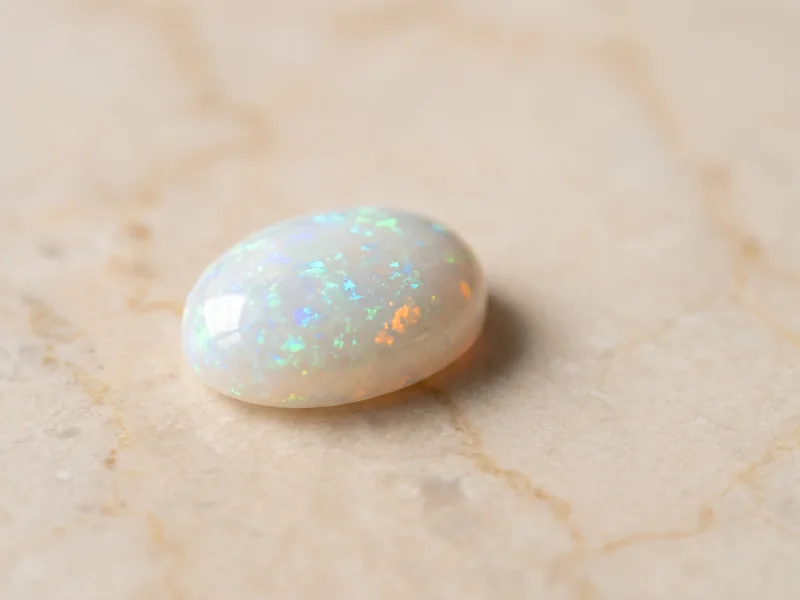 GemstonesWhite Opal
Explore more
More guides on this topic
Education