
- Education
- Lab-Grown Diamonds
- Choosing a 2 Carat Lab-Grown Diamond: Size, Grades and AUD Prices
Lab-Grown Diamonds
Choosing a 2 Carat Lab-Grown Diamond: Size, Grades and AUD Prices
Lab-grown diamond has put a two-carat stone within reach of many more people, and at this size the details you could ignore at one carat start to show. Here is how to choose a 2 carat lab-grown diamond that looks its size, faces up white and clean, and comes with a report you can trust.
 Reviewed by Raj Sood, Graduate Gemologist (GIA), AJP (GIA)Master jeweller and Graduate Gemologist (GIA) · reviewed 4 November 2026
Quick answer
A 2 carat lab-grown diamond is real diamond grown by CVD or HPHT. A well-cut round measures about 8.0–8.2 mm across. Aim for an Excellent or Ideal cut, G colour or better in white metal, eye-clean VS2 or better, and an IGI or GIA report. Expect roughly AUD $1,500–$5,000, far less than a natural 2 carat.
What is a 2 carat lab-grown diamond?
A 2 carat lab-grown diamond is a diamond weighing 2.00 carats (0.40 grams; one carat is 0.2 grams) that was grown in a laboratory instead of mined. It is not a simulant like cubic zirconia or moissanite. It is crystallised carbon with the same atomic structure as a natural diamond, the same hardness (10 on the Mohs scale) and the same refractive index of about 2.42, which is the measure of how strongly it bends light. If you want the science behind that, read why lab-grown diamonds are real diamond.
Lab-grown diamonds are made in one of two ways. CVD (chemical vapour deposition) builds the crystal layer by layer from a carbon-rich gas onto a thin diamond seed plate. HPHT (high pressure, high temperature) recreates the crushing pressure and heat deep in the earth inside a large press. Both produce real diamond in a matter of weeks. Our explainer on how CVD and HPHT diamonds are grown goes through each step.
Two carats is a size where lab-grown has changed the conversation. A natural 2 carat diamond of good colour and clarity costs about as much as a small car; a lab-grown one of similar grades costs a small fraction of that. That price gap means many people who would have looked at a 1 carat natural stone now compare it with a 2 carat lab-grown one. For the bigger picture on origin, value and disclosure, start with our complete lab-grown diamonds guide, and if any term on this page is new to you, our plain-English jewellery glossary explains it.
How big is a 2 carat lab-grown diamond in mm?
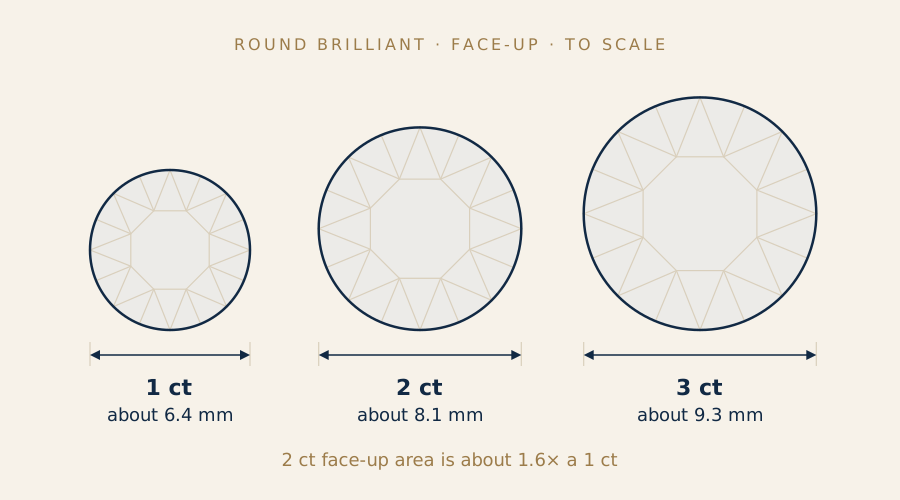
Carat is weight, not size, so what you actually see depends on the shape and how the stone is cut. A well-cut 2 carat round brilliant measures about 8.0–8.2 mm across. A 1 carat round is about 6.4–6.5 mm, so doubling the weight increases the diameter by only about a quarter and the face-up area (the area you see from above) by about 1.6 times. A 2 carat stone looks clearly bigger than a 1 carat, but not twice as big.
| Shape (2 ct) | Typical size | How it faces up |
|---|---|---|
| Round | about 8.0–8.2 mm | The benchmark; most sparkle per millimetre |
| Oval | about 10.0–10.5 × 7.0–7.5 mm | Looks larger than a round; elongates the finger |
| Pear | about 11.0 × 7.0 mm | Long outline; point needs protecting |
| Marquise | about 13.0–13.5 × 6.5–7.0 mm | Largest-looking outline per carat |
| Emerald | about 9.0 × 6.5 mm | Step-cut; shows clarity and colour more |
| Radiant | about 8.0 × 6.5 mm | Brilliant sparkle in a rectangle |
| Cushion | about 7.3–7.8 × 7.0 mm | Often cut deep, so can look smaller |
| Princess | about 6.8–7.0 mm square | Compact; sharp corners need claws |
These are typical figures for stones with standard proportions. Our page on lab-grown carat sizes from 1 to 5 carats shows how each shape grows across the range. If you are deciding between sizes, compare this page with our guide to choosing a 1 carat lab-grown diamond, see what an extra half carat adds in our 2.5 carat diamonds guide, or read about the jump when you step up to a 3 carat lab-grown stone.
On the hand, a 2 carat round covers a large share of the finger's width on an average Australian ring size such as M to O, and on a slim finger it can reach close to half. Elongated shapes run along the finger instead of across it, which is one reason a 2 carat oval lab-grown diamond is a popular choice. Our guides to oval diamonds and their ratios, the pear cut and its point and the long, two-pointed marquise cover each outline in detail, and which shapes look biggest for their weight puts the face-up numbers side by side. For every shape at a glance, see our overview of the main diamond shapes.
Related guideChoosing a 1 Carat Lab-Grown DiamondWhich cut grade and proportions matter most at 2 carats?
Cut is the quality of the angles, proportions and finish, and it decides how much light the diamond returns as brightness and sparkle. At 2 carats the facets are large enough that a poor cut shows quickly: dark patches, a glassy look or a stone that looks smaller than its weight. For rounds, choose an Excellent cut grade on a GIA report or Excellent or Ideal on an IGI report, with Excellent or Very Good polish and symmetry.
As a rough guide, many well-cut rounds sit at a total depth of about 59–62.5%, a table (the large flat top facet) of about 54–58%, a crown angle of about 34–35° and a pavilion angle of about 40.6–41°. Fancy shapes such as ovals and cushions do not get an overall cut grade from GIA, so judge them from the measurements, the ratio and a 360° video.
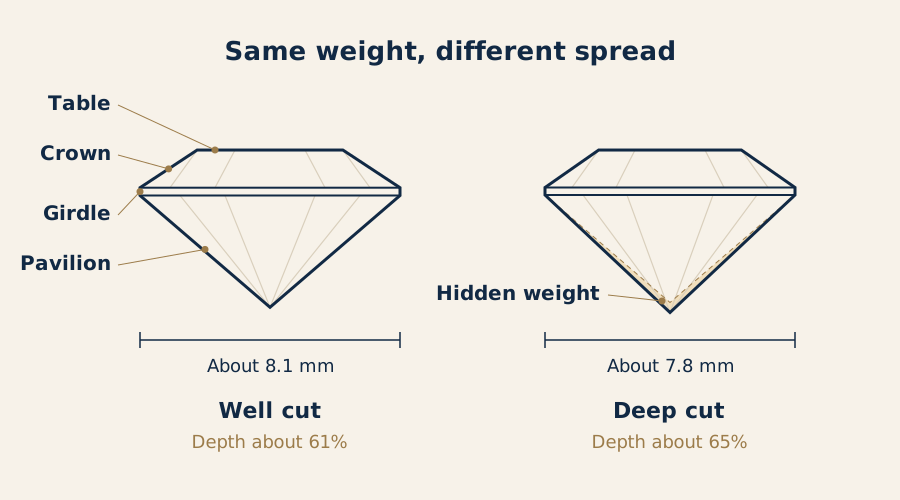
Watch for spread, meaning how wide a stone is for its weight. Some lab-grown rough is cut deep to hold on to weight and reach the 2.00 carat mark. A deep 2 carat round can measure 7.8 mm or less across and look like a 1.8 carat stone. A very shallow one spreads wide but leaks light and can look flat. That is why the millimetre measurements on the report matter as much as the carat weight. Our guide to 2 carat diamonds, natural and lab-grown compares how proportions affect face-up size across both types.
What colour and clarity should a 2 carat lab-grown diamond have?
Colour in white diamonds is graded from D (colourless) down the alphabet as a yellow or brown tint increases. A larger stone has a longer path for light to travel, so body colour is easier to see at 2 carats than at 1. Because lab-grown colour grades cost much less to step up than natural ones, many people choose F or G for a white-metal setting. H can still look white in a well-cut round, especially once it is set.
Clarity describes inclusions, the tiny internal features left by growth. At 2 carats the table of a round is about 4.4–4.8 mm wide, a window large enough that an SI1 or SI2 inclusion may be visible without magnification. The goal is an eye-clean stone: nothing you can see from about 25–30 cm away. Lab-grown inclusions are different from natural ones; CVD stones can show dark pinpoints of non-diamond carbon, and HPHT stones can contain small metallic flux inclusions left by the metal used in the growth process.
| Shape and metal | Colour to aim for | Clarity to aim for |
|---|---|---|
| Round in platinum or white gold | F–H | VS2 or better; SI1 only if checked eye-clean |
| Round in yellow or rose gold | G–J | VS2 or better; SI1 only if checked eye-clean |
| Oval, pear, marquise, radiant, cushion | F–G (shapes with points hold colour) | VS2 or better |
| Emerald or Asscher (step cuts) | F–G | VS1 or better; the open facets show everything |
Lab-grown diamonds can also show tints that are less common in natural stones. Some CVD diamonds have a faint grey or brown tone, and some HPHT stones have a slight blue tinge from traces of boron. A report grade will not always capture this, so look at the stone in daylight next to a white card. Tints and growth features can become more noticeable as size climbs, as our page on what changes once lab-grown diamonds pass 3 carats explains.
Not sure which one is right?
Send us the stones you are looking at and our gemologist will tell you which to choose and why.
Does CVD or HPHT matter for a 2 carat stone?
Neither method is better by default. Both can produce excellent 2 carat diamonds, and both can produce poor ones. What matters is the individual stone: its cut, colour, clarity and how it looks in person. The method is printed on most lab-grown reports, so you will see it, but it should be a footnote in your decision, not the headline.
- CVD: often grown as flat, tabular crystals. Many CVD stones are given a post-growth treatment (usually an HPHT anneal) to improve colour, which the report should note. Some show graining, faint internal lines from the layered growth, which is rarely visible without magnification.
- HPHT: grows in a cube-octahedral crystal shape. Stones are often very white but may contain metallic flux inclusions and can sometimes glow (phosphorescence) briefly after strong UV light. Some have a slight blue tint.
- As-grown: a term some reports and sellers use for a diamond that has not been treated after growth. It is not automatically better; it simply describes what was done.
Post-growth treatment is permanent and does not affect durability or everyday wear. It must, however, be disclosed, and a reputable report will state it. For the full detail on how each process works and why treatments are used, see the growth and treatment process explained.
How do you read a lab-grown diamond grading report?
At 2 carats, a grading report from an independent laboratory is essential. The most common for lab-grown diamonds in Australia are IGI (International Gemological Institute) and GIA (Gemological Institute of America). IGI lab-grown reports use the familiar D-to-Z colour and FL-to-I clarity scales. GIA's lab-grown reports have changed format over recent years, so check exactly which grades or descriptions the report shows before comparing it with an IGI stone.
| Report field | What to check |
|---|---|
| Origin statement | Says clearly that the diamond is laboratory-grown |
| Growth method | CVD or HPHT; useful information, not a quality grade |
| Post-growth treatment | Whether the stone was treated after growth to improve colour |
| Measurements | Diameter (or length × width) and depth in mm; check spread |
| Cut, polish, symmetry | Excellent or Ideal for rounds; Excellent or Very Good polish and symmetry |
| Colour and clarity | Matches what you were told; plotting diagram shows where inclusions sit |
| Laser inscription | Report number on the girdle, usually with "LG" or "Laboratory-Grown" |
The laser inscription is a microscopic line of text on the girdle (the thin edge around the stone). Ask your jeweller to show it under a loupe and match the number to the report, then check the number on the laboratory's website. This ties the paper to the stone.
Under Australian Consumer Law, a seller must not mislead you about what a product is. In practice that means a lab-grown diamond should be described clearly as lab-grown, laboratory-grown or laboratory-created on the listing, the invoice and any valuation. A lab-grown diamond cannot be told apart from a natural one by eye or with a basic thermal diamond tester; it takes specialist equipment at a gemmological laboratory. Keep the report and invoice together for insurance.
How much does a 2 carat lab-grown diamond cost in Australia?
Lab-grown prices have fallen sharply over the past several years, and 2 carats is where the gap with natural is most striking. As a broad guide, a 2 carat lab-grown round with an Excellent cut, G–H colour and VS clarity sits at roughly AUD $1,500–$5,000 loose, depending on the exact grades, the report and the retailer. Australian retail prices include 10% GST.
| 2 ct round, G–H, VS, Excellent cut | Lab-grown | Natural |
|---|---|---|
| Approximate price (AUD, loose) | about $1,500–$5,000 | about $25,000–$60,000 |
| How it forms | Grown by CVD or HPHT in weeks | Formed deep in the earth over a very long geological time |
| Hardness and refractive index | Mohs 10, RI about 2.42 | Mohs 10, RI about 2.42 |
| Typical report | IGI most common; GIA also grades | GIA most common; IGI also grades |
| Inscription | Report number, usually with LG | Report number |
| Resale | Very limited | Possible but usually well below retail; not an investment |
These ranges are approximate and move with the market. Natural prices are explained in our guide to natural 2 carat diamond prices. The honest view from selling both: buy a lab-grown diamond because you love how it looks and what it costs, not with any expectation of resale value. Shape also moves the price; our page on how price per carat differs between shapes sets out the pattern across the main cuts.
Weight thresholds still affect price. Stones at 2.00 carats and above cost more per carat than stones at 1.90–1.99 carats, even though the difference in diameter is only about 0.1 mm. With lab-grown, that premium is smaller than with natural but can still be worth checking. In the other direction, a well-cut 2.10 or 2.20 carat stone often costs little more than a 2.00 and can give you a bit of extra spread.
Shop lab-grown diamonds 2.0–2.29 ct
What setting suits a 2 carat lab-grown diamond ring?
A 2 carat round is about 4.9 mm deep, so the setting sits noticeably higher than for a 1 carat stone. That height affects how the ring catches on clothing and whether a wedding band sits flush beside it. The common choices for a 2 carat lab-grown diamond ring:
- Four claws: shows the most diamond and makes a round look slightly squarer. Fine for a 2 carat if the claws are sturdy.
- Six claws: more security and a rounder outline; each claw can be finer.
- Bezel: a rim of metal around the girdle. The most protective option for active hands, though it covers a little of the outline.
- Halo: a ring of small diamonds that makes the centre look larger. At 2 carats many people find the centre stone already has enough presence on its own.
- Low-set or cathedral: lowers the profile so the ring catches less and a straight band sits closer.
A slim band of about 1.8–2.2 mm makes a 2 carat centre look larger, while a band of 2.5 mm or wider wears longer, especially for a stone of this size. Platinum and 18 carat gold are both strong choices for the claws. Have the claws checked about once a year; a larger stone puts more leverage on them if it takes a knock, and that only grows as stones get bigger.
How do you choose a 2 carat lab-grown diamond? Step by step
- Pick the shape first. Decide on round, oval or another shape, then note the typical millimetre size for 2 carats in that shape.
- Check the report. Confirm it is IGI or GIA, states laboratory-grown, lists the growth method and any post-growth treatment.
- Check the spread. For a round, look for about 8.0–8.2 mm across and a depth around 59–62.5%.
- Set your colour and clarity. F–H and eye-clean VS2 or better for most rounds; F–G and VS1 or better for step cuts.
- Look at the stone. Watch a 360° video or view it in daylight against white for grey, brown or blue tints and visible inclusions.
- Match the inscription. Ask to see the laser inscription under a loupe and check the number on the lab's website.
- Plan the setting. Choose claws or a bezel that suit your lifestyle and a band that sits comfortably beside a stone of this height.
- Compare sizes before you commit. If you are unsure, compare every carat size side by side to confirm 2 carats is right for you.
Free consultation
Talk to a gemologist
Compare stones in person or online with Raj Sood, Graduate Gemologist (GIA), AJP (GIA).
Book a consultationShop this shape
FAQ
Common questions
How big is a 2 carat lab-grown diamond in mm?
A well-cut 2 carat round measures about 8.0–8.2 mm across. A 2 carat oval is roughly 10.0–10.5 × 7.0–7.5 mm, and a 2 carat emerald cut about 9.0 × 6.5 mm.
How much is a 2 carat lab-grown diamond in Australia?
As a broad guide, a 2 carat lab-grown round with an Excellent cut, G–H colour and VS clarity costs roughly AUD $1,500–$5,000 loose. A natural diamond of similar grades costs many times more.
Is a 2 carat lab-grown diamond worth it?
It is worth it if you want a large, real diamond at a much lower price than natural. Resale value is very limited, so choose it for how it looks and wears rather than as something to sell later.
Can anyone tell a 2 carat lab-grown diamond is not natural?
Not by eye, and not with a basic diamond tester. Identifying origin takes specialist laboratory equipment, which is why the grading report and laser inscription matter.
Is CVD or HPHT better for a 2 carat diamond?
Neither is better by default. Judge the individual stone on its cut, colour, clarity and appearance, and check whether the report notes any post-growth treatment.
What clarity do I need for a 2 carat lab-grown diamond?
Aim for an eye-clean VS2 or better for a round, and VS1 or better for emerald and Asscher cuts. A carefully checked SI1 can work in a round, but at this size inclusions are easier to see.

Ask a gemologist
Not sure which diamond to choose?
Raj Sood is a Graduate Gemologist (GIA) and master jeweller. Bring the stones you are considering, or send the reports, and he will tell you honestly which one is better and why.
Keep learning
Related guides
 Lab-Grown DiamondsChoosing a 1 Carat Lab-Grown Diamond
 Lab-Grown DiamondsChoosing a 3 Carat Lab-Grown DiamondLab-Grown DiamondsLab-Grown Diamond Carat Sizes: 1 to 5 Carats
 Diamond 4Cs & Grading2 Carat DiamondsLab-Grown DiamondsLab-Grown Diamonds Guide
 Diamond 4Cs & Grading2.5 Carat DiamondsLab-Grown DiamondsLarge Lab-Grown Diamonds: What Changes Above 3 Carats?Lab-Grown DiamondsAre Lab-Grown Diamonds Real Diamonds
Explore more
More guides on this topic
Education