
- Education
- Lab-Grown Diamonds
- Choosing a 1 Carat Lab-Grown Diamond: Size, Grades, Reports and Price
Lab-Grown Diamonds
Choosing a 1 Carat Lab-Grown Diamond: Size, Grades, Reports and Price
A 1 carat lab-grown diamond is now within reach of many Australian budgets, which makes the details matter more, not less. Here is how to judge the cut, grades, report and growth method so you get a bright stone that suits you.
 Reviewed by Raj Sood, Graduate Gemologist (GIA), AJP (GIA)Master jeweller and Graduate Gemologist (GIA) · reviewed 4 November 2026
Quick answer
A 1 carat lab-grown diamond is real diamond grown in a laboratory, about 6.4–6.5 mm across as a round. For a white, bright stone choose an Excellent or Ideal cut, F–H colour and VS2 or better clarity, check the IGI or GIA report and laser inscription, and expect roughly AUD $800–$2,500 in Australia.
What is a 1 carat lab-grown diamond?
A 1 carat lab-grown diamond is a diamond that weighs 1.00 carat (0.2 grams, or 200 milligrams) and was grown in a laboratory rather than mined. It is made of the same thing as a natural diamond: carbon atoms locked in a cubic crystal structure. That means the same hardness (10 on the Mohs scale), the same refractive index of about 2.42 and the same density of about 3.52 g/cm³. If you want the full science, our page on whether lab-grown diamonds are real diamonds walks through the chemistry and how labs prove it.
Lab-grown is not the same as a simulant, which is a different material made to look like diamond. Cubic zirconia (about 8–8.5 on the Mohs scale, refractive index about 2.15) and lab-created moissanite (about 9.25 Mohs, refractive index about 2.65) are simulants. They can look similar across a room, but they are not diamond and should never be sold as one.
One carat matters because it is the size most Australians picture when they think of an engagement ring centre stone. With lab-grown, it is also the point where the price stops being the main limit and the choices about cut, colour and growth quality start to make the real difference. At GemTrove we sell both natural and lab-grown diamonds, so this guide sets out what we actually look for in either, without pushing you one way. For the wider picture, start with our complete lab-grown diamonds guide, and keep our glossary of jewellery terms open for any word you have not met before.
How big is a 1 carat lab-grown diamond in mm?
Carat is a weight, not a size. What you actually see on the hand is the face-up size: the width and length of the stone looking down from above, measured in millimetres on the report. Two stones of exactly 1.00 carat can look different sizes if one carries more weight hidden in its base.
| Shape (1.00 ct) | Typical face-up size | Notes |
|---|---|---|
| Round brilliant | about 6.4–6.5 mm | The benchmark; under 6.3 mm usually means it is cut deep |
| Oval (ratio ~1.35) | about 7.7 × 5.7 mm | Looks larger than a round of the same weight |
| Pear | about 8.5 × 5.5 mm | Long outline; point needs protecting |
| Marquise | about 10.0 × 5.0 mm | Longest look per carat; two points |
| Emerald (ratio ~1.40) | about 7.0 × 5.0 mm | Step cut; clarity shows more |
| Cushion | about 5.8–6.2 mm square | Varies widely with depth |
| Princess | about 5.5 mm square | Deep cut; faces up smaller |
| Radiant (rectangular) | about 6.5 × 5.5 mm | Bright, often cut deep |
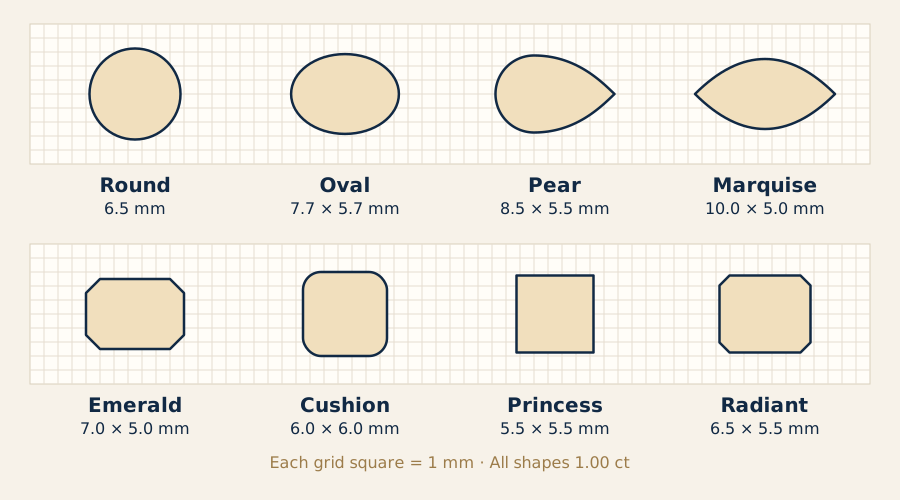
Lab-grown stones are often cut a little deeper or with a thicker girdle (the narrow band around the widest part) to keep the weight at or above 1.00 carat. That can shrink a round to 6.2 mm, which looks closer to a 0.90 carat. Always compare millimetres, not just carat. Our lab-grown carat size chart from 1 to 5 carats lists the measurements for every common shape, and our guide to 1 carat diamonds, natural and lab-grown shows how the same size looks on different finger sizes.
If face-up size is your priority, elongated shapes give you more outline for the weight. Our comparison of which shapes look largest for their carat weight sets out the numbers, and the oval diamond guide covers the most popular of those shapes in detail.
What cut grade matters most for a 1 carat lab diamond?
Cut is the grade that decides how much light comes back to your eye, and it is the one we would never compromise on. On a round, IGI gives an overall cut grade (Ideal or Excellent at the top); GIA's newer lab-grown reports use simpler descriptive wording, so check what yours actually states. Fancy shapes do not get an overall cut grade, so you judge them by proportions, symmetry and video.
| Measurement (round) | Range we look for | What goes wrong outside it |
|---|---|---|
| Total depth | about 59–62.5% | Deeper stones face up smaller and can look dark |
| Table (top facet) | about 54–58% | Very large tables lose fire (flashes of colour) |
| Crown angle | about 34–35° | Shallow crowns look flat |
| Pavilion angle | about 40.6–41° | Steep or shallow pavilions leak light |
| Girdle | thin to slightly thick | Very thick girdles hide weight in the edge |
| Polish and symmetry | Excellent / Excellent | Lower grades can dull the sparkle slightly |
Because lab-grown rough is easier to come by than natural rough, there is less reason for a cutter to keep extra weight at the cost of looks. Even so, some stones are cut deep to reach exactly 1.00 carat. A 1.00 carat round at 64% depth may measure about 6.25 mm, while a well-cut 0.95 carat can measure 6.3 mm and look the same or larger. Price jumps at the 1.00 carat mark are smaller in lab-grown than in natural, but they still exist, so a stone between 0.90 and 0.99 carat with excellent proportions is worth comparing.
Related guideLab-Grown Diamond Carat Sizes: 1 to 5 CaratsWhat colour and clarity should you choose for a 1 carat lab-grown diamond?
Colour is graded from D (colourless) down the alphabet as a faint yellow or brown tint appears. Clarity grades the inclusions (tiny internal features) from Flawless down to Included. Lab-grown makes the top grades affordable, which is tempting, but at 1 carat most people cannot see a difference above a certain point.
| Your setting | Colour | Clarity | Why |
|---|---|---|---|
| Platinum or white gold | F–G (H if you are not sensitive to warmth) | VS2 or better | White metal shows tint more |
| Yellow or rose gold | G–I | VS2 or better | Warm metal masks a faint tint |
| Step cuts (emerald, Asscher) | F–G | VS1 or better | Large open facets show inclusions and colour |
| Brilliant fancy shapes (oval, pear, radiant) | F–G | VS2 or better | Colour gathers in the ends and points |
The aim is an eye-clean stone: no inclusions you can see without magnification at normal viewing distance. Lab-grown inclusions look different from natural ones. HPHT stones can contain small dark metallic flux inclusions, and CVD stones can show tiny dark pinpoints of graphite or faint growth lines. Watch a magnified video and check that nothing dark sits under the table.
Fluorescence (a glow under ultraviolet light) is usually none or faint in lab-grown stones. Some show unusual colours or a short afterglow under strong UV, which is one of the ways gem labs identify them. It has no effect on how the stone looks in daylight in almost every case.
Not sure which one is right?
Send us the stones you are looking at and our gemologist will tell you which to choose and why.
CVD vs HPHT lab-grown diamond: does the growth method matter?
There are two ways to grow a gem-quality diamond, and both produce real diamond. Our page on how CVD and HPHT growing works explains the equipment in detail; here is what each means for a 1 carat stone.
- HPHT (high pressure, high temperature): carbon is dissolved in molten metal and crystallised under conditions similar to deep in the earth. Crystals grow in a cube-and-octahedron shape, often with good colour, and may contain metallic inclusions. Some HPHT stones are very slightly attracted to a strong magnet.
- CVD (chemical vapour deposition): carbon from a gas such as methane is deposited layer by layer onto a thin diamond seed plate. CVD stones are usually very pure (type IIa, meaning almost no nitrogen) but can grow with a brown or grey tint, internal strain or faint layered graining.
- Post-growth treatment: many CVD diamonds are heated after growth (often by HPHT annealing) to remove brown tint and improve colour. This is permanent and widely used, but it must be disclosed, and the report will note it.
Neither method is better in itself. A well-grown, well-cut stone from either process looks the same to the eye. What to watch for is a faint grey or brown undertone that the colour grade alone does not describe, which is more common in some CVD stones. If the report or a comment says As Grown, the stone has not had colour treatment after growth; some people prefer that, and it is worth asking about, though it does not make a treated stone a poor choice.
How do you read a lab-grown diamond grading report?
A 1 carat lab-grown diamond should come with an independent grading report. In Australia, most are graded by IGI (International Gemological Institute); some carry GIA reports. GIA has recently moved to a simpler descriptive style for lab-grown stones rather than the full colour and clarity scales it uses for natural diamonds, so read the GIA wording carefully and ask us if you are comparing the two.
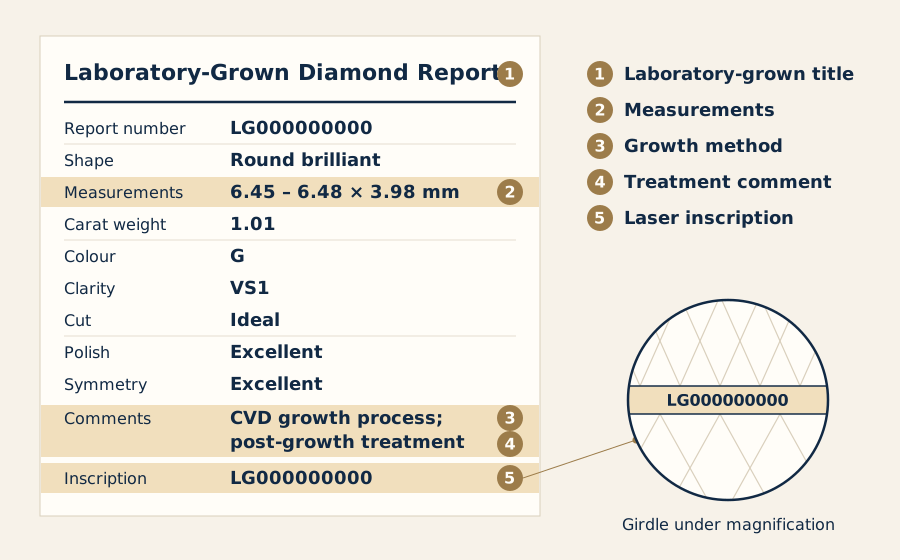
- Report title and number: it should say laboratory-grown clearly. Check the number on the lab's own website.
- Growth method: CVD or HPHT, usually stated in the comments.
- Treatment comment: for example "post-growth treatment" or "As Grown".
- Measurements: the millimetre size, which tells you the real face-up size.
- Proportions: depth and table percentages, plus cut, polish and symmetry.
- Laser inscription: a tiny number, usually with "LG" or "Laboratory-Grown", engraved on the girdle. A jeweller's loupe or microscope will show it matches the report.
Under Australian Consumer Law, a business must not mislead you about what a product is. In practice that means any lab-grown diamond must be described clearly as lab-grown or laboratory-grown on the label and the invoice, and the report should say so too. A seller cannot call it just a "diamond" without the qualifier, and cannot describe a simulant as a diamond at all. If the paperwork is vague, ask. Gem labs use spectroscopy and UV imaging to separate the two, which our article on how labs tell natural and lab-grown apart covers in more depth.
How much does a 1 carat lab-grown diamond cost in Australia?
Lab-grown prices have fallen a long way over the past few years, and they still move. The ranges below are broad and assume a round with an Excellent or Ideal cut and an independent report; prices include GST.
| 1 ct round, Excellent cut | Lab-grown (approx. AUD) | Natural (approx. AUD) |
|---|---|---|
| D–F colour, VVS–VS1 | about $1,200–$2,500 | about $12,000–$22,000 |
| F–H colour, VS2 | about $800–$1,800 | about $8,000–$14,000 |
| H–I colour, SI1 | about $700–$1,400 | about $5,500–$9,000 |
In short, lab-grown costs much less than natural at the same grades. What moves a lab price most is cut quality, colour, whether the stone was colour-treated after growth, and the reporting lab. Shape matters too: rounds usually cost the most per carat, and our page on how price per carat differs between shapes shows the pattern. For the natural side of the same comparison, see our page on natural 1 carat diamond prices and grades.
A straight word on value: neither natural nor lab-grown diamonds should be bought expecting to make money. Lab-grown stones in particular have very little resale value, because new stones keep getting cheaper to produce. Buy the stone you love looking at and the size that suits your hand.
Shop lab-grown diamonds 1.0–1.19 ct
Is a 1 carat lab-grown diamond worth it, or should you go bigger?
Because lab-grown is so much less per carat than natural, many people find they can afford more than 1 carat. That is a genuine option, but bigger is not automatically better. A 1 carat stone suits most finger sizes, sits low enough for everyday wear and leaves budget for a well-made setting.
| Carat (round) | Diameter | Look on the hand |
|---|---|---|
| 1.00 ct | about 6.4–6.5 mm | Classic engagement size |
| 1.25 ct | about 6.9–7.0 mm | Noticeably fuller from above |
| 1.50 ct | about 7.3–7.4 mm | Clearly larger; covers more finger |
| 2.00 ct | about 8.0–8.2 mm | Bold; reads as a statement stone |
| 3.00 ct | about 9.2–9.4 mm | Very large; setting height matters |
Notice that doubling the weight from 1 to 2 carats adds only about 1.6 mm to the diameter, because the extra weight goes into depth as well as width. If you want a little more presence without a big jump, compare 1.25 carat diamonds and our 1.5 carat diamond guide. For larger lab stones, read choosing a 2 carat lab-grown diamond and what to check in a 3 carat lab-grown stone; colour and growth quality become harder to get right as size goes up, which our page on what changes once lab-grown stones pass 3 carats explains. Our chart of how face-up size grows with carat weight puts all of these side by side.
What setting suits a 1 carat lab-grown diamond?
A 1 carat centre is large enough to carry almost any style. The setting matters as much as the stone for how the ring wears day to day:
- Four claws: shows the most diamond and lets in light; slightly squarer look on a round.
- Six claws: more secure and makes a round look rounder; claws hide a little more of the edge.
- Bezel: a rim of metal around the edge; very secure for active hands, and the stone faces up a touch smaller.
- Halo: small diamonds around the centre add about 2–3 mm of apparent width.
- Low-profile or cathedral: how high the stone sits affects snagging and whether a wedding band sits flush.
Claws wear over time, so a centre stone of this size is worth checking every year or two. Our definitions of claw, bezel, halo and cathedral settings cover each style in more detail.
How to choose a 1 carat lab-grown diamond: step by step
If you have not settled on a shape yet, our overview of every diamond shape is the place to start. Then work through these checks in order:
- Pick the shape first. It decides the face-up size, the ideal proportions and how much colour shows.
- Check the report. Confirm it says laboratory-grown, note the growth method and any post-growth treatment, and verify the number online.
- Read the millimetres. For a round, look for about 6.4–6.5 mm; compare fancy shapes using the size table above.
- Prioritise cut. Excellent or Ideal on rounds, depth about 59–62.5% and table about 54–58%; Excellent polish and symmetry.
- Set colour and clarity to suit the metal. F–H and VS2 or better covers most rings; go higher for step cuts.
- Watch a magnified video. Look for a grey or brown undertone and dark inclusions under the table.
- Match the inscription. Ask to see the girdle number under magnification and confirm it matches the report.
- Plan the setting. Choose claws, bezel or halo for how you live, and budget for regular claw checks.
Free consultation
Talk to a gemologist
Compare stones in person or online with Raj Sood, Graduate Gemologist (GIA), AJP (GIA).
Book a consultationShop this shape
FAQ
Common questions
How big is a 1 carat lab-grown diamond?
A well-cut 1 carat round measures about 6.4–6.5 mm across. An oval of the same weight is about 7.7 × 5.7 mm and looks larger from above.
How much is a 1 carat lab-grown diamond in Australia?
Roughly AUD $800–$2,500 for a well-cut round with an independent report, depending on colour, clarity and treatment. A natural diamond of the same grades costs many times more.
Is a 1 carat lab-grown diamond a real diamond?
Yes. It is carbon in the same crystal structure as natural diamond, with the same hardness and sparkle. It must always be sold as lab-grown or laboratory-grown.
Is CVD or HPHT better for a 1 carat diamond?
Neither is better in itself. Judge the individual stone by its report, colour undertone and cut; both methods produce excellent stones.
Can a jeweller tell a lab-grown diamond from a natural one?
Not by eye. Gem labs and specialist instruments identify lab-grown diamonds from their growth features and how they react to UV light, and most lab-grown stones carry a laser inscription saying so.
Do lab-grown diamonds have resale value?
Very little. Buy a lab-grown diamond because you love it and it suits your budget, not to resell.

Ask a gemologist
Not sure which diamond to choose?
Raj Sood is a Graduate Gemologist (GIA) and master jeweller. Bring the stones you are considering, or send the reports, and he will tell you honestly which one is better and why.
Keep learning
Related guides
 Lab-Grown DiamondsLab-Grown Diamond Carat Sizes: 1 to 5 Carats
 Lab-Grown DiamondsChoosing a 2 Carat Lab-Grown Diamond
 Diamond 4Cs & Grading1 Carat DiamondsLab-Grown DiamondsChoosing a 3 Carat Lab-Grown Diamond
 Diamond 4Cs & Grading1.5 Carat DiamondsDiamond 4Cs & Grading1.25 Carat DiamondsLab-Grown DiamondsLarge Lab-Grown Diamonds: What Changes Above 3 Carats?
Explore more
More guides on this topic
Education