
- Education
- Lab-Grown Diamonds
- Choosing a 3 Carat Lab-Grown Diamond: Size, Grades, Reports and Price
Lab-Grown Diamonds
Choosing a 3 Carat Lab-Grown Diamond: Size, Grades, Reports and Price
A 3 carat lab-grown diamond puts a size most people once only saw in magazines within reach. At this size every grade shows, so here is what to check before you commit.
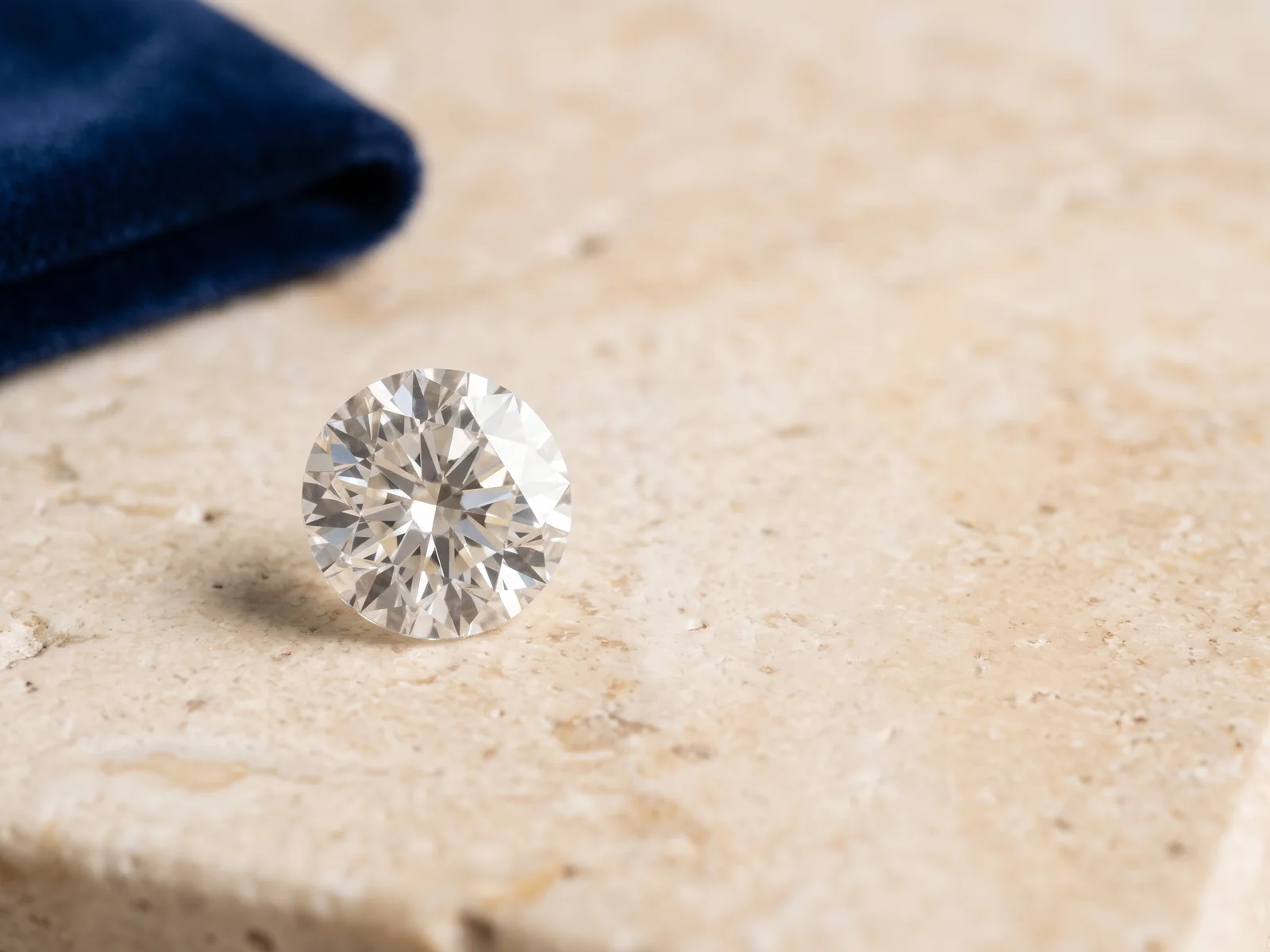
 Reviewed by Raj Sood, Graduate Gemologist (GIA), AJP (GIA)Master jeweller and Graduate Gemologist (GIA) · reviewed 4 November 2026
Quick answer
A 3 carat lab-grown diamond is real diamond grown in a laboratory, about 9.3 mm across as a round. At this size, prioritise an Excellent or Ideal cut, F–H colour and VS2 or better clarity (VS1 for emerald cuts), check the IGI or GIA report and inscription, and expect roughly AUD $3,000–$10,000 for the loose stone.
What is a 3 carat lab-grown diamond?
A 3 carat lab-grown diamond is a diamond weighing 3.00 carats, or 0.6 grams, that was grown in a laboratory rather than mined. It is real diamond: the same carbon crystal, the same hardness of 10 on the Mohs scale and the same refractive index of about 2.42 as a natural stone. The difference is origin, not material, which our explainer on why lab-grown diamonds are real diamond covers in detail. If you are new to the category, start with our complete guide to lab-grown diamonds.
Three carats is where lab-grown changes the conversation most. A natural 3 carat diamond of good quality is a very large purchase, often $60,000 or more in Australian dollars. A laboratory-grown stone of the same size and grades costs a small fraction of that, so many people who would have chosen 1 carat are now looking at 3.
The catch is that a bigger stone is less forgiving. Facets are larger, so inclusions (internal features) are easier to see. The stone is deeper, so body colour is more noticeable. And a poorly cut 3 carat diamond looks dull in a way that is obvious across a room. The rest of this guide is about those three things, plus the report, the price and the setting. For the wider picture, including natural stones, see everything about 3 carat diamonds, natural and lab-grown.
How big is a 3 carat diamond in mm?
Carat is weight, not size. What you see on the hand is the face-up size, also called spread: the measurement across the top of the stone. Shape changes this a lot. Elongated shapes such as oval, pear and marquise spread their weight along their length, so they look larger than a round of the same weight. Princess and cushion cuts carry more weight in their corners and depth, so they face up smaller.
| Shape (3.00 ct) | Typical face-up size | Notes |
|---|---|---|
| Round brilliant | about 9.2–9.4 mm | The reference point; widest range of cut grades |
| Oval | about 12.0 × 8.3 mm | Ratio around 1.40–1.50; looks larger than a round |
| Pear | about 13.5 × 8.5 mm | Long outline; protect the point |
| Marquise | about 15.5 × 7.8 mm | Largest-looking outline per carat |
| Emerald | about 10.5 × 7.8 mm | Step cut; shows clarity and colour most |
| Radiant | about 9.5 × 7.8 mm | Often cut deep; check the spread |
| Cushion | about 8.6 × 8.6 mm | Faces up smaller than a round |
| Princess | about 7.8 × 7.8 mm | Smallest face-up size of the common shapes |
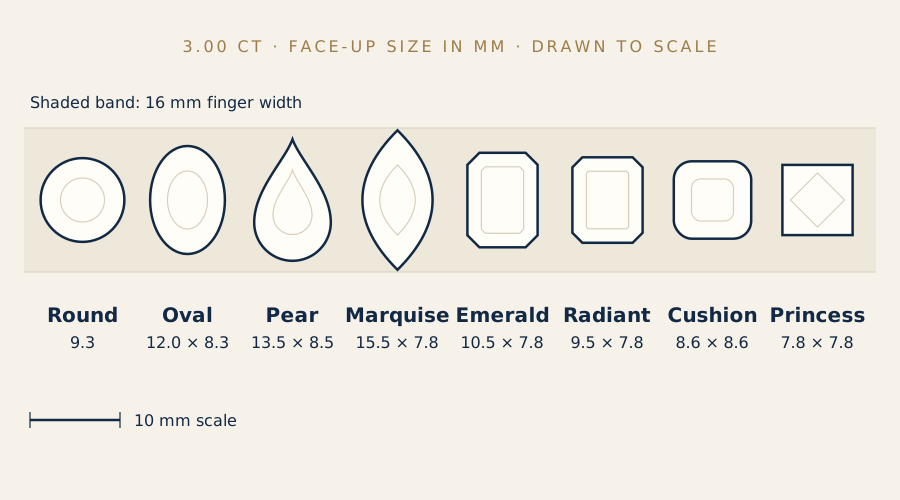
These figures are typical, not fixed. A round cut with a depth of 64% instead of 61.5% carries more weight underneath and can face up closer to 9.0 mm, the size of a stone around 2.7 carats. Always compare millimetre measurements on the report, not just the carat weight. Our chart of lab-grown carat sizes from 1 to 5 carats shows how the millimetres grow at each step, and our comparison of which shapes look biggest for their carat weight explains the spread differences. A 3 carat oval lab-grown diamond is one of the most popular choices for exactly this reason; our oval diamond guide covers its ratios and bow-tie.
On a finger, a 9.3 mm round covers most of the width of an average Australian woman's ring finger, which is roughly 15–17 mm across. If that feels like a lot, choosing a 2 carat lab-grown stone at around 8.1 mm may suit you better. If you want to go bigger again, our 5 carat diamond guide explains what happens to proportions and setting choices at that size.
What cut grade matters most at 3 carats?
Cut is the grade that matters most at any size, but at 3 carats it matters more, because you are paying for a stone that is meant to be seen. Cut decides how much light returns to your eye as brightness (white light), fire (flashes of colour) and scintillation (the sparkle as the stone moves).
For a round brilliant, ask for an Excellent cut grade on a GIA or IGI report, or an Ideal grade where the lab uses one. As a guide, well-cut rounds usually sit at a total depth of about 59–62.5% and a table (the flat top facet) of about 54–58%, with crown angles around 34–35° and pavilion angles around 40.6–41°. Those numbers are a starting point; the stone's appearance in a video or under the loupe is what counts.
Fancy shapes do not get an overall cut grade from GIA, so judge them on the ratio, polish, symmetry and how the light pattern looks. Our overview of every diamond shape sets out the usual ratios for each. Watch for a dark bow-tie across the middle of ovals, pears and marquises; at 3 carats it is larger and harder to ignore. Also watch for stones cut deep to hold weight. Lab-grown rough is far less costly than natural rough, so there is little reason to accept a deep, small-looking stone just to reach 3.00 carats.
What colour and clarity should a 3 carat lab-grown diamond be?
Colour is graded on the GIA D-to-Z scale, where D is completely colourless and each letter down shows a little more warmth. A bigger diamond is deeper, so light travels further through it and picks up more body colour. A tint you would never see in a 1 carat H can become just visible in a 3 carat H, especially in a fancy shape where colour gathers at the ends.
- Platinum or white gold: F–G for most people; H if you are not sensitive to a faint warmth.
- Yellow or rose gold: H–I usually looks white against the warm metal.
- Emerald, Asscher and radiant cuts: lean a grade higher (E–F), as their open facets and corners show tint.
- Round brilliants: hide colour best; G is a common sweet spot.
Clarity is about inclusions and blemishes. The goal is eye-clean: nothing visible without magnification at normal viewing distance. At 1 carat, a well-placed SI1 can be eye-clean. At 3 carats the facets are large enough that an SI1 often is not, so most people should look at VS2 or better for brilliant cuts and VS1 or better for step cuts such as emerald and Asscher, which act like a window into the stone.
Lab-grown diamonds are widely available in high colour and clarity grades, so you can usually move up a grade without a large price change. Going beyond VVS2 adds little you can see, though some people simply like knowing the stone is near flawless. Terms such as feather, pinpoint and crystal are explained in our plain-English jewellery glossary.
Not sure which one is right?
Send us the stones you are looking at and our gemologist will tell you which to choose and why.
Does CVD or HPHT matter for a 3 carat lab-grown diamond?
Lab-grown diamonds are made by one of two methods. HPHT (high pressure, high temperature) recreates the crushing pressure and heat deep in the earth, growing diamond from carbon around a seed crystal in a metal solution. CVD (chemical vapour deposition) builds diamond up layer by layer from carbon-rich gas in a vacuum chamber. Our page on how CVD and HPHT growth work explains both in more depth.
| CVD | HPHT | |
|---|---|---|
| How it grows | Layers from carbon gas on a flat seed | From molten metal solution around a seed |
| Typical inclusions | Dark pinpoints of graphite or non-diamond carbon | Metallic flux inclusions, sometimes weakly magnetic |
| Common colour issues | Brown or grey tint, often reduced by post-growth treatment | Can show a faint blue or grey tint from boron |
| Other traits | Strain patterns visible to labs | Can glow (phosphoresce) after UV light is switched off |
| Common at 3 ct? | Yes, very common | Yes, very common |
Neither method is better in itself. What matters is the finished stone and its grades. Many CVD diamonds are treated after growth with heat and pressure to improve colour, and reputable reports say so, often with a comment such as "post-growth treatment" or "as grown" where there has been none. A treated stone is stable and permanent; the point is simply that it is disclosed.
At 3 carats, look at the stone itself with this in mind. A faint brown or grey cast can make a CVD stone look slightly dull even at a good colour grade, and a cluster of dark pinpoints is easier to see in a large table. If stock allows, compare a CVD and an HPHT stone side by side before deciding.
Related guideLarge Lab-Grown Diamonds: What Changes Above 3 Carats?How do you read a lab-grown diamond grading report?
Every 3 carat lab-grown diamond should come with an independent grading report. In Australia the most common is IGI (International Gemological Institute), which grades lab-grown stones on the familiar colour, clarity and cut scales. GIA also issues lab-grown reports, and has announced changes to how it describes lab-grown diamonds, moving away from the full 4Cs scales, so check the current format of any GIA report you are shown.
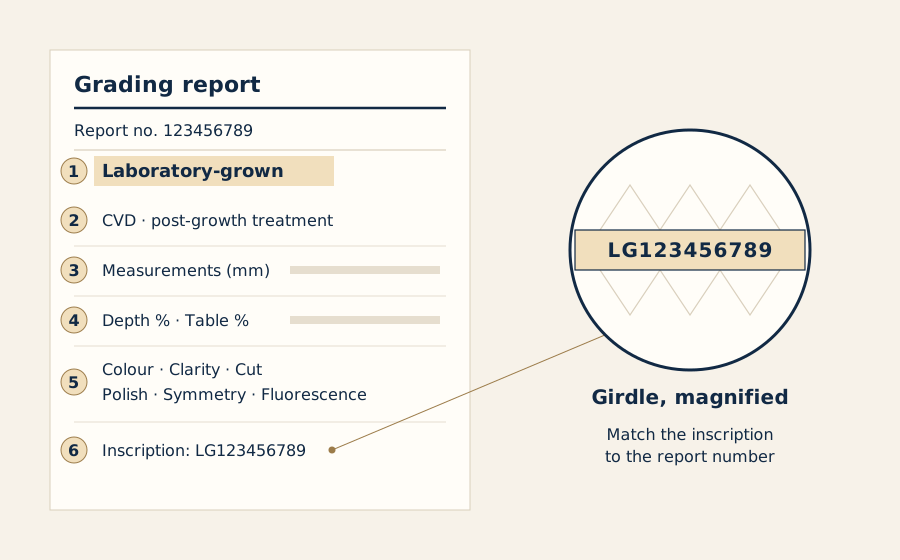
- Origin statement: the report must clearly say "laboratory-grown" or "lab-grown".
- Growth method: CVD or HPHT, and any post-growth treatment.
- Measurements: the three millimetre figures tell you the face-up size and depth.
- Proportions: total depth and table percentages, plus cut grade for rounds.
- Colour, clarity, polish, symmetry and fluorescence.
- Laser inscription: a tiny code on the girdle (the thin outer edge), usually the report number and often "LG", that you or your jeweller can check under magnification.
Match the inscription to the report number before you pay. Report numbers can also be looked up on the lab's website. If you want to know how labs and jewellers confirm a stone's origin, see how gem labs tell lab-grown from natural.
What do Australian rules say about selling lab-grown diamonds?
Under the Australian Consumer Law, a business must not mislead you about what a product is. For diamonds, that means a lab-grown diamond has to be clearly described as lab-grown, laboratory-grown or with a similar clear qualifier such as "laboratory-created" or "synthetic" in advertising, in the listing, on the invoice and when you talk to the seller. Calling it simply a "diamond" in a way that suggests it was mined, or using vague words like "cultured" without making the origin plain, risks misleading you.
The same law protects the other side. A seller should not describe lab-grown diamonds as "fake", and should not describe natural diamonds as an investment or promise that either will hold its value. In practice, both types have resale values well below their retail price, and lab-grown diamonds in particular have little resale value at present, because new stones keep falling in price.
Your consumer guarantees also apply: the stone must match its description and its report. Keep the report, invoice and any valuation together. For insurance, ask for a valuation that states the diamond is lab-grown, so a claim is assessed on the cost of replacing a lab-grown stone rather than a natural one.
How much does a 3 carat lab-grown diamond cost in Australia?
Lab-grown prices have fallen a long way in recent years, and 3 carat stones have fallen the furthest. These are broad ranges for a loose round with an Excellent cut; settings are extra, and prices move quickly.
| 3 ct round, Excellent cut | Approximate price range (AUD) |
|---|---|
| Lab-grown, G–H, VS2 | about $3,000–$7,000 |
| Lab-grown, E–F, VS1–VVS2 | about $4,500–$10,000 |
| Natural, G–H, VS2 | about $60,000–$120,000 |
Three things move a 3 carat lab-grown price most: cut quality, colour and the exact weight. Prices also step up at round numbers. A 2.90 carat stone usually costs noticeably less than a 3.00 carat stone of the same grades, but looks almost identical, about 0.1 mm smaller across. Our page on price jumps at each carat step shows the pattern, and shape matters too: see how price per carat varies by shape.
| 3 ct, same grades | Lab-grown | Natural |
|---|---|---|
| Material | Diamond (carbon crystal) | Diamond (carbon crystal) |
| Hardness / refractive index | Mohs 10 / about 2.42 | Mohs 10 / about 2.42 |
| Origin | Grown in weeks in a laboratory | Formed underground, typically 1–3 billion years ago |
| Typical report | IGI, or GIA lab-grown report | GIA or IGI |
| Price | A small fraction of natural | Very high, rises steeply with size |
| Resale | Very low at present | Well below retail; not an investment |
| Availability at 3 ct | Wide range of shapes and grades | Limited, especially in high grades |
For context on the natural side, see natural 3 carat diamond prices and grades. It is also worth seeing how a 1 carat diamond compares on price and size, and our guide on how to pick a 1 carat lab-grown diamond if a smaller centre stone is on your list.
Shop 3 carat lab-grown diamonds
What setting suits a 3 carat lab-grown engagement ring?
A 3 carat centre stone is around 5.5–6 mm deep for a round, so it sits higher than a smaller diamond and catches more knocks. The setting needs to hold it firmly and keep it at a comfortable height.
- Claws: six claws, or four slightly heavier claws, give security without hiding much of the stone. Claw tips should be checked every year or two.
- Shank width: a band of about 2.0–2.5 mm balances a 3 carat stone; very thin bands can bend under the weight of the head.
- Low-profile basket or cathedral: keeps the stone closer to the finger so it snags less on clothing and gloves.
- Bezel: a rim of metal around the whole stone, the most protective choice for an active life.
- Halo: small diamonds around the centre make a 9.3 mm round look closer to 11–12 mm across. Ask whether the halo stones are natural or lab-grown.
- Metal: platinum or 18ct gold for the claws; they hold up well under a large stone.
If the finished ring feels too large once you see it modelled, a 2 carat lab-grown centre in a halo can give a similar look on the hand with less height. If you are thinking of going larger than 3 carats, read what changes once a lab-grown stone passes 3 carats before you settle on a setting.
How to choose a 3 carat lab-grown diamond: step by step
- Choose the shape first. Use the millimetre table to decide how much finger coverage you want.
- Set the cut standard. Excellent for rounds; for fancy shapes, check ratio, symmetry and the bow-tie in a video.
- Pick colour for your metal. F–G in white metal, H–I in yellow or rose gold, a grade higher for step cuts.
- Set clarity at VS2 or better. VS1 or better for emerald and Asscher cuts, and check the video for dark pinpoints.
- Read the report. Confirm "laboratory-grown", the growth method, any treatment and the measurements.
- Match the inscription. Check the girdle code against the report number before payment.
- Consider 2.90–2.99 ct. Compare prices just under 3.00 ct, which can look almost identical.
- Plan the setting and insurance. Choose secure claws or a bezel, and get a valuation that states lab-grown.
Free consultation
Talk to a gemologist
Compare stones in person or online with Raj Sood, Graduate Gemologist (GIA), AJP (GIA).
Book a consultationShop this shape
FAQ
Common questions
Is a 3 carat lab-grown diamond a real diamond?
Yes. It is the same carbon crystal as a natural diamond, with the same hardness and sparkle. The only difference is that it was grown in a laboratory, and it must always be sold as lab-grown.
How big is a 3 carat lab-grown diamond?
A well-cut 3 carat round is about 9.2–9.4 mm across. An oval of the same weight is about 12 × 8.3 mm, and a princess about 7.8 mm square.
What clarity do I need for a 3 carat diamond?
Most people should look at VS2 or better for brilliant cuts and VS1 or better for emerald or Asscher cuts. At this size, many SI1 stones show inclusions without magnification.
Is CVD or HPHT better for a 3 carat diamond?
Neither is better in itself. Judge the finished stone on its grades and appearance, and check the report for any post-growth treatment.
Does a 3 carat lab-grown diamond hold its value?
No. Lab-grown diamonds have little resale value at present because prices for new stones keep falling. Choose one because you love it, not as something to sell later.
Can you tell a lab-grown diamond from natural by looking?
Not by eye, and not with a standard loupe. Gem labs use specialised instruments, and the laser inscription and report confirm a stone's origin.

Ask a gemologist
Not sure which diamond to choose?
Raj Sood is a Graduate Gemologist (GIA) and master jeweller. Bring the stones you are considering, or send the reports, and he will tell you honestly which one is better and why.
Keep learning
Related guides
 Lab-Grown DiamondsLarge Lab-Grown Diamonds: What Changes Above 3 Carats?Lab-Grown DiamondsChoosing a 2 Carat Lab-Grown Diamond
 Diamond 4Cs & Grading3 Carat Diamonds
 Lab-Grown DiamondsLab-Grown Diamond Carat Sizes: 1 to 5 CaratsLab-Grown DiamondsLab-Grown Diamonds GuideLab-Grown DiamondsChoosing a 1 Carat Lab-Grown DiamondLab-Grown DiamondsAre Lab-Grown Diamonds Real DiamondsDiamond 4Cs & Grading1 Carat Diamonds
Explore more
More guides on this topic
Education