
- Education
- Lab-Grown Diamonds
- Large Lab-Grown Diamonds: What Changes Above 3 Carats
Lab-Grown Diamonds
Large Lab-Grown Diamonds: What Changes Above 3 Carats
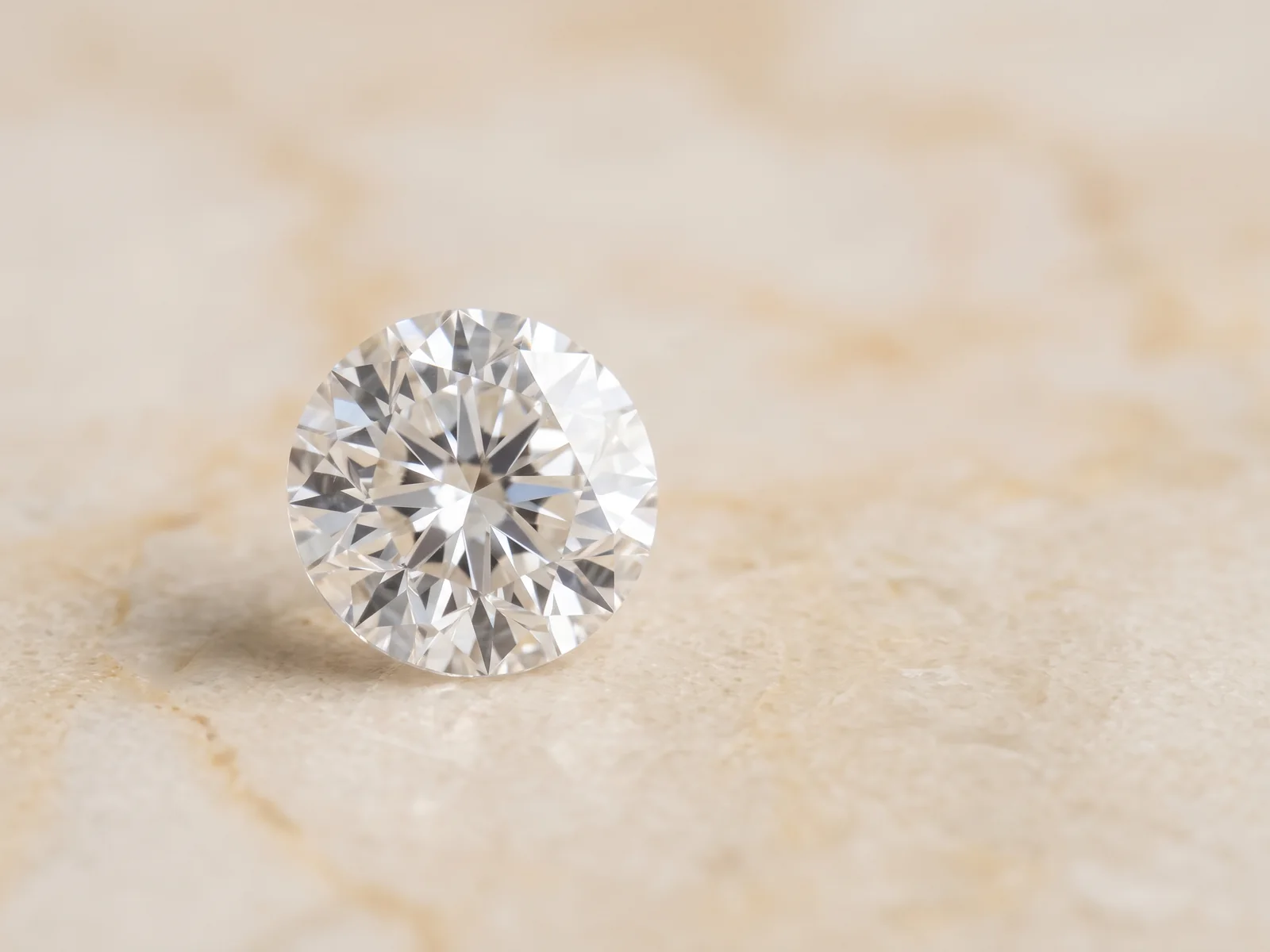
Large lab-grown diamonds have put 3, 4 and 5 carat stones within reach of many more Australians. Above 3 carats, though, colour, clarity, cut, the grading report and the setting all matter more than they do in a smaller stone.
 Reviewed by Raj Sood, Graduate Gemologist (GIA), AJP (GIA)Master jeweller and Graduate Gemologist (GIA) · reviewed 4 November 2026
Quick answer
Large lab-grown diamonds above 3 carats are real diamond, but size magnifies everything. Colour and inclusions become easier to see, many stones are CVD-grown with post-growth treatment, and the setting must carry more weight. Choose an eye-clean VS2 or better, G colour or better in white metal, an IGI or GIA report, and six claws or a bezel.
What counts as large lab-grown diamonds?
In the trade, a diamond of 3 carats or more is generally treated as a large stone. A carat is a unit of weight, 0.2 grams, not a measure of size; our explainer on how carat weight is measured covers the detail. A 3 carat round is roughly 9.3 mm across, about the width of a pea, and it sits well beyond the 1 carat benchmark many engagement rings used to be built around.
Lab-grown diamonds are real diamond: the same carbon crystal, the same hardness (10 on the Mohs scale) and the same refractive index of about 2.42 as a mined stone. The difference is origin. They are grown in a laboratory over weeks rather than formed underground over billions of years. If you are new to the topic, start with our complete lab-grown diamonds guide.
Large sizes are where lab-grown changed the market most. A natural 3 carat diamond has always been rare and priced accordingly, while growers can now produce crystals big enough to cut 3, 5 and even 10 carat stones. That makes sizes that were once out of reach a real option, but it also means more large stones of very uneven quality are on offer. The same buying habits that work for 1 carat diamonds need tightening once you go past 3 carats.
Below we look at what genuinely changes with size: how the stone was grown, how colour and inclusions show, the millimetre size, the grading report, Australian disclosure rules, price and the setting. Any unfamiliar term is also in our jewellery glossary of grading terms.
How are lab-grown diamonds above 3 carats grown?
There are two growing methods, and both now produce large crystals. Knowing which one made your stone helps you read the report and understand some of the quirks you may see. For the basics of each method, see how lab-grown diamonds are made and graded.
- CVD (chemical vapour deposition): a thin diamond seed plate sits in a chamber filled with methane and hydrogen gas. A microwave plasma breaks the gas apart and carbon builds up on the seed, layer by layer. CVD crystals grow as flat, square-ish blocks, which suit large emerald, cushion and radiant cuts as well as rounds.
- HPHT (high pressure, high temperature): a small seed sits in molten metal (usually iron, nickel or cobalt) with a carbon source, under roughly 5–6 gigapascals and about 1,300–1,600 °C. Diamond crystallises on the seed. HPHT crystals grow as cube-and-octahedron shapes.
| CVD | HPHT | |
|---|---|---|
| Growth shape | Flat square block, grown in layers | Cube-octahedron crystal |
| Typical as-grown colour issue | Brownish or greyish tint | Yellow (nitrogen) or blue (boron) tint |
| Common post-growth treatment | Often HPHT-annealed to remove brown | Less often treated |
| Typical inclusions | Dark graphite specks, growth lines (strain) | Metallic flux inclusions, can be slightly magnetic |
| Under UV light | Often orange or red fluorescence | Can glow and phosphoresce (glow after the light is off) |
| Large sizes | Common for 3 ct+ | Increasingly common for 3 ct+ |
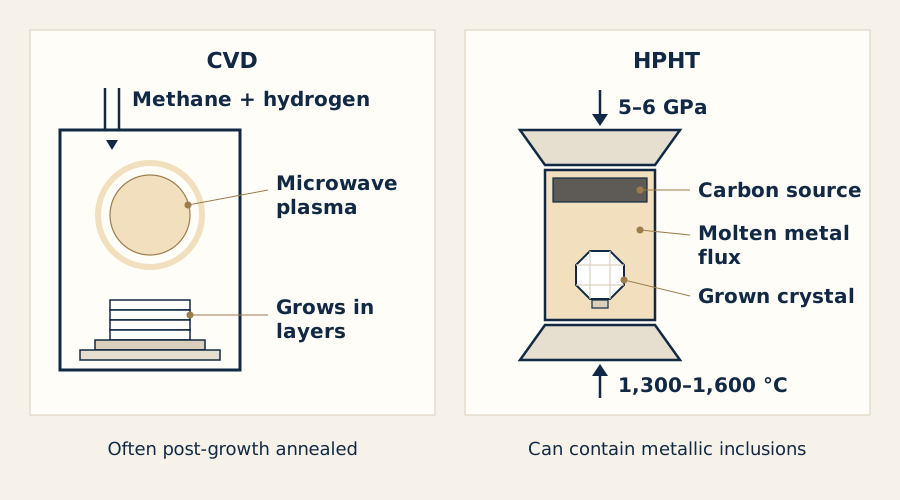
Neither method is better in itself. What matters is the finished stone: its colour, clarity, cut and whether it has been treated. A well-grown HPHT diamond and a well-grown CVD diamond look the same to the eye, and a gemmological laboratory can identify both as lab-grown with specialised instruments.
Does colour show more in a 3 carat lab-grown diamond?
Yes. In a bigger stone, light travels a longer path through the diamond before it returns to your eye, so any body colour has more chance to show. A faint warmth that is invisible in a 0.70 carat stone can be noticeable in a 3.50 carat one, especially in fancy shapes such as ovals, pears and cushions, where colour gathers at the ends and corners.
- White gold or platinum: G colour or better for most people; F or E if you are sensitive to warmth. In a well-cut round, H can still look white.
- Yellow or rose gold: H to J often looks white, because the metal warms the whole ring.
- Step cuts (emerald, Asscher): these show colour more openly, so go one grade higher than you would for a round.
The bigger question with large lab-grown stones is post-growth treatment. Many CVD diamonds come out of the chamber with a brownish tint, and growers then anneal them under high pressure and temperature to remove it. This is a permanent, accepted process, but it must be disclosed, and the report will normally note it. Some buyers prefer an 'as-grown' stone; others are happy with a treated one at a lower price. Either is a valid choice as long as you know which you are buying. Our colour advice for a 2 carat lab stone covers the same grading scale in a smaller size.
Watch for undertones too. A large lab-grown diamond graded G can occasionally show a faint grey or blue cast rather than yellow. It is not a flaw, but it changes the look, so view the stone in daylight next to a white card if you can.
What clarity and cut do you need above 3 carats?
Clarity grades describe inclusions (internal features) relative to the stone, so an SI1 in a 3 carat diamond can contain physically larger inclusions than an SI1 in a half-carat stone. The table facet (the large flat top) on a 3 carat round is around 5–5.5 mm wide, a big clear window to look through. That is why an SI grade that is eye-clean at 1 carat is often not eye-clean at 3.
| Shape | Suggested clarity above 3 ct | Why |
|---|---|---|
| Round brilliant | VS2 or better (eye-clean SI1 possible) | Brilliant facets break up and hide small inclusions |
| Oval, pear, cushion | VS2 or better | Brilliant faceting, but larger open centres |
| Radiant, princess | VS2 or better | Brilliant-style facets, corners need checking |
| Emerald, Asscher | VS1 or better | Step cuts act like a window into the stone |
If you are still deciding between these outlines, our overview of every diamond shape explained side by side shows how each one handles colour and inclusions. Because lab-grown rough is far cheaper than natural, stepping up a clarity grade usually adds much less to the price than it would for a mined stone. For most people above 3 carats, the sensible spend is on an eye-clean stone with no dark graphite specks or metallic inclusions, rather than on Flawless or IF grades that look no different to the eye.
Cut is where large lab stones vary most. Some are cut deep to reach a round number such as 3.00 carats, which hides weight in the pavilion (the lower half) and makes the stone look smaller face-up. For rounds, look for an Excellent cut grade, a total depth of about 59–62.5% and a table of about 54–58%. Fancy shapes do not receive a cut grade, so judge them on proportions, symmetry and a 360° video. Our step-by-step advice on choosing a 3 carat lab-grown diamond goes through the numbers for each shape.
Not sure which one is right?
Send us the stones you are looking at and our gemologist will tell you which to choose and why.
How big is a 3, 4 or 5 carat lab-grown diamond in mm?
Diameter does not grow as fast as weight. Doubling carat weight increases the face-up diameter of a round by only about a quarter, because weight is spread across depth as well as width. This is why carat weight is not the same as size, and it matters most at the top end, where each extra carat costs more but adds less visible width.
| Carat weight | Round (diameter) | Oval (about 1.40 ratio) | Emerald (about 1.45 ratio) |
|---|---|---|---|
| 3.00 ct | about 9.3 mm | about 11.6 × 8.3 mm | about 10.0 × 7.0 mm |
| 4.00 ct | about 10.2 mm | about 12.8 × 9.1 mm | about 11.0 × 7.6 mm |
| 5.00 ct | about 11.0 mm | about 13.8 × 9.8 mm | about 11.8 × 8.2 mm |
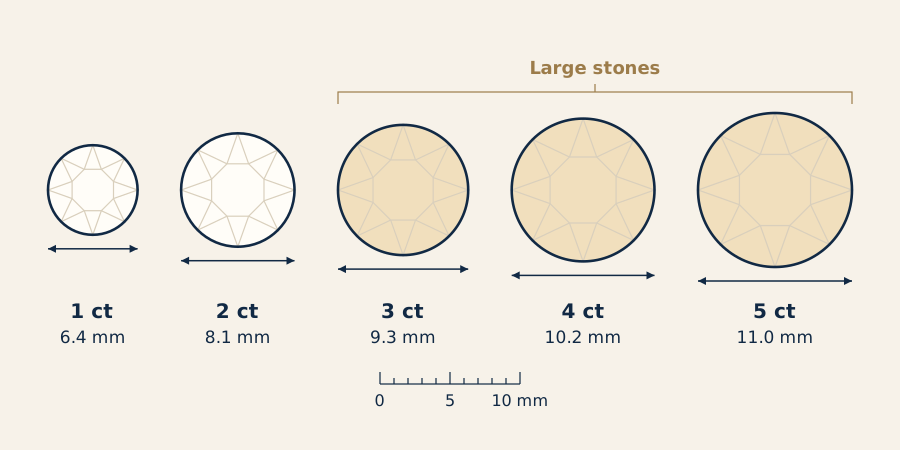
These are typical figures for well-proportioned stones; a deep-cut stone will measure smaller and a shallow one wider. Always compare the millimetre measurements on the report, not just the weight. For every common size and shape, see our full millimetre chart for lab-grown sizes from 1 to 5 carats, and for a sense of scale on the hand, read what a 5 carat diamond looks like on the hand.
On a typical Australian ring size of about M to O, a 3 carat round covers more than half the finger's width, and a 5 carat oval covers a noticeable length of the finger. Elongated shapes such as oval diamonds look larger for their weight and make the finger look longer; our comparison of which shapes look biggest for their weight puts the numbers side by side.
What should the grading report say for a large lab-grown diamond?
Above 3 carats, an independent grading report is essential. Most large lab-grown diamonds sold in Australia are graded by IGI (International Gemological Institute); some are graded by GIA (Gemological Institute of America), whose lab-grown report format has changed over recent years, so read the current version carefully. Check these points:
- Origin: the report must clearly state the diamond is laboratory-grown.
- Growth method: CVD or HPHT is often stated.
- Treatment: look for wording such as 'as grown' or a note of post-growth treatment.
- Laser inscription: a tiny inscription on the girdle (the thin outer edge) carrying the report number and usually a lab-grown marker. Your jeweller can show it to you under magnification.
- Measurements and proportions: confirm face-up size, depth and table.
- Plotting diagram: shows where inclusions sit.
Under the Australian Consumer Law, a business must not mislead you about what you are buying. In practice that means a lab-grown diamond must be clearly described as lab-grown, laboratory-grown, lab-created or synthetic, on the label, the invoice and in any advertising. It should never be described simply as a 'diamond' in a way that suggests it was mined. Your invoice should name the report number so the stone and paperwork can always be matched.
Related guide3 Carat DiamondsFor insurance, ask for a written valuation that names the report number and states the stone is lab-grown. Because lab-grown prices have been falling, the replacement value can change quickly; review the valuation every couple of years so you are not paying premiums on an outdated figure.
What actually changes between a 2 carat and a 3 carat+ lab stone?
If you have read how to choose a 1 carat lab-grown diamond or our 2 carat lab-grown diamond guide, most of the principles carry over. The differences are in degree, and they add up:
| 1–2 ct lab-grown | 3 ct+ lab-grown | |
|---|---|---|
| Visible colour | Warmth is subtle | Warmth and grey or blue undertones show more |
| Clarity needed to be eye-clean | SI1–SI2 often fine in rounds | VS2 or better in most shapes |
| Cut risks | Minor | Deep cuts to reach a round weight are more common |
| Post-growth treatment | Common | Very common in CVD stones |
| Setting | Four claws usually fine | Six claws, a bezel or heavier claws recommended |
| Band | 1.8–2.2 mm common | 2.2–2.8 mm or more for stability |
| Price step at the round number | Small | Small compared with natural |
| Natural equivalent | Expensive | Very rare and much more expensive |
The biggest practical change is on the hand. A large stone sits higher, catches on clothing more easily and puts more leverage on the claws when knocked. You also notice weight more in earrings: a pair of 3 carat studs needs secure screw-backs or locking backs. If you are weighing up natural against lab-grown at this size, our page on 3 carat diamonds, natural and lab-grown compared sets out the trade-offs.
How much do large lab-grown diamonds cost in Australia?
Price is the main reason people consider large lab-grown diamonds. A natural diamond above 3 carats is rare, and its price per carat climbs steeply with size. Lab-grown prices climb much more gently, and they have fallen considerably over the past few years as production has expanded.
| Round, G colour, VS clarity, excellent cut | Approximate range (AUD) |
|---|---|
| 3 ct lab-grown | about $3,000–$9,000 |
| 4 ct lab-grown | about $5,000–$14,000 |
| 5 ct lab-grown | about $7,000–$20,000 |
| 3 ct natural | about $60,000–$140,000 |
These are broad ranges only, and they move with the market. Within lab-grown, what moves the price most is colour, clarity, cut quality and whether the stone is as-grown or treated, more than the jump from one carat size to the next. Our page on how lab-grown prices step up by carat shows the pattern, and shape matters too: see price differences between diamond shapes for how ovals, emeralds and rounds compare.
Be clear-eyed about value later on. Lab-grown diamonds have little resale value and their retail prices have dropped over time, so think of one as a stone to wear and enjoy. Natural diamonds hold value better on the secondary market, but they also sell back for well under retail, so neither type should be bought expecting to make money. As a store that sells both, we would rather you choose the type that suits you, not the one you think will hold its price.
Browse lab-grown diamonds 3 ct and above
What is the right setting for a large diamond?
A 3 carat or larger stone needs a setting built for it, not a standard mount scaled up. The extra weight and height put more stress on the claws and band, and a knock carries more force. What we look at:
- Claws: six claws for rounds, or four double claws, so the stone stays put if one claw wears or bends. Claws should be thick enough to last, roughly 1.2–1.5 mm at the tip for a stone this size.
- Bezel or half-bezel: a rim of metal around the edge. The most protective option for an active lifestyle.
- Height: a lower head or cathedral shoulders reduce snagging, though the stone needs enough height to sit above a wedding band.
- Band: a sturdier shank, usually 2.2 mm or wider, resists bending and stops a heavy stone rolling to the side of the finger.
- Metal: platinum holds claws well over decades; 18 carat white or yellow gold is also widely used for large stones.
Large stones also need more care. Have the claws checked every six to twelve months, take the ring off for the gym, gardening and heavy lifting, and clean it regularly; a big diamond collects skin oils on the pavilion that dull its sparkle.
How do you choose a lab-grown diamond above 3 carats? Step by step
- Set your shape and budget. Decide on the shape first, then whether 3, 4 or 5 carats fits, using face-up millimetres rather than weight.
- Ask for the report. Confirm it says laboratory-grown, check the growth method and whether the stone is as-grown or treated.
- Check the laser inscription. Make sure the number on the girdle matches the report.
- Set your colour floor. G or better in white metal, one grade higher for step cuts.
- Check it is eye-clean. Look at the plotting diagram and a 360° video; avoid dark graphite or metallic inclusions under the table.
- Check the proportions. Make sure the stone is not cut deep to hit a round weight; compare the millimetre measurements against a size chart.
- Plan the setting. Six claws, double claws or a bezel, with a band sturdy enough for the weight.
- Arrange paperwork and insurance. The invoice and valuation should name the report number and describe the stone as lab-grown.
For a shape-by-shape version of this process, use our 3 carat lab-grown buying checklist before you compare stones side by side.
Free consultation
Talk to a gemologist
Compare stones in person or online with Raj Sood, Graduate Gemologist (GIA), AJP (GIA).
Book a consultationShop this shape
FAQ
Common questions
Are large lab-grown diamonds real diamonds?
Yes. They are made of the same crystallised carbon as natural diamonds, with the same hardness and sparkle. The only difference is that they were grown in a laboratory, which must always be disclosed.
Is a 3 carat lab-grown diamond too big for everyday wear?
Many people wear one daily without problems. The key is a protective setting, such as six claws or a bezel, a sturdy band and regular claw checks.
Should I choose CVD or HPHT for a large lab-grown diamond?
Neither is better in itself. Judge the finished stone on colour, clarity, cut and whether it has had post-growth treatment, all of which the report should show.
What clarity should a 3 carat lab-grown diamond be?
VS2 or better is a sensible floor for most shapes, and VS1 or better for emerald and Asscher cuts. Above all, the stone should be eye-clean with no dark inclusions under the table.
Do large lab-grown diamonds hold their value?
No. Lab-grown diamonds have little resale value and prices have fallen over time, so buy one to wear rather than as a store of value.
How can I tell if a large diamond is lab-grown?
Not by eye. Check the grading report and the laser inscription on the girdle; a gemmological laboratory uses specialised instruments to confirm origin.

Ask a gemologist
Not sure which diamond to choose?
Raj Sood is a Graduate Gemologist (GIA) and master jeweller. Bring the stones you are considering, or send the reports, and he will tell you honestly which one is better and why.
Keep learning
Related guides
 Lab-Grown DiamondsChoosing a 3 Carat Lab-Grown DiamondLab-Grown DiamondsLab-Grown Diamond Carat Sizes: 1 to 5 Carats
 Diamond 4Cs & Grading5 Carat DiamondsLab-Grown DiamondsLab-Grown Diamonds Guide
 Diamond 4Cs & Grading3 Carat DiamondsLab-Grown DiamondsChoosing a 1 Carat Lab-Grown Diamond
 Lab-Grown DiamondsChoosing a 2 Carat Lab-Grown DiamondDiamond 4Cs & Grading1 Carat Diamonds
Explore more
More guides on this topic
Education