
- Education
- Lab-Grown Diamonds
- Lab-Grown Diamond Carat Sizes: A 1 to 5 Carat Guide in mm, Grades and AUD
Lab-Grown Diamonds
Lab-Grown Diamond Carat Sizes: A 1 to 5 Carat Guide in mm, Grades and AUD
Lab-grown diamond carat sizes that were out of reach for most people a decade ago are now common, so the real question is how big each weight looks and what changes as you go up. Here is the honest picture, in millimetres and Australian dollars.
 Reviewed by Raj Sood, Graduate Gemologist (GIA), AJP (GIA)Master jeweller and Graduate Gemologist (GIA) · reviewed 4 November 2026
Quick answer
Lab-grown diamond carat sizes measure weight, not width: one carat is 0.2 g. An ideal-cut round grows from about 6.4 mm at 1 carat to 8.1 mm at 2, 9.3 mm at 3 and 11.1 mm at 5 carats. Doubling the weight adds about a quarter to the diameter, so compare millimetres, grades and the report, not carats alone.
What do lab-grown diamond carat sizes actually mean?
A carat is a unit of weight, not size. One carat is exactly 0.2 grams, and it is split into 100 points, so a 0.75 carat diamond is a "75 pointer". A 5 carat diamond weighs just 1 gram. Our page on how carat weight is measured and graded covers the history of the unit and how labs round weights on a report.
Lab-grown diamonds are real diamond: the same carbon crystal, the same hardness (10 on the Mohs scale), the same refractive index of about 2.42 and the same density of about 3.52 g/cm³. They are grown in a laboratory by one of two methods, CVD (chemical vapour deposition, where carbon builds up layer by layer from a gas) or HPHT (high pressure, high temperature, which recreates the conditions deep in the earth). Because the density is identical, a 2 carat lab-grown diamond and a 2 carat natural diamond of the same cut are the same size. If you are new to the topic, start with our complete introduction to lab-grown diamonds.
What makes carat confusing is that weight grows in three dimensions, but you only see two of them from above. The face-up size (how big the stone looks when you look down at it) depends on the diameter or length and width, and that grows much more slowly than the weight. Any term here you have not met yet is explained in our jewellery glossary of grading terms.
Lab-grown diamond carat sizes in mm: how big is 1 to 5 carats?
The table below shows typical diameters for a well-cut round brilliant with a total depth of about 59–62%. The last column compares face-up area with a 1 carat stone, which is closer to what your eye actually notices than the carat figure.
| Carat weight | Typical round diameter | Face-up area vs 1 ct |
|---|---|---|
| 0.50 ct | about 5.1–5.2 mm | about 0.6× |
| 1.00 ct | about 6.4–6.5 mm | 1.0× |
| 1.25 ct | about 6.8–6.9 mm | about 1.1× |
| 1.50 ct | about 7.3–7.4 mm | about 1.3× |
| 2.00 ct | about 8.1–8.2 mm | about 1.6× |
| 2.50 ct | about 8.7–8.8 mm | about 1.8× |
| 3.00 ct | about 9.3–9.4 mm | about 2.1× |
| 4.00 ct | about 10.2–10.3 mm | about 2.5× |
| 5.00 ct | about 11.0–11.1 mm | about 2.9× |
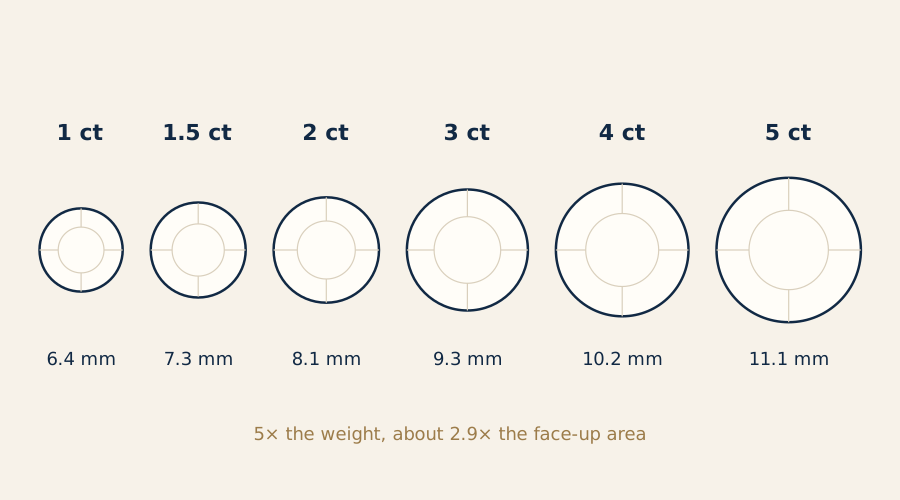
The maths is simple once you see it. Diameter grows with the cube root of the weight, so doubling the weight from 1 to 2 carats makes the stone about 26% wider, and going from 1 to 5 carats makes it about 71% wider. That is why many people find the jump from half-carat diamonds to a full carat more noticeable than the jump from 4 to 5 carats.
Cut quality changes these numbers. A stone cut too deep hides weight underneath and can look like a smaller size; a stone cut too shallow spreads wider but leaks light and looks glassy. Before you fix on a weight, see what a 1 carat diamond looks like across different cuts, and if you are between sizes, our page on the 1.25 carat middle ground shows how a quarter carat changes the look.
How do carat sizes compare across round, oval, emerald and other shapes?
The same weight spreads differently depending on the shape. Elongated shapes such as oval, pear and marquise look larger for their weight because more of the stone is spread across the length. Square and deep shapes such as princess and cushion carry more weight below the girdle (the outer edge) and look smaller.
| Shape (typical ratio) | 1 ct | 2 ct | 3 ct | 5 ct |
|---|---|---|---|---|
| Round | 6.4 mm | 8.1 mm | 9.3 mm | 11.1 mm |
| Oval (about 1.35–1.45) | 7.7 × 5.7 mm | 9.7 × 7.2 mm | 11.1 × 8.2 mm | 13.2 × 9.7 mm |
| Pear (about 1.55) | 8.5 × 5.5 mm | 10.7 × 6.9 mm | 12.3 × 7.9 mm | 14.5 × 9.4 mm |
| Emerald (about 1.40) | 7.0 × 5.0 mm | 8.8 × 6.3 mm | 10.1 × 7.2 mm | 12.0 × 8.6 mm |
| Cushion (square) | 5.8 × 5.8 mm | 7.3 × 7.3 mm | 8.4 × 8.4 mm | 9.9 × 9.9 mm |
| Princess | 5.5 × 5.5 mm | 6.9 × 6.9 mm | 7.9 × 7.9 mm | 9.4 × 9.4 mm |
These are approximate figures for well-proportioned stones; individual diamonds vary by several tenths of a millimetre either way, so always read the measurements on the report. A 2 carat oval at about 9.7 mm long, for example, can read from across the room as similar in size to a 2.5 carat round, which is about 8.7 mm across. Our guide to 2.5 carat diamonds sets that comparison out in more detail.
Lab-grown rough also behaves a little differently from natural rough. CVD crystals often grow as flat, tabular blocks, which suits shapes with a shallower outline, while HPHT crystals tend to be more cube-octahedral (a squared-off block with corners cut away). Cutters choose the shape that keeps the most weight from each crystal, which is part of why some shapes are easier to find in large lab-grown sizes than others.
What changes as you go from 1 to 5 carats?
Each step up the scale brings different priorities. Here is how a gemmologist thinks about each size band for lab-grown stones:
- 1 carat: the most popular engagement size. At about 6.4 mm a round looks clearly substantial on most hands, and small grading differences are hard to see. Our guide to choosing a 1 carat lab-grown diamond goes through the grades step by step.
- 1.5 carats: about 7.3 mm round. A popular step up once people see how affordable lab-grown has become; read our 1.5 carat diamond size and grade guide for the natural and lab-grown view side by side.
- 2 carats: about 8.1 mm round, around 60% more face-up area than a 1 carat. Colour starts to matter more here. See what to check on a 2 carat lab-grown stone and our general page on how big a 2 carat diamond looks.
- 3 carats: about 9.3 mm round. Inclusions and any brown or grey tint are easier to see, and the setting has to be more robust. Our guide to selecting a 3 carat lab-grown diamond and the broader 3 carat diamond overview explain what changes.
- 4 to 5 carats: 10–11 mm round. The stone covers much of the finger width, sits higher and needs claws sized for its weight. Grades that are invisible at 1 carat can become visible at this size.
Lab-grown pricing has changed what people ask for. Where many Australians once chose between 0.70 and 1.00 carat in natural, it is now common for buyers to compare a 1 carat natural with a 2 or 3 carat lab-grown at a similar budget. Neither is the right answer for everyone; it comes down to whether rarity or size matters more to you.
Not sure which one is right?
Send us the stones you are looking at and our gemologist will tell you which to choose and why.
What colour and clarity should you choose at each lab-grown carat size?
Bigger stones show more. A larger table (the flat top facet) is a bigger window into the stone, so inclusions (internal features) are easier to spot, and a longer light path through the diamond makes body colour more visible. Because stepping up a grade in lab-grown usually costs far less than in natural, many people choose higher grades as the size goes up.
| Size band | Colour in white gold or platinum | Clarity, brilliant cuts | Clarity, step cuts (emerald, Asscher) |
|---|---|---|---|
| 1–1.5 ct | G–H | SI1–VS2, eye-clean | VS2 or better |
| 2–2.5 ct | F–G | VS2 | VS1 or better |
| 3–4 ct | E–G | VS1–VS2 | VS1 or better |
| 5 ct | D–F | VS1 or better | VVS2–VS1 |
Yellow and rose gold warm everything around them, so at any size you can usually drop one or two colour grades in those metals without the stone looking tinted. Eye-clean (no inclusions visible without magnification at normal viewing distance) is the practical target; you do not need flawless.
Lab-grown stones have their own typical features. CVD diamonds can show a faint brown or grey tint or tiny dark pinpoints, while HPHT diamonds can contain small metallic flux inclusions left from the growth process. Many larger CVD diamonds are given a post-growth treatment (usually high-temperature annealing) to improve colour, and the report should say so. These points matter more above 3 carats, which is why we wrote a separate guide on what changes with lab-grown diamonds above 3 carats.
How much do lab-grown diamonds cost from 1 to 5 carats in Australia?
Lab-grown prices have fallen a long way in the past several years, and they keep moving. The ranges below are broad guides for round brilliants with an excellent cut, G–H colour and VS clarity, graded by an independent lab. Fancy shapes usually sit a little below rounds at the same weight.
| Carat weight | Lab-grown (approx. AUD) | Natural (approx. AUD) |
|---|---|---|
| 1 ct | about $800–$2,000 | about $7,000–$15,000 |
| 1.5 ct | about $1,200–$3,000 | about $14,000–$30,000 |
| 2 ct | about $1,500–$4,500 | about $25,000–$55,000 |
| 3 ct | about $2,500–$7,500 | about $50,000–$120,000 |
| 5 ct | about $5,500–$15,000 | usually well into six figures |
The pattern matters more than the exact numbers. Natural diamond prices per carat jump steeply as size rises, because large natural rough is genuinely rare. Lab-grown prices per carat rise much more gently, because a lab can grow larger crystals on demand. That is why lab-grown costs much less than natural at every size, and the gap widens dramatically at 3 carats and above. Our page on 5 carat diamonds, natural and lab-grown shows how far apart the two become at the top of the range.
A few honest points from a store that sells both. Lab-grown diamonds have very little resale value, and that value has fallen as prices have dropped. Natural diamonds should not be bought as a financial asset either; resale for any diamond is usually well below the retail price. Choose the stone you want to wear, at a price you are comfortable with.
Price jumps also happen at round numbers such as 1.00, 1.50 and 2.00 carats, because many people search for those exact weights. A 0.95 carat stone looks the same as a 1.00 carat to the eye. The jump is smaller in lab-grown than in natural, but it is still worth looking just under the round numbers.
Browse lab-grown diamonds from 1 to 5 carats
What should a lab-grown diamond report show?
Every lab-grown diamond of a carat or more should come with an independent grading report. In Australia most lab-grown stones are graded by IGI, and GIA also issues lab-grown reports. Check the report for these points:
- A clear lab-grown statement: words such as "Laboratory-Grown Diamond" printed on the report itself, not just in the shop listing.
- Growth method: many reports state CVD or HPHT.
- Treatment: a note such as "as grown" or a comment that post-growth treatment has been applied to change the colour.
- Laser inscription: a microscopic number on the girdle that matches the report number, usually with a lab-grown prefix or wording.
- Measurements: the exact millimetre dimensions, which tell you the real face-up size.
- Cut, polish and symmetry: for rounds, an overall cut grade; for fancy shapes, polish and symmetry plus the proportions.
- Fluorescence: a glow under ultraviolet light. Some HPHT lab-grown stones also show phosphorescence, a short glow after the UV light is switched off.
Grading lab formats change from time to time. GIA, for example, has moved towards simpler descriptive quality terms for lab-grown diamonds rather than the full colour and clarity scale it uses for natural stones. Whatever format you see, the report should let you match the physical stone to the paperwork.
Related guideLab-Grown Diamonds GuideHow should lab-grown diamonds be described under Australian law?
Under the Australian Consumer Law, a business must not mislead you about what a product is. For diamonds, that means a lab-grown stone should be clearly described as lab-grown, laboratory-grown or laboratory-created on the listing, the invoice and the report, and the description should not leave you with the impression that it was mined.
Plain wording cuts both ways. A lab-grown diamond is not "fake" or a "simulant": it is real diamond with the same chemistry and physical properties. Simulants are different materials that only look like diamond, such as cubic zirconia (Mohs 8–8.5, refractive index about 2.15) or moissanite (Mohs about 9.25, refractive index about 2.65–2.69). Equally, nobody should sell you a natural diamond as a way to store or grow money; its value lies in its rarity and what it means to you.
- Clear: "2.01 ct laboratory-grown diamond, CVD, IGI report".
- Unclear: a stone listed simply as a "diamond" with the lab-grown detail only in the fine print.
- Ask about: vague terms such as "cultured" or environmental claims with no evidence behind them.
Lab-grown and natural diamonds cannot be told apart by eye, or even with a standard loupe. Labs use spectroscopy and ultraviolet imaging to identify them, which is why the report and the girdle inscription matter so much.
Which settings suit larger lab-grown diamonds?
As the stone gets bigger, the setting has more work to do. A 1 carat round sits comfortably in four slim claws on a 2 mm band. A 3 carat stone, at about 9.3 mm, is better held by six claws or thicker four-claw heads, and a band of about 2.3–2.8 mm stops the ring from rolling on the finger. At 4 or 5 carats, the stone sits higher, so low-profile baskets and claws sized for the weight are worth considering; our 4 carat diamond guide covers what happens on the hand at that size.
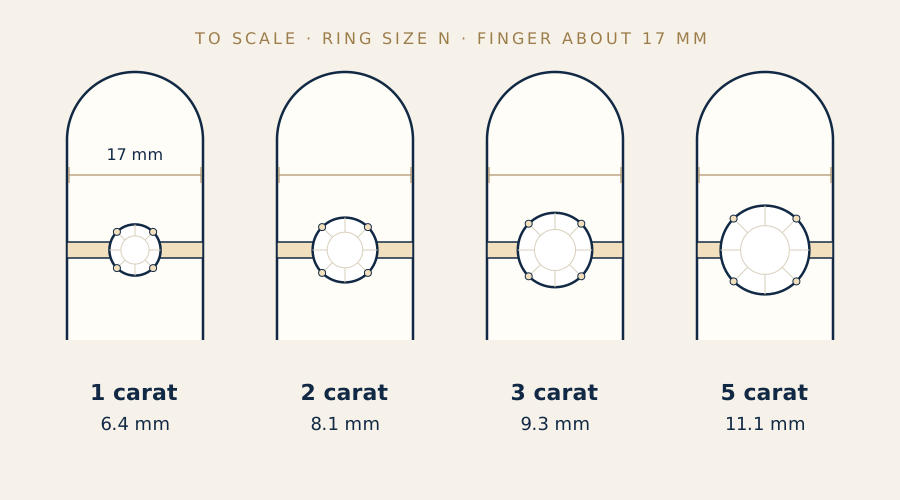
- Solitaire: keeps the focus on size; choose six claws from about 2.5 carats.
- Halo: adds roughly 2–3 mm to the overall width, so a 2 carat centre with a halo can look closer to a 3 carat solitaire.
- Three-stone: side stones of 0.30–0.75 carat each balance a 2–3 carat centre.
- Earrings: check whether a weight is per stone or ctw (carat total weight). "2 ct studs" usually means two 1 carat stones.
How do you choose the right lab-grown carat size? Step by step
- Set your budget and priorities. Decide whether size, grades or natural origin matters most before you look at stones.
- Compare millimetres, not carats. Use the size tables above and look at the measurements on each report.
- Choose the shape. Elongated shapes look larger for their weight; step cuts need cleaner clarity.
- Match the grades to the size. Move up in colour and clarity as you move above 2 carats.
- Read the report. Confirm the lab-grown wording, growth method, any post-growth treatment and the inscription number.
- Watch a 360° video or see it in person. Look for tint, visible inclusions and how bright the stone is in different light.
- Plan the setting with the stone. Make sure the claws, band width and height suit the weight you have chosen.
Free consultation
Talk to a gemologist
Compare stones in person or online with Raj Sood, Graduate Gemologist (GIA), AJP (GIA).
Book a consultationShop this shape
FAQ
Common questions
How big is a 2 carat lab-grown diamond?
A well-cut 2 carat round is about 8.1–8.2 mm across, the same as a natural 2 carat. A 2 carat oval is roughly 9.7 × 7.2 mm, so it looks larger face-up.
Is a 5 carat lab-grown diamond a real diamond?
Yes. It is real diamond with the same hardness, refractive index and density as natural diamond. It should be clearly described as lab-grown and come with an independent grading report.
Do lab-grown diamonds hold their value?
No. Lab-grown diamonds have very low resale value, and prices have fallen over recent years. Buy one for how it looks and what it means to you, not as a financial asset.
Can anyone tell my lab-grown diamond is not natural?
Not by eye or with a normal jeweller's loupe. Specialised testing equipment, mostly used by gemmological labs, is needed to identify it, which is why the report and girdle inscription matter.
Why are large lab-grown diamonds so much cheaper than natural ones?
Large natural rough is rare, so natural prices per carat climb steeply with size. Labs can grow large crystals on demand, so lab-grown prices rise much more gently.
What colour should I choose for a 3 carat lab-grown diamond?
In white gold or platinum, most people choose E to G, because body colour is easier to see in a larger stone. In yellow or rose gold, a grade or two lower usually looks just as white.

Ask a gemologist
Not sure which diamond to choose?
Raj Sood is a Graduate Gemologist (GIA) and master jeweller. Bring the stones you are considering, or send the reports, and he will tell you honestly which one is better and why.
Keep learning
Related guides
 Lab-Grown DiamondsChoosing a 1 Carat Lab-Grown Diamond
 Lab-Grown DiamondsChoosing a 2 Carat Lab-Grown Diamond
 Lab-Grown DiamondsChoosing a 3 Carat Lab-Grown DiamondLab-Grown DiamondsLarge Lab-Grown Diamonds: What Changes Above 3 Carats?Lab-Grown DiamondsLab-Grown Diamonds Guide
 Diamond 4Cs & Grading1.5 Carat Diamonds
 Diamond 4Cs & Grading5 Carat DiamondsDiamond 4Cs & Grading1 Carat Diamonds
Explore more
More guides on this topic
Education