
- Education
- Wedding Bands & Eternity
- Designing an Engagement Ring Around an Existing Wedding Band
Wedding Bands & Eternity
Designing an Engagement Ring Around an Existing Wedding Band
Usually the engagement ring comes first and the wedding band is made to fit it. When the band already exists, the order flips. Designing an engagement ring around a wedding band takes careful measuring, a clear decision about fit and a setting built to clear the band.
 Reviewed by Raj Sood, Graduate Gemologist (GIA), AJP (GIA)Master jeweller and Graduate Gemologist (GIA) · reviewed 4 November 2026
Quick answer
To design an engagement ring around an existing wedding band, start with the band: measure its width, depth, profile, metal and size. Then choose whether the rings sit flush or with a gap, set the head high enough to clear the band, match the metal, and test a CAD model or resin print against the band before casting.
Can you design an engagement ring around an existing wedding band?
Yes, and it is more common than most people expect. The usual order is engagement ring first, band second, and most advice is written that way, including our own guide to matching a new band to an engagement ring you already have. But plenty of people start with the band. Some married quickly or eloped and wore plain bands for years, then decide to add an engagement ring for an anniversary. Some inherit a grandmother's wedding band and want an engagement ring that suits it. Others are remarrying, or simply love the band they have and want to build on it.
Whatever the reason, the band becomes the fixed point. Its width, metal, shape and size are already decided, so the engagement ring has to be designed to work beside it. That is the reverse of building a custom band around an heirloom engagement ring, and it is in some ways easier: a new engagement ring can be shaped, raised and proportioned freely, while an existing band usually should not be changed much.
A quick note on words. People use wedding ring and wedding band to mean the same thing, and we do here too; if you want the detail, see the difference between a wedding ring and a wedding band.
What do you need to know about your wedding band first?
Before anyone sketches a setting, the band needs to be measured properly. A jeweller will use digital callipers (a precise measuring tool) and a ring mandrel (a tapered sizing stick). These are the details that shape every later decision:
| Measurement | Why it matters | Typical range |
|---|---|---|
| Width (top view, across the finger) | The engagement ring's shank (the band part of the ring) is usually made to match it | about 1.8–3 mm for most women's bands; 4–6 mm for wider styles |
| Depth (thickness, finger to top surface) | Decides how high the engagement ring's head must sit to clear it | about 1.3–2 mm |
| Profile (cross-section shape) | Flat, court, D-shape and knife-edge bands meet a shank differently | Varies by style |
| Metal and hallmark | Sets the colour and wear of the new ring | 375 = 9ct, 585 = 14ct, 750 = 18ct, 950 = platinum |
| Ring size | Both rings should be the same size so they sit together | Australian letter sizes, A–Z |
| Shape (straight or curved) | A curved band dictates where the engagement ring's head must sit | Straight, contoured or notched |
The profile is the one people overlook. A court profile is rounded inside and out, a flat profile has squared edges, and a D-shape is flat inside and domed outside. Two flat-edged rings sit tight against each other; two domed rings touch only along a thin line and can leave a small visible gap. Our page on how court, flat and D-shape profiles differ has cross-section drawings of each.
Check the hallmark stamped inside the band too. An older band may be 9ct or 18ct gold, and the alloy affects colour. If a stamp is worn or missing, a jeweller can test the metal. Any term here that is new to you is in our glossary of jewellery terms.
Should the engagement ring sit flush or with a gap?
This is the first real design decision. A flush fit means the two rings sit side by side with no space between them, along their whole length. A gap means the rings sit slightly apart: the engagement ring's head or gallery sits low or overhangs the shank, so the band rests against the setting and leaves a small visible space between the two rings.
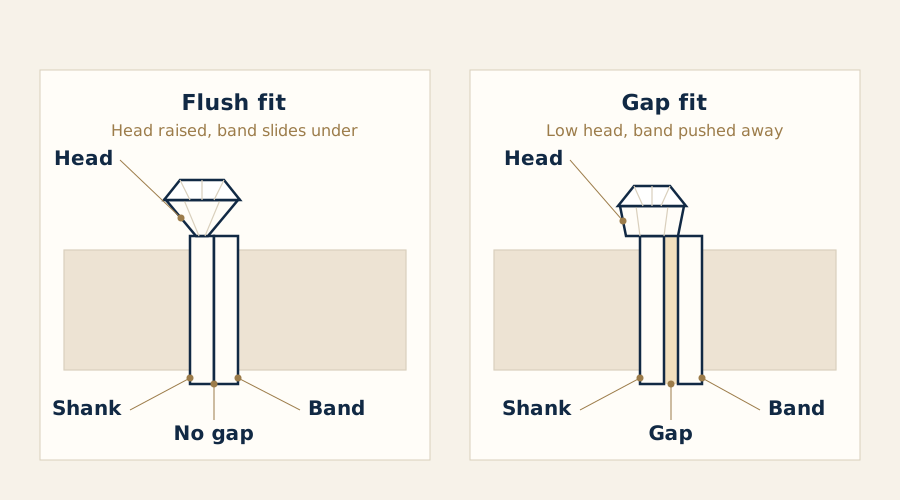
| Flush fit | Gap fit | |
|---|---|---|
| Look | One continuous stack, no light between rings | Two separate rings, with a small visible space |
| Setting needed | Head raised to clear the band, or a contoured shank | Any setting, including low-set |
| Wear | Rings move together, less twisting | Rings can spin slightly and rub |
| Works with a straight band | Yes, if the head is high enough | Yes |
| Works with a curved band | Only if the head fits the curve | Yes, if the gap is accepted |
| Design freedom | More limited | Wider |
Neither is right or wrong. Many people prefer a flush fit because the stack looks tidy and the rings stay aligned. Others like the gap, or choose a low-set design they love and accept it. If the existing band is curved, the engagement ring has to be built to sit inside that curve, a different problem from pairing with a straight band. See curved versus straight bands for how each shape behaves, and how fitted, contoured bands are made if you are considering a second, shaped band later.
How high should the setting sit above a wedding band?
For a flush fit, the lowest point of the engagement ring's head (the part that holds the diamond) must sit above the top surface of the band. Otherwise the band bumps into the setting and pushes the rings apart. As a working rule, the underside of the head or gallery (the open metalwork under the stone) should clear the band by about 0.3–0.5 mm.
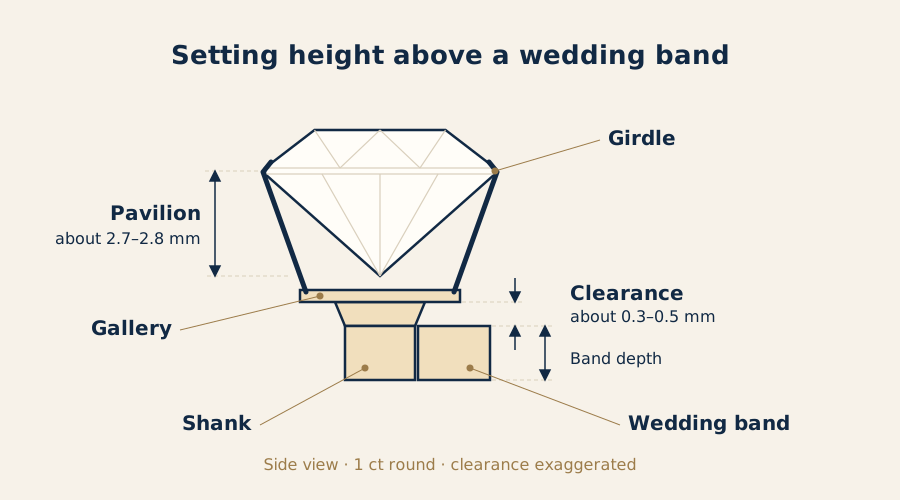
That height depends on the diamond, too. A 1 carat round brilliant is about 6.4 mm across and about 3.9 mm deep, with roughly 2.7–2.8 mm of that below the girdle (the stone's outer edge). The pavilion (the pointed underside) has to fit inside the head, so a deeper stone needs a taller head. Different settings handle this in different ways:
- Cathedral shoulders: the shank arches up to meet the head, leaving natural space for a straight band underneath.
- Raised claw solitaire: a classic four or six-claw head set high enough to clear the band.
- Hidden halo or under-gallery: a ring of small diamonds or a decorative rail under the head; it must clear the band too.
- Halo: small diamonds around the centre stone widen the head, so it overhangs the band more; still needs height.
- Low bezel: a rim of metal around a low-set stone; rarely sits flush with a straight band without a notch or a gap.
The band's profile changes this as well. A domed D-shape band rises higher in the middle than at the edges, while a flat band is the same height across, so how a band's profile changes the way rings sit together matters for exact clearance. Going too high has a cost: a tall head catches on clothing and gloves more easily.
Not sure which one is right?
Send us the stones you are looking at and our gemologist will tell you which to choose and why.
Which diamond shapes suit an engagement ring around a wedding band you already own?
Every diamond shape overhangs the shank differently, so the shape of the centre stone affects how it meets the band. Rounds are the most forgiving. Shapes with corners or points need more care, because the corners can sit over the band and catch.
| Shape | How it meets a straight band | What to watch |
|---|---|---|
| Round | Even overhang on both sides | Head height only; the easiest shape to sit flush |
| Oval (north-south) | Long axis runs along the finger, so the ends overhang the band more | Turned east-west it overhangs much less but sits wider across the finger |
| Princess | Corners overhang the band | Corner claws or V-claws can rub the band |
| Emerald | Straight sides line up neatly with a straight band | Step-cut corners still need protecting |
| Cushion | Similar to a round, slightly wider | Larger cushions overhang more |
| Pear or marquise | Points sit along the finger, sides curve away | Points must be protected; gaps can show beside the curves |
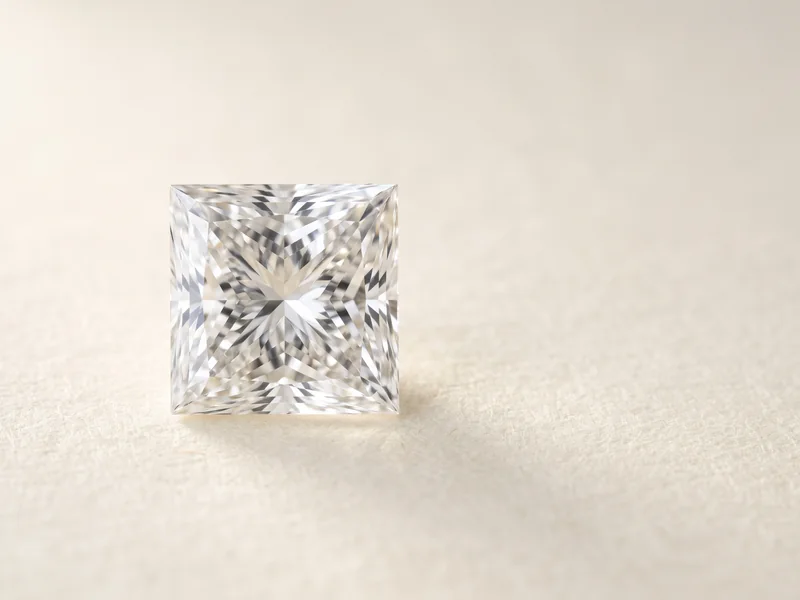
Princess cuts deserve a closer look because their sharp corners sit right where the band meets them. The same principles apply in reverse when the band comes second, which we cover in pairing bands with princess-cut engagement rings.
Related guideHow to Match a Wedding Band to an Engagement RingSize matters too. A small diamond beside a wide band can look lost, while a large halo beside a very fine band can look top-heavy. As a rough guide, a 2 mm band suits centre stones from about 0.50 to 1.50 carat; a band of 4 mm or more often looks balanced with a larger stone or a bolder setting.
Should the engagement ring match the metal of your wedding band?
In most cases, yes. Rings worn side by side rub against each other every day. When both are the same metal and similar hardness, they wear at much the same rate. When they differ, the softer alloy tends to show wear first, and over many years a fine band can thin noticeably where it rubs.
- Yellow and rose gold: colour varies with carat and alloy. An old 9ct yellow band is paler than a new 18ct one, so the alloy should be matched, not just the colour name.
- White gold: usually rhodium plated (a bright white coating). Underneath, 18ct white gold is slightly warm, so both rings will need re-plating from time to time to stay matched.
- Platinum: naturally white and dense; usually marked 950. It scratches to a soft matte patina, tending to displace metal rather than lose it as quickly as gold does.
- Mixed metals: a yellow band with a white engagement ring can look deliberate and attractive, but choose similar hardness so neither wears out first.
A custom build means the new ring's alloy can be chosen to match the band closely. If the band is part of a matching set with a partner's ring, the guide to men's wedding bands covers the wider widths and profiles that often go with it.
How do you balance a plain or diamond wedding band with a new engagement ring?
A plain band is the simplest starting point: almost any engagement ring style works beside it, as long as the width and metal match. A diamond-set band, such as a half or full eternity ring, changes the rules. Two rows of stones side by side can rub, and diamond can scratch or chip diamond and wear down claws. A plain shank on the engagement ring, or a slight gap, keeps the stones from grinding against each other.
Style balance matters as much as fit. A pavé engagement ring beside a pavé band reads as one sparkling stack; a plain shank beside a pavé band gives contrast. A vintage milgrain band (a fine beaded edge) looks more at home with a vintage-style engagement ring. Our comparison of whether to choose a plain or diamond-set wedding band sets out the trade-offs of each.
Width proportion is the other rule. The engagement ring's shank usually looks best within about 0.5 mm of the band's width: for a 2 mm band, a shank of about 1.8–2.2 mm. A much narrower shank looks fragile beside it, and a much wider one dominates. For everything else about choosing bands, our complete wedding ring buying guide covers widths, profiles and finishes in detail.
How much does it cost to design an engagement ring around a wedding band?
The cost has two parts: the setting (the metal ring and its claws or halo) and the centre stone. Designing around an existing band rarely adds much on its own, because the band is measured and modelled as part of the normal custom process. What moves the price is the metal, the setting style and, most of all, the diamond.
| Part | Approximate price range (AUD) |
|---|---|
| 18ct gold solitaire setting, custom | about $1,500–$3,500 |
| 18ct gold halo or pavé setting, custom | about $2,500–$5,500 |
| Platinum instead of 18ct gold | adds about $500–$1,500 |
| 1 ct round lab-grown diamond, G–H, VS | about $1,000–$3,000 |
| 1 ct round natural diamond, G–H, VS | about $7,000–$15,000 |
These are broad ranges only and move with metal prices and diamond markets. Lab-grown diamonds are real diamond, grown in a laboratory rather than mined, and cost much less than natural diamonds of the same size and grades. Natural diamonds are rarer. Both should come with an independent grading report from a lab such as GIA or IGI. If you already have a loose diamond, perhaps from family, read about setting a loose diamond into a ring you already own, and compare ranges with what wedding rings typically cost.
Browse round diamonds, natural and lab-grown, or create your ring
How do you design an engagement ring around an existing wedding band? Step by step
- Bring the band in. Have its width, depth, profile, size and hallmark measured and recorded. Check for thin or worn areas that may need repair first.
- Decide flush or gap. This sets how high the head must sit and which settings will work.
- Choose the centre stone. Pick the shape and size, natural or lab-grown, with the band's width in mind.
- Choose the setting. Cathedral, raised solitaire, hidden halo or halo; confirm the head clears the band.
- Match the metal. Same alloy and carat where possible, or a deliberate mix of similar hardness.
- Review the CAD model. CAD (computer-aided design) lets you see the new ring beside a digital model of your band from every angle.
- Test-fit a resin print. A 3D-printed prototype is tried against the real band before the metal is cast.
- Final fitting. Check both rings together on your finger, and decide whether to have them soldered together later.
Soldering the two rings together stops them spinning and rubbing, but makes resizing harder and means you can no longer wear them separately. Many people wear them loose for a year before deciding. For the same process in reverse, see the reverse process, choosing a band for a ring.
Free consultation
Talk to a gemologist
Compare stones in person or online with Raj Sood, Graduate Gemologist (GIA), AJP (GIA).
Book a consultationFAQ
Common questions
Can I design an engagement ring to match a wedding band I already have?
Yes. The band is measured for width, depth, profile, metal and size, and the engagement ring is designed and test-fitted around it. It is often simpler than the usual order, because a new ring can be shaped freely.
Why won't my engagement ring sit flush with my wedding band?
Usually the head or gallery sits too low, so it bumps into the band. A curved band or two domed profiles can also leave a gap. Raising the head or reshaping the shank normally fixes it.
Should my engagement ring be the same width as my wedding band?
Not exactly, but close. A shank within about 0.5 mm of the band's width usually looks balanced, for example 1.8–2.2 mm beside a 2 mm band.
Can I mix metals between my wedding band and engagement ring?
Yes, it can look deliberate and attractive. Choose metals of similar hardness, because the softer one wears faster where the rings rub.
Can I put a diamond engagement ring next to a diamond eternity band?
Yes, but the stones and claws can rub against each other. A plain shank on the engagement ring, or a small gap, reduces the wear.
Should I solder my engagement ring and wedding band together?
It stops them spinning and rubbing, but makes resizing harder and you can't wear them separately. Many people wait a year or so before deciding.

Ask a gemologist
Not sure which diamond to choose?
Raj Sood is a Graduate Gemologist (GIA) and master jeweller. Bring the stones you are considering, or send the reports, and he will tell you honestly which one is better and why.
Keep learning
Related guides
 Wedding Bands & EternityHow to Match a Wedding Band to an Engagement Ring
 Wedding Bands & EternityFitted Wedding Bands Explained | Custom Curved Bands
 Wedding Bands & EternityWedding Band Profiles Explained
 Wedding Bands & EternityCustom Wedding Band Around an Heirloom Engagement RingWedding Bands & EternityWedding Ring Buying Guide
 Wedding Bands & EternityWedding Ring vs Wedding Band
 Wedding Bands & EternityMen’s Wedding Band Guide
 Wedding Bands & EternityBest Wedding Band for Princess Engagement Rings
Explore more
More guides on this topic
Education