
- Education
- Care, Repairs & Remodelling
- Setting a Loose Diamond Into an Existing Ring: Fit, Options and Cost
Care, Repairs & Remodelling
Setting a Loose Diamond Into an Existing Ring: Fit, Options and Cost
Setting a loose diamond into an existing ring can save a much-loved band and give a stone a new home, but only if the stone, the head and the metal are matched properly. Here is what a bench jeweller checks, what can go wrong and what it typically costs in Australia.
 Reviewed by Raj Sood, Graduate Gemologist (GIA), AJP (GIA)Master jeweller and Graduate Gemologist (GIA) · reviewed 4 November 2026
Quick answer
Setting a loose diamond into an existing ring is usually possible if the stone's millimetre size and shape suit the ring's head, or if a jeweller replaces the head. Expect an assessment of both stone and ring, about 1–3 weeks' work and roughly AUD $80–$800, with bezels, halos and custom rebuilds costing more.
Can you put a loose diamond into an existing ring?
Yes, in most cases. Bench jewellers set customers' own stones all the time: a diamond from a broken pendant, an inherited stone, a lab-grown diamond bought loose, or a larger centre stone replacing a smaller one. Whether it works in your ring depends on three things: the size and shape of the diamond in millimetres, the style and condition of the ring's head (the part that holds the centre stone), and whether the ring can safely take the work involved.
The head is usually a claw setting (also called prongs), a bezel (a continuous rim of metal around the stone) or a halo of small diamonds around the centre. Our guide to how each type of setting holds a stone explains these in detail, and any unfamiliar word on this page is defined in our plain-English jewellery glossary.
When people say 'set my diamond into my ring', they usually mean one of two very different jobs. The first is placing a stone into a head that already suits it, a relatively small bench job. The second is replacing or rebuilding the head so a different stone fits, which involves soldering or laser welding, more time and more cost. Working out which one you need is most of the answer.
- Replacing a lost centre stone with one of the same size and shape.
- Upgrading to a larger diamond while keeping the original band.
- Setting an heirloom diamond into a ring you already wear.
- Moving a stone from a ring that is too worn or damaged to repair.
- Setting a loose lab-grown or natural diamond bought separately from the ring.
Will a loose diamond fit my ring's existing setting?
Carat is a weight, not a size, so two 1 carat diamonds can measure quite differently. A jeweller judges fit from the stone's diameter (or length and width for fancy shapes), its depth from table to culet, and its girdle thickness (the girdle is the thin edge around the widest part of the stone). These figures are on the grading report, but they are always re-measured with a gauge before quoting.
| Round brilliant weight | Typical diameter | What usually happens |
|---|---|---|
| 0.25 ct | about 4.0–4.2 mm | Fits a 4 mm head; small heads are often replaced rather than adjusted |
| 0.50 ct | about 5.0–5.2 mm | Fits a 5 mm head with re-cut seats |
| 0.75 ct | about 5.7–5.9 mm | Needs a head made for 5.75–6 mm |
| 1.00 ct | about 6.3–6.5 mm | Fits a 6.5 mm head; a 5 mm head cannot stretch this far |
| 1.50 ct | about 7.3–7.5 mm | Usually needs a new, heavier head |
| 2.00 ct | about 8.0–8.2 mm | New head, often with thicker claws |
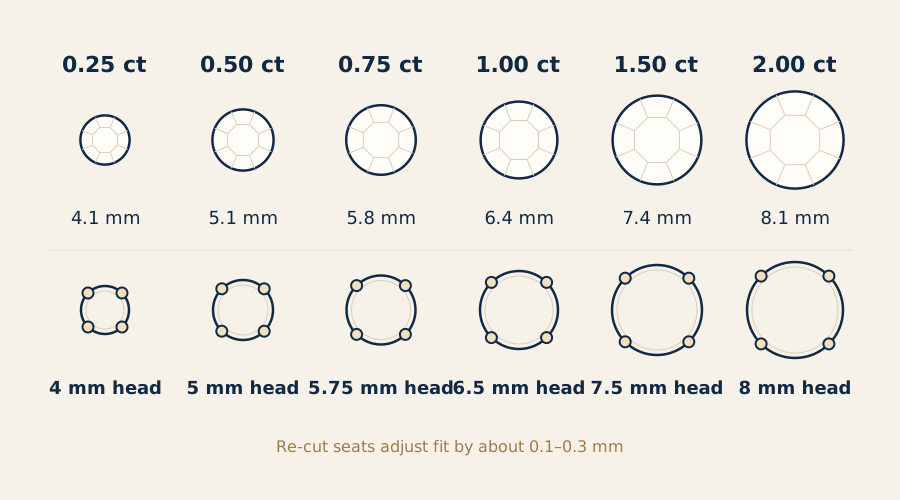
Inside each claw the jeweller cuts a small notch called a seat (or bearing), which the girdle sits in. Cutting the seats a little deeper or shallower lets a claw head take a stone that is slightly larger or smaller than it was made for, often about 0.1–0.3 mm either way. Beyond that the claws are either too short to reach over the stone or too thin once the seat is cut, and a new head is the safer choice.
Shape matters as much as size. A round head will not hold a princess, oval or pear diamond properly, because the claws sit in the wrong places and leave corners or points exposed. Our overview of every diamond shape and its outline shows where each shape's vulnerable corners and points sit. Depth matters too: a deep stone may push its culet (the bottom point) through the base of a low head and rub on the finger. If your current centre stone has already been moving, have that checked first; our page on a stone that has started to move in its claws explains why worn heads are often the real problem.
Should you reuse the old head, replace it or rebuild the setting?
Once the stone and ring are measured, there are four realistic paths. The right one depends on how close the fit is and how worn the existing claws are.
| Option | When it suits | What is involved | Typical time |
|---|---|---|---|
| Reuse the existing head | Same shape, size within about 0.1–0.3 mm, claws in good condition | Open claws, re-cut seats, set, tighten and polish | A few days to 1 week |
| Re-tip and reuse | Good fit but claw tips worn thin | Add new metal to each claw tip, then set | 1–2 weeks |
| Replace the head | Different size or shape, or worn-out claws | Remove old head, fit a new claw or bezel head to the shank, set | 1–3 weeks |
| Rebuild or remake | Halo, bezel or detailed setting that cannot adapt, or shank too thin | New setting designed around the stone, often in CAD | 3–6 weeks |
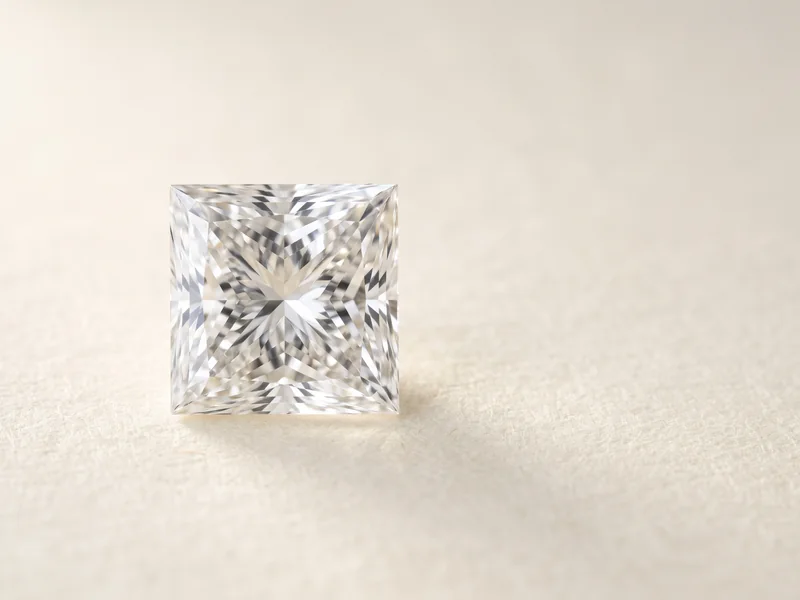
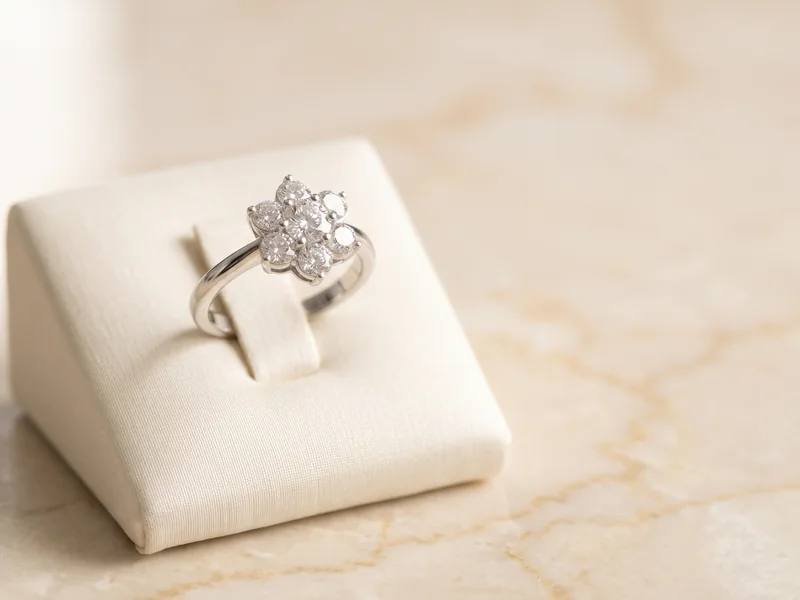
Replacement heads come in standard sizes for round, oval, princess, cushion, pear, emerald and marquise shapes, in four or six claws, with basket or cathedral styles. A square stone needs its corners protected; our page on settings that guard princess cut corners shows the V-claw options, and heart setting examples with a protected point show the same idea for pointed shapes. If you want the new head to change the look of the ring as well, petal-style floral heads are a popular way to do it without replacing the band.
A new head should be made in the same metal family as the ring: 18 carat yellow on yellow, platinum on platinum. Mixing alloys can show colour differences and can weaken the join. White gold heads on a white gold band will usually be rhodium plated (a thin bright white coating) after the work so they match. For a side-by-side look at claw, bezel and halo heads, see our comparison of claw, bezel and halo heads.
Which ring settings can't easily take a different diamond?
Some settings are adjustable; others are made around one particular stone and can only be adapted within very small limits.
- Claw heads: the most adaptable. Seats can be re-cut, tips rebuilt and whole heads swapped.
- Bezels: made to the stone's exact outline. A bezel can sometimes be opened for a stone a fraction smaller, but a larger stone usually needs a new bezel.
- Halos: the small diamonds are set around a centre opening of a fixed size. A different centre stone generally means a new halo or a new centre basket inside it.
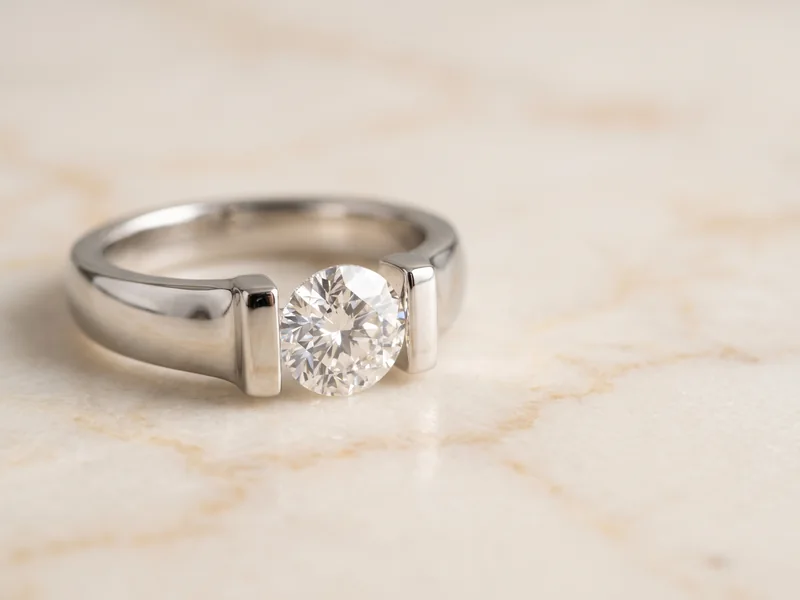
- Tension settings: the band itself grips the stone under spring pressure, so the gap is made to the stone's girdle within very fine tolerances. Our page on why tension settings are built around one specific stone explains the engineering.
- Flush (gypsy) settings: the stone sits in a hole drilled into the band. A seat can be enlarged for a bigger stone if the band is thick enough, but never made smaller; see flush settings drilled into the band.
- Channel and bar settings: built for a row of stones of matching size, so a single replacement must match its neighbours closely.
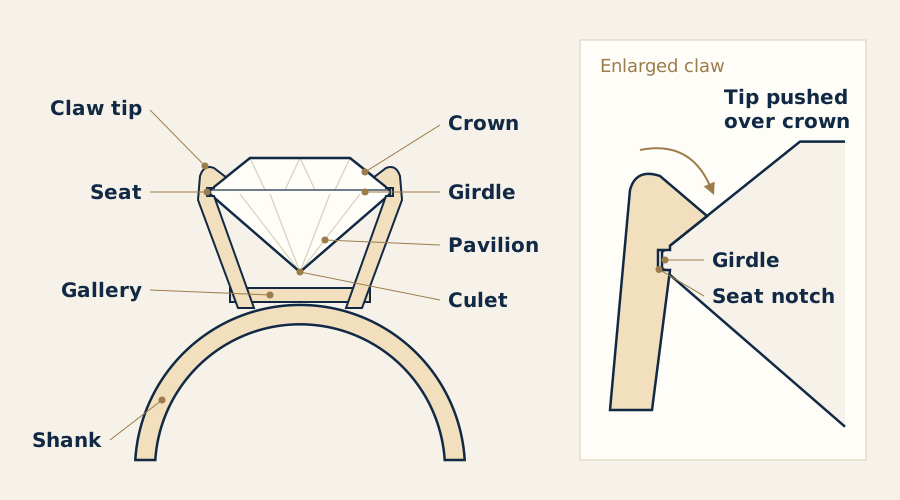
Ring parts such as the gallery (the metal under the stone), basket and cathedral shoulders also limit what will fit. If those words are new, the definitions of gallery, basket and cathedral will help when you talk to the jeweller.
Not sure which one is right?
Send us the stones you are looking at and our gemologist will tell you which to choose and why.
Can you set an heirloom or lab-grown diamond into an existing ring?
Yes, both are common, with a few things to watch.
Heirloom and old-cut diamonds: Old European and old mine cuts were cut by hand for weight, not spread, so they are often deeper, have a small table and a larger culet, and can be slightly out of round; our page on how an Old European cut differs from a modern round explains why. A 1 carat Old European may measure only about 6.0–6.3 mm across, against about 6.4 mm for a modern round. Standard heads may not fit, and the culet may need a taller head to clear the finger. Older stones also tend to have small chips or worn facet edges at the girdle from decades of wear, which the jeweller should point out before setting. If the ring itself needs more than a new head, our guide to redesigning an old ring into a modern engagement ring walks through the choices.
Lab-grown diamonds: a laboratory-grown diamond is real diamond, with the same hardness (10 on the Mohs scale) and the same behaviour at the bench as a natural diamond, so it is set in exactly the same way. If you are replacing a natural centre stone with a lab-grown one, the stone should be identified as lab-grown on its report and on any new insurance valuation.
Wedding band fit: a larger stone often needs a taller head, and that changes how the engagement ring sits beside a straight band. Before you commit, read about planning a ring around the wedding band you already wear. Sometimes it is simpler to remake the whole piece; remodelling an inherited ring from the ground up covers when that makes more sense than a reset.
Related guideDesigning an Engagement Ring Around an Existing Wedding BandIs it safe to set a diamond with heat and solder?
Diamond is the hardest natural material, but hardness is not heat resistance. In air, diamond begins to oxidise (burn at the surface, leaving a frosty look) at roughly 700–900°C, and the solders used to join gold heads flow in a similar range. That is why careful jewellers take the diamond out before heavy soldering, protect it with a flux coating if it must stay in, or use a laser welder, which joins metal with a tiny, very local pulse of heat.
Other stones in the ring are often more fragile than the diamond. Before any heat is applied, the jeweller should check every stone in the piece:
- Must come out before heat: emerald, opal, pearl, tanzanite, turquoise, coral and most glass-filled or oiled stones.
- Usually tolerate careful work: untreated sapphire and ruby, though lead-glass-filled rubies do not.
- Fracture-filled diamonds: a diamond whose cracks have been filled with glass to improve clarity can lose or cloud its filling with heat or ultrasonic cleaning. Tell the jeweller if the report mentions clarity enhancement.
- Coated stones: surface coatings used to add colour can be damaged by heat and polishing compounds.
Setting itself puts mechanical pressure on the stone as claws are pushed over. An existing feather (an internal crack) that reaches the girdle can extend under that pressure, so a good jeweller inspects the stone under magnification and records any damage before starting. The same caution applies at home; our notes on why ultrasonic cleaners are risky for some stones explain what is and isn't safe to clean.
How much does setting a loose diamond into an existing ring cost?
Prices vary with the metal, the size of the stone, the number of claws and how much of the ring needs work. These are broad Australian ranges only; a jeweller can quote properly once the ring and stone are on the bench.
| Job | Approximate cost (AUD) |
|---|---|
| Set a stone into a suitable existing head | about $80–$250 |
| Re-tip four or six claws, then set | about $150–$400 |
| New 18 ct gold claw head, fitted and set | about $250–$600 |
| New platinum claw head, fitted and set | about $350–$800 |
| New bezel or halo, fitted and set | about $500–$1,500 |
| Custom rebuild or new setting around your stone | about $1,000–$3,000+ |
Larger stones need heavier heads with more metal, and platinum costs more to work than gold because of its higher melting point and the specialist welding involved. Small accent stones that are loose or missing in the same ring are usually quoted separately. After any reset, it is worth updating your insurance valuation, especially if the stone has changed.
Jewellery repairs and resetting service
What should you check before you hand over your diamond?
Leaving a valuable stone with someone else is reasonable cause for care. A few simple records protect you and the jeweller:
- The grading report or valuation: note the measurements, weight, colour, clarity and any laser inscription on the girdle.
- Photos and video: ask for clear before and after photos of the stone and ring, and take your own.
- A written job receipt: it should describe the stone (shape, approximate weight, natural or lab-grown) and the work to be done.
- Existing damage: ask the jeweller to note any chips, feathers or worn facets they find under magnification.
- Insurance: check whether your policy covers the stone while it is out of your hands.
- Ring height and band fit: if the head is changing, ask how tall the new head will be and how it will sit beside your wedding band; our article on how a taller head changes the way a band sits has examples.
A straightforward reset into a suitable head often takes a few days to a week. A new head or re-tipping usually takes 1–3 weeks, and a custom setting designed in CAD (computer-aided design) and cast can take 3–6 weeks, depending on the workshop's queue.
How does setting a loose diamond into an existing ring work, step by step?
- Assessment. The jeweller gauges the diamond's diameter and depth, inspects it under magnification and checks the ring's head, claws and shank for wear.
- Choose the path. Reuse the head, re-tip it, fit a new head or rebuild the setting, based on fit and condition.
- Remove other stones if needed. Heat-sensitive gems come out before any soldering or welding.
- Metal work. Old head removed and new one fitted, or claws re-tipped, using solder or a laser welder.
- Cut the seats. Each claw is notched so the girdle sits level and the stone is centred.
- Set the stone. Claws are pushed over the crown, shaped and checked so no edge or point is exposed.
- Finish. The ring is cleaned, polished and rhodium plated if it is white gold, then checked again under magnification.
- Hand-over. You check the stone and setting, compare with your before photos and update your insurance.
How do you look after a newly set diamond?
A freshly set stone is at its most secure, but claws wear with every knock against a bench, steering wheel or gym bar. Platinum claws tend to move and thicken slightly with wear, while gold claws wear away gradually, which is why claw checks every 6–12 months are a sensible habit for a ring worn daily.
- Look side-on at the claws: tips should sit snugly over the crown with no gap.
- Tap the ring gently beside your ear; a faint rattle means the stone is moving.
- Run a cotton ball over the head; catching threads can mean a lifted claw.
- Take the ring off for gardening, gym and heavy cleaning.
For day-to-day cleaning, warm water, a drop of dishwashing liquid and a soft toothbrush are enough; our simple home cleaning routine covers the details. If anything feels loose, stop wearing the ring until it is checked, and read the warning signs of a lifting claw so you catch it early.
Free consultation
Talk to a gemologist
Compare stones in person or online with Raj Sood, Graduate Gemologist (GIA), AJP (GIA).
Book a consultationShop this shape
FAQ
Common questions
Can a jeweller put my own diamond in a ring I already have?
Usually, yes. If the diamond's size and shape suit the existing head, it can often be set in a few days; if not, the head can be replaced so the stone fits securely.
Will a 1 carat diamond fit a setting made for a 0.50 carat stone?
No. A 1 carat round is about 6.3–6.5 mm across and a 0.50 carat about 5.0–5.2 mm, which is too big a difference for re-cut seats. A new head sized for the larger stone is needed.
Can heat from soldering damage a diamond?
It can. Diamond starts to oxidise at roughly 700–900°C, so jewellers remove the stone, protect it with flux or use a laser welder for work close to it.
How much does it cost to have a diamond set into an existing ring in Australia?
Setting into a suitable head is roughly AUD $80–$250, while a new gold or platinum head fitted and set is roughly $250–$800. Custom rebuilds can cost $1,000 or more.
Can I put a lab-grown diamond in my original engagement ring?
Yes. A lab-grown diamond is real diamond and is set the same way as a natural one. Make sure it is described as lab-grown on your report and insurance valuation.
How long does it take to reset a diamond?
A simple reset often takes a few days to a week, a new head or re-tipping about 1–3 weeks, and a custom setting around 3–6 weeks.

Ask a gemologist
Not sure which diamond to choose?
Raj Sood is a Graduate Gemologist (GIA) and master jeweller. Bring the stones you are considering, or send the reports, and he will tell you honestly which one is better and why.
Keep learning
Related guides
 Engagement Rings & SettingsDiamond & Gemstone Setting Guide
 Care, Repairs & RemodellingLoose Stones and Stone TighteningCare, Repairs & RemodellingHow to Redesign an Old Ring Into a Modern Engagement RingCare, Repairs & RemodellingJewellery Care and Maintenance
 Wedding Bands & EternityDesigning an Engagement Ring Around an Existing Wedding Band
 Engagement Rings & SettingsBest Settings for Princess Diamonds
 Engagement Rings & SettingsFloral Engagement Ring Settings
 Engagement Rings & SettingsTension and Suspended Settings
Explore more
More guides on this topic
Education