
- Education
- Diamond Shapes
- Emerald Cut Diamond Clarity: Why Inclusions Show More and What to Choose
Diamond shapes
Emerald Cut Diamond Clarity: Why Inclusions Show More and What to Choose
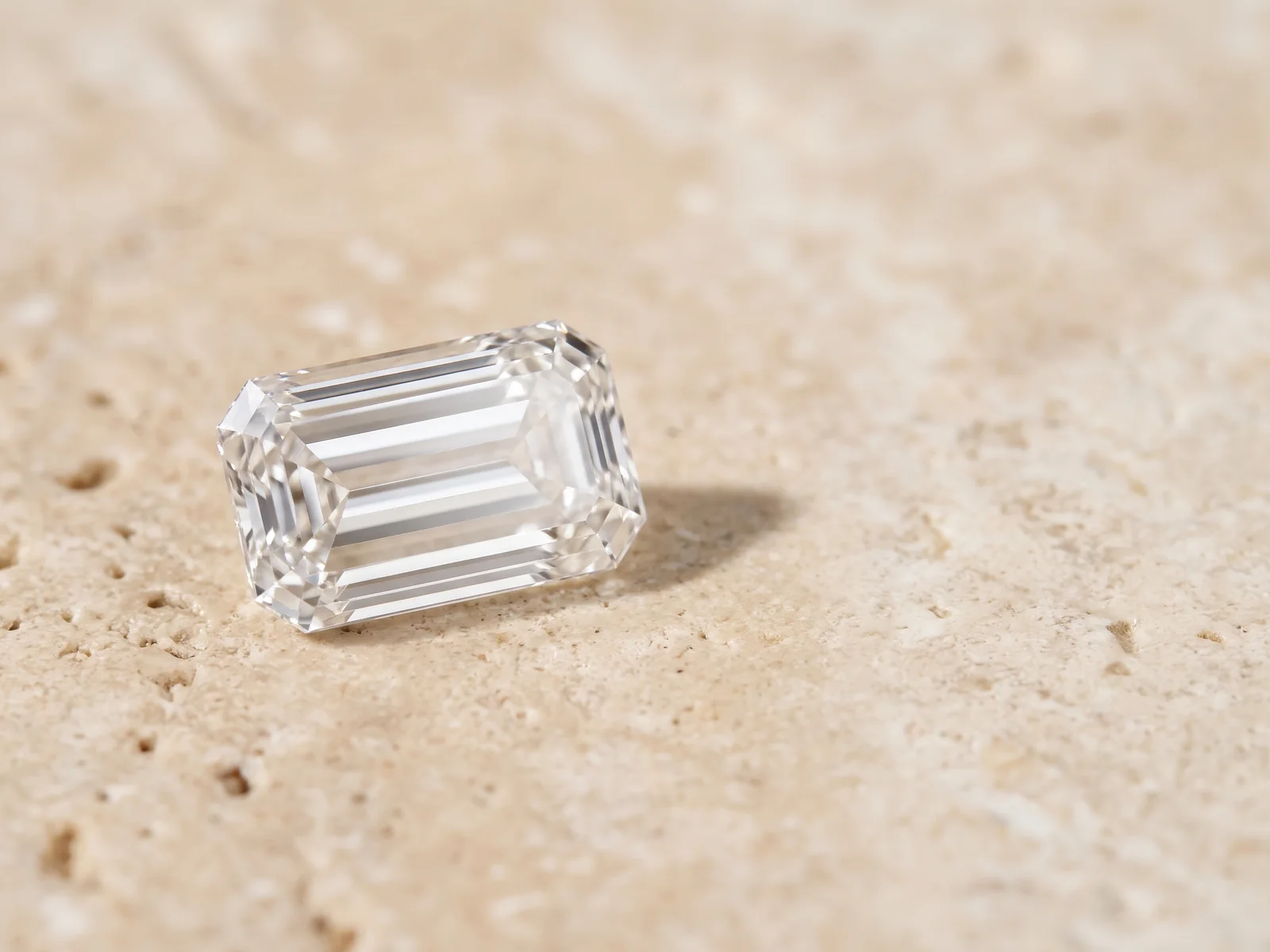
Emerald cut diamond clarity matters more than in almost any other shape. The clean, open facets that make an emerald cut so calm and glassy also work like a window into the stone, so here is how to choose a grade you will be happy looking into.
 Reviewed by Raj Sood, Graduate Gemologist (GIA), AJP (GIA)Master jeweller and Graduate Gemologist (GIA) · reviewed 4 November 2026
Quick answer
Emerald cut diamond clarity matters more than in most shapes because the step cut has a large, open table and long parallel facets that act like windows rather than hiding inclusions in sparkle. Most people choose VS1 or better, or a carefully checked VS2, and avoid any inclusion under the table or near the corners.
What is emerald cut diamond clarity and why is it different?
Clarity describes how many internal features (inclusions) and surface marks (blemishes) a diamond has, and how visible they are under 10× magnification. The grade on a report is the same for every shape, but how that grade looks on the hand is not. An SI1 round can look perfectly clean to the eye; an SI1 emerald cut often will not.
The emerald cut is one of only a handful of step-cut shapes among the 34 diamond cuts we cover, and that faceting style is the whole reason clarity behaves differently here.
Why do inclusions show more in emerald cut diamonds?
The emerald cut is a step cut: instead of the triangular and kite-shaped facets of a brilliant cut, it has long, rectangular facets arranged in rows, like steps running down from the table to the girdle (the thin outer edge). A classic emerald cut has about 57 facets, usually three rows of steps on the crown (top) and three or four on the pavilion (underneath), with cut corners to protect the stone. Our complete emerald cut diamond guide covers the shape in full, and our overview of how step cuts differ from brilliant shapes puts it in context. Any unfamiliar term is also in our plain-English jewellery glossary.
Three things about that faceting make inclusions easier to see:
- A large, flat table. The table (the top facet) of an emerald cut is usually about 61–69% of the stone's width and has no facets breaking it up. You look straight down into the diamond as if through a pane of glass.
- Broad flashes, not fine sparkle. A brilliant cut throws back hundreds of small, bright pinpoints of light (called scintillation) that distract the eye and camouflage small inclusions. A step cut gives fewer, larger flashes of light and dark, often called the hall-of-mirrors effect. It is beautiful, but it leaves inclusions nowhere to hide.
- Parallel facets that repeat what is inside. Because the pavilion steps run parallel to the crown steps, an inclusion can be reflected along a row of facets, so one small crystal can appear as two or three faint images.
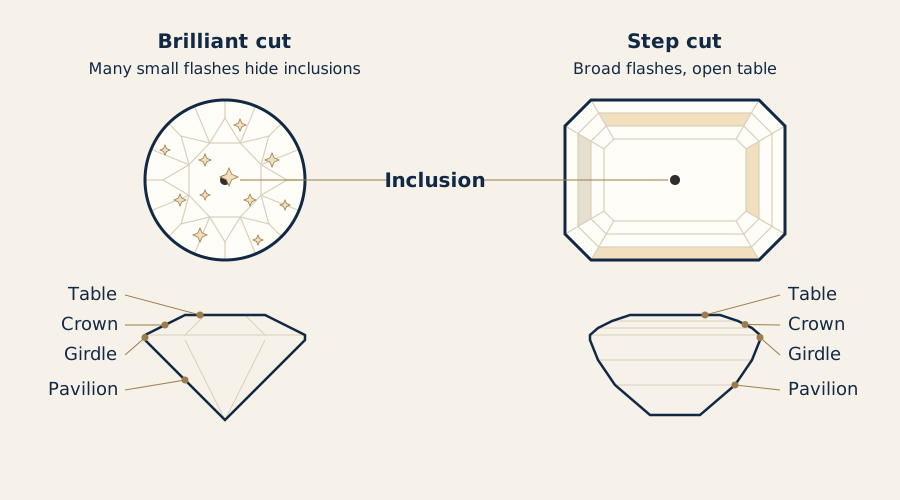
Diamond itself has a refractive index of about 2.42 and sits at 10 on the Mohs hardness scale, so the material is identical whatever the shape. What changes is how the cut handles light. The same logic applies to smaller step cuts, such as baguette and tapered baguette side stones, which also need cleaner clarity than brilliant accents. If you want to know what each kind of inclusion actually is, our full guide to diamond inclusion types explains them one by one.
What clarity grade is best for an emerald cut diamond?
GIA and IGI use the same 11-grade clarity scale for natural diamonds, and IGI also applies it to lab-grown stones (GIA now describes lab-grown diamonds in simpler quality terms). The table shows how each grade typically behaves in an emerald cut, judged face-up at normal viewing distance without magnification.
| Clarity grade | What it means | In an emerald cut |
|---|---|---|
| FL / IF | Flawless / internally flawless | Clean; you pay for a difference you cannot see |
| VVS1 / VVS2 | Very, very slightly included; minute features hard to find at 10× | Clean to the eye; good if you want no compromise |
| VS1 | Very slightly included; minor features | Almost always eye-clean; the most common choice |
| VS2 | Very slightly included; features easier to find at 10× | Often eye-clean, but check where the inclusion sits |
| SI1 | Slightly included; noticeable at 10× | Sometimes eye-clean in small stones; many are not |
| SI2 | Slightly included; easy to see at 10× | Inclusions usually visible through the table |
| I1–I3 | Included; obvious features | Visible to the eye; can affect durability |
For most people, VS1 or better is the comfortable choice for an emerald cut. A VS2 emerald cut diamond can be just as clean to the eye if its inclusion is small, pale and near the edge, so it is worth checking stone by stone rather than ruling out. An SI1 emerald cut diamond is possible under about 1 carat, but you should see it in person or on a sharp, still photo before you decide.
If you want a rectangular outline but would rather buy at SI1 with confidence, a brilliant-faceted rectangle is often the answer: our radiant cut as a more forgiving alternative explains why.
Which emerald cut diamond inclusions matter most?
Two stones with the same grade can look very different, because the grade weighs the size, number, colour, type and position of inclusions together. In an emerald cut, position and colour matter most. Our page on how feathers, clouds and crystals form covers the science; here is how each behaves in a step cut.
| Inclusion | What it is | Visibility in an emerald cut | Durability concern |
|---|---|---|---|
| Crystal (dark) | A tiny mineral trapped inside, sometimes black | High, especially under the table | Low, unless large |
| Crystal (white/clear) | A pale or colourless mineral crystal | Moderate; can be reflected along the steps | Low |
| Feather | A small internal fracture | Moderate; catches light as a white flash | Higher if it reaches the surface or a corner |
| Cloud | A cluster of tiny pinpoints | Low if small; large clouds make the stone hazy | Low |
| Needle | A thin, rod-shaped crystal | Moderate; lines show clearly in a step cut | Low |
| Twinning wisp | Thread-like features where crystal growth changed direction | Moderate to high; common in some emerald cuts | Low |
| Indented natural / chip | Original crystal surface or small break at the girdle | Low face-up; usually under a claw | Moderate at corners |
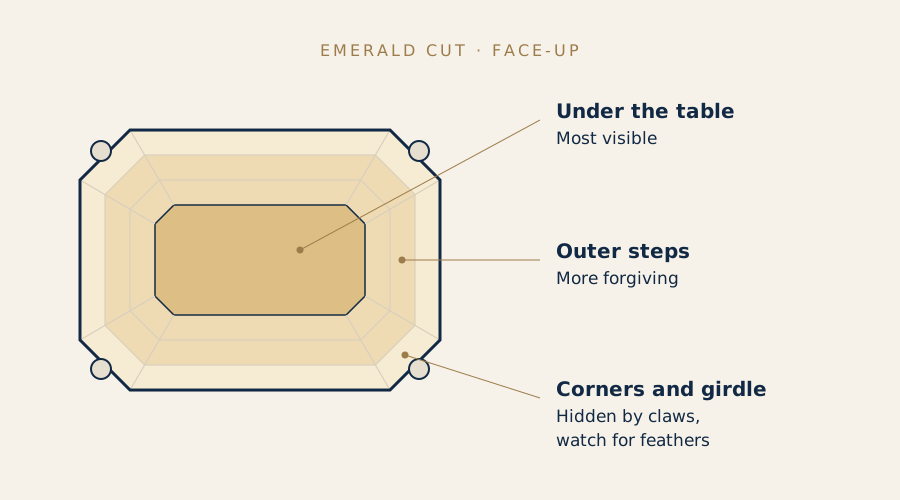
Think of the stone in three zones. Under the table is where inclusions are most visible, so even a small dark crystal there can spoil a VS2. The outer steps are more forgiving, because the broken-up reflections help hide what sits behind them. The corners and girdle hide inclusions well and can sit under a claw, but a feather that reaches the surface at a corner is a weak point in a stone that will be worn every day.
Not sure which one is right?
Send us the stones you are looking at and our gemologist will tell you which to choose and why.
Does carat size change how clarity shows in an emerald cut?
Yes. Inclusions scale with the stone, and a larger emerald cut has a larger table to look through. A VS2 that is invisible at 0.70 carat may be easy to find at 2 carats. As a rule of thumb, many people go one grade higher in clarity for every big step up in size.
| Carat weight | Typical size (length × width), ratio about 1.40 | Clarity most people are comfortable with |
|---|---|---|
| 0.50 ct | about 6.0 × 4.0 mm | VS2, or a carefully checked SI1 |
| 1.00 ct | about 7.0 × 5.0 mm | VS2–VS1 |
| 1.50 ct | about 8.0 × 5.7 mm | VS1 |
| 2.00 ct | about 8.5 × 6.2 mm | VS1–VVS2 |
| 3.00 ct | about 9.8 × 7.0 mm | VVS2 or better |
The ratio matters too. A classic emerald cut sits around 1.30–1.50 in length-to-width ratio. Longer, slimmer emerald cuts of 1.50 and above spread the same weight over a longer table, which looks larger on the hand but also gives inclusions a bigger stage. Depth matters as well: well-cut emerald cuts often sit around 60–68% total depth, and a stone cut much shallower spreads wider but tends to look washed-out in the centre. For how face-up size varies by outline, see which shapes face up largest for their weight.
Is it clarity, windowing or colour you are seeing?
Because an emerald cut is so transparent, three different things can make the centre look less than crisp, and they are easy to confuse.
- Inclusions: specific, fixed points or lines that stay in the same place as the stone moves.
- Windowing: a pale, see-through patch in the middle where light passes straight through instead of reflecting back, usually from a pavilion cut too shallow. It moves and changes with the viewing angle. Our guide to windowing in a shallow emerald cut shows examples.
- Body colour: step cuts show colour a little more than brilliants, especially at the corners. Many people choose G–H in white metal and I–J in yellow or rose gold.
The practical point: a high clarity grade will not rescue a poorly proportioned emerald cut. A VS1 stone with a strong window can look emptier than a well-cut VS2. Judge clarity, proportions and colour together, as we do when choosing an emerald cut on proportions and colour.
How does emerald cut clarity compare with radiant, Asscher and round?
Every shape hides inclusions differently. This comparison is about how forgiving each shape is, not which is better.
| Emerald | Asscher | Radiant | Round brilliant | |
|---|---|---|---|---|
| Facet style | Step cut | Step cut | Brilliant / mixed | Brilliant |
| Typical facets | about 57 | about 58 | about 70 | 57–58 |
| Hides inclusions | Least | Low; a little better (deeper, higher crown) | Well | Very well |
| Clarity most people choose | VS1+ | VS1+ | SI1–VS2 | SI1–VS2 |
| Shows colour | More | More | Moderate | Least |
| Light look | Broad flashes, hall of mirrors | Concentric squares, windmill pattern | Lively, crushed-ice sparkle | Bright, even sparkle |
If you love a square step cut, our guide to how an Asscher's square step cut compares explains why Asschers are a touch more forgiving: they are usually cut deeper with a higher crown, which adds reflections. For the same rectangular outline with more sparkle, see our emerald vs radiant comparison. To weigh up every outline, start with every diamond shape side by side.
How does clarity affect emerald cut diamond price in Australia?
Emerald cuts usually cost less per carat than rounds of the same grades, partly because more of the rough crystal can be kept when cutting. Our page on how price per carat varies between shapes sets out that pattern. Clarity then moves the price within the shape. Emerald cuts are made in both natural and laboratory-grown diamond. Both are real diamond with the same hardness and refractive index; lab-grown diamonds are grown in a laboratory rather than mined and cost much less.
| 1 ct emerald cut, G colour | Approximate price range (AUD) |
|---|---|
| Lab-grown, VS1 | about $800–$2,500 |
| Natural, SI1 | about $4,500–$8,000 |
| Natural, VS2 | about $5,500–$9,500 |
| Natural, VS1 | about $6,000–$11,000 |
These are broad ranges only and move with the market and the exact stone. For natural emerald cuts, the step from SI1 to VS1 is usually a noticeable jump in price, which is why a well-placed VS2 is often good value. With lab-grown emerald cut diamond clarity, the gap between grades is much smaller in dollars, so many people simply choose VS1 or VVS and remove the question. Lab-grown stones have their own inclusion types, such as pinpoints and dark graphite-like specks in CVD-grown stones (chemical vapour deposition) or metallic flux inclusions in HPHT-grown stones (high pressure, high temperature), and the report will state that the diamond is laboratory-grown.
One common mix-up: the emerald cut diamond has nothing to do with the emerald gemstone. Emeralds are green beryl, 7.5–8 on the Mohs scale, and are almost always included; most are treated with oil or resin to improve their clarity. Our page on how emerald gemstones are clarity-enhanced covers that separate topic, including lab-created emeralds.
Browse emerald cut diamonds: natural and lab-grown
Can a setting hide inclusions in an emerald cut?
A little, but only at the edges. The setting cannot hide anything under the table, so choose the stone first. Where it helps:
- Four claws on the corners: the cut corners of an emerald cut sit under the claws, which can cover a small inclusion or natural right at the corner and protect that area from knocks.
- Double claws: eight claws in pairs give extra security and cover a little more of each corner.
- Bezel or half-bezel: a rim of metal around the girdle can cover small features at the edge and protects the corners well, though it hides some of the outline.
- Halo: small diamonds around the centre stone frame it; they do not hide inclusions inside the centre stone.
If a stone has a feather near a corner, position it under a claw where possible and avoid tension or very open settings. Our guide to settings that suit an emerald cut shows each style in detail.
How do you check emerald cut diamond clarity before you buy?
- Read the report. Confirm the clarity grade, the measurements and whether the diamond is natural or lab-grown.
- Study the plotting diagram. This map on the report shows where each inclusion sits. Red marks are internal, green are surface. Prefer inclusions in the outer steps or corners, not under the table.
- Read the comments. Look for notes such as "clouds not shown" or "twinning wisps", which can affect transparency.
- Look at a still, face-up photo. Use soft, even light with the table flat to the camera; this is closest to what you will see when worn.
- Watch a 360° video. Fixed spots are inclusions; a pale centre that changes with angle is windowing. Our tips on spotting a window in a video help here.
- Check durability spots. Make sure no feather reaches the surface at a corner or along the girdle.
- Match clarity to size. Go up a grade as the stone gets bigger, and see larger stones in person if you can.
Free consultation
Talk to a gemologist
Compare stones in person or online with Raj Sood, Graduate Gemologist (GIA), AJP (GIA).
Book a consultationFAQ
Common questions
Is VS2 clarity good enough for an emerald cut diamond?
Often, yes, if the inclusion is small, pale and near the edge rather than under the table. Check the plotting diagram and a clear face-up photo before deciding.
Can an SI1 emerald cut diamond be eye-clean?
Some are, mostly under about 1 carat with inclusions near the corners. Many SI1 emerald cuts show inclusions through the table, so see the stone before choosing it.
Why do emerald cuts need higher clarity than round diamonds?
An emerald cut is a step cut with a large, open table and long facets, so it does not break light into small sparkles that hide inclusions. You see further into the stone, so inclusions are easier to spot.
Do lab-grown emerald cut diamonds have inclusions?
Yes. Lab-grown diamonds can have pinpoints, dark specks or metallic inclusions from the growing process, and they are usually graded on the same clarity scale as natural diamonds. Higher grades cost little extra, so many buyers choose VS1 or above.
Does the setting hide inclusions in an emerald cut?
Claws or a bezel can cover small features at the corners or girdle, but nothing can hide an inclusion under the table. Choose a stone that is clean in the centre.
Is an emerald cut diamond the same as an emerald?
No. An emerald cut is a diamond shape; an emerald is a green gemstone that is almost always included and often clarity-treated.

Ask a gemologist
Not sure which diamond to choose?
Raj Sood is a Graduate Gemologist (GIA) and master jeweller. Bring the stones you are considering, or send the reports, and he will tell you honestly which one is better and why.
Keep learning
Related guides
 Diamond ShapesEmerald Cut DiamondsDiamond ShapesWhat Is Windowing in an Emerald-Cut Diamond?
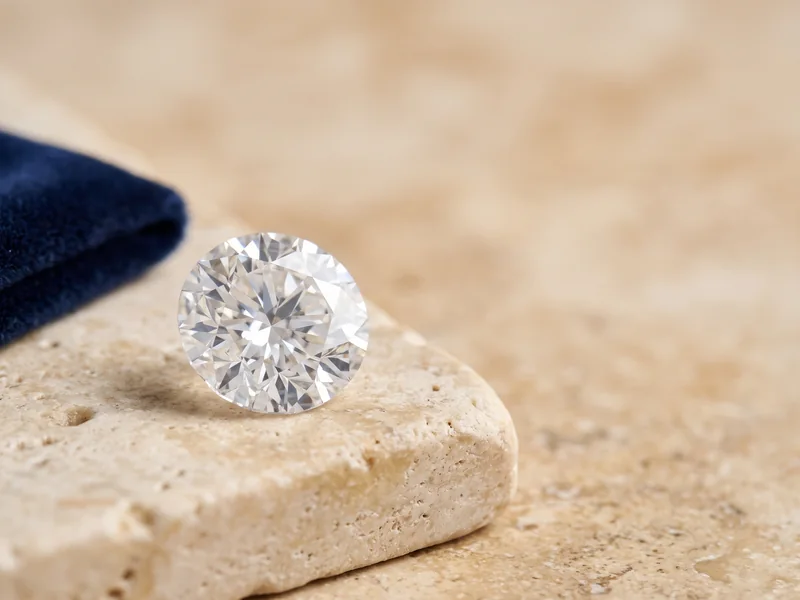 Diamond 4Cs & GradingDiamond Inclusions GuideEngagement Rings & SettingsBest Settings for Emerald Cut DiamondsDiamond ShapesUnderstanding Diamond Shapes
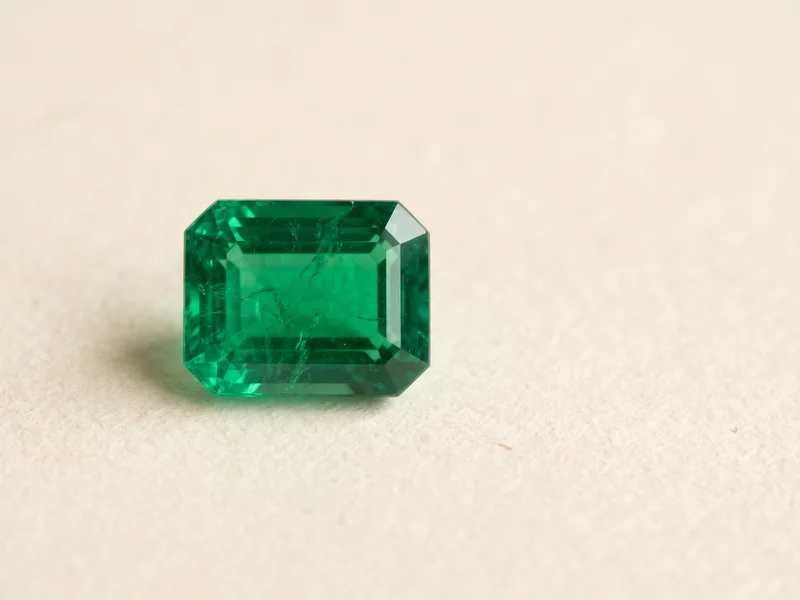 Diamond 4Cs & GradingEmerald Inclusions and Clarity Enhancement
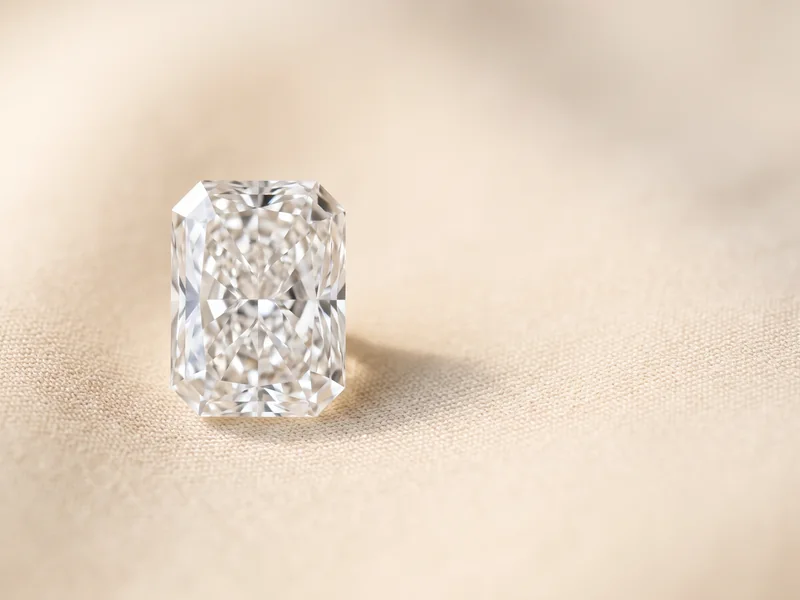 Diamond ShapesEmerald vs Radiant Cut Diamonds
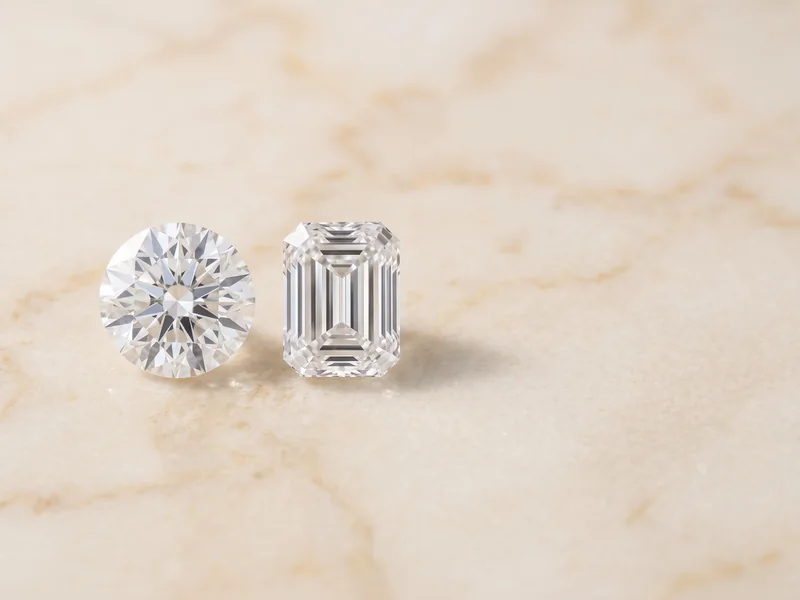 Diamond ShapesEmerald vs Asscher Cut Diamonds
Explore more
More guides on this topic
Education