
Gemstones
Garnet Engagement Ring Guide: Colours, Toughness and Settings
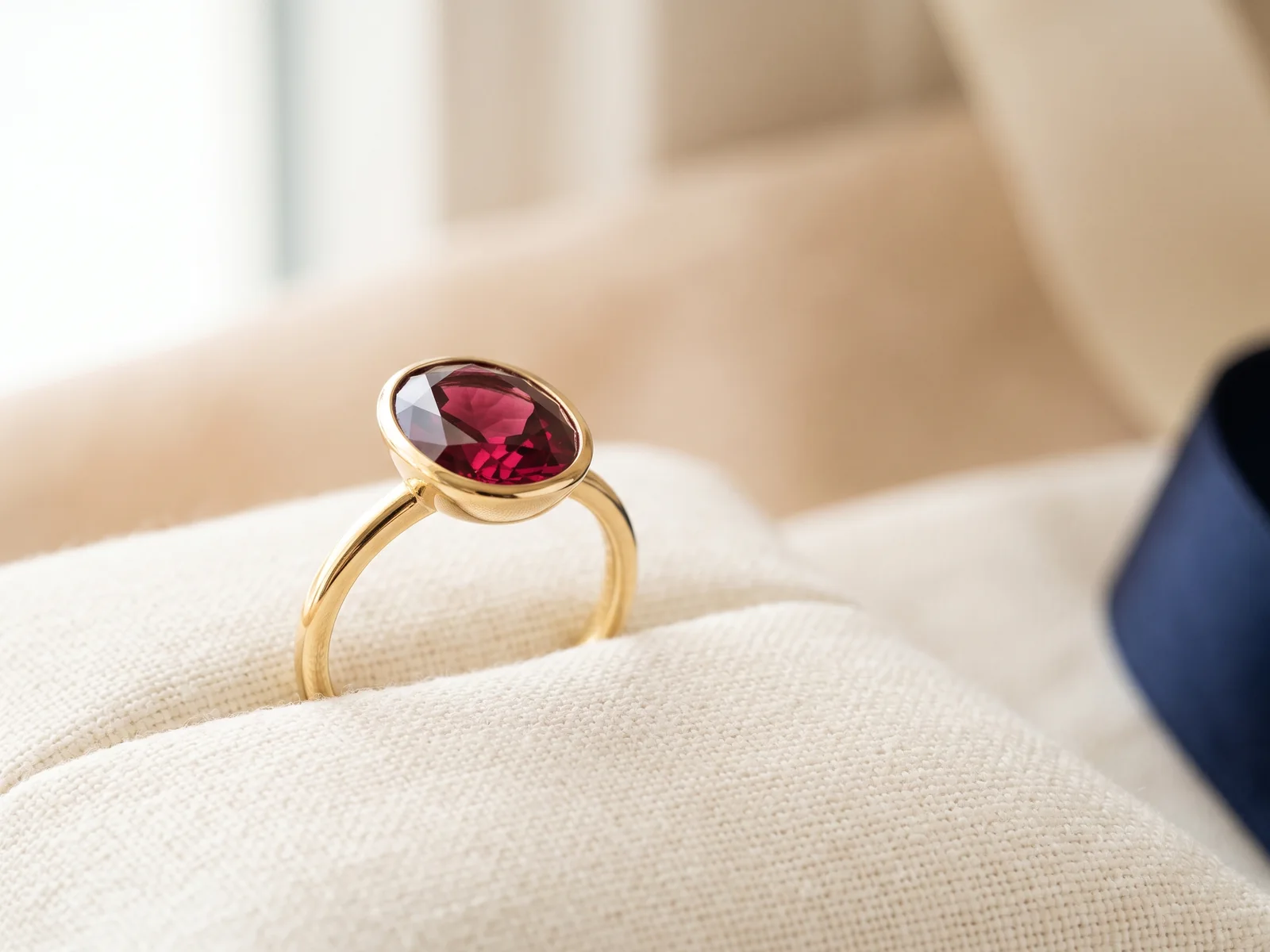
Most people picture garnet as a small, dark red stone, but the garnet family runs from raspberry pink and mandarin orange to vivid green. If you are considering a garnet engagement ring, the type of garnet and the setting decide whether it suits everyday wear.
 Reviewed by Raj Sood, Graduate Gemologist (GIA), AJP (GIA)Master jeweller and Graduate Gemologist (GIA) · reviewed 4 November 2026
Quick answer
A garnet engagement ring can work well if you choose the right garnet and setting. Garnets come in red, pink, orange, green and colour-change varieties, rate 6.5–7.5 on the Mohs scale and have no cleavage. Choose a harder type such as rhodolite, almandine or tsavorite, a protective bezel or claw setting, and plan an occasional re-polish.
What is a garnet engagement ring?
A garnet engagement ring is any engagement ring with a garnet as its centre stone. Garnet is not one mineral but a group of closely related minerals that share the same cubic crystal structure and differ in their chemistry. Swap one element for another, such as iron for magnesium or manganese, and you change the colour, the hardness and even the sparkle. That is why a garnet can be almost black-red, bright orange or emerald-like green.
Garnet is one of the most varied of all the coloured gemstones for rings, and most of it is natural. Garnets are rarely treated, which is unusual among gems: sapphires and rubies are routinely heated, emeralds are oiled, but most garnets go from rough to ring with nothing but cutting and polishing. You can see the full range of varieties on our main garnet gemstone page.
Garnet is also garnet as the January birthstone, and in older traditions it was linked with loyalty, constancy and safe travel. Those are stories rather than properties, but they explain why garnet turns up in Victorian and Georgian engagement rings, often as clusters of small red pyropes.
A few technical words appear throughout this guide. Hardness is resistance to scratching, measured on the Mohs scale from 1 (talc) to 10 (diamond). Toughness is resistance to chipping and breaking. Tone is how light or dark a colour is. Every other term is explained as it comes up, or in our glossary of gem and jewellery terms.
What colours do garnets come in?
Gemmologists sort gem garnets into a handful of species and the blends between them. The table below shows the ones you are most likely to meet in an engagement ring. The refractive index (RI) is a measure of how strongly a gem bends light; higher numbers generally mean more brilliance. For comparison, diamond is about 2.42 and sapphire about 1.76–1.77.
| Garnet type | Typical colours | Refractive index (approx.) | What to know |
|---|---|---|---|
| Pyrope | Deep red to purplish red | 1.72–1.76 | The classic Bohemian garnet; can look dark in larger sizes |
| Almandine | Dark red to purplish or brownish red | 1.76–1.83 | The most common red garnet; often very dark above 1 ct |
| Rhodolite (pyrope-almandine) | Raspberry, purplish red to pink | 1.75–1.76 | Lighter, brighter tone; a popular ring choice |
| Spessartine | Orange to reddish orange | 1.79–1.81 | Bright 'mandarin' orange is the most sought after |
| Grossular: tsavorite | Light to deep green | 1.73–1.75 | Clean, bright green; durable for a garnet |
| Grossular: hessonite | Cinnamon, orange-brown, honey | 1.73–1.75 | Often shows a swirly, slightly hazy look |
| Andradite: demantoid | Yellowish green to green | 1.88–1.89 | Highest RI and fire in the family; softer |
| Colour-change garnet | Blue-green or grey-green to purple-red | 1.75–1.78 | Changes colour between daylight and warm indoor light |
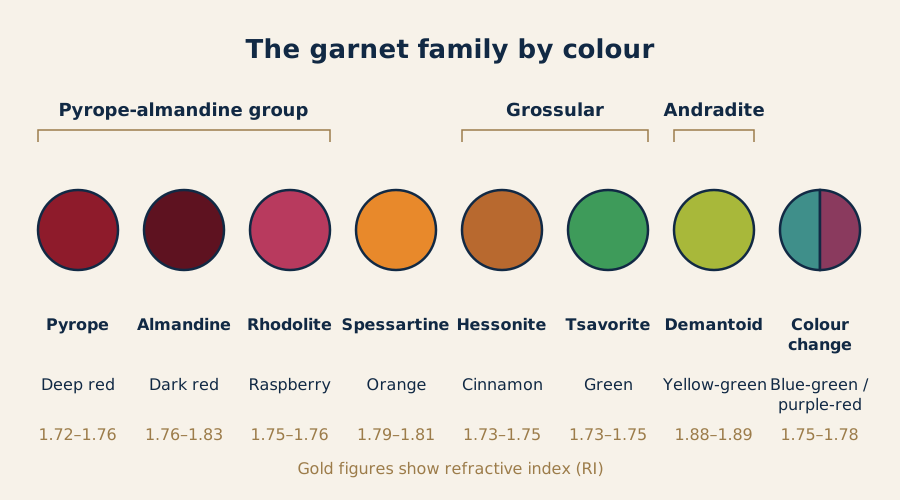
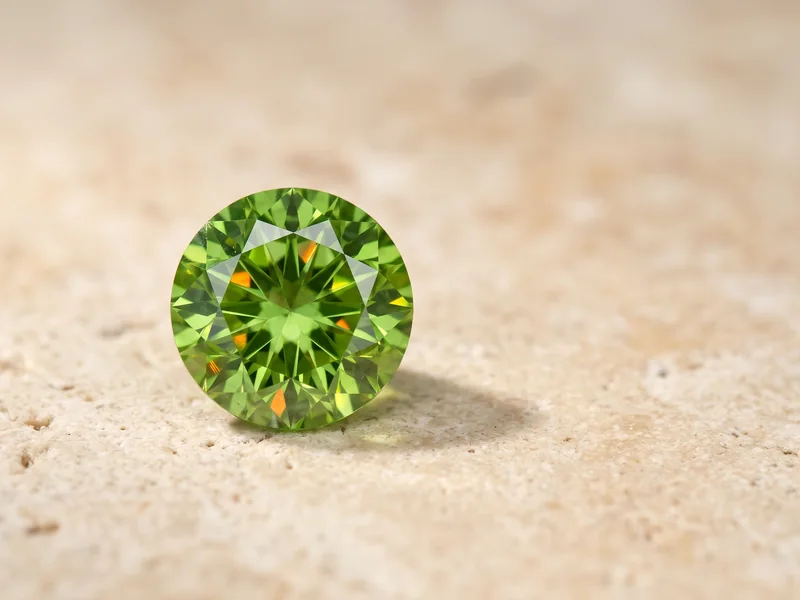
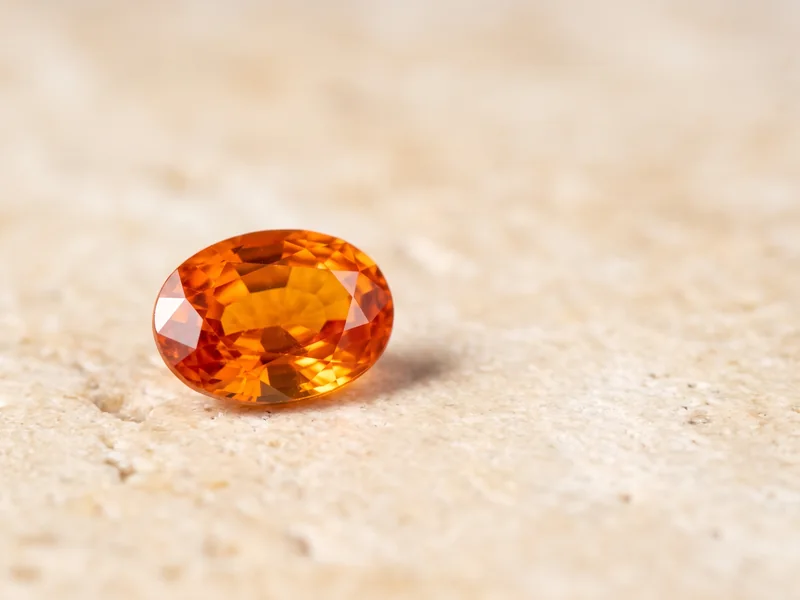
So a garnet engagement ring does not have to be dark red. For pink-red, look at raspberry-toned rhodolite. For green, there is green tsavorite from East Africa or the rarer demantoid, the high-dispersion green garnet. For warm colours, orange spessartine and cinnamon-coloured hessonite give options that few other gems match at the price.
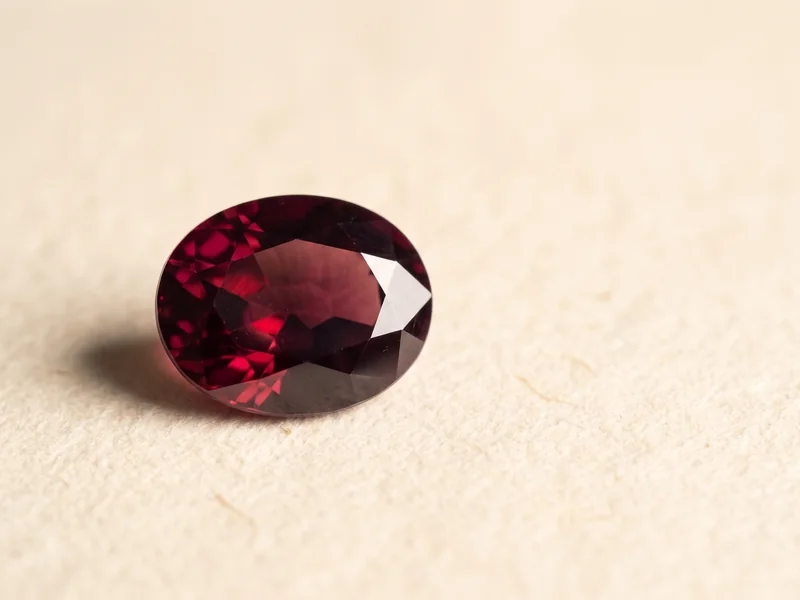
Related guideRhodolite GarnetA note on dark red: almandine and pyrope absorb a lot of light, so the bigger the stone, the darker it looks. A 5 mm almandine may glow; an 8 mm one can read as nearly black indoors. If you love classic garnet red, either keep the stone smaller, ask for a lighter tone, or choose rhodolite, which stays brighter at larger sizes.
Is garnet good for an engagement ring?
An engagement ring is worn every day for decades, so it faces knocks against benches, door handles and gym equipment, plus constant contact with household dust. That dust contains quartz grains, which rate 7 on the Mohs scale. Any gem softer than 7 will slowly lose its polish; gems at 7–7.5 hold it reasonably well but show wear on facet edges over years.
Garnet hardness ranges from about 6.5 to 7.5 depending on the species. In its favour, garnet has no cleavage, meaning no natural flat planes along which it splits, and its toughness is rated fair to good. Diamond, by contrast, is far harder but does have cleavage planes and can chip if a thin edge is hit. Here is how garnet compares with other centre stones:
| Gem | Mohs hardness | Toughness | Cleavage | Daily-wear verdict |
|---|---|---|---|---|
| Diamond | 10 | Good | Perfect in four directions | Excellent |
| Sapphire and ruby | 9 | Excellent | None | Excellent |
| Spinel | 8 | Good | None to indistinct | Very good |
| Tsavorite | 7–7.5 | Good | None | Good, with a protective setting |
| Almandine, pyrope, rhodolite | 7–7.5 | Fair to good | None | Good, with some care |
| Spessartine | 6.5–7.5 | Fair to good | None | Good, with some care |
| Hessonite | 6.5–7 | Fair | None | Careful daily wear or occasional wear |
| Demantoid | 6.5–7 | Fair | None | Occasional wear or a full bezel |
| Emerald | 7.5–8 | Poor to fair | Indistinct | Careful wear; inclusions reduce toughness |
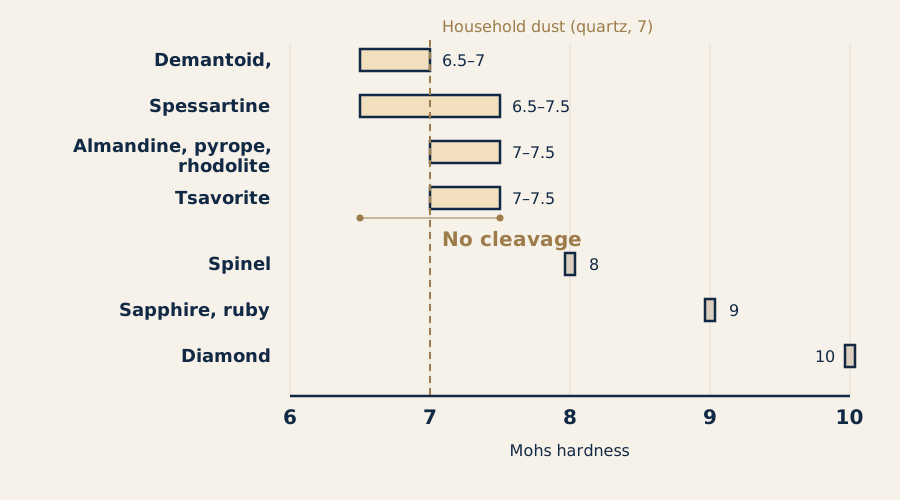
In practice, a well-set rhodolite, almandine or tsavorite makes a perfectly wearable engagement stone for someone who takes the ring off for heavy work. If you want red with maximum durability, ruby or spinel are harder, and there is also the extreme end of the market: see how red diamonds compare for price and rarity. Garnet sits in between: softer than those, but far more affordable and with colours they cannot offer.
Which garnet type suits an engagement ring?
Each garnet type behaves a little differently on the hand. Here is the gemmologist's view, from most to least suited to daily wear:
- Tsavorite (green): about 7–7.5 hardness, usually clean and bright, rarely treated. It is the most popular choice for a green garnet engagement ring, and stones over 2 ct are scarce. Read more on tsavorite's durability for daily wear.
- Rhodolite (raspberry to pink-red): 7–7.5, good transparency, often eye-clean, and lighter in tone than almandine. See rhodolite engagement stone options if you want garnet red without the darkness.
- Almandine and pyrope (classic red): 7–7.5 and very affordable. Best below about 1.5 ct, or in a lighter tone, so the colour does not go black indoors.
- Spessartine (orange): around 7, with high brilliance thanks to an RI near 1.80. Bright 'mandarin' stones from Namibia and Nigeria command the highest prices; our mandarin spessartine buying notes explain the colour grades.
- Colour-change garnet: pyrope-spessartine blends that shift from blue-green in daylight to purple-red under warm light. Durable enough for rings; the rare 'blue garnet' from Madagascar is in this group.
- Hessonite (cinnamon): 6.5–7, often with a swirly look inside. Better for a right-hand or occasional ring.
- Demantoid (green): 6.5–7 but with dispersion (fire, the splitting of white light into rainbow flashes) of about 0.057, higher than diamond's 0.044. Beautiful, but softer; read why demantoid needs a protective setting.
If the ring will be worn every day by someone who works with their hands, tsavorite or rhodolite in a bezel is the safest garnet combination. If it is a ring for lighter wear, any garnet type can work.
Not sure which one is right?
Send us the stones you are looking at and our gemologist will tell you which to choose and why.
Are there Australian garnets?
Yes, though most Australian garnet never becomes jewellery. Western Australia, around Port Gregory north of Geraldton, has long been a major source of industrial garnet: almandine sand mined from beach and alluvial deposits and used as an abrasive for waterjet cutting and sandblasting.
Gem-quality Australian garnet is found in smaller amounts. The Harts Range in the Northern Territory, north-east of Alice Springs, is known to fossickers for almandine and pyrope-almandine garnets, some clear enough to facet. Broken Hill in New South Wales is known for garnet mineral specimens. Stones from these areas are usually small and dark, so they suit accent stones or a keepsake ring more than a large centre stone.
Most garnets in Australian jewellery are imported. Tsavorite comes mainly from Kenya and Tanzania, demantoid from Russia's Ural Mountains, Namibia and Madagascar, spessartine from Namibia, Nigeria and Tanzania, hessonite from Sri Lanka, and red garnets from India, Sri Lanka, Madagascar, Mozambique and East Africa. Origin does not change how durable a garnet is, but it can affect price, especially for demantoid, where Russian stones with fine inclusions often sell for more.
How do gemmologists identify a garnet?
Because the garnet group overlaps in colour with ruby, spinel, tourmaline, peridot and even emerald, identification matters. Garnet is singly refractive, meaning light passes through it as one ray rather than splitting into two. On a polariscope (an instrument with two polarising filters) a garnet usually stays dark as it turns, while a ruby or tourmaline blinks light and dark. That one test rules out many look-alikes.
From there, a gemmologist narrows down the species:
- Refractive index: on a refractometer, almandine and spessartine sit near 1.78–1.81, rhodolite near 1.76, grossular near 1.74. Demantoid is above the range of a standard refractometer (1.81).
- Magnetism: iron- and manganese-rich garnets such as almandine and spessartine are drawn to a strong neodymium magnet, a quick and surprisingly reliable test.
- Inclusions under magnification: demantoid often shows 'horsetail' inclusions, fine curved fibres radiating from a point. Hessonite has a rolling, syrupy look, described as treacle or heat-wave effect; hessonite's treacle-like inclusions are a near-certain identifier. Almandine and rhodolite often contain fine needles of rutile.
- Spectroscope: almandine shows a distinctive set of absorption bands, and demantoid shows chromium lines.
Imitations are worth knowing about. Red glass has been sold as garnet for centuries, and older pieces sometimes contain a garnet-and-glass doublet: a thin slice of almandine fused on top of coloured glass. YAG (yttrium aluminium garnet) and GGG (gadolinium gallium garnet) are synthetic, lab-created materials with a garnet crystal structure; they were used as diamond simulants in the 1970s and are not natural garnet. Lab-created gem garnet is uncommon in jewellery, but any synthetic stone must be described as synthetic or lab-created. At GemTrove, stones are checked by Raj Sood, a Graduate Gemologist (GIA).
What is the best setting for a garnet engagement ring?
With a gem at 6.5–7.5 on the Mohs scale, the setting does a lot of the work. The goal is to protect the girdle (the outer edge) and any corners from knocks.
- Bezel or half-bezel: a rim of metal around the stone. The most protective option, and a bezel in yellow gold deepens the warmth of red and orange garnets.
- Four or six claws: shows more of the stone and lets in more light, which helps darker garnets. Six claws hold the stone more securely if one wears down.
- Halo: a ring of small diamonds or lab-grown diamonds around the garnet adds sparkle and a buffer against side knocks.
- Lower profile: a centre stone sitting closer to the finger is knocked less often than a tall cathedral setting.
- Shape choice: ovals, rounds and cushions have no sharp points; the same shape logic used for diamonds applies, as our overview of centre stone shapes shows. Pears, marquises and princess cuts have corners that need V-claws or a bezel, just like protecting a pear cut's point or guarding the marquise's two fragile tips.
Metal colour changes how a garnet looks. Yellow and rose gold flatter red, orange and cinnamon garnets. White gold or platinum makes tsavorite and demantoid greens look crisper and cooler. For dark almandine, an open gallery underneath lets more light into the stone.
How much does a garnet engagement ring cost in Australia?
Garnet prices vary enormously by type. A common almandine costs less than many lunches out per carat; a fine demantoid can cost more per carat than a lab-grown diamond. These are broad, approximate ranges for a well-cut, eye-clean stone of about 1 carat, before the setting:
| Garnet type (about 1 ct) | Approximate stone price (AUD) |
|---|---|
| Almandine or pyrope | about $50–$300 |
| Hessonite | about $80–$400 |
| Rhodolite | about $100–$600 |
| Spessartine (bright orange) | about $300–$1,500 |
| Colour-change garnet | about $300–$3,000 |
| Tsavorite | about $800–$4,000 |
| Demantoid | about $1,500–$8,000 |
Prices per carat climb steeply with size for tsavorite, demantoid and mandarin spessartine, because large clean crystals are rare. For almandine and rhodolite, price rises slowly with size. The setting usually costs more than the stone for most red garnets: a solid 9 ct or 18 ct gold ring typically adds about $1,000–$4,000 or more, depending on the gold, the design and any diamonds.
Garnet ring price in Australia also depends on cut quality. Many commercial garnets are cut to save weight rather than for brightness, which leaves dark areas or washed-out windows. A precision-cut stone costs more but looks brighter. You can compare options among natural garnets and custom garnet jewellery or across the full range of natural gemstones.
Browse natural gemstones, including garnet
How do you choose and care for a garnet engagement ring? Step by step
- Pick the colour, then the species. Red: rhodolite or almandine. Green: tsavorite for durability, demantoid for fire. Orange: spessartine.
- Match the species to the wearer. For hands-on work or sport, choose a garnet at 7–7.5 hardness and a bezel or halo.
- Check tone indoors. View the stone under normal room light; red garnets above about 1 ct should not look black.
- Look for an eye-clean stone. Tsavorite, rhodolite and spessartine are usually clean; demantoid inclusions such as horsetails are accepted and can add value.
- Ask what the stone is and whether it is treated. Most garnets are untreated; ask for the species, origin if known, and any treatment in writing.
- Choose a protective setting. Bezel, six claws or halo, sitting fairly low on the finger.
- Care for it. Clean with warm soapy water and a soft brush. Avoid ultrasonic cleaners for demantoid and included stones, avoid sudden heat, and remove the ring for gardening or the gym.
- Plan maintenance. Have the claws checked yearly and the stone re-polished if facet edges look worn after some years of daily wear.
Free consultation
Talk to a gemologist
Compare stones in person or online with Raj Sood, Graduate Gemologist (GIA), AJP (GIA).
Book a consultationShop this shape
FAQ
Common questions
Is garnet good for an engagement ring?
It can be, if you choose a harder type such as tsavorite, rhodolite or almandine (7–7.5 on the Mohs scale) and a protective setting. Garnet has no cleavage, but it is softer than sapphire or diamond, so expect to re-polish it after years of daily wear.
Do garnets only come in dark red?
No. Garnets come in pink-red rhodolite, orange spessartine, cinnamon hessonite, green tsavorite and demantoid, and colour-change varieties. Only blue is very rare, found in some colour-change garnets.
What is the green garnet in engagement rings?
Usually tsavorite, a green grossular garnet from Kenya and Tanzania that rates about 7–7.5 in hardness. Demantoid is the other green garnet, with more fire but slightly softer at 6.5–7.
Are garnets treated?
Most garnets are not treated at all, which is unusual among coloured gems. Imitations such as glass or garnet-and-glass doublets do exist, so ask for the stone to be identified.
How much does a garnet engagement ring cost in Australia?
The stone ranges from about $50 for a 1 ct almandine to several thousand dollars for fine tsavorite or demantoid. A solid gold setting typically adds about $1,000–$4,000 or more.
Can I wear a garnet engagement ring every day?
Yes, with sensible care. Take it off for heavy work, the gym and gardening, clean it gently, and have the setting checked once a year.

Ask a gemologist
Not sure which diamond to choose?
Raj Sood is a Graduate Gemologist (GIA) and master jeweller. Bring the stones you are considering, or send the reports, and he will tell you honestly which one is better and why.
Keep learning
Related guides
Explore more
More guides on this topic
Education