
Gemstones
Spessartine Garnet Guide: Colour, Hardness, Value and Ring Suitability
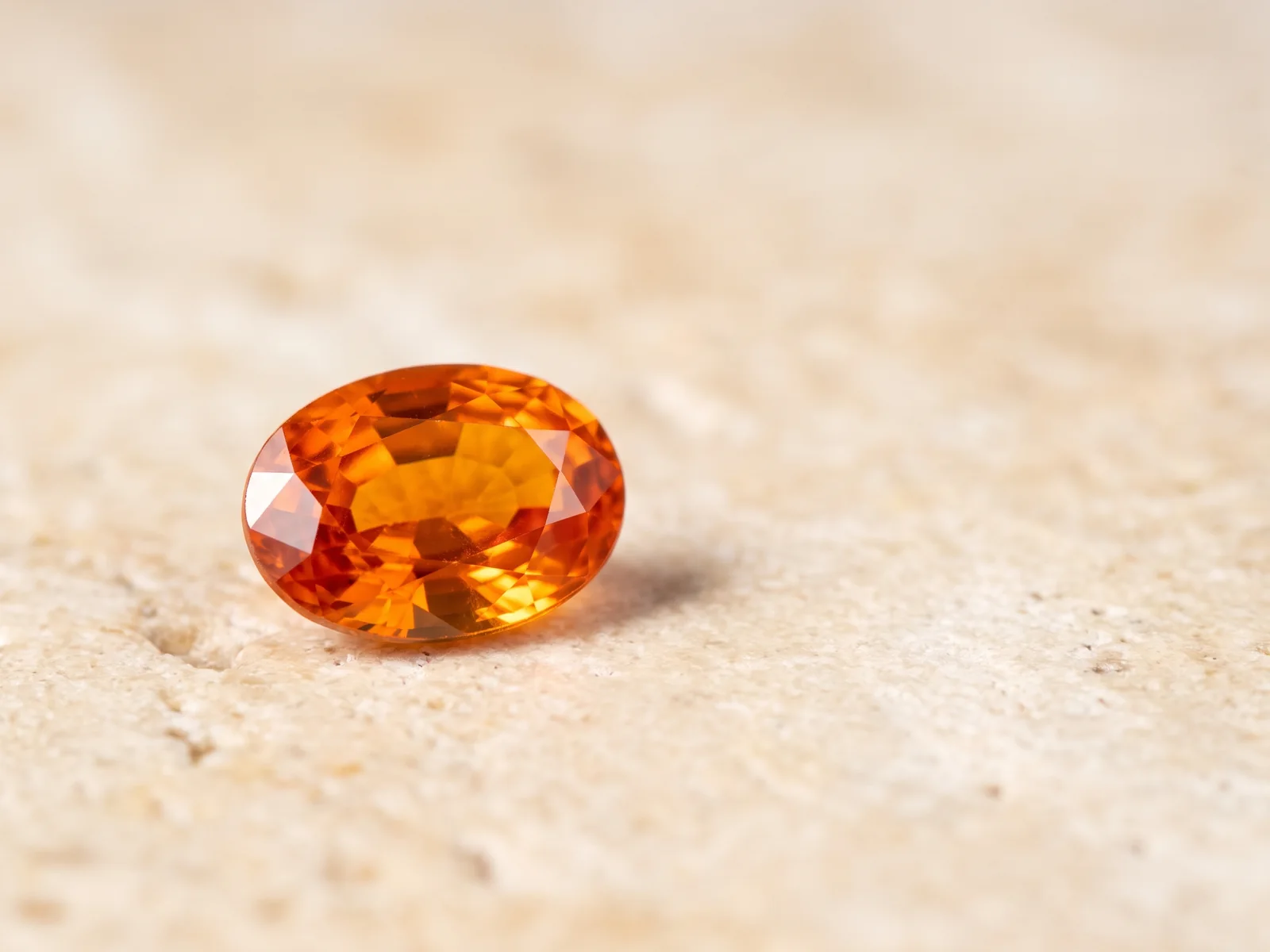
Spessartine garnet is the orange member of the garnet family, and the brightest examples are among the most vivid orange gems you can wear. Here is how to judge its colour, how it holds up in a ring and what drives its price.
 Reviewed by Raj Sood, Graduate Gemologist (GIA), AJP (GIA)Master jeweller and Graduate Gemologist (GIA) · reviewed 4 November 2026
Quick answer
Spessartine garnet is a natural manganese-aluminium garnet prized for its orange colour, from yellowish orange to reddish orange. The purest vivid orange, often sold as mandarin garnet, is worth most. It rates 7–7.5 on the Mohs scale, has no cleavage and is rarely treated, so it suits rings with a protective setting and gentle care.
What is spessartine garnet?
Spessartine (sometimes spelled spessartite) is one of the species in the wider garnet family. Chemically it is a manganese aluminium silicate, Mn3Al2(SiO4)3. The manganese is what gives it its orange colour. It takes its name from the Spessart hills in Bavaria, Germany, one of the early places it was described.
Garnets are not one mineral but a group of closely related ones that share the same crystal structure and blend into each other. Gemmologists split them into two broad series. The pyralspite series covers pyrope, almandine and spessartine, the reds, purples and oranges. The ugrandite series covers uvarovite, grossular and andradite, which gives us green tsavorite, hessonite, the cinnamon-orange grossular garnet and demantoid, the fiery green andradite.
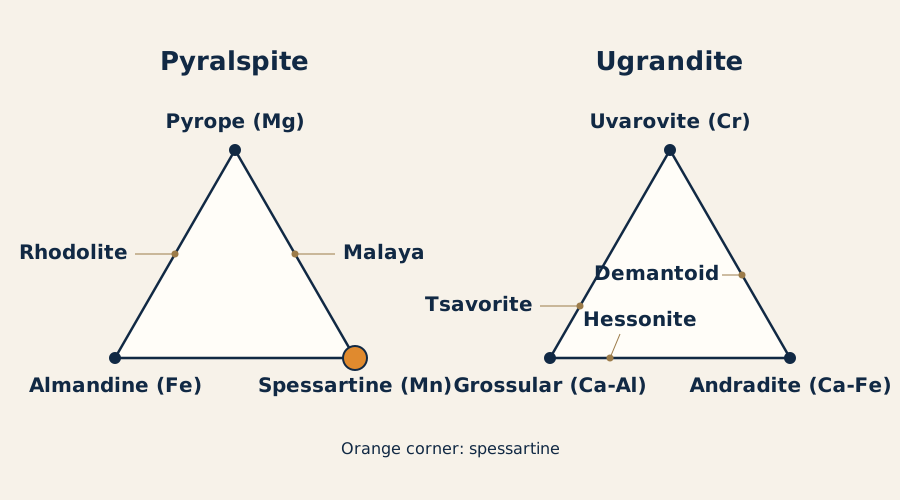
Natural garnets are almost never pure end members. Most spessartine contains some almandine (iron garnet) or pyrope (magnesium garnet). A little almandine pushes the colour towards red and brown; a pyrope-spessartine blend gives the pinkish-orange trade variety called malaya (or malaia) garnet and some colour-change garnets. Like all garnets, spessartine is singly refractive, meaning light travels through it at one speed in every direction, so it never shows the doubled facet edges you see in zircon. For the wider picture of coloured stones, see our coloured gemstones overview, and any unfamiliar term is defined in the GemTrove jewellery glossary.
What colours does spessartine garnet come in?
Spessartine garnet colour runs from pale yellowish orange through pure orange to reddish orange and brownish orange. Pure, iron-free spessartine is a bright yellowish orange; the more iron it contains, the redder and browner it gets. Colour is by far the biggest factor in its value.
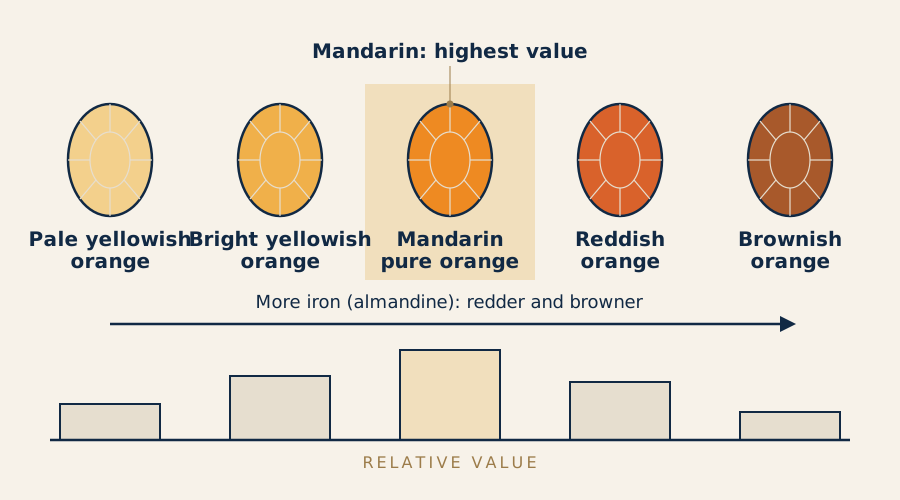
- Mandarin or fanta orange: a vivid, saturated pure orange with almost no brown. This is the most sought-after colour and the trade name mandarin garnet is used for it.
- Yellowish orange: lighter and brighter, often very lively, usually priced a step below mandarin.
- Reddish orange: warmer, with more almandine. Attractive and often good value.
- Brownish orange: the most common commercial colour. Brown dulls the stone, especially in indoor light, and lowers the price.
Gemmologists judge colour on three parts: hue (the basic colour), tone (how light or dark) and saturation (how strong or pure). Our explainer on how hue, tone and saturation are graded covers the system. For spessartine, the sweet spot is a medium tone with high saturation. Very dark stones can look brown-red in a ring, and pale stones can look washed out.
Spessartine also has high brilliance for a garnet. Its refractive index of about 1.79–1.82 is higher than sapphire's (about 1.76–1.77), and its dispersion (the splitting of light into spectral colours) of about 0.027 is moderate. A well-cut stone shows strong brightness with some flashes of fire.
How hard and tough is spessartine garnet for everyday wear?
Spessartine garnet hardness is 7–7.5 on the Mohs scale, which measures scratch resistance. That is as hard as or a little harder than quartz (7), the main component of household dust, so a spessartine resists scratching by everyday dust but will slowly show wear on facet edges over many years of daily knocks.
Toughness is different from hardness. It describes how well a gem resists chipping and breaking. Spessartine has no cleavage (a flat plane along which a crystal splits easily) and its toughness is rated fair to good. Some stones contain internal fractures, which can lower toughness. Here is how it compares with other ring stones:
| Gem | Mohs hardness | Toughness | Cleavage | Everyday ring? |
|---|---|---|---|---|
| Diamond | 10 | Good | Yes, in four directions | Yes |
| Sapphire and ruby | 9 | Excellent | None | Yes |
| Spessartine garnet | 7–7.5 | Fair to good | None | Yes, with a protective setting |
| Rhodolite garnet | 7–7.5 | Fair to good | None | Yes, with a protective setting |
| Tsavorite garnet | 7–7.5 | Good | None | Yes, with a protective setting |
| Demantoid garnet | 6.5–7 | Fair | None | Occasional wear, or well protected |
| Citrine (quartz) | 7 | Good | None | Yes, with care |
| Amber | 2–2.5 | Poor | None | No, pendants and earrings only |
For context on the gems at the top of that table, our ruby and diamond durability comparison explains why hardness and toughness do not always go together. At the other end of the scale, warm orange amber, a soft fossil resin looks similar in colour but is far too soft for a ring.
How do gemmologists identify spessartine, and how is it different from hessonite?
Orange gems can look alike across the counter. Here is what Raj Sood, our Graduate Gemologist (GIA), checks when a stone is sold as spessartine:
- Refractive index: about 1.79–1.82 and singly refractive. Many standard refractometers only read to about 1.81, so a spessartine can read near or over the top of the scale.
- Specific gravity: about 4.12–4.20, heavy for its size.
- Inclusions: spessartine often shows wavy, lace-like or shredded-looking fluid inclusions and fingerprint patterns, plus small crystals.
- Spectroscope: manganese gives absorption bands in the violet-blue part of the spectrum, around 410–432 nm.
- Magnet: spessartine reacts noticeably to a strong neodymium magnet because of its manganese and iron, a quick, non-destructive screen.
Spessartine vs hessonite is the most common question, because both are orange garnets. Hessonite has a lower refractive index (about 1.74), is lighter in weight, and often shows a swirly, treacle-like texture inside. Spessartine is brighter and usually more saturated. Other orange lookalikes are orange sapphire, citrine and zircon; the zircon in our December birthstone guide to zircon can be orange too, but shows strong facet doubling.
| Gem | Refractive index | Optic character | Specific gravity | Key clue |
|---|---|---|---|---|
| Spessartine garnet | 1.79–1.82 | Single | 4.12–4.20 | Wavy fluid inclusions, strong magnet response |
| Hessonite garnet | about 1.74 | Single | about 3.6 | Treacle-like swirls, granular look |
| Orange sapphire | 1.76–1.77 | Double | about 4.00 | Silk, colour zoning |
| Orange zircon | about 1.92–1.99 | Double (strong) | about 4.6–4.8 | Obvious doubled facet edges |
| Citrine | 1.54–1.55 | Double | about 2.65 | Light for its size, lower brilliance |
Under GIA's colour-stone clarity system, spessartine is a Type II gem: it usually has some inclusions, and eye-visible ones are common in larger stones. Our guide to GIA's Type I, II and III clarity system explains what that means for what you should expect.
Not sure which one is right?
Send us the stones you are looking at and our gemologist will tell you which to choose and why.
Is spessartine garnet treated or lab-created?
Most spessartine on the market is untreated. The colour is natural and stable, and heating is not a routine practice for this gem. That is part of its appeal: what you see is generally how the crystal came out of the ground, plus the cutter's work.
Occasionally, stones with surface-reaching fractures may be filled with oil or resin to make the cracks less visible. This is uncommon, but it should be disclosed, and it matters for cleaning, because heat, steam and ultrasonic machines can damage fillers. Ask whether a stone has been treated and get the answer in writing on the receipt or report.
Lab-created spessartine is not commercially produced for jewellery. The more likely substitutes are orange glass and other orange gems. Older synthetic materials with a garnet-type crystal structure, such as YAG (yttrium aluminium garnet), are not true garnets and are sold as synthetic or lab-created materials. Any lab-created stone must be described as lab-created or synthetic, never simply as spessartine.
Where is spessartine garnet found, including Australia?
Spessartine forms mainly in granite pegmatites (coarse-grained igneous rocks) and in some manganese-rich metamorphic rocks. Gem-quality material comes from a fairly short list of places:
- Namibia: the Kunene region in the north-west produced the vivid mandarin material that made spessartine famous from the early 1990s.
- Nigeria: a major source of bright orange stones since the mid-1990s, often similar to Namibian colour.
- Tanzania, Mozambique and Madagascar: regular sources, from yellowish to reddish orange.
- Sri Lanka, Brazil and Pakistan: long-standing sources, frequently with more brown or red.
- United States: historic pegmatite localities in California and Virginia.
Australia is better known for other gems, such as chrysoprase, often called Australian jade, and for almandine and pyrope garnets from central Australia. Manganese-rich garnets do occur in Australia, notably in the Broken Hill region of New South Wales, but they are mostly collector specimens rather than gem-quality facet rough. An Australian origin is unusual for a cut spessartine, so ask for the source if it is being promoted.
Origin can affect price because Namibian mandarin garnet has a strong reputation, but colour matters more than country. A pure orange Nigerian stone can equal or beat a browner Namibian one, and origin is very hard to prove from the stone alone.
How much is spessartine garnet worth in Australia?
Spessartine garnet price in Australia depends on four things, in roughly this order: colour, size, clarity and cut. A saturated pure orange with little brown carries the biggest premium. Fine colour in stones over about 5 carats is genuinely scarce, so the price per carat climbs with size.
| Quality | Typical size | Approximate price per carat (AUD) |
|---|---|---|
| Commercial brownish orange, visible inclusions | Under 1 ct | about $80–$300 |
| Good orange, eye-clean | 1–3 ct | about $300–$900 |
| Fine mandarin orange, eye-clean | 1–3 ct | about $700–$2,000 |
| Fine mandarin orange, eye-clean | 5 ct and above | about $1,500–$4,000+ |
These are broad ranges only and move with supply. Clarity matters more in lighter stones, where inclusions are easier to see; in a saturated mandarin, buyers often accept small inclusions for the colour. Cut matters because spessartine is dense and often cut deep to save weight, which can make a stone look smaller face-up and darker in the centre. Most gems are faceted, but you will also see cabochons and carvings in lower grades; our guide to faceted, cabochon and carved cutting styles explains the differences.
Compared with other garnets, fine spessartine is usually priced above rhodolite and most hessonite, and below fine tsavorite and demantoid. Most of them cost less than a sapphire of similar size and quality.
Browse natural gemstones
Is spessartine garnet good for an engagement ring?
Yes, with the right setting and realistic expectations. A spessartine garnet engagement ring gives you a bright orange centre stone with no cleavage and good resistance to everyday dust. At 7–7.5 on the Mohs scale it will not stay as crisp as sapphire or diamond over decades, so plan for occasional re-polishing of worn facet edges.
- Bezel or half-bezel: a rim of metal around the edge gives the most protection for a stone worn every day.
- Four or six claws: fine for rounds, ovals and cushions; check the claws every year or so.
- Halo: diamonds or white sapphires around the stone frame the orange and shield the girdle (the stone's outer edge).
- Metal colour: yellow and rose gold deepen the warmth; white gold and platinum make the orange look brighter and more yellow.
If you want a garnet ring in another colour, our guide to garnet engagement rings beyond deep red compares the options, from orange spessartine to green tsavorite and purplish-red rhodolite. Spessartine is also a natural choice for anyone born in January, since it counts under garnet as January's birthstone.
Related guideGarnet Engagement Rings: More Than Dark RedHow do you clean and care for spessartine garnet jewellery?
Spessartine garnet care is simple. Clean it with warm water, a drop of mild dishwashing liquid and a soft toothbrush, paying attention to the back of the stone, where soap and skin oils collect and dull the colour. Rinse and dry with a lint-free cloth.
- Ultrasonic cleaners: usually safe for clean, untreated stones, but avoid them for any stone with fractures or fillings.
- Steam and heat: avoid. Sudden temperature changes can stress inclusions and fractures.
- Chemicals: take rings off before using chlorine, pool water and harsh cleaners, which mainly harm the metal.
- Storage: keep it apart from diamonds and sapphires, which can scratch it, and from softer gems it can scratch.
Take a spessartine ring off for the gym, gardening and heavy work. A yearly check of the claws or bezel is the best way to catch wear before a stone comes loose.
How to choose a spessartine garnet: step by step
- Judge colour first. Look for a saturated, medium-toned orange with as little brown as possible, in daylight and indoor light.
- Check brightness. Tilt the stone; a good cut stays lively across the face without a dark, lifeless centre.
- Look for eye-visible inclusions. Small wavy inclusions are normal, but avoid fractures that reach the surface, especially near the edges.
- Compare face-up size. Spessartine is dense, so compare millimetre measurements, not just carats.
- Ask about treatment and origin. Get any treatment and the stated natural or lab-created status in writing.
- Plan the setting. For daily wear choose a bezel, halo or sturdy claws, and pick the metal colour that flatters the orange.
Free consultation
Talk to a gemologist
Compare stones in person or online with Raj Sood, Graduate Gemologist (GIA), AJP (GIA).
Book a consultationShop this shape
FAQ
Common questions
Is mandarin garnet the same as spessartine?
Yes. Mandarin garnet is a trade name for spessartine with a vivid, pure orange colour, first made famous by stones from Namibia. It is not a separate species.
Is spessartine garnet rare?
Spessartine itself is not rare, but clean, saturated orange stones with little brown are scarce, especially above about 5 carats. That is why fine mandarin colour costs much more per carat than commercial brownish material.
Can you wear spessartine garnet every day?
Yes. At 7–7.5 on the Mohs scale with no cleavage, it handles daily wear in a protective setting, though facet edges may need re-polishing after many years.
What is the difference between spessartine and hessonite?
Both are orange garnets, but spessartine is a manganese garnet with a higher refractive index and more brilliance, while hessonite is a grossular garnet with a softer, swirly look inside. A gemmologist can separate them with a refractometer or by specific gravity.
Is spessartine garnet treated?
Usually not. Most spessartine is untreated, though stones with surface fractures are occasionally filled, which should be disclosed.
Is spessartine a January birthstone?
Yes. Garnet is the January birthstone, and spessartine is one of the garnet species, so it qualifies alongside the more traditional red garnets.

Ask a gemologist
Not sure which diamond to choose?
Raj Sood is a Graduate Gemologist (GIA) and master jeweller. Bring the stones you are considering, or send the reports, and he will tell you honestly which one is better and why.
Keep learning
Related guides
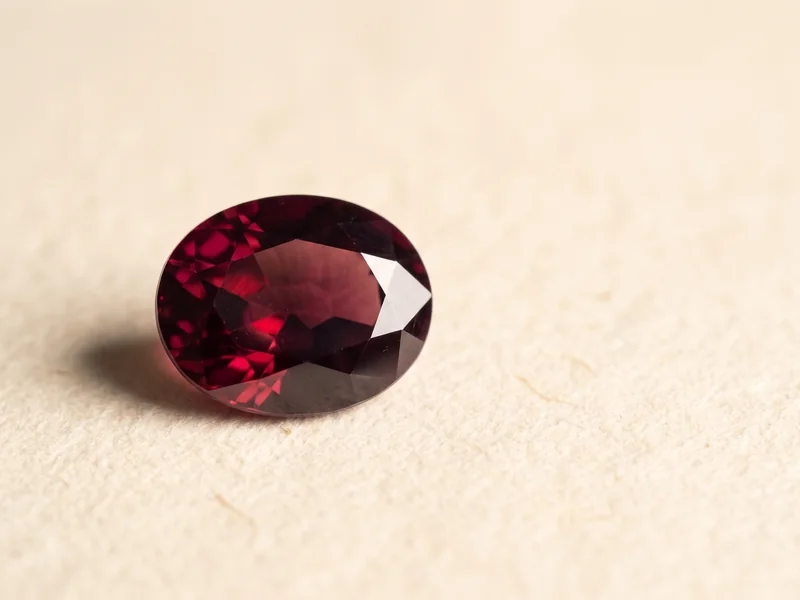 GemstonesNatural Garnet Gemstones and Custom Garnet JewelleryGemstonesHessonite Garnet
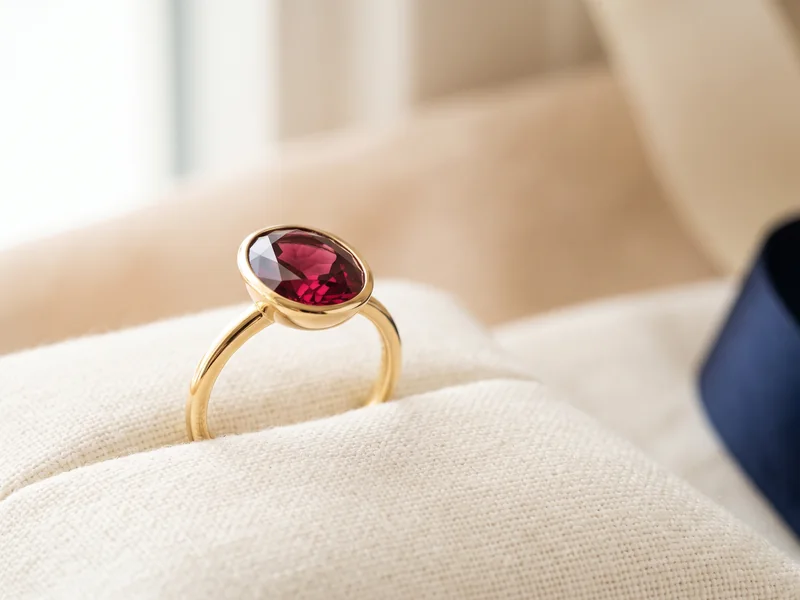 GemstonesGarnet Engagement Rings: More Than Dark Red
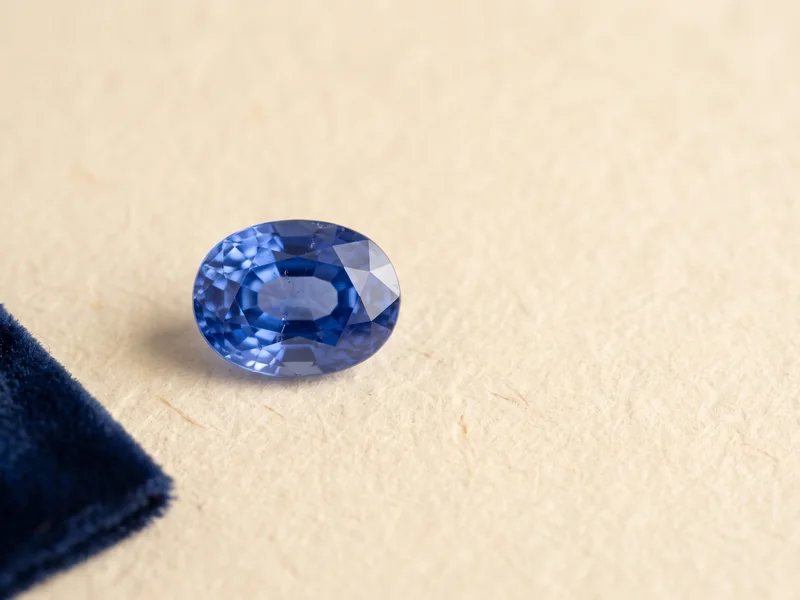 GemstonesGemstone Colour Grading: Hue, Tone, SaturationGemstonesGemstones | Coloured Gemstones, Birthstones and Custom Jewellery
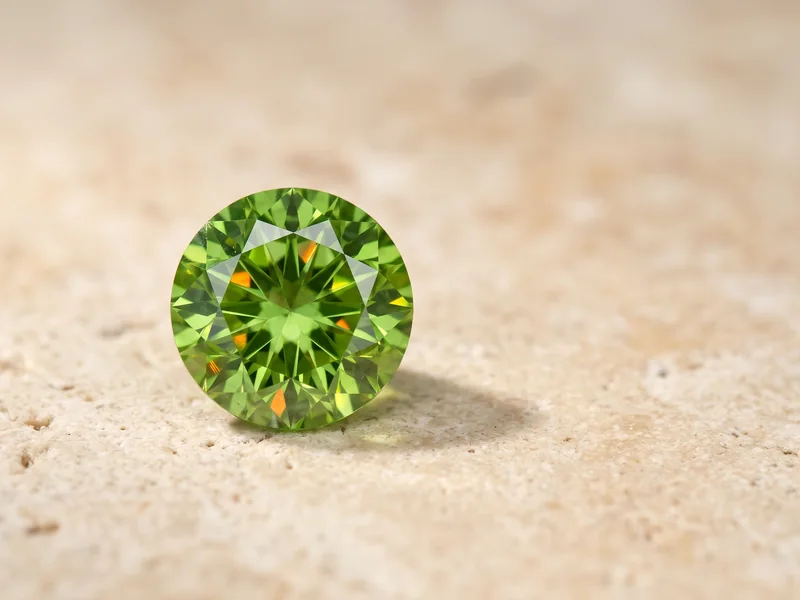 GemstonesTsavorite GarnetGemstonesRhodolite GarnetGemstonesDemantoid Garnet
Explore more
More guides on this topic
Education