
Gemstones
Rhodolite Garnet Guide: Colour, Hardness, Origins and Value
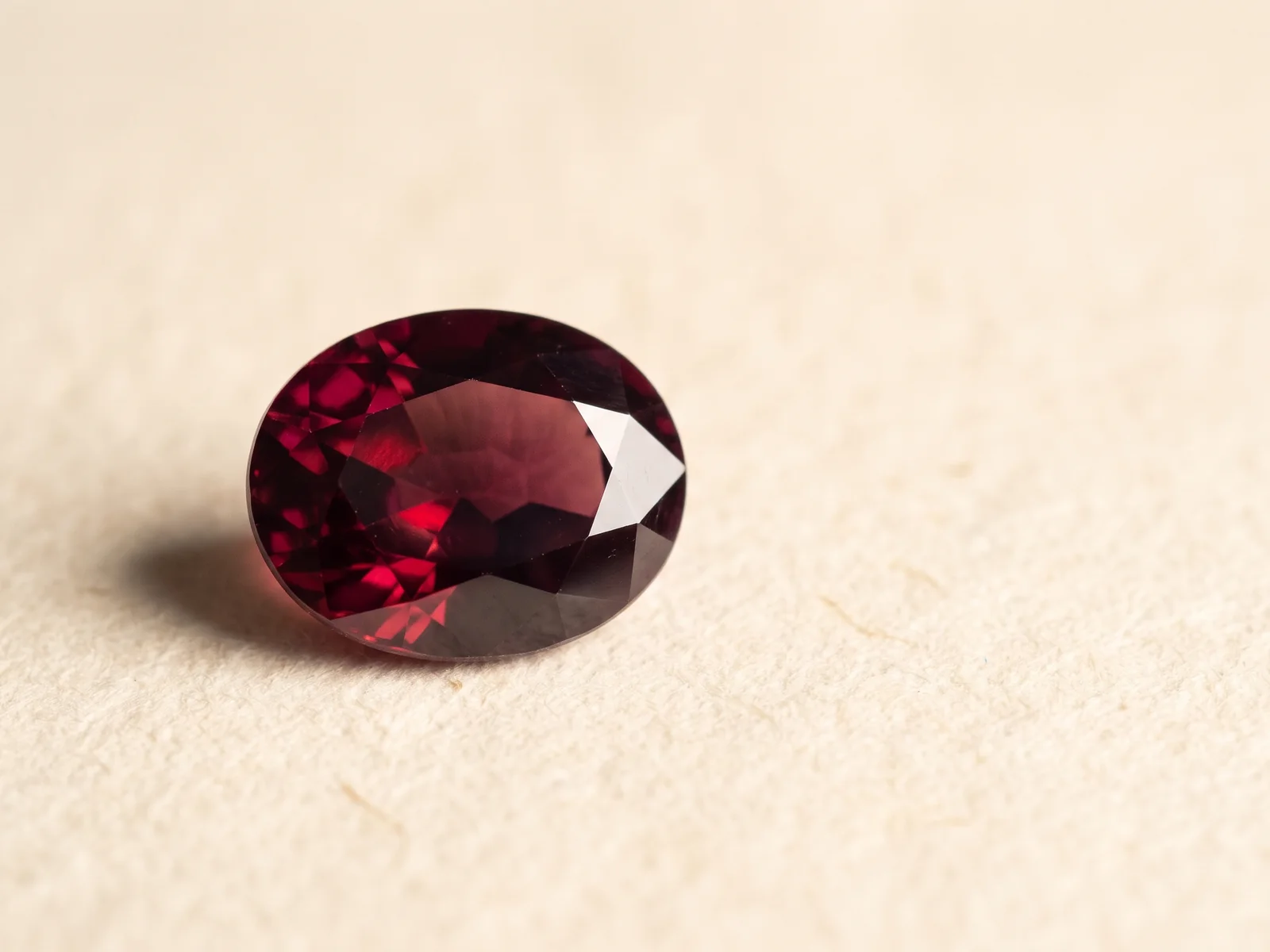
Rhodolite garnet is the rose-to-raspberry member of the garnet family, brighter and more purple than the deep red garnets most people picture. Here is what decides its colour, durability and value, and how to wear it well in a ring.
 Reviewed by Raj Sood, Graduate Gemologist (GIA), AJP (GIA)Master jeweller and Graduate Gemologist (GIA) · reviewed 4 November 2026
Quick answer
Rhodolite garnet is a natural pyrope–almandine garnet in raspberry red to purplish red. It rates 7–7.5 on the Mohs scale, has no cleavage and fair to good toughness, and is almost never treated. It suits rings with protective settings and sensible care. Value rests on a bright, saturated purple-red colour, eye-clean clarity and size.
What is rhodolite garnet?
Rhodolite garnet is a trade name, not a separate mineral species. It describes garnets that sit between two species, pyrope (a magnesium aluminium garnet, Mg3Al2(SiO4)3) and almandine (an iron aluminium garnet, Fe3Al2(SiO4)3), and that show a purplish red to red-purple colour. The name comes from the Greek word for rose, and it was first used in the late 1890s for stones from the Cowee Valley in North Carolina, whose colour reminded early writers of rhododendron flowers.
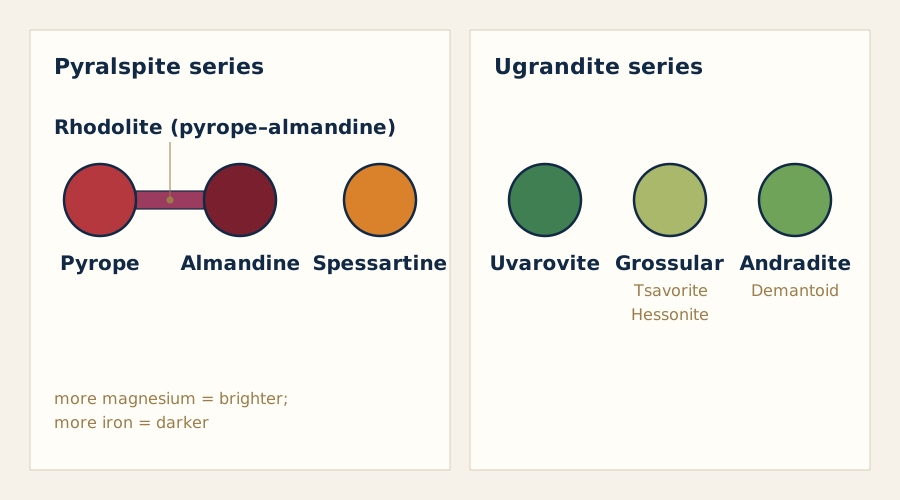
All garnets share the same cubic crystal structure, but their chemistry varies, and mixtures between species are the rule rather than the exception. Gemmologists split the gem garnets into two broad series. The pyralspite series covers pyrope, almandine and spessartine, mostly red to orange. The ugrandite series covers uvarovite, grossular and andradite, which give us the greens and warm browns. Rhodolite sits in the red half. For the whole family in one place, see the full garnet family guide, and for how garnet fits among other coloured stones, visit our coloured gemstones hub.
Rhodolite rates 7–7.5 on the Mohs scale (a 1–10 scale of scratch resistance), with a refractive index (how strongly the stone bends light) of about 1.75–1.78 and a specific gravity (density compared with water) of roughly 3.74–3.94. It is singly refractive, meaning light travels through it at one speed in every direction, so it shows no pleochroism (different colours from different angles). Any term here that is new to you is also defined in our jewellery glossary.
What colour is rhodolite garnet?
Rhodolite garnet colour runs from a light pinkish purple through raspberry red to a deep red-purple. The purple edge is what separates it from almandine, which leans brownish red, and from pyrope, which tends towards a pure, often dark red. In general, more magnesium (pyrope) gives a brighter, lighter stone, while more iron (almandine) pushes the colour deeper and darker.
| Trade description | How it looks | Notes |
|---|---|---|
| Light rhodolite | Pale pinkish purple to rose | Lively and bright, but less saturated; usually lower priced |
| Raspberry rhodolite | Medium purplish red, strongly saturated | The colour most buyers look for and pay most for |
| Grape garnet | Strong reddish purple to purple | A trade name used mainly for stones from Mozambique |
| Dark rhodolite | Deep red-purple | Can look almost black in low light; close to almandine |
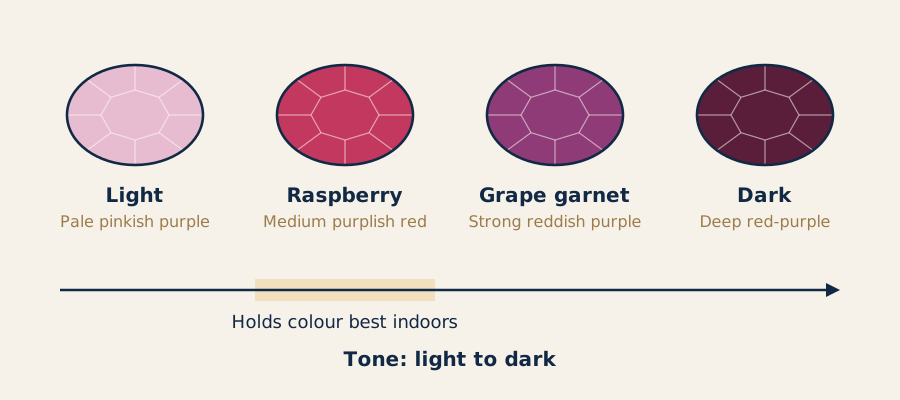
Tone (how light or dark a stone is) matters as much as hue. A rhodolite cut too deep, or rich in iron, loses brightness and goes inky under indoor lighting. Medium tones, roughly in the middle of the light-to-dark range, stay lively both in daylight and under warm downlights.
How is rhodolite different from almandine, pyrope and other garnets?
Because garnets blend into one another, the line between rhodolite, almandine and pyrope is drawn mostly by colour and confirmed by refractive index and density. The table compares rhodolite with the garnets you will meet most often in jewellery.
| Garnet | Species | Typical colour | Mohs | Refractive index (approx.) |
|---|---|---|---|---|
| Rhodolite | Pyrope–almandine | Purplish red to red-purple | 7–7.5 | 1.75–1.78 |
| Almandine | Almandine | Dark red, often brownish | 7.5 | 1.78–1.81 |
| Pyrope | Pyrope | Red, often dark | 7–7.5 | 1.72–1.76 |
| Spessartine | Spessartine | Orange to reddish orange | 7–7.5 | 1.79–1.81 |
| Tsavorite | Grossular | Green | 7–7.5 | about 1.74 |
| Hessonite | Grossular | Orange-brown to cinnamon | 7–7.5 | about 1.74 |
| Demantoid | Andradite | Yellowish to emerald green | 6.5–7 | about 1.88 |
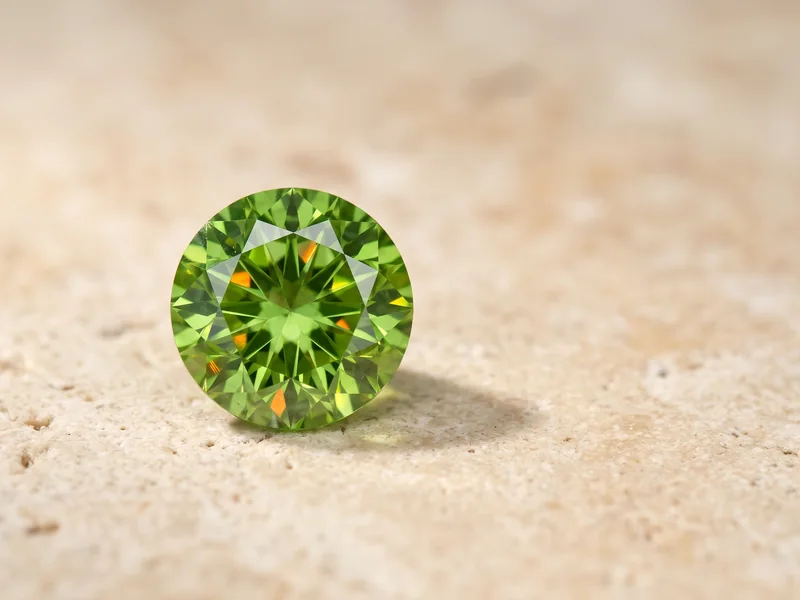
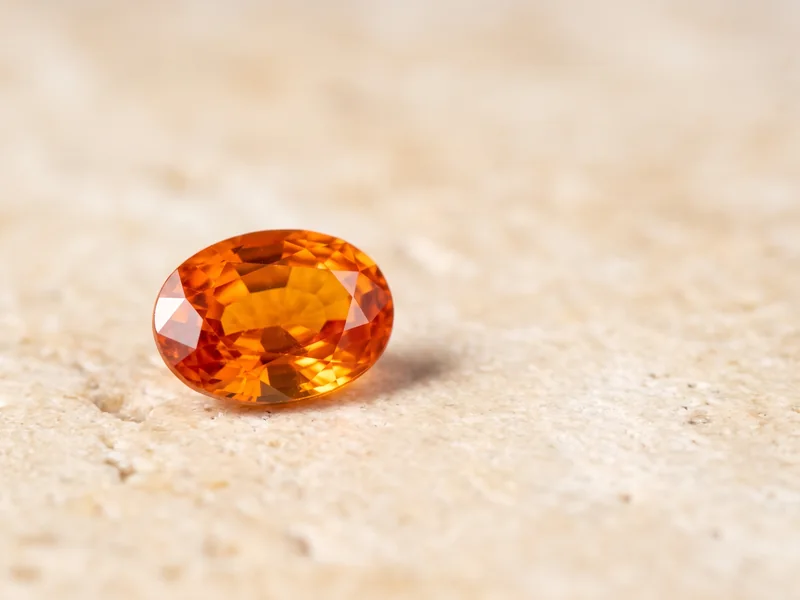
If you like garnet but want a different colour, our guides to green tsavorite garnet and fiery green demantoid, which has more dispersion than diamond cover the greens. For warm tones, see orange spessartine garnet and cinnamon-toned hessonite. Rhodolite is usually among the most affordable of these in clean, larger sizes, while fine tsavorite and demantoid cost considerably more per carat.
How hard is rhodolite garnet, and is it tough enough for a ring?
Hardness and toughness are different things. Hardness is resistance to scratching. Toughness is resistance to chipping and breaking. Rhodolite garnet hardness of 7–7.5 means it resists scratches from household dust, which contains quartz at about 7, but it can be scratched by harder stones such as diamond and sapphire. Its toughness is fair to good, and it has no cleavage (no natural plane along which it splits), which helps. A hard knock on a sharp corner, though, can still chip it.
| Gem | Mohs hardness | Toughness | Everyday ring wear |
|---|---|---|---|
| Diamond | 10 | Good (has cleavage) | Yes |
| Sapphire | 9 | Excellent | Yes |
| Spinel | 8 | Good | Yes |
| Rhodolite garnet | 7–7.5 | Fair to good, no cleavage | Yes, with a protective setting and care |
| Smoky quartz | 7 | Good | Yes, with care; scratches over time |
| Chrysoprase | 6.5–7 | Good | Occasional wear or protective settings |
| Tanzanite | 6–7 | Poor to fair, perfect cleavage | Occasional wear; protective settings only |
| Amber | 2–2.5 | Poor | Pendants and earrings rather than rings |
Rhodolite sits comfortably above softer stones such as tanzanite and the other December birthstones, and well above soft, warm amber, which is better kept for pendants. It is a little harder than brown-grey smoky quartz and pale pink rose quartz, and is a similar choice for wear to chrysoprase, often called Australian jade, which is softer but quite tough because of its fine-grained structure. For an engagement ring worn every day, rhodolite works if the setting shields its edges and you take it off for gardening, gym and heavy work.
Not sure which one is right?
Send us the stones you are looking at and our gemologist will tell you which to choose and why.
How do gemmologists identify rhodolite garnet?
At the bench, a rhodolite is usually straightforward to identify with standard tests. These are the checks a trained gemmologist runs:
- Refractometer: a single reading of about 1.75–1.78 with no double refraction. Some garnets show weak anomalous double refraction (a patchy glow between crossed polarising filters, caused by internal strain), which is normal.
- Spectroscope: the iron in almandine gives absorption bands at about 505, 527 and 576 nanometres. They are present in rhodolite, though weaker than in a pure almandine.
- Magnet: iron-rich garnets are drawn to a strong neodymium magnet, which helps separate them from ruby and red spinel at a glance.
- Fluorescence: rhodolite is typically inert under ultraviolet light, whereas many rubies glow red.
- Inclusions: fine needles (often rutile), small rounded crystals and occasional healed fractures. Gas bubbles or swirl marks point to glass instead.
GIA places rhodolite in clarity Type II, a group of gems that usually form with some inclusions but are often eye-clean (no inclusions visible without magnification). Our guide to GIA's Type I, II and III clarity groups explains what that means for what you should expect. Because clean rhodolite is relatively common, buyers can reasonably ask for an eye-clean stone.
Two imitations come up. Red glass is the simplest, and it is easily separated by its lower refractive index and its bubbles. A garnet-and-glass doublet, a thin slice of garnet fused onto a glass base, was widely used in older jewellery; laid table-down on white paper, it often shows a red ring at the join. Man-made materials with a garnet crystal structure, such as YAG and GGG, are lab-created but have a different chemistry from rhodolite and were mainly used to imitate diamond. Lab-created rhodolite is rarely seen in jewellery.
Is rhodolite garnet treated, and where is it found?
Is rhodolite garnet treated? Almost never. Its colour is natural and stable, and heating is not a routine treatment for this gem. Rarely, a stone with surface-reaching fractures may be filled, and any treatment should be disclosed by the seller. Because untreated rhodolite is the norm, an honest description is simply "natural rhodolite garnet, no indications of treatment" when a lab report confirms it.
Where is rhodolite garnet found? The main sources today are:
- East Africa: Tanzania (including the Umba Valley), Kenya and Mozambique, the source of much of the purple grape garnet.
- Madagascar: a range of tones, from light rose to raspberry.
- Sri Lanka and India: long-standing sources, often from gem gravels.
- Brazil and Zambia: smaller but steady production.
- United States: the historic Cowee Valley deposit in North Carolina, now mainly of historical interest.
Australia has plenty of garnet, but very little of it is gem-quality rhodolite. Most Australian garnet is almandine, and much of it is mined as garnet sand for industrial abrasives and waterjet cutting, particularly in Western Australia. Gem-quality almandine has been found in the Harts Range in the Northern Territory, and pyrope garnets occur as indicator minerals in some diamond exploration areas. A faceted Australian rhodolite is an uncommon find rather than a regular source, so origin should be stated on the paperwork rather than assumed.
What affects rhodolite garnet price?
Rhodolite garnet price is set mostly by colour, then by clarity, cut and size. In order of importance:
- Colour: a saturated raspberry or purplish red in a medium tone commands the most. Pale stones and very dark, inky stones cost less.
- Clarity: eye-clean is expected. Visible needles or fractures lower the price sharply.
- Cut: a well-proportioned stone returns light evenly with few dark or washed-out patches (windows). Ovals, cushions and rounds are common; precision and fantasy cuts cost more.
- Size: clean rhodolite is available in larger sizes than many red gems, so the price per carat rises gently with size rather than steeply.
- Origin: it has less effect than for sapphire, though named stones such as grape garnet from Mozambique can carry a premium.
| Quality (natural, eye-clean, 1–3 ct) | Approximate price per carat (AUD) |
|---|---|
| Commercial: lighter or darker tone, good cut | about $40–$150 |
| Fine: saturated raspberry, medium tone, well cut | about $150–$400 |
| Exceptional: vivid colour, larger size or precision cut | about $400–$800+ |
These are broad ranges only and move with supply and with the exact stone. Because rhodolite is dense (heavier than diamond for its size), a 1 carat round rhodolite measures about 6.0 mm across, a little smaller than a 1 carat round diamond at about 6.4 mm. Cutting style also changes the look: our guide to faceted, cabochon and carved gemstone cuts explains why dark rhodolites are sometimes cut as cabochons (smooth domed stones) to lighten their colour.
Browse natural gemstones, including garnets
Is a rhodolite garnet engagement ring a good idea?
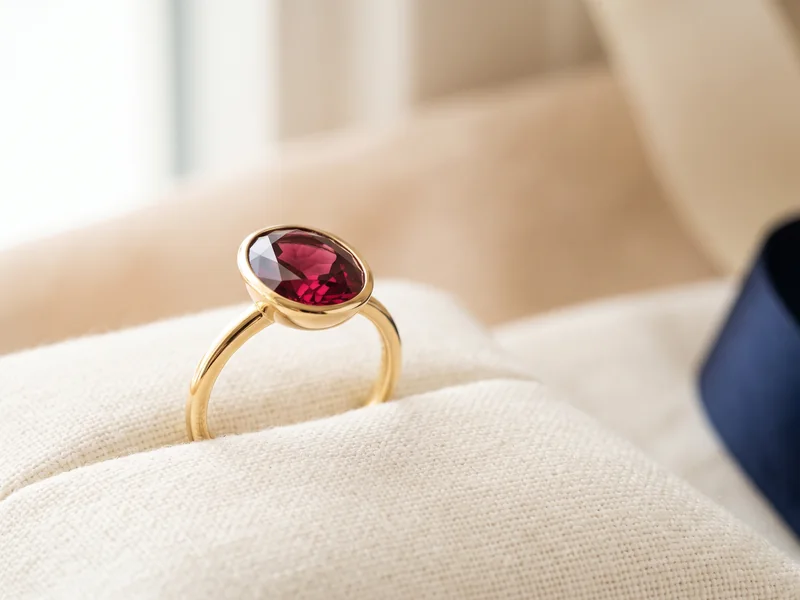
A rhodolite garnet engagement ring can work well for everyday wear, provided the design accepts that the stone will slowly pick up wear on its facet edges over many years, and that it can chip if knocked hard. Good choices are:
- Bezel or half-bezel settings: a rim of metal around the edge protects the girdle (the outer edge) from knocks.
- Four or six claws: secure and open to light, with claws checked once a year.
- Halo: small diamonds around the centre frame the colour and shield the edge.
- Lower profiles: a centre stone that sits closer to the finger is less likely to take a hit.
- Metal colour: yellow and rose gold warm up the raspberry tones; white gold and platinum make the purple read more strongly.
For design ideas beyond the classic dark red solitaire, see garnet engagement rings in every colour. Rhodolite is also a popular way to mark garnet as January's birthstone in a ring or pendant. If the ring will be re-polished in the future, a jeweller can usually refresh worn facet edges on a rhodolite with very little weight loss.
Related guideJanuary Birthstone: GarnetHow do you choose and care for rhodolite garnet? Step by step
- Pick your colour. Decide between light rose, raspberry, grape-purple or deep red-purple, and view stones in both daylight and warm indoor light.
- Check the tone. Choose a medium tone that stays bright indoors rather than the darkest stone available.
- Ask for eye-clean. Clean rhodolite is relatively common, so an eye-clean stone is reasonable to expect at most sizes.
- Look for an even cut. Rock the stone and watch for windows (pale patches) or large dark areas.
- Confirm what it is. Ask that the paperwork state natural rhodolite garnet, any treatment, and origin if known.
- Choose a protective setting. A bezel, halo or sturdy claws for rings worn every day.
- Clean it gently. Use warm water, mild detergent and a soft brush. Ultrasonic cleaners are usually safe for stones without fractures; avoid steam and sudden temperature changes.
- Store it separately. Keep it away from diamonds and sapphires, which can scratch it, and have claws checked every 12 months.
Free consultation
Talk to a gemologist
Compare stones in person or online with Raj Sood, Graduate Gemologist (GIA), AJP (GIA).
Book a consultationShop this shape
FAQ
Common questions
Is rhodolite garnet a real gemstone?
Yes. Rhodolite is a natural garnet, a blend of the pyrope and almandine species. The name is a trade name for its purplish red colour rather than a separate mineral.
What is the difference between rhodolite and almandine garnet?
Rhodolite contains more magnesium and shows a brighter purplish red, while almandine is richer in iron and usually darker and more brownish red. They overlap, so the boundary is set by colour and confirmed by refractive index and density.
Is rhodolite garnet good for an engagement ring?
It can be, at 7–7.5 on the Mohs scale with no cleavage. Choose a protective setting such as a bezel or halo, and take it off for heavy work so the edges are not chipped.
Is rhodolite garnet usually treated?
No. Almost all rhodolite on the market is untreated, with natural, stable colour. Any rare treatment, such as fracture filling, should be disclosed.
How much is rhodolite garnet worth in Australia?
Broadly, about AUD $40–$150 per carat for commercial stones and about $150–$400 per carat for fine raspberry colour, with exceptional stones higher. Prices vary with colour, clarity, cut and size.
Can you clean rhodolite garnet in an ultrasonic cleaner?
Usually, if the stone has no fractures. Warm soapy water and a soft brush are the safest option, and steam cleaning and sudden temperature changes should be avoided.

Ask a gemologist
Not sure which diamond to choose?
Raj Sood is a Graduate Gemologist (GIA) and master jeweller. Bring the stones you are considering, or send the reports, and he will tell you honestly which one is better and why.
Keep learning
Related guides
 GemstonesNatural Garnet Gemstones and Custom Garnet Jewellery
 GemstonesGarnet Engagement Rings: More Than Dark Red
 GemstonesTsavorite Garnet
 GemstonesSpessartine GarnetGemstonesGemstones | Coloured Gemstones, Birthstones and Custom JewelleryGemstonesHessonite GarnetGemstonesDemantoid GarnetGemstonesJanuary Birthstone: Garnet
Explore more
More guides on this topic
Education