
Gemstones
January Birthstone Garnet: Colours, History and Choosing One for a Ring
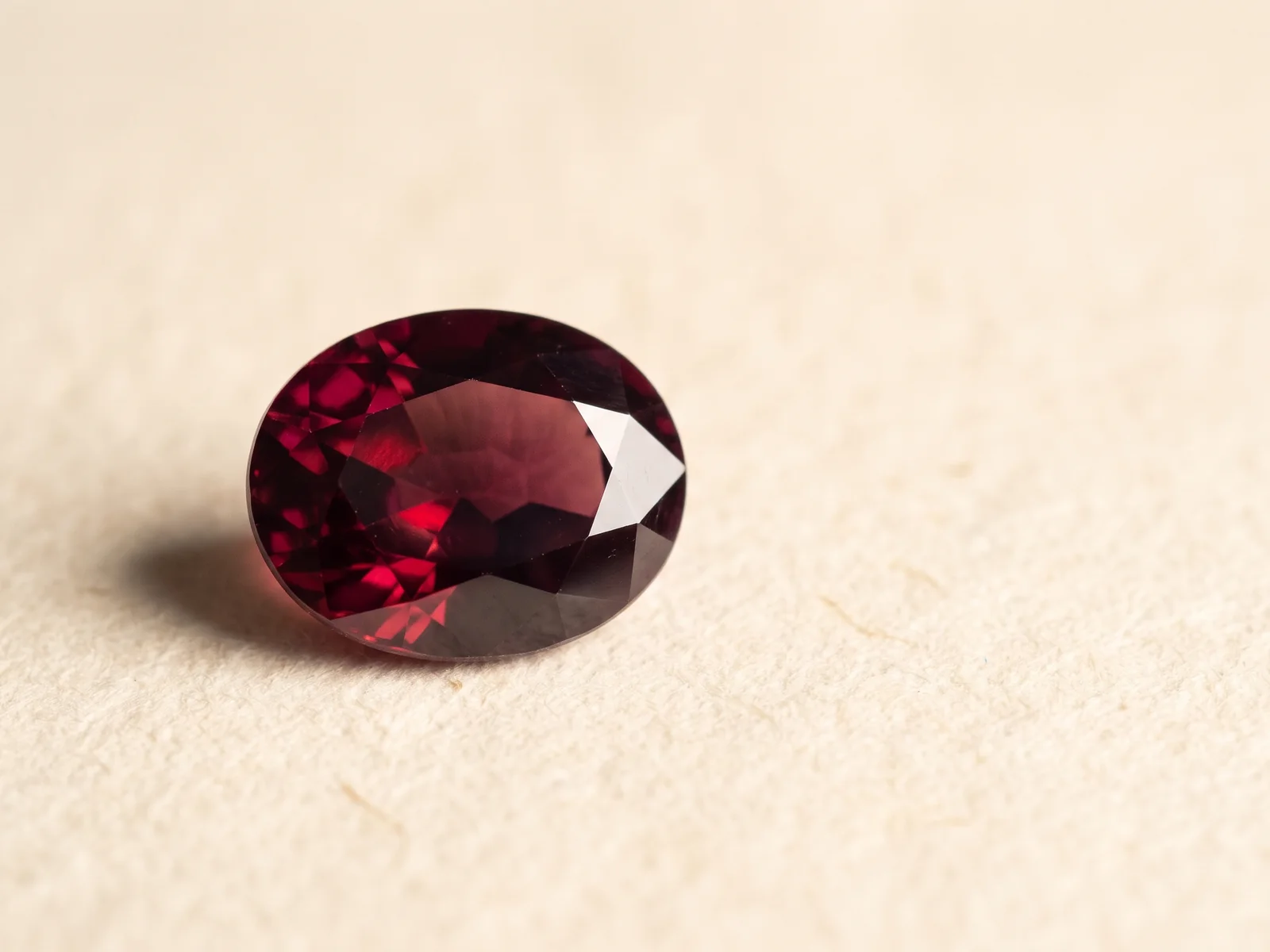
Garnet is the January birthstone, and it is far more than the dark red stone in an old Victorian brooch. Here is what the January birthstone garnet actually is, which colours to look for, and how to set one so it lasts in a ring worn every day.
 Reviewed by Raj Sood, Graduate Gemologist (GIA), AJP (GIA)Master jeweller and Graduate Gemologist (GIA) · reviewed 4 November 2026
Quick answer
The January birthstone is garnet, a family of silicate minerals most familiar in deep red but also found in orange, raspberry pink, green and colour-change varieties. Garnet rates 6.5–7.5 on the Mohs scale, has no cleavage and is rarely treated, so it suits pendants and earrings and, in a protective setting, everyday rings.
What is the January birthstone garnet?
Garnet is not one mineral but a group of closely related silicate minerals that share the same crystal structure. Their general formula is X3Y2(SiO4)3, where different metals such as magnesium, iron, manganese, calcium, aluminium and chromium fill the X and Y positions. Swap one metal for another and the colour, hardness and sparkle all shift. That is why the January birthstone covers everything from a wine-red almandine to a grass-green tsavorite. Our main garnet gemstone page gathers the stones and jewellery in one place.
Six species matter in jewellery: pyrope, almandine, spessartine, grossular, andradite and uvarovite. Very few gem garnets are pure examples of one species. Most are natural blends, which is how trade names such as rhodolite (a pyrope–almandine mix) come about.
Garnet is singly refractive, meaning light travels through it at one speed in every direction, so you never see the doubled facet edges you find in zircon or peridot. Its refractive index (how strongly it bends light) runs from about 1.71 in pyrope to about 1.89 in andradite, compared with about 2.42 for diamond. Demantoid, the green andradite, has a dispersion (the splitting of white light into rainbow flashes, often called fire) of about 0.057, higher than diamond's 0.044.
Rough garnet often grows as rounded twelve-sided crystals called dodecahedra, which look a lot like pomegranate seeds. If you are comparing garnet with other coloured stones, start with our overview of coloured gemstones and birthstones, and look up any unfamiliar word in our plain-English glossary of gem terms.
Why is garnet the birthstone for January?
The word garnet comes from the Latin granatum, meaning pomegranate, a nod to those seed-like red crystals. Garnet is one of the oldest gems in continuous use. Garnet beads have been found in ancient Egyptian burials, Roman jewellers carved garnets into intaglios (designs cut into the stone) for signet rings, and the early seventh-century Anglo-Saxon treasure at Sutton Hoo in England includes thousands of thin garnet slices set in gold cloisonné, a technique where each stone sits in its own little gold cell.
In the 1800s, small red pyropes from Bohemia (now part of the Czech Republic) were packed tightly into brooches, earrings and combs, and Victorian garnet jewellery is still common in antique shops today. Many of those pieces are rose cut, an old style with a flat base and a domed top of triangular facets.
The modern list of birthstones was standardised in 1912 by the American National Association of Jewelers, now Jewelers of America, and garnet has held January ever since. Traditionally, garnet has been linked with protection on journeys, friendship and constancy. That garnet birthstone meaning is folklore rather than science, but it is a big part of why people give it. If you are planning a gift for someone born in January, our Melbourne-made birthstone jewellery page shows how the stone can be worked into rings, pendants and family pieces.
What colours does garnet come in?
Garnet comes in nearly every colour. Natural blue garnet is the rare exception: it occurs only as an unusual colour-change garnet, so a cheap stone sold as plain blue garnet is very likely something else. The table sets out the garnet colours you are most likely to see in jewellery.
| Trade name | Species | Colour | Mohs | Refractive index (approx.) |
|---|---|---|---|---|
| Pyrope | Pyrope | Deep red, sometimes slightly brownish | 7–7.5 | 1.72–1.76 |
| Almandine | Almandine | Brownish red to purplish red | 7.5 | 1.76–1.83 |
| Rhodolite | Pyrope–almandine | Raspberry red to purplish pink | 7–7.5 | 1.75–1.76 |
| Spessartine (mandarin) | Spessartine | Orange to reddish orange | 6.5–7.5 | 1.79–1.81 |
| Hessonite | Grossular | Honey to cinnamon orange-brown | 6.5–7 | 1.74 |
| Tsavorite | Grossular | Light to deep green | 7–7.5 | 1.74 |
| Demantoid | Andradite | Yellowish green to emerald green | 6.5–7 | 1.88–1.89 |
| Colour-change | Pyrope–spessartine | Blue-green in daylight, purplish red in warm light | 7–7.5 | about 1.76 |
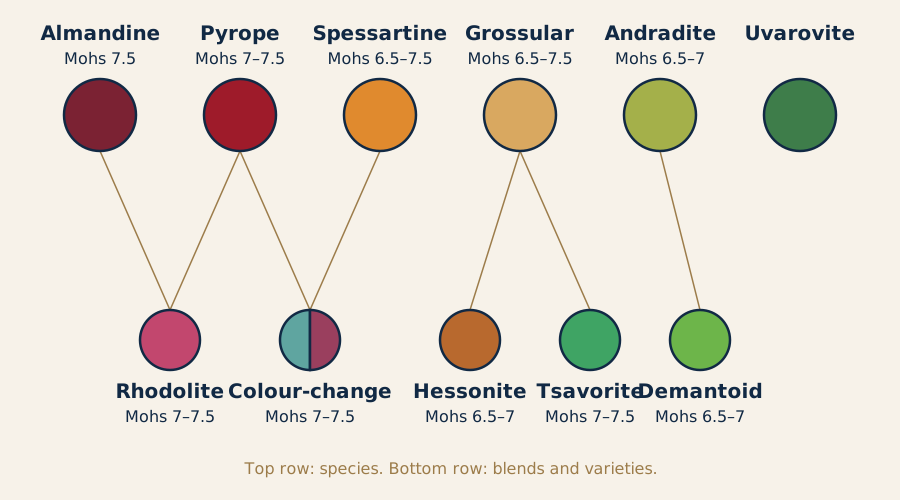
Red garnets (pyrope and almandine) are what most people picture. Their one weakness is that a strongly saturated stone can look almost black in dim light or in a small size. Rhodolite is lighter and brighter, with a raspberry tone; our guide to raspberry-pink rhodolite covers how it is graded. For orange, vivid orange spessartine is one of the brightest garnets because of its higher refractive index, while cinnamon-coloured hessonite has a softer, warmer glow, often with a slightly swirly look inside caused by tiny included crystals.
For green garnet, there are two quite different choices. Tsavorite, found in Kenya and Tanzania from the late 1960s, has a clear, crisp green that rivals fine emerald but with fewer inclusions; see our page on tsavorite, the green grossular. Demantoid, first found in Russia's Ural Mountains in the mid-1800s, is rarer and has more fire than diamond. Its most prized inclusion is the fine, curving horsetail, and our demantoid garnet guide explains why collectors look for it.
Is the January birthstone garnet durable enough for an everyday ring?
Durability has three parts. Hardness is resistance to scratching, measured on the Mohs scale from 1 (talc) to 10 (diamond). Toughness is resistance to chipping and breaking. Cleavage is a tendency to split cleanly along flat planes inside the crystal. Garnet sits at 6.5–7.5 for hardness, has no cleavage and has fair to good toughness, so it rarely breaks from a single knock.
The catch is everyday dust. Household and garden dust contains quartz, which is 7 on the Mohs scale. Over years of wear, the softer garnets (hessonite, demantoid and some spessartine at 6.5–7) will slowly lose the sharpness of their facet edges, and even the harder red garnets will pick up fine scuffs on the table (the large top facet). A pendant or earrings will hardly change. A ring worn every day will need occasional care.
| Birthstone | Mohs hardness | Cleavage | Everyday ring? |
|---|---|---|---|
| Garnet (January) | 6.5–7.5 | None | Yes, with a protective setting and some care |
| Amethyst (February) | 7 | None to poor | Yes, with a protective setting and some care |
| Diamond (April) | 10 | Perfect, in four directions | Yes; very scratch resistant but can chip on a hard knock |
| Emerald (May) | 7.5–8 | Poor, but usually included and brittle | Possible, with a bezel and careful wear |
| Ruby (July) | 9 | None | Yes, very well suited |
| Sapphire (September) | 9 | None | Yes, very well suited |
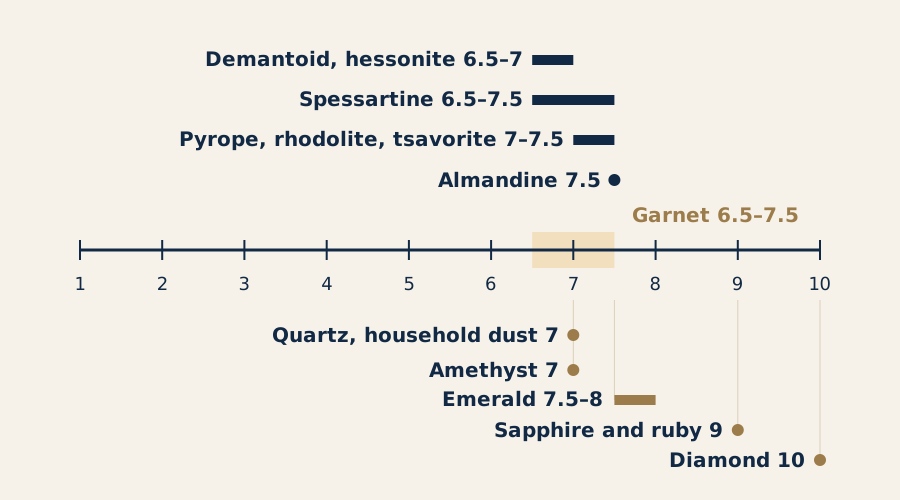
So yes, garnet works in a ring, and it is noticeably tougher in daily wear than an emerald. It is simply not in the same league as corundum or diamond. Our article on choosing a birthstone for a ring you wear daily ranks all twelve months side by side. For close relatives on the scale, compare amethyst, February's purple quartz, which wears much like a red garnet, emerald for May, which is harder but more fragile, and the far harder September's sapphire or diamond, the April birthstone.
Not sure which one is right?
Send us the stones you are looking at and our gemologist will tell you which to choose and why.
Is there Australian garnet?
Yes. Garnet is common in Australian rocks, but most of it is not gem quality. Western Australia has large garnet sand deposits, including around Port Gregory north of Geraldton, mined mainly for industrial abrasives and waterjet cutting rather than jewellery. Gem-quality almandine and pyrope have been found in the Harts Range in the Northern Territory, and fossickers turn up small red garnets in several other states.
Australian garnets tend to be small and dark red, which suits studs, pendants, accent stones and cluster designs better than a large centre stone. Most faceted garnet in the Australian market comes from East Africa (Tanzania, Kenya, Mozambique and Madagascar), Nigeria, Namibia, Sri Lanka, India and Brazil. Origin is rarely recorded on garnet the way it is for fine sapphire, so if you would like an Australian-sourced garnet, ask, and we will tell you what we know about each stone's source.
Is garnet treated, and are there lab-created garnets?
Garnet is one of the least treated gems. The great majority of red, orange and green garnets are sold exactly as they came out of the ground, cut and polished. Occasionally a stone has surface-reaching fractures filled with resin or glass, and some demantoid may be gently heated to improve colour. Any treatment should be disclosed, and a lab report is worth having on a valuable tsavorite, demantoid or colour-change garnet.
Lab-created versions of the gem garnet species are rarely sold. You may see two synthetic materials with garnet in their names, YAG (yttrium aluminium garnet) and GGG (gadolinium gallium garnet). These are lab-created crystals with a garnet-type structure, used mostly as diamond simulants in the 1970s, and they are not the same material as natural January garnet.
Imitations exist too. Red glass is the usual one, and older jewellery sometimes contains a garnet-and-glass doublet: a thin slice of natural garnet fused on top of coloured glass, made to imitate other gems such as ruby or sapphire. A gemmologist can spot these quickly with magnification and a refractometer.
Which setting suits a garnet engagement ring or everyday ring?
Because garnet sits in the middle of the hardness scale, the setting's job is to shield the girdle (the outer edge) and keep the stone low enough that it does not take the first knock. Popular choices:
- Bezel or half-bezel: a rim of metal around the edge. The most protective option for an everyday garnet ring, and it suits a clean, modern look.
- Low four or six claws: shows more of the stone and lets light in from the sides, which helps dark red garnets look brighter. Keep the head low on the finger.
- Halo: a ring of small diamonds frames the colour and adds a buffer around the garnet's edge.
- Cluster and Victorian styles: small garnets grouped together, a natural fit for Australian stones and for remodelling heirloom pieces.
- Pendants and earrings: they take very little wear, so even softer demantoid and hessonite last for generations.
Metal changes how garnet reads. Red and orange garnets glow in yellow and rose gold, which warm the colour further. Green tsavorite and demantoid look crisper in white gold or platinum, and rhodolite works in either. For very saturated red garnets, an open gallery (the part under the stone) lets more light through so the stone does not look black indoors. For design ideas well beyond the classic red solitaire, see our guide to garnet engagement rings in every colour.
Related guideGarnet Engagement Rings: More Than Dark RedHow much does garnet cost in Australia?
Garnet prices vary more than almost any other gem family, because the same group includes everyday red stones and genuine rarities. Colour, size, clarity and cut matter most. Red and pink garnets are usually eye-clean (no inclusions visible without magnification), so you can be choosy. Clean tsavorite over about 2 carats and demantoid over about 1 carat are scarce, which pushes their price per carat up sharply.
| Garnet type, about 1–2 ct, good colour | Approximate price per carat (AUD) |
|---|---|
| Red almandine or pyrope | about $30–$200 |
| Rhodolite | about $60–$400 |
| Hessonite | about $60–$300 |
| Spessartine (bright orange) | about $300–$1,500 |
| Colour-change garnet | about $400–$3,000 |
| Tsavorite | about $500–$4,000 |
| Demantoid | about $1,500–$8,000 |
These are broad ranges only and move with the market and the exact stone. Garnets are also denser than diamond, so a 1 carat almandine is slightly smaller face-up than a 1 carat diamond; compare stones by their millimetre measurements rather than carat alone. For context, a fine red garnet costs a small fraction of a comparable natural ruby, and our page on ruby, the July birthstone explains why the two red stones sit so far apart in price.
Browse natural gemstones, including garnet
How do you care for garnet jewellery?
Garnet is easy to look after. Clean it in warm water with a drop of mild dishwashing liquid and a soft toothbrush, paying attention to the back of the stone where soap and skin oils build up, then rinse and dry with a lint-free cloth.
- Ultrasonic cleaners: usually fine for untreated, clean red garnets; avoid them for fracture-filled stones and for demantoid or hessonite with many inclusions.
- Steam and heat: avoid sudden temperature changes, which can stress included stones.
- Storage: keep garnet apart from diamonds, sapphires and rubies, which are harder and will scratch it.
- Daily wear: take rings off for the gym, gardening and cleaning, where grit and knocks do most damage.
- Check-ups: have claws and bezels checked about once a year so a loose stone is caught early.
How to choose a January birthstone garnet: step by step
- Pick a colour family. Red, raspberry, orange, honey or green; this decides which garnet species you are shopping for.
- Match the type to the wear. For a daily ring, lean towards rhodolite, pyrope, almandine or tsavorite (7–7.5); keep demantoid and hessonite for pendants, earrings or occasional rings.
- Look in two kinds of light. View the stone in daylight and under warm indoor light; dark red garnets can close up indoors and colour-change garnets shift between the two.
- Check brightness and windowing. Tilt the stone and watch for a washed-out, see-through patch in the middle (a window), a sign of a shallow cut.
- Check clarity for the type. Red and orange garnets should be eye-clean; small inclusions are normal in tsavorite, and horsetails are prized in demantoid.
- Compare millimetres, not just carats. Garnet is denser than diamond, so check the face-up measurements.
- Ask about treatment and origin. Most garnet is untreated; for valuable green or colour-change stones, ask for a lab report.
- Plan the setting. Choose a bezel, low claws or halo and a metal colour that suits the stone before you commit.
Free consultation
Talk to a gemologist
Compare stones in person or online with Raj Sood, Graduate Gemologist (GIA), AJP (GIA).
Book a consultationShop this shape
FAQ
Common questions
What colour is the January birthstone?
Garnet is best known as deep red, but the January birthstone also includes raspberry rhodolite, orange spessartine, honey-coloured hessonite, green tsavorite and demantoid, and rare colour-change garnets. Any of them counts as a January birthstone.
Is garnet durable enough for an engagement ring?
It can be, if you choose a harder type such as rhodolite, almandine or tsavorite (7–7.5 on the Mohs scale) and a protective setting like a bezel or low claws. Expect some softening of facet edges over many years, which a jeweller can repolish.
What is the garnet birthstone meaning?
Traditionally garnet has been linked with protection on journeys, friendship and loyalty. These associations come from folklore and history rather than any proven effect.
Is green garnet rarer than red garnet?
Yes. Red almandine and pyrope are plentiful, while fine green tsavorite and especially demantoid are much rarer and cost far more per carat.
Are garnets found in Australia?
Yes. Gem-quality red garnets have been found in the Northern Territory's Harts Range and elsewhere, and Western Australia mines large amounts of garnet sand for industrial use. Australian gem garnets are usually small and dark red.
Can you get a lab-created garnet?
Lab-created versions of the gem garnet species are rarely sold. Materials like YAG and GGG are synthetic crystals with a garnet-type structure used as diamond simulants, not lab-created January garnet.

Ask a gemologist
Not sure which diamond to choose?
Raj Sood is a Graduate Gemologist (GIA) and master jeweller. Bring the stones you are considering, or send the reports, and he will tell you honestly which one is better and why.
Keep learning
Related guides
 GemstonesNatural Garnet Gemstones and Custom Garnet JewelleryGemstonesRhodolite Garnet
 GemstonesBirthstone Engagement Rings: Choosing for Durability
 GemstonesTsavorite GarnetGemstonesGemstones | Coloured Gemstones, Birthstones and Custom Jewellery
 GemstonesSpessartine GarnetGemstonesHessonite GarnetGemstonesDemantoid Garnet
Explore more
More guides on this topic
Education