
Gemstones
Tsavorite Garnet Guide: Colour, Hardness, Origins, Value and Care
Tsavorite garnet offers a rich green to rival emerald, with fewer fractures and usually no treatment. Here is what decides its colour, durability and price, and how to set and care for one.
 Reviewed by Raj Sood, Graduate Gemologist (GIA), AJP (GIA)Master jeweller and Graduate Gemologist (GIA) · reviewed 4 November 2026
Quick answer
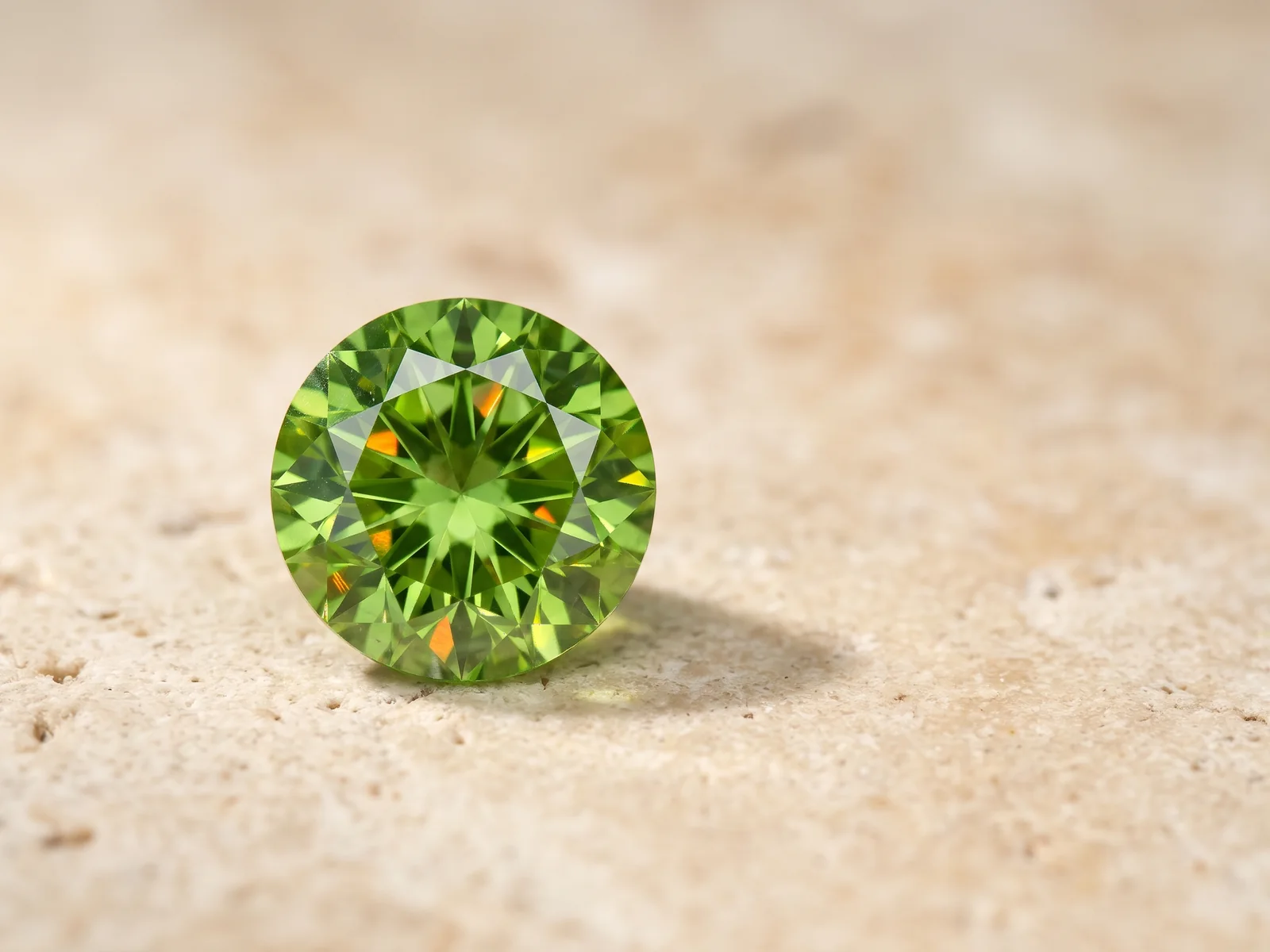
Tsavorite garnet is the green, vanadium- and chromium-coloured variety of grossular garnet, found mainly in Kenya and Tanzania since 1967. It rates 7–7.5 on the Mohs scale, has no cleavage and is almost always untreated. Value rests on a vivid, medium-dark green, eye-clean clarity and size, because clean stones over 2 carats are uncommon.
What is tsavorite garnet?
Tsavorite is the green variety of grossular garnet, a calcium aluminium silicate with the formula Ca3Al2(SiO4)3. Pure grossular is colourless. Tsavorite turns green because traces of vanadium and chromium take the place of some of the aluminium in the crystal. If you want to see how such small amounts of an element can change a stone's colour completely, our page on the chemistry behind gemstone colour sets it out gem by gem.
Garnet is not one mineral but a group of closely related minerals that share the same cubic crystal structure. Our main garnet gemstone guide covers the whole family, from raspberry-toned rhodolite and bright orange spessartine to cinnamon-coloured hessonite. Hessonite is grossular as well; it simply carries iron and manganese instead of vanadium and chromium, which is why it is orange-brown rather than green.
Tsavorite is a young gem in trade terms. Scottish geologist Campbell Bridges first found green grossular in north-east Tanzania in 1967, then found a richer deposit in 1971 in south-east Kenya, close to Tsavo National Park. Tiffany & Co. introduced the stone to the public in the mid-1970s under the name tsavorite, after Tsavo. That short history is one reason many people have never heard of it, even though it is one of the more durable green gems.
What colours does tsavorite garnet come in?
All tsavorite is green, but the shade runs from a pale mint green through bright grass green to a deep forest green. Some stones lean slightly yellowish, others slightly bluish. Gemmologists describe colour by three things: hue (the colour itself), tone (how light or dark it is) and saturation (how strong or pure it is).
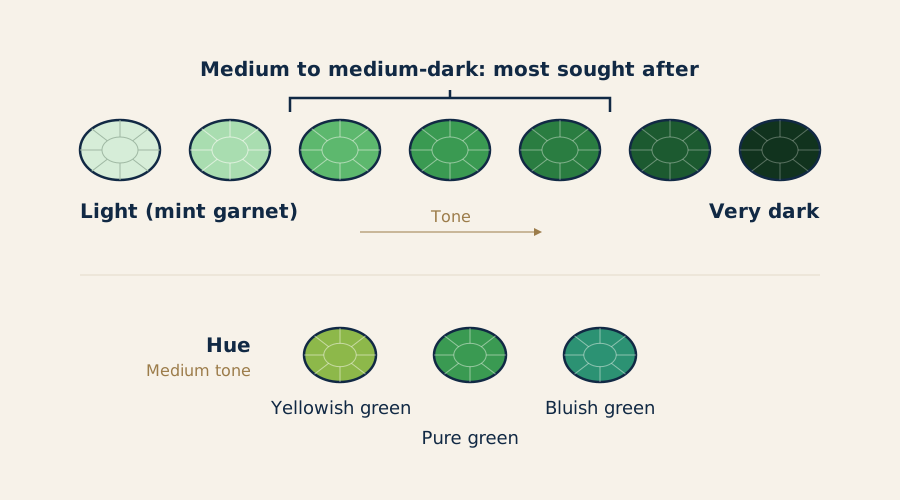
- Most valued: pure, vivid green in a medium to medium-dark tone, sometimes with a faint blue edge.
- Very dark stones: can look blackish in dim light, especially in larger sizes, and are usually priced below the best colour.
- Light stones: pale green grossular, often sold as "mint garnet", is lively and bright but costs noticeably less than saturated tsavorite.
- Yellowish green: attractive and more affordable; the stronger the yellow, the lower the price.
Tsavorite is singly refractive, meaning light travels through it at one speed whatever its direction. In practice, its colour looks the same from every angle, so a cutter can orient the rough to save weight without losing colour. Its dispersion (the splitting of white light into flashes of colour, often called fire) is about 0.028. That is roughly double an emerald's and gives a well-cut tsavorite a lively sparkle. Its rarer green cousin, demantoid, the high-fire green garnet, shows even more fire.
Related guideDemantoid GarnetHow hard is tsavorite? Hardness and toughness for everyday wear
Two different numbers decide how well a gem survives daily life. Hardness, on the Mohs scale, is resistance to scratching. Toughness is resistance to chipping and breaking. Our guide to hardness, refractive index and durability explains both in detail; here is how tsavorite measures up.
| Property | Tsavorite | What it means for you |
|---|---|---|
| Mohs hardness | 7–7.5 | As hard as or slightly harder than quartz dust (7), so it resists most everyday scratching, but softer than sapphire (9) and diamond (10) |
| Toughness | Fair to good | No cleavage, so it does not split cleanly, but a hard knock on an edge can still chip it |
| Cleavage | None | Safer to set and wear than emerald or topaz |
| Refractive index | about 1.734–1.759 (most tsavorite near 1.74) | Bright, with good light return |
| Specific gravity | about 3.57–3.73 | Heavier than emerald, so a 1 ct tsavorite looks noticeably smaller than a 1 ct emerald |
| Dispersion | about 0.028 | Visible fire in good light |
| Heat sensitivity | Avoid sudden temperature change | Protect it from torch heat during jewellery repairs and from steam cleaners |
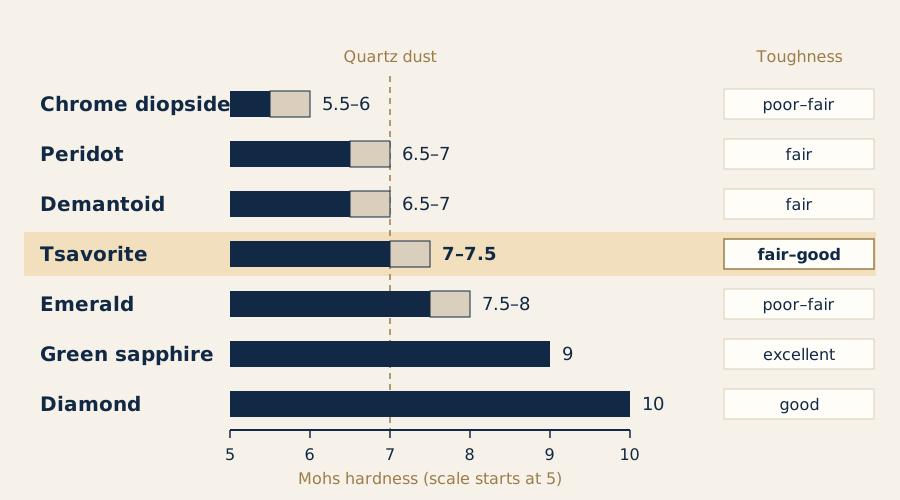
The key number for rings is 7. Household dust contains quartz, which is also about 7 on the Mohs scale. A tsavorite at 7–7.5 is only just harder, so over many years of daily wear the facet edges can lose their crispness. A jeweller can repolish them, and most people find that a fair trade for the stone's colour and lack of cleavage.
Is tsavorite garnet treated?
Usually not, and this is one of tsavorite's real strengths. Unlike sapphire and ruby, which are routinely heated, and emerald, which is almost always oiled or resin-filled, tsavorite is normally sold exactly as it comes out of the ground, cut and polished. Heating does not improve its colour, so there is no reason to heat it. Our comparison of heated and unheated gemstones explains why heating matters so much to value in other gems.
The exception is occasional fracture filling, where an oil or resin is pushed into a surface-reaching crack to make it less visible. This is uncommon in tsavorite but not unknown, particularly in lower-priced stones with visible fractures. Filling has to be disclosed, and filled stones need gentler cleaning. Our page on how fracture and glass filling work shows what to look for under magnification.
For a significant stone, ask whether it has a report from an independent gem laboratory that states the identity, any treatment and, where the lab offers it, the likely origin.
Not sure which one is right?
Send us the stones you are looking at and our gemologist will tell you which to choose and why.
Where is tsavorite found?
Almost all tsavorite comes from a narrow belt of ancient metamorphic rock (rock changed by heat and pressure deep underground) running through East Africa and Madagascar. The tsavorite forms in nodules inside graphite-bearing gneiss, and the earth movements that created it also left most crystals heavily fractured. That is why clean rough is small and clean cut stones over a few carats are rare.
- Kenya: the Taita-Taveta district near Tsavo National Park, the source that gave the gem its name. Small-scale mines here still produce some of the richest greens.
- Tanzania: the Merelani Hills (also home to tanzanite) and other deposits in the north, including the original 1967 find. Merelani is also a source of lighter mint grossular.
- Madagascar: smaller deposits in the south, producing green grossular of variable colour.
- Elsewhere: small amounts of green grossular have been reported from Pakistan and Afghanistan, but these are minor sources.
Australia is not a source of gem tsavorite. The garnets found here are mostly almandine and pyrope, the red to purplish-red family members, with notable occurrences such as the Harts Range in the Northern Territory, and much Australian garnet is mined as abrasive sand rather than gem rough. If a seller describes a tsavorite as Australian, ask for the evidence. In Australian jewellery, tsavorite is an imported stone, usually cut in East Africa, Thailand or India.
How does a gemmologist identify tsavorite?
Several green stones look similar to tsavorite at a glance, so identification relies on simple gem-testing instruments. These are the checks used at the bench, explained in plain terms (the glossary of jewellery and gem terms covers any word you have not met).
- Refractometer: measures the refractive index (how much the stone bends light). Tsavorite reads about 1.74, with a single reading because it is singly refractive.
- Polariscope: confirms single refraction. Some garnets show patchy "anomalous" extinction from internal strain, which an experienced eye learns to read.
- Chelsea filter: a coloured filter that shows chromium and vanadium. Many tsavorites glow pink to red through it, as do many emeralds, so it narrows the field but does not decide it on its own.
- Magnification: typical inclusions are short needles, small included crystals, fluid inclusions and healed fractures that look like fingerprints.
- Specific gravity: about 3.61, noticeably heavier than emerald (about 2.72).
| Stone | Refractive index | Single or double refraction | Quick clue |
|---|---|---|---|
| Tsavorite | about 1.74 | Single | Needles, healed fractures; no pleochroism |
| Emerald | about 1.57–1.59 | Double | Lower reading; often oiled |
| Demantoid garnet | about 1.88 | Single | Very strong fire; Russian stones may show horsetail inclusions |
| Green sapphire | about 1.76–1.77 | Double | Doubling of facet edges under a loupe; usually darker, olive greens |
| Chrome diopside | about 1.67–1.70 | Double | Softer (5.5–6), often very dark in larger sizes |
| Lab-created green YAG | about 1.83 | Single | Synthetic garnet-structured material used as a simulant; very clean |
| Green cubic zirconia or glass | about 2.15 (CZ); 1.50–1.70 (glass) | Single | Gas bubbles or swirls in glass; CZ has very strong fire |
Synthetic grossular can be grown in a laboratory, but lab-created tsavorite is not a common commercial product. The look-alikes you are more likely to meet are glass, lab-created green YAG and green cubic zirconia, which is why a refractometer reading matters.
What affects tsavorite garnet price?
Tsavorite is priced mainly on colour, then size, clarity and cut. Compared with the wider range of coloured gemstones, it sits well above common garnets and below fine emerald and demantoid of similar size.
- Colour: the single biggest factor. A saturated, medium-dark pure green can cost several times as much as a pale or yellowish stone of the same size.
- Size: most tsavorite is cut under 1 carat. Price per carat rises steeply above about 2 carats, and clean stones above 5 carats are rare.
- Clarity: tsavorite is assessed as a gem that usually has some inclusions. An eye-clean stone (no inclusions visible without magnification at normal distance) is expected at the fine end, especially in smaller sizes.
- Cut: because rough is precious, some stones are cut deep or lopsided to keep weight. A well-proportioned stone with even brightness across the face is worth more than a heavier, darker one.
- Treatment and documentation: an untreated stone with a laboratory report sells at a premium over a filled or undocumented one.
| Tsavorite quality | Typical size | Approximate price per carat (AUD) |
|---|---|---|
| Light to medium or yellowish green, commercial | under 1 ct | about $150–$500 |
| Good medium green, eye-clean | 0.50–1 ct | about $500–$1,500 |
| Fine vivid green, eye-clean | 1–2 ct | about $1,500–$4,000 |
| Fine vivid green, eye-clean | 3 ct and above | about $4,000–$10,000 or more |
These are broad ranges only. Coloured gem prices vary with the individual stone and the market, so compare stones of similar colour and size side by side rather than relying on one figure.
Is tsavorite garnet good for an engagement ring?
Yes, with sensible settings and realistic expectations. Tsavorite has no cleavage and is tougher than emerald, so it handles daily wear better than most green gems. It is softer than sapphire and diamond, so it will show wear sooner. Here is how it compares with other green and alternative ring stones.
| Stone | Mohs hardness | Toughness | Usual treatment | Everyday ring wear |
|---|---|---|---|---|
| Tsavorite garnet | 7–7.5 | Fair to good | Usually none | Good with a protective setting |
| Emerald | 7.5–8 | Poor to fair | Oil or resin, very common | Needs care; prone to chipping |
| Demantoid garnet | 6.5–7 | Fair | Sometimes heated | Better for occasional wear |
| Green sapphire | 9 | Excellent | Heating common | Very good |
| Alexandrite | 8.5 | Excellent | Usually none | Very good |
| Peridot | 6.5–7 | Fair | Usually none | Better for occasional wear |
| Chrome diopside | 5.5–6 | Poor to fair | Usually none | Not ideal for daily rings |
| Diamond | 10 | Good | Varies; must be disclosed | Excellent |
If you are weighing tsavorite against emerald, our guide to emerald engagement rings and their care explains why emerald needs more protection. For a green stone that also changes colour, see alexandrite rings and their colour change; for a pale, cool alternative, aquamarine as a ring stone is worth a look. And for the wider family, garnet engagement rings in every colour shows how green, orange and pink garnets suit a ring.
For daily wear, choose a bezel (a metal rim around the stone) or four to six sturdy claws, and avoid knife-edge corners on fancy shapes. Ovals, cushions and rounds are safer than pointed pears and marquises. Many people pair tsavorite with yellow gold to warm the green, or with white gold or platinum and diamonds for a cooler, brighter contrast.
How do you choose and care for tsavorite garnet? Step by step
- Judge colour in two lights. Look in daylight and warm indoor light; aim for a vivid green that stays green, not olive or blackish.
- Check clarity by eye. At arm's length the stone should look clean; look closely for fractures reaching the surface, especially near the girdle.
- Ask about treatment. Confirm in writing whether the stone is untreated or filled, and ask for a laboratory report on larger stones.
- Compare millimetres, not just carats. Tsavorite is dense, so it looks smaller for its weight than emerald; ask for face-up measurements.
- Choose a protective setting. A bezel or sturdy claws for a daily ring; open settings suit pendants and earrings.
- Clean it gently. Warm water, a drop of mild dish soap and a soft toothbrush. Avoid steam cleaners and sudden heat; use ultrasonic cleaners only on stones with no fractures or fillings.
- Store and maintain. Keep it apart from diamonds and sapphires, which can scratch it, take it off for the gym and gardening, and have the claws checked once a year.
Tsavorite also makes a green option for anyone who wants a garnet but not the classic red; our page on the January birthstone and its garnet colours covers the full range of choices.
Shop natural gemstones
Free consultation
Talk to a gemologist
Compare stones in person or online with Raj Sood, Graduate Gemologist (GIA), AJP (GIA).
Book a consultationShop this shape
FAQ
Common questions
Is tsavorite garnet rare?
Yes, compared with most garnets. It is mined mainly in a small area of Kenya and Tanzania, and clean stones above 2 carats are uncommon, with clean stones over 5 carats rare.
Is tsavorite better than emerald for an engagement ring?
For durability, usually yes. Tsavorite has no cleavage, better toughness and is normally untreated, while emerald is prone to chipping and is almost always oiled or resin-filled, although emerald is slightly harder at 7.5–8.
How much is a 1 carat tsavorite worth?
A 1 carat tsavorite ranges from roughly AUD $150–$500 for a lighter or yellowish stone to around $1,500–$4,000 for a fine, vivid, eye-clean green. Colour is the biggest factor, followed by clarity and cut.
Is tsavorite treated?
Almost never. Tsavorite is not heated because heating does not improve it; occasional fracture filling in lower-priced stones should be disclosed by the seller.
What is the difference between tsavorite and demantoid?
Both are green garnets, but tsavorite is grossular and demantoid is andradite. Demantoid has much stronger fire and a higher refractive index (about 1.88) but is softer at 6.5–7, so tsavorite is the more practical choice for daily rings.
Can you wear tsavorite every day?
Yes, in a protective setting. At 7–7.5 on the Mohs scale it resists most scratches, though facet edges may soften after years of daily wear and can be repolished by a jeweller.

Ask a gemologist
Not sure which diamond to choose?
Raj Sood is a Graduate Gemologist (GIA) and master jeweller. Bring the stones you are considering, or send the reports, and he will tell you honestly which one is better and why.
Keep learning
Related guides
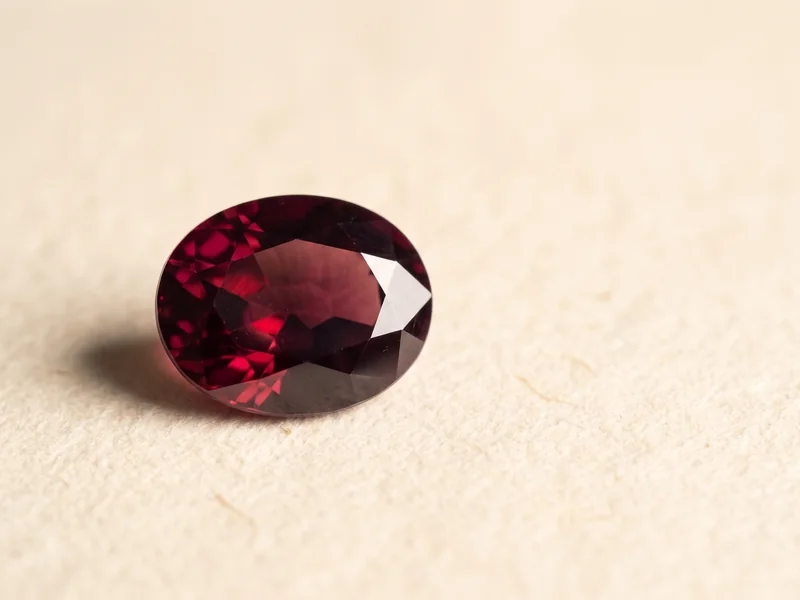 GemstonesNatural Garnet Gemstones and Custom Garnet Jewellery
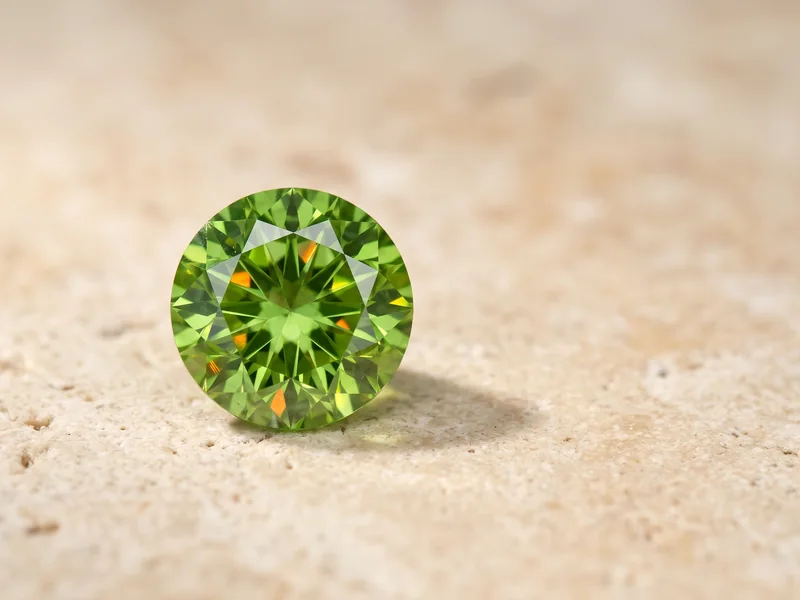 GemstonesDemantoid Garnet
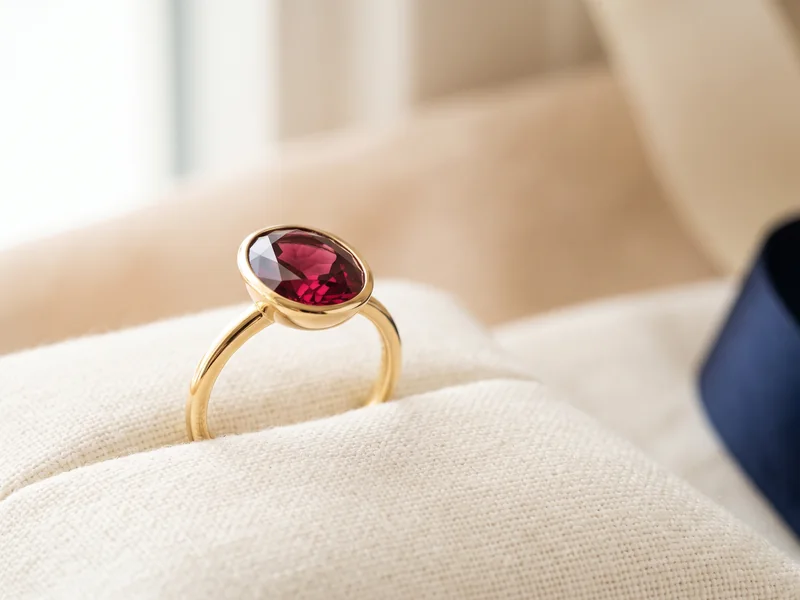 GemstonesGarnet Engagement Rings: More Than Dark Red
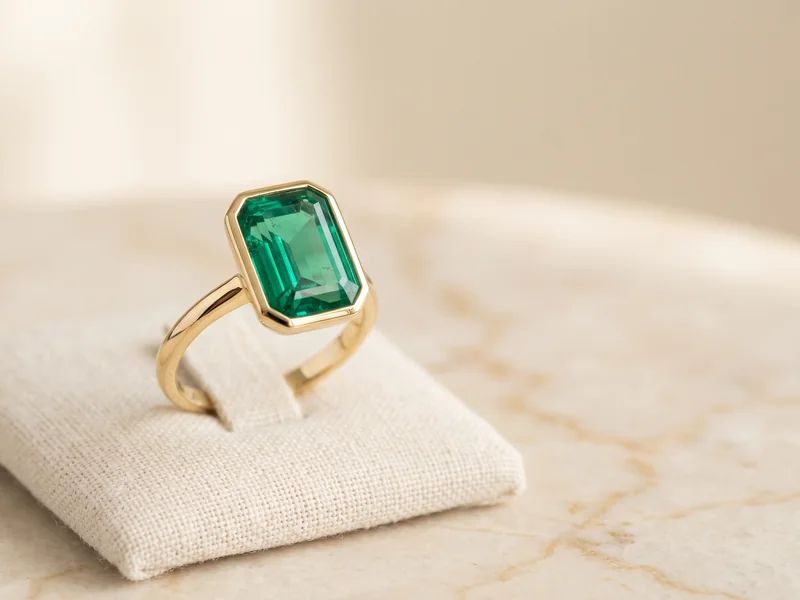 GemstonesEmerald Engagement RingsGemstonesGemstones | Coloured Gemstones, Birthstones and Custom Jewellery
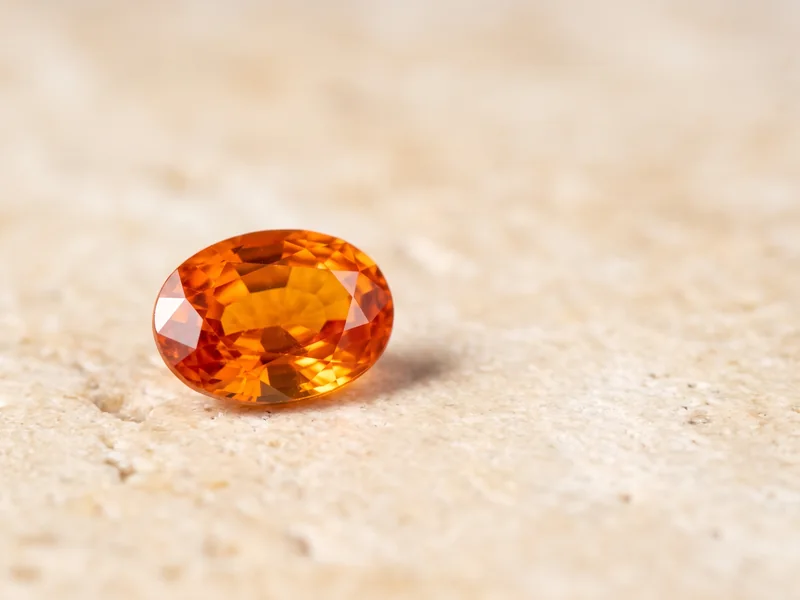 GemstonesSpessartine GarnetGemstonesRhodolite GarnetGemstonesHessonite Garnet
Explore more
More guides on this topic
Education