
Gemstones
Demantoid Garnet Guide: Colour, Fire, Origins and Value
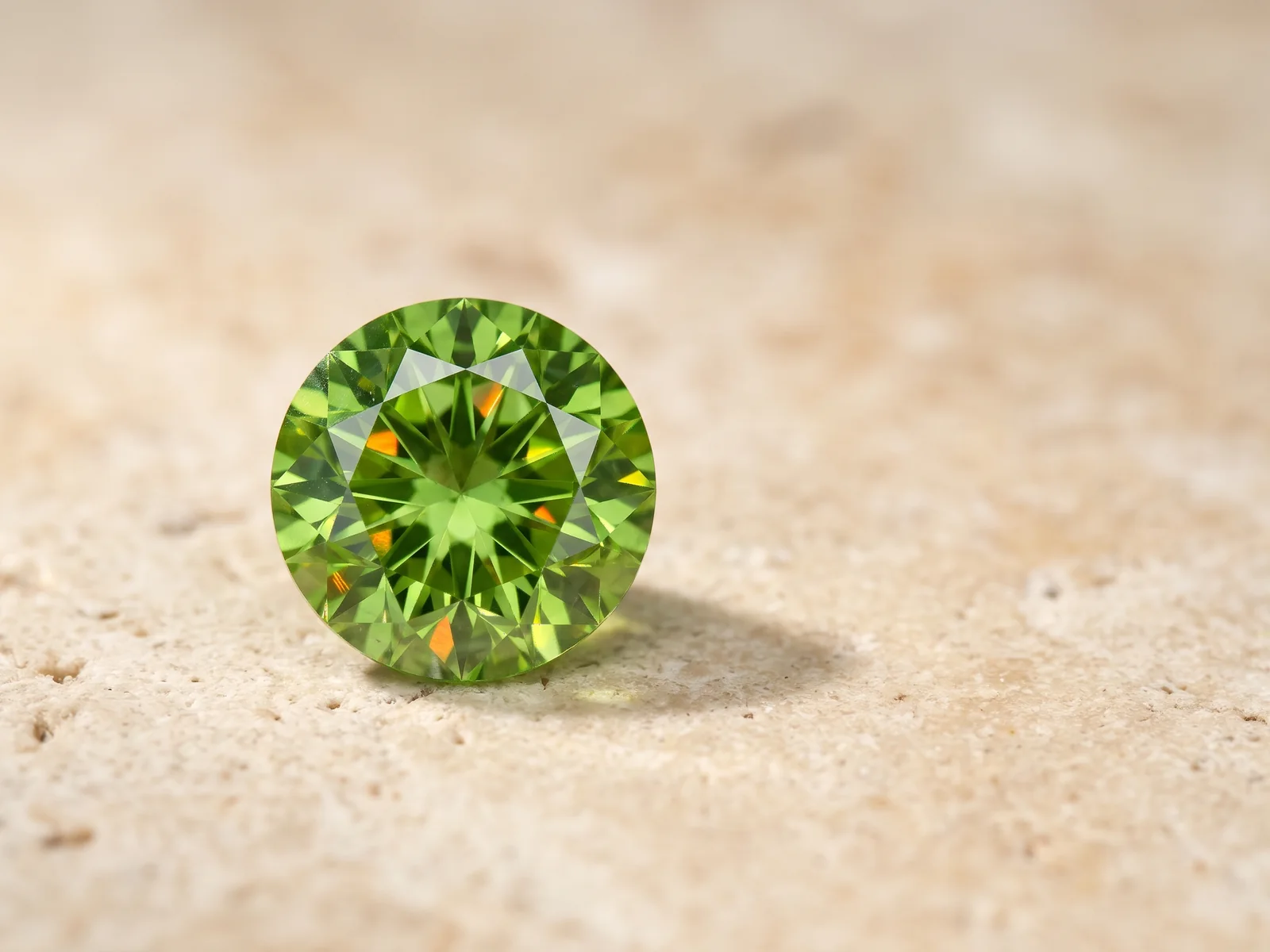
Demantoid garnet is one of the rarest members of the garnet family and one of the few coloured gems with more fire than diamond. Here is how to judge its colour, origin, treatments and price, and whether it will stand up to life on a ring.
 Reviewed by Raj Sood, Graduate Gemologist (GIA), AJP (GIA)Master jeweller and Graduate Gemologist (GIA) · reviewed 4 November 2026
Quick answer
Demantoid garnet is the green variety of andradite garnet, coloured by chromium and iron. It has more fire (dispersion 0.057) than diamond, a refractive index near 1.89 and hardness of 6.5–7. The finest stones are intense green, and Russian stones often show horsetail inclusions. It suits pendants, earrings and carefully set rings worn with care.
What is a demantoid garnet?
Demantoid is the green variety of andradite, a calcium-iron garnet with the formula Ca3Fe2(SiO4)3. Garnet is not a single mineral but a family of related minerals that share the same cubic crystal structure and swap different elements in and out. Our guide to the whole garnet family explains how the species fit together. Andradite also comes in yellow (called topazolite) and black (called melanite), but green demantoid is the only andradite widely used in fine jewellery.
The name comes from 'demant', an old German and Dutch word for diamond, and it is earned. Dispersion is a gem's ability to split white light into spectral colours, which you see as flashes of 'fire'. Demantoid's dispersion is about 0.057, compared with about 0.044 for diamond. Only a handful of gems go higher, including moissanite, a lab-created gem with even stronger fire. Demantoid's refractive index (how strongly it bends light) is about 1.88–1.89, the highest of any garnet, which gives it a bright, almost oily lustre.
Demantoid was found in Russia's Ural Mountains in the mid-1800s and became a favourite of Russian jewellers in the late nineteenth and early twentieth centuries, including the workshops associated with Fabergé. Supply was small then and remains small today: most demantoids are cut under 1 carat, and clean, well-coloured stones over 2 carats are genuinely scarce.
If you are comparing demantoid with other coloured stones, our overview of coloured gemstones and birthstones sets out the main options, and any unfamiliar term on this page is explained in the GemTrove jewellery glossary.
What colours does demantoid garnet come in?
Demantoid ranges from light yellowish green through to a deep, saturated green that can rival a fine emerald. Two elements decide where a stone sits. Chromium produces the purer, more intense greens. Iron, which is part of andradite's basic chemistry, adds yellow and, in some stones, a brownish cast.
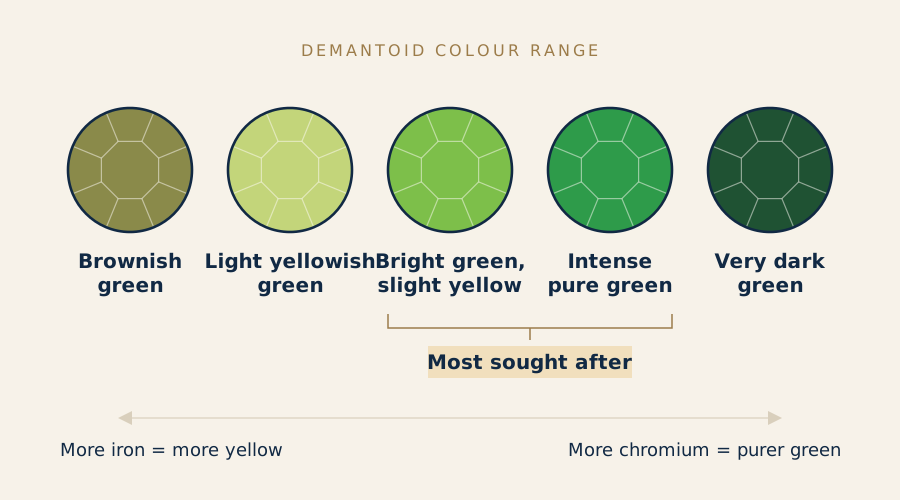
- Yellowish green: light to medium tone, often the most fiery because lighter stones show dispersion more easily. Common in Madagascan and some Namibian material.
- Bright green with a slight yellow note: the colour many collectors look for, with a good balance of colour and fire.
- Intense pure green: the rarest colour, typical of fine Russian stones. Fire can be partly masked by the depth of colour.
- Brownish green: lower value. Some of these stones are heated to reduce the brown.
There is a real trade-off here. A very dark, saturated demantoid looks rich but can swallow its own fire, while a lighter stone flashes colour but looks less green. Most people end up preferring a medium to medium-dark green where both show. Under warm indoor light demantoid usually stays green, though yellowish stones look warmer still.
The other important green garnet is tsavorite, a green grossular garnet coloured by vanadium and chromium. Tsavorite tends to be a cooler, bluer green with less fire; demantoid is warmer and livelier. Side by side, a gemmologist can often tell them apart by the fire alone.
How do gemmologists identify demantoid garnet?
Demantoid is singly refractive, meaning light travels through it at one speed in every direction, like glass or diamond. Some stones show weak anomalous double refraction (a patchy light-and-dark effect in a polariscope caused by strain in the crystal), but there is no true doubling of facet edges. The quickest clue on the gem bench is the refractometer: standard instruments read only to about 1.79–1.81, so a demantoid gives no reading at all. Gemmologists record this as 'over the limit'.
| Property | Demantoid garnet | Why it matters |
|---|---|---|
| Species | Andradite garnet | Separates it from tsavorite (grossular) |
| Crystal system | Cubic | Singly refractive, no doubling |
| Refractive index | about 1.88–1.89 | Above a standard refractometer's limit |
| Dispersion | about 0.057 | Strong fire, more than diamond |
| Specific gravity | about 3.81–3.87 | Heavier than most green gems of the same size |
| Mohs hardness | 6.5–7 | No harder than quartz dust (7), so it abrades over time |
| Toughness | Fair to good | No cleavage, but facet edges can chip |
| Key inclusion | Horsetail fibres | Strong sign of a natural stone from serpentinite |
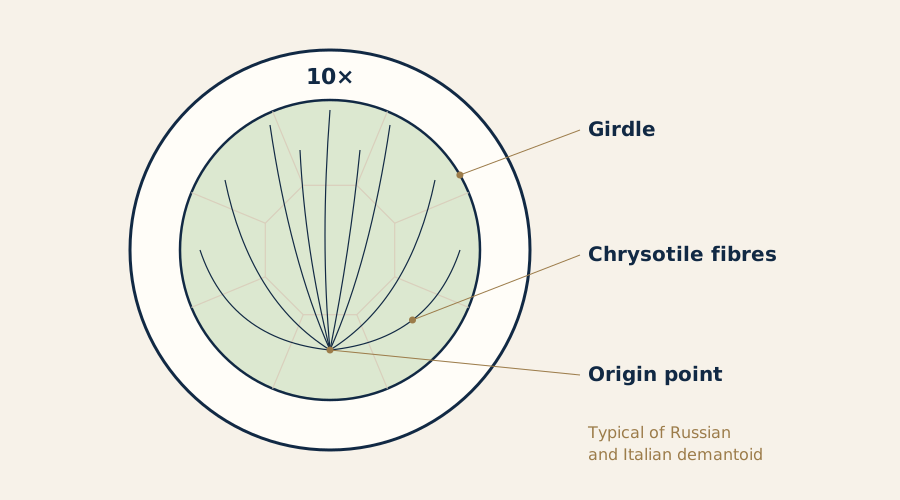
The inclusion most people have heard of is the horsetail: fine, curved fibres of chrysotile (a serpentine mineral) that spray out from a single point like a horse's tail. They form in demantoids grown in serpentinite rock, which is why they are typical of Russian and Italian stones and occasionally seen in Iranian and Pakistani material. Unlike most inclusions, a well-formed horsetail is welcomed by collectors and can add value, because it points strongly to a natural stone from a classic source.
Other gemmological notes help confirm an identification. Under a Chelsea colour filter, chromium-rich demantoids can appear reddish or pinkish. A hand spectroscope often shows a strong absorption band in the violet at about 440 nm from iron, with chromium lines in the red in greener stones. Demantoid is most often confused with tsavorite, peridot, green zircon, chrome diopside, green glass and green YAG (yttrium aluminium garnet, a lab-created material with a refractive index around 1.83). The combination of an over-the-limit reading, no doubling and strong fire narrows it down quickly.
Where does demantoid garnet come from?
Origin affects both the look and the price of a demantoid. Russian stones carry the strongest premium, partly for history and partly for their colour and horsetails. Newer sources have made demantoid easier to find, though never common.
| Source | Found | Typical character |
|---|---|---|
| Russia (Ural Mountains) | mid-1800s | Intense green, horsetails common, mostly under 1 ct |
| Namibia (Green Dragon area) | 1990s | Bright green, usually few or no horsetails, often clean |
| Madagascar (north-west) | about 2009 | Yellowish to brownish green, often heated, some horsetails |
| Italy (Val Malenco) | 1800s | Yellowish green, horsetails common, mostly small |
| Iran, Pakistan, Afghanistan | more recent, small output | Variable colour, horsetails in some material |
Namibian demantoid, sometimes sold as Namibian demantoid or by mine name, grows in skarn (rock altered where limestone meets hot fluids), not serpentinite, so it usually lacks horsetails. Namibia is also the classic source of bright orange 'mandarin' garnet, covered in our guide to orange spessartine garnet.
What about Australian demantoid? Australia produces several garnets, but we are not aware of any commercial demantoid deposit here, so any stone sold as Australian demantoid deserves careful questions. Australian-sourced garnets you are more likely to see belong to other species. For an origin you can rely on, ask for a report from an independent laboratory; some labs will give an origin opinion for demantoid, and a stated origin should match the stone's inclusions and chemistry.
Not sure which one is right?
Send us the stones you are looking at and our gemologist will tell you which to choose and why.
Is demantoid garnet treated, and are there lab-created stones?
Many demantoids are heat treated. Gentle heating can reduce brown or yellow tones and leave a cleaner green, and it is particularly common in Madagascan material. The result is stable and permanent, but it usually cannot be detected, so treat it as possible in any demantoid unless a report says otherwise. Less often, surface-reaching fractures are filled with oil or resin to improve clarity, which is less stable and should always be disclosed. Our A to Z of gemstone treatments explains each method and how durable it is.
Lab-created demantoid has been grown experimentally, but it is rarely seen in the jewellery market. You are much more likely to meet imitations: green glass, green YAG and occasionally assembled stones such as doublets (a thin slice of gem glued to glass). Glass usually shows gas bubbles and swirl marks under magnification, and YAG has much weaker fire. Any synthetic or lab-created material should be sold as such, never simply as 'demantoid'.
- Ask: is the stone heated, and is it fracture-filled?
- Ask: is there an independent report stating natural andradite garnet?
- Look: for horsetails, which support a natural origin, and for bubbles, which point to glass.
How much does demantoid garnet cost?
Demantoid garnet price is driven mostly by colour and size, then by origin, clarity and cut. Because rough crystals are small, the price per carat climbs steeply as stones get larger. A 1 carat round demantoid measures only about 6 mm across, because the stone is dense, so a large-looking demantoid is a rare thing.
- Colour: intense, even green with a slight yellow note commands the most; brownish stones the least.
- Size: prices per carat can roughly double or more between half-carat and 2 carat stones.
- Origin: documented Russian stones carry a premium; Namibian and Madagascan stones are generally more affordable for the same look.
- Clarity: eye-clean (no inclusions visible without magnification) is expected, but a fine horsetail can add value rather than reduce it.
- Cut: a well-proportioned stone shows fire across the face; deep, lumpy cuts save weight but look smaller and darker.
| Natural demantoid, per carat | Approximate price range (AUD) |
|---|---|
| Under 0.50 ct, commercial green | about $300–$1,200 per carat |
| 0.50–1 ct, good green | about $1,000–$4,000 per carat |
| 1–2 ct, fine green | about $3,000–$10,000 per carat |
| Over 2 ct, fine Russian with horsetail | about $8,000 per carat and up |
These are broad ranges only and move with supply and exact quality. Treat any single quoted figure with care, and compare stones on colour and size rather than origin alone. Demantoid is a gem to enjoy wearing; like any natural stone, its future value is not something to rely on.
Browse natural gemstones
Is demantoid garnet good for an engagement ring?
Demantoid garnet hardness is 6.5–7 on the Mohs scale. Everyday dust contains quartz, which is 7, so over years of daily wear a demantoid's facet edges will slowly scuff and round off. Its toughness (resistance to chipping and breaking) is fair to good, and it has no cleavage, so it is less likely to split than some softer-looking gems. The table below compares it with other stones often considered for rings.
| Gem | Mohs hardness | Toughness | Daily-wear ring? |
|---|---|---|---|
| Diamond | 10 | Good (has cleavage) | Yes |
| Sapphire | 9 | Excellent | Yes |
| Moissanite (lab-created) | 9.25 | Excellent | Yes |
| Chrysoberyl | 8.5 | Excellent | Yes |
| Tsavorite garnet | 7–7.5 | Good | Yes, with a protective setting |
| Rhodolite garnet | 7–7.5 | Fair to good | Yes, with a protective setting |
| Iolite | 7–7.5 | Fair (has cleavage) | Occasional wear |
| Demantoid garnet | 6.5–7 | Fair to good | Occasional wear, or daily with care |
| Peridot | 6.5–7 | Fair | Occasional wear |
| Kunzite | 6.5–7 | Poor (perfect cleavage) | Pendants and earrings |
So a demantoid garnet engagement ring is possible, but it needs the right setting and realistic expectations. Compare it with tougher everyday stones such as chrysoberyl, at 8.5 on the Mohs scale, or with gentler choices like violet-blue iolite and pink kunzite, which splits easily along its cleavage. For more green, orange and pink options in a ring, see garnet engagement rings beyond the classic dark red.
- Bezel or half-bezel: a rim of metal that guards the girdle (outer edge), the setting most likely to protect a softer stone.
- Low profile: keep the stone close to the finger so it is knocked less often.
- Halo: small diamonds around the demantoid take the knocks first.
- Yellow gold: warms and lifts the yellow-green, a pairing Russian jewellers used often. White metals make the green look cooler.
Garnet is the January birthstone, and demantoid is a less expected way to wear it; our January birthstone guide to garnet colours covers the full range.
Related guideTsavorite GarnetDemantoid vs tsavorite, emerald and peridot: which green gem suits you?
| Demantoid | Tsavorite | Emerald | Peridot | |
|---|---|---|---|---|
| Species | Andradite garnet | Grossular garnet | Beryl | Olivine |
| Colour cause | Chromium and iron | Vanadium and chromium | Chromium and vanadium | Iron |
| Refractive index | about 1.88–1.89 | about 1.74 | about 1.57–1.58 | about 1.65–1.69 |
| Dispersion | 0.057 (strong fire) | 0.028 | 0.014 | 0.020 |
| Mohs hardness | 6.5–7 | 7–7.5 | 7.5–8 | 6.5–7 |
| Toughness | Fair to good | Good | Poor to fair | Fair |
| Typical treatment | Heat, sometimes | Usually none | Oil or resin, common | Usually none |
| Large sizes | Rare over 2 ct | Rare over 3 ct | Available | Common |
In short: choose demantoid for fire and rarity, tsavorite for a tougher garnet with a cooler green, emerald for the classic soft green glow, and peridot for a larger, more affordable yellow-green. Demantoid vs tsavorite is the closest call, as both are garnets; tsavorite is the more practical for daily rings, demantoid the more lively and collectable.
Within the garnet family, the orange to cinnamon hessonite, the 'cinnamon stone' variety of grossular and the raspberry-pink rhodolite garnet round out the colour range. If you are drawn to unusual collector stones, sunstone with its glittering copper or hematite flecks and deep blue lapis lazuli, a rock rather than a single mineral offer very different looks, though both are softer and better suited to pendants and earrings.
How do you choose and care for a demantoid garnet? Step by step
- Decide on the job. Pendant, earrings or occasional-wear ring all suit demantoid; a daily-wear ring needs a bezel or halo.
- Judge the colour first. Look for a medium to medium-dark green that still shows fire; avoid brownish or very dark stones.
- Check for fire in different light. Watch a video or view the stone under a single spotlight; flashes of colour should appear across the face.
- Look for horsetails and bubbles. Use a 10× loupe or a magnified video: horsetails support a natural stone, round bubbles suggest glass.
- Ask about treatment and origin. Confirm whether it is heated or filled, and whether an independent report states natural andradite garnet and any origin.
- Compare by size and price per carat. Check millimetre measurements, as deep cuts carry hidden weight.
Caring for demantoid is simple. Clean it in warm water with a drop of mild dishwashing liquid and a soft toothbrush, then rinse and dry with a lint-free cloth. Avoid ultrasonic and steam cleaners, especially if the stone has fractures or fillings, and keep it away from sudden heat. Take a demantoid ring off for gardening, gym work and cleaning, and store it in its own pouch so harder gems like diamond and sapphire cannot scratch it. If claws ever need re-tipping, ask the jeweller whether the stone should be removed first, as demantoid does not like a torch flame.
Free consultation
Talk to a gemologist
Compare stones in person or online with Raj Sood, Graduate Gemologist (GIA), AJP (GIA).
Book a consultationShop this shape
FAQ
Common questions
Is demantoid garnet rare?
Yes. It is the rarest of the commonly sold garnets, with most cut stones under 1 carat. Clean, intensely green stones over 2 carats are scarce, especially from Russia.
Does demantoid have more fire than diamond?
Its dispersion is about 0.057 compared with diamond's 0.044, so in principle it shows more fire. In practice, the green body colour can mask some of it, so lighter stones often look the most fiery.
What are horsetail inclusions in demantoid?
They are fine, curved fibres of chrysotile that radiate from one point like a horse's tail. They are typical of Russian and Italian demantoid and are often valued because they support a natural, classic origin.
Can you wear a demantoid garnet ring every day?
You can, but at 6.5–7 on the Mohs scale it will slowly scuff with daily wear. A bezel or halo setting, a low profile and an occasional re-polish make it practical.
What is the difference between demantoid and tsavorite?
Both are green garnets, but demantoid is andradite and tsavorite is grossular. Demantoid has much more fire and is slightly softer, while tsavorite is tougher and usually a cooler green.
Is demantoid garnet heat treated?
Many are, particularly stones from Madagascar. The heating is stable but usually undetectable, so ask the seller and check the report.

Ask a gemologist
Not sure which diamond to choose?
Raj Sood is a Graduate Gemologist (GIA) and master jeweller. Bring the stones you are considering, or send the reports, and he will tell you honestly which one is better and why.
Keep learning
Related guides
 GemstonesTsavorite Garnet
 GemstonesNatural Garnet Gemstones and Custom Garnet Jewellery
 GemstonesGemstone Treatments A to Z
 GemstonesGarnet Engagement Rings: More Than Dark RedGemstonesGemstones | Coloured Gemstones, Birthstones and Custom Jewellery
 GemstonesSpessartine GarnetGemstonesRhodolite GarnetGemstonesHessonite Garnet
Explore more
More guides on this topic
Education