
- Education
- Wedding Bands & Eternity
- Should You Design the Engagement Ring and Wedding Band Together?
Wedding Bands & Eternity
Should You Design the Engagement Ring and Wedding Band Together?
You will probably wear your engagement ring and wedding band together on the same finger for decades. Planning them as a pair decides whether they sit flush, wear evenly and still look right when you wear one on its own.
 Reviewed by Raj Sood, Graduate Gemologist (GIA), AJP (GIA)Master jeweller and Graduate Gemologist (GIA) · reviewed 4 November 2026
Quick answer
Usually, yes. Designing the engagement ring and wedding band together lets the jeweller set the centre stone high enough, or shape the band, so the two rings sit flush with no gap, match in metal and width, and wear evenly. You can still add a band later, but it may need a fitted curve or leave a gap.
Should you design the engagement ring and wedding band together?
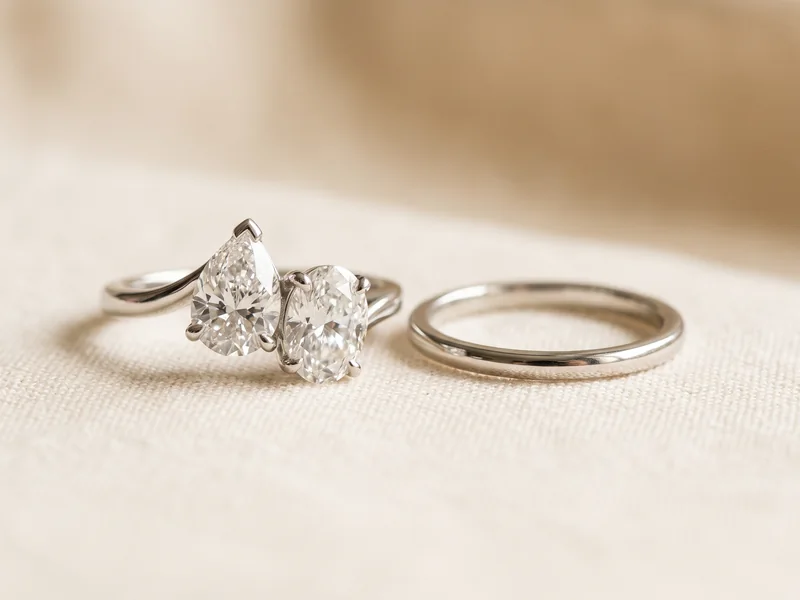
Most people wear two rings on the same finger for the rest of their lives: the engagement ring and the wedding band. Designing them together means planning both as one bridal set from the start, so the height of the setting, the width of each band, the metal and the style are all chosen to work as a pair. If the terms themselves are muddled, our explainer on the difference between a wedding ring and a wedding band sorts that out first.
The honest answer is that designing the engagement ring and wedding band together gives you the most choice and the cleanest fit, but it is not essential. Plenty of couples propose with a ring and choose the band months later, and that works well too. What changes is the order of decisions. Once the engagement ring is made, the band has to fit around it. When both are designed at once, each can be adjusted to suit the other.
When you plan the two rings together, you settle these points at the same time:
- Setting height: how high the centre stone sits above the finger, which decides whether a straight band can slide underneath.
- Shank width: the shank is the band part of the engagement ring; matching its width to the wedding band keeps the stack balanced.
- Profile: the cross-section shape of each band, such as flat, court (rounded inside and out) or knife-edge.
- Metal and alloy: the same gold or platinum alloy on both, so they match in colour and wear at the same rate.
- Stone setting style: claw, bezel, grain or channel, chosen so the diamonds on each ring look like they belong together.
- Finger size: two rings worn together take up more room, which can change the size you need.
For the wider picture on metals, widths and budgets, start with our complete wedding ring buying guide. Any technical word on this page is also explained in our plain-English jewellery glossary.
Why does it matter if the two rings sit flush?
A flush fit means the wedding band sits right against the engagement ring along its whole length, with no visible space between them. Whether that is possible depends almost entirely on what is happening underneath the centre stone.
The part of the engagement ring below the stone is called the gallery (or under-bezel). In a raised solitaire, the gallery sits above the shank, often supported by cathedral shoulders (arches of metal that rise from the band up to the setting). A straight wedding band can slide under that raised setting and sit flat against the shank. In a low-set ring, or one with a halo that is wider than the shank, the stone or halo hangs out over the side of the ring. A straight band then hits the overhang and stops short, leaving a gap of roughly 1–3 mm under the centre.
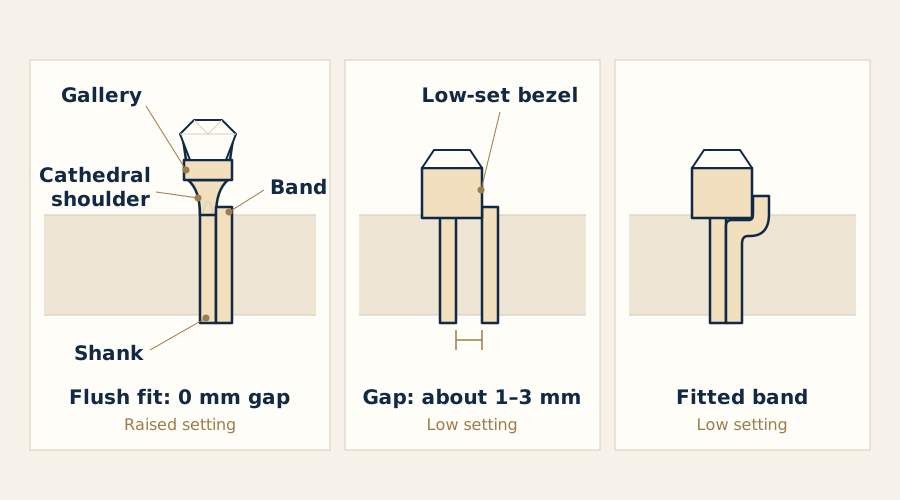
Why it matters in daily wear:
- Looks: many people simply prefer the two rings reading as one piece. Others like a small gap; it is a style choice, not a fault.
- Spinning: a band that only touches the engagement ring at one point tends to rotate, so the diamonds on a diamond band drift around the finger.
- Rubbing: rings that sit tightly together rub every time you move your hand. Over years that wears a flat spot on each shank, especially if the metals differ in hardness.
- Catching: a low claw or a pointed stone can grind against the edge of the band and slowly loosen.
Our guide to how much gap to leave between the two rings covers when a small space is the better choice. The shape of each band's cross-section matters too: a court profile rolls against its neighbour more gently than two flat edges, which you can compare in our page on band profiles such as court, flat and knife-edge.
Flush fit, gap or fitted band: which option suits you?
There are six common ways to pair an engagement ring with a wedding band. Designing both together lets you choose any of them; adding a band later usually narrows the options.
| Option | How it looks | Suits | Watch for |
|---|---|---|---|
| Straight band, flush fit | Two rings touching along their whole length | Raised solitaires, cathedral settings | The engagement ring must be designed high enough; rings rub against each other |
| Straight band with a gap | A small space under the centre stone | Low-set bezels, halos, a deliberately separate look | The band can spin; soap and dirt collect in the gap |
| Fitted (contoured) band | Band curves to follow the stone's outline | Pear, marquise, heart, halos, low settings | Usually custom; looks right mainly with that one ring |
| Notched band | Straight band with a cut-out for the setting | Bezels and some halos | The notch must line up exactly; resizing can shift it |
| Ring enhancer or wrap | Bands either side of the engagement ring | Adding presence to a simple solitaire | Wider and heavier on the finger |
| Soldered set | Both rings joined permanently | Stopping spinning and rubbing | Cannot be worn separately; resized as one piece |
A fitted band (also called a contoured or shadow band) is shaped to follow the edge of the engagement ring, so it can sit close even where a straight band never could. It is the usual answer for pointed shapes and low settings. Our guide to how fitted and contoured bands are made shows the curves and the trade-offs, including how a fitted band looks when worn on its own.
Related guidePlain vs Diamond Wedding BandsWhich engagement ring shapes need a matching band most?
Most pairing guides stop at general advice. In practice, the shape of the centre stone and the way it is set decide what kind of band will sit well beside it. This is how the common shapes behave:
| Engagement ring | Will a straight band sit flush? | Common solution |
|---|---|---|
| Round solitaire, raised claws or cathedral | Usually, if designed for it | Straight plain or diamond band |
| Round or oval in a low bezel | Rarely; the bezel rim overhangs | Small gap, notched band or fitted band |
| Oval, elongated cushion | Depends how far the stone overhangs the shank | Lift the gallery, or use a gentle curve |
| Pear, heart | The point and lobes can catch | Contoured band or a V-shaped curve |
| Marquise | Two points overhang on long stones | Curved or V band, or a slight gap |
| Princess, Asscher, emerald cut | Corners overhang on larger stones | Straight band if the claws sit above it; otherwise a fitted band |
| Halo (any shape) | Often not; the halo is wider than the shank | Raised halo, or a fitted band |
| Three-stone or toi et moi | Rarely; side stones spread wide | Fitted band or a deliberate gap |
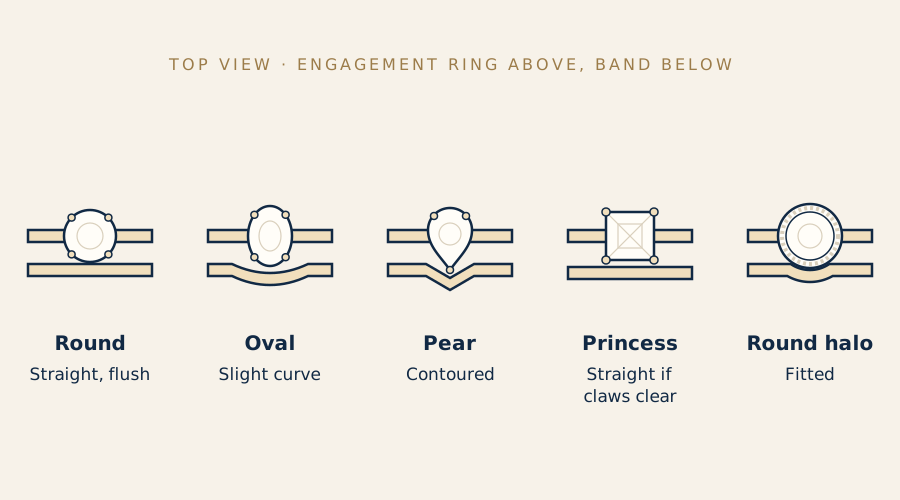
Square shapes deserve a special mention: a princess cut's corners sit right at the edge of the setting, so even a small overhang stops a straight band. Our page on bands that suit a princess cut's square corners goes into the claw positions that make a flush fit possible.
Size matters as much as shape. A 0.50 carat round is about 5.1 mm across, wider than a 2 mm shank, but once lifted it usually clears a straight band; a 1.50 carat oval is around 9 × 7 mm and will hang well over it. The bigger the stone and the lower the setting, the more likely you are to need a curved or notched band. If your engagement ring already exists, our guide to matching a band to a ring you already own walks through the checks shape by shape.
Not sure which one is right?
Send us the stones you are looking at and our gemologist will tell you which to choose and why.
Should the engagement ring and wedding band be the same metal?
In most cases, yes. Rings worn side by side rub constantly, and two different metals wear at different rates. The softer one loses metal faster, and over the years you can see a flattened edge or a thinned shank on the weaker ring. Matching alloys also keeps the colour identical, which matters more than people expect.
- 18ct gold is 75% pure gold. It holds stones well and is a common choice for both rings. Pairing an 18ct engagement ring with a 9ct band (37.5% gold) can show a visible colour difference, especially in yellow and rose.
- White gold is usually plated with rhodium, a bright white metal. The plating wears through in time, typically every one to two years for a ring worn daily, and both rings should be replated together so they stay the same shade.
- Rose gold gets its colour from copper, and different makers use different mixes. A rose gold band from one jeweller can look pinker or more coppery than an engagement ring from another.
- Platinum (usually 95% pure in Australia) is dense and naturally white. It scratches into a soft, matte patina, with metal mostly pushed aside rather than lost, so it loses very little weight over time. Paired with a white gold band, the white gold will usually wear faster against it.
- Mixing on purpose: a yellow gold band beside a platinum engagement ring can look striking. If you choose it, accept that the two will age differently and have both checked regularly.
The other big choice is whether the band is plain or set with diamonds. A plain band lets the centre stone stand alone and is easier to resize; a diamond band adds sparkle but needs more care. Our comparison of a plain or diamond-set band covers both. If you choose diamonds, stones of roughly 1.5–2.0 mm (about 0.015–0.03 carat each) usually suit a 2 mm band, and our page on diamond sizes that balance the centre stone explains how to scale them.
When should you buy the wedding band: at the same time or later?
Many proposals are a surprise, so the engagement ring is often made without the wearer's input and the band comes later. That is fine. The trick is to design the engagement ring so it is band-friendly: a gallery lifted enough to clear a 2–3 mm straight band, and a shank width that a future band can match. Then you keep every option open without giving the surprise away.
| Design both together | Add the band later | |
|---|---|---|
| Fit | Can be planned for a flush fit with any style | Band must work around the finished ring |
| Style | Widths, profiles and diamonds matched from the start | You may find a style you prefer after living with the ring |
| Metal match | Same alloy and batch, same colour | Possible, but colour can differ between makers |
| Budget | Larger spend at once | Spreads the cost over months |
| Surprise | Harder to keep the proposal secret | The proposal stays a surprise |
| Wearer's input | Both rings chosen together | The wearer chooses the band themselves |
A common middle path is to propose with the engagement ring, then design the band together around six months before the wedding. That leaves time for a custom curve if needed, plus a fitting. Partners often choose their own band at the same appointment; our men's wedding band guide covers widths, profiles and comfort fit for a wider band.
If you are working from a ring you already own, such as a family piece, the band has to be designed around it. Bring the ring in early: older rings are often set low, and some need small changes, such as lifting the head or re-tipping worn claws, before a band can sit beside them safely.
How much does an engagement ring and wedding band together cost in Australia?
A matching band is priced like any other band; designing it at the same time as the engagement ring does not change the cost of the metal or stones. What adds cost is custom work, such as a fitted curve or a notch. As a broad guide for a women's band of about 2–2.5 mm:
- Plain 18ct gold band: about AUD $700–$1,600, depending on width, weight and profile.
- Plain platinum band: about AUD $900–$2,000; platinum is denser, so the same band uses more metal by weight.
- Custom fitted or contoured band: often about AUD $200–$800 more than a straight band of the same weight, for the design and hand-fitting.
- Half-eternity diamond band, natural diamonds: about AUD $1,800–$4,500 in 18ct gold, depending on diamond size and grade.
- Half-eternity diamond band, lab-grown diamonds: lower, often about AUD $1,200–$3,000, because laboratory-grown diamonds cost much less than natural diamonds of the same size and grade.
Lab-grown diamonds are real diamond, grown in a laboratory rather than mined, and they look the same as natural diamonds once set. If your engagement ring has a natural centre stone, a band with lab-grown diamonds is a perfectly reasonable pairing; just make sure both are clearly described on your paperwork. For what moves band prices up or down, our guide to what drives wedding band prices has the detail.
Create your engagement ring or wedding band
How do lifestyle and resizing affect a matching set?
Two rings on one finger behave differently from one. The combined width matters: a 2 mm engagement shank plus a 2.5 mm band makes a 4.5 mm stack, which can feel snug. Once a stack goes past about 5–6 mm, many people need a quarter to half a size larger than they would wear in a single ring. Have your finger sized with a sizer the same width as the finished stack, ideally late in the day when fingers are slightly larger.
Think about how you will actually wear them. If you work with your hands, train at the gym or wash up constantly, a low, smooth set with a plain band snags less than a high claw setting beside a claw-set diamond band. Our guide on how your work and hobbies should shape the design goes through the options. Some people only wear the band day to day and keep the engagement ring for going out, which is one more reason the band should look complete on its own.
Resizing is the other long-term question. A plain band and a solitaire are straightforward to resize. A full eternity band, with diamonds all the way round, generally cannot be resized, and a fitted band can only change a little before its curve no longer lines up. Soldering the two rings together stops spinning and rubbing, but they then have to be resized as one piece. Our page on planning an engagement ring for future resizing covers how to leave room for change.
How do you design an engagement ring and wedding band together? Step by step
- Decide how you want them to sit. Flush, with a small gap, or curved around the stone. Bring photos of sets you like, viewed from the side as well as the top.
- Choose the centre stone and setting style. Its shape, size and setting height decide which band styles are possible.
- Set the setting height. If you want a straight flush band, the gallery must clear the band's width and height; ask for it to be drawn that way.
- Match metal, width and profile. Same alloy on both; shank and band widths that look balanced, usually within about 0.5 mm of each other.
- Choose plain or diamond. If diamond, match the stone size and setting style (claw, grain or channel) to the engagement ring.
- Check the CAD from every angle. Look at the side view with both rings together before anything is cast.
- Size for the stack. Measure with a sizer as wide as both rings combined.
- Try them on together at collection. Check the fit, that the band does not spin, and that each ring still looks complete on its own. If a straight band will not sit right, consider a custom curved band instead.
Free consultation
Talk to a gemologist
Compare stones in person or online with Raj Sood, Graduate Gemologist (GIA), AJP (GIA).
Book a consultationShop this shape
FAQ
Common questions
Do engagement rings and wedding bands have to match?
No. Many people choose a contrasting band or mix metals on purpose. Matching the metal and width simply makes the two wear evenly and read as one set.
Why won't my wedding band sit flush with my engagement ring?
Usually because the centre stone, halo or setting hangs out over the side of the engagement ring's shank. A straight band stops against that overhang; a fitted or notched band, or lifting the setting, solves it.
Is it bad to have a gap between your engagement ring and wedding band?
No, it is a style choice. A small gap can suit low bezels and halos, though the band may spin more and dirt can collect underneath.
Can you buy a wedding band from a different jeweller to the engagement ring?
Yes, but the metal colour can differ slightly between makers, especially in rose and yellow gold. Bring the engagement ring with you so the band can be checked against it.
Should you solder your engagement ring and wedding band together?
It stops the rings rubbing and spinning, but you can no longer wear them separately and they must be resized as one piece. Many people wait a year or so to see how they like wearing them first.
When should you order a wedding band?
Allow at least two to three months before the wedding for a custom or fitted band, so there is time for design, making and a fitting.

Ask a gemologist
Not sure which diamond to choose?
Raj Sood is a Graduate Gemologist (GIA) and master jeweller. Bring the stones you are considering, or send the reports, and he will tell you honestly which one is better and why.
Keep learning
Related guides
 Wedding Bands & EternityHow to Match a Wedding Band to an Engagement Ring
 Wedding Bands & EternityFitted Wedding Bands Explained | Custom Curved BandsWedding Bands & EternityHow Much Gap Should There Be Between an Engagement Ring and Wedding Band?
 Wedding Bands & EternityWedding Band Profiles ExplainedWedding Bands & EternityWedding Ring Buying Guide
 Wedding Bands & EternityWedding Ring vs Wedding Band
 Wedding Bands & EternityMen’s Wedding Band Guide
 Wedding Bands & EternityHow Big Should Diamonds Be in a Wedding Band?
Explore more
More guides on this topic
Education