
- Education
- Engagement Rings & Settings
- How to Balance Two Stones in a Toi et Moi Ring
Engagement Rings & Settings
How to Balance Two Stones in a Toi et Moi Ring
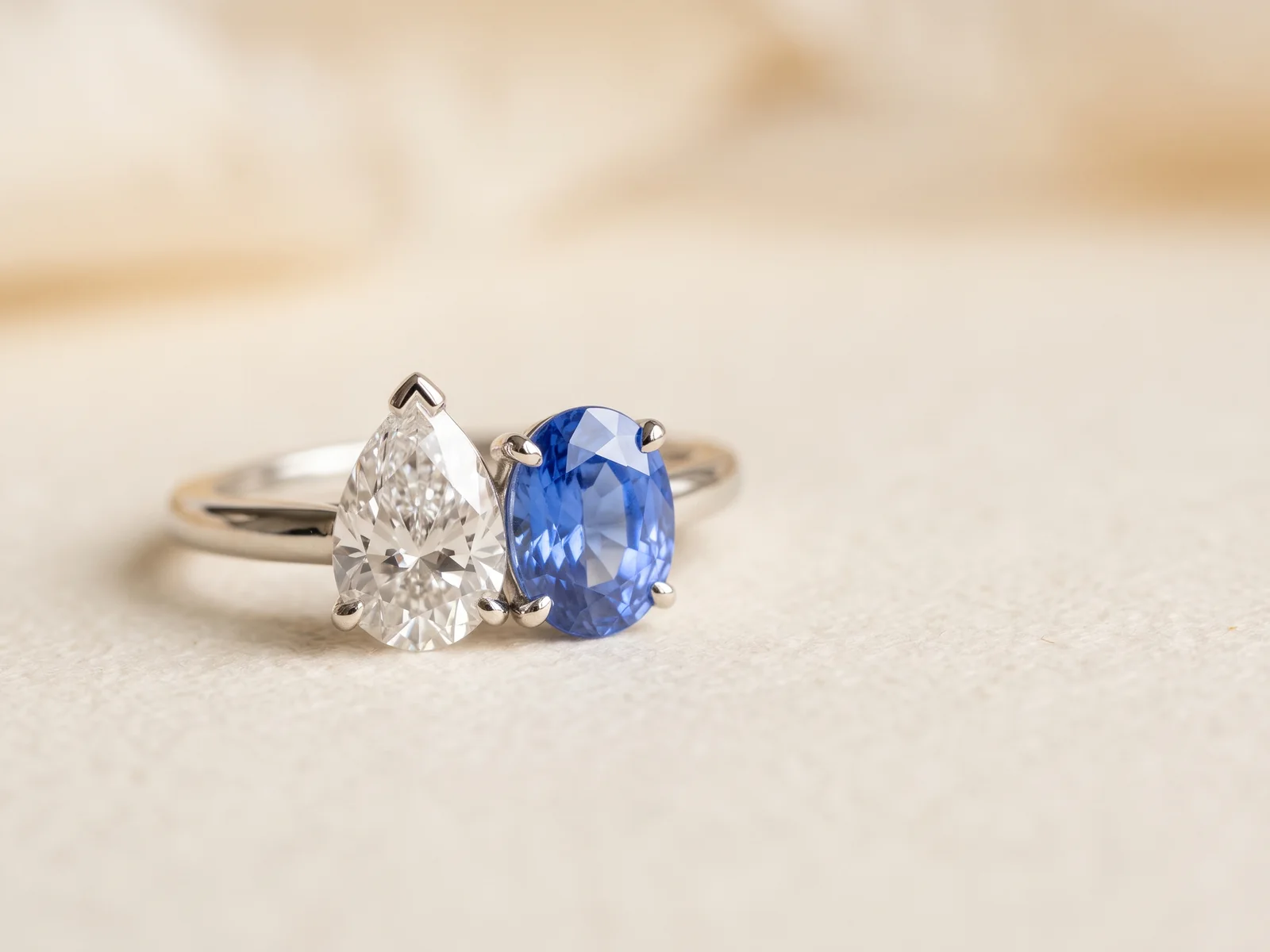
A toi et moi ring puts two stones side by side, so every difference between them shows. Getting the balance right comes down to millimetres, heights and angles, not just carat weight.
 Reviewed by Raj Sood, Graduate Gemologist (GIA), AJP (GIA)Master jeweller and Graduate Gemologist (GIA) · reviewed 4 November 2026
Quick answer
To balance a toi et moi ring, choose the two stones by face-up size in millimetres, not carats. Either match them closely in size or make one clearly larger, with the smaller about 60–80% of its length. Set both tables at the same height, angle the outlines so they complement, match colour and protect any points with V-claws.
What is a toi et moi ring, and what does balance mean?
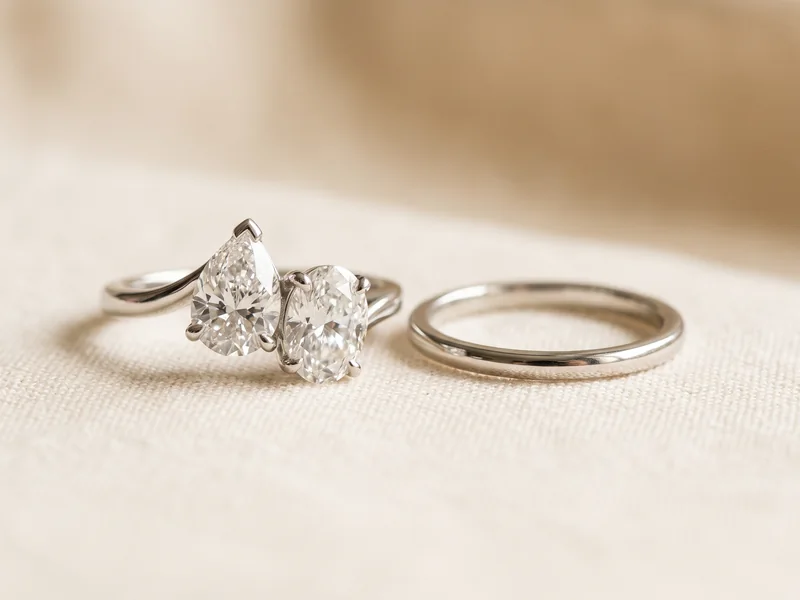
Toi et moi is French for "you and me". A toi et moi ring sets two centre stones next to each other on one band, usually touching or nearly touching, often on a slight diagonal. The idea is two people, two stones, one ring. For the history and the main styles, start with our main guide to toi et moi engagement rings; this page goes deeper into the single hardest part of the design, which is making two stones look like they belong together.
Balance in a toi et moi ring means three things working at once. First, visual weight: how big and how bright each stone looks from above, which is not the same as its carat weight. Second, alignment: both stones sitting at the same height and at angles that suit their outlines. Third, tone: colour, sparkle and metal that make the pair read as a deliberate choice rather than two stones that happened to be lying around.
With a solitaire, a small error in height or angle goes unnoticed because there is nothing next to the stone to compare it with. In a toi et moi, the second stone is a built-in ruler. A 0.3 mm difference in height, or a stone that is nearly but not quite the same size as its partner, is easy to see. If you are still deciding between this and other designs, our overview of the full range of engagement ring setting styles puts it in context, and any unfamiliar term below is explained in our jewellery glossary of setting terms.
Should both stones in a toi et moi ring be the same size?
They can be, but they do not have to be. What matters is that the size relationship looks intentional. There are three approaches that work, and one that usually does not.
| Approach | Example | How it reads | Watch out for |
|---|---|---|---|
| Matched pair | Two 1.00 ct ovals, same mm | Calm, symmetrical, formal | Needs closely matched colour and cut; any difference shows |
| Equal size, different shapes | 1.00 ct round + pear of similar face-up area | Two personalities, equal standing | Match face-up area, not carat; shapes face up differently |
| Clear lead stone | 1.50 ct oval + 0.50 ct pear | One stone leads, the other supports | Keep the smaller stone at roughly 60–80% of the larger's length |
| Near miss (avoid) | 1.00 ct + 0.90 ct of the same shape | Looks like a mismatch rather than a choice | A small difference in size reads as an error |
The near miss is the most common problem we see. Two stones that are almost the same size make the eye search for the difference, and once someone notices it, they keep noticing it. If the stones cannot be matched within a few tenths of a millimetre, it is usually better to make the difference obvious.
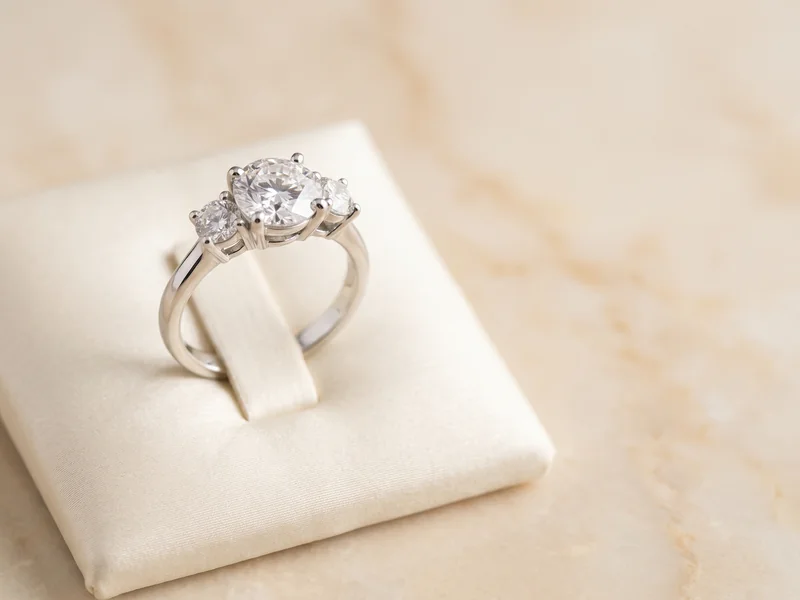
A clear lead stone also borrows a principle from how three-stone rings handle proportion, where the centre is usually noticeably larger than its side stones. The difference is that a toi et moi has no middle, so the pair sits off-centre on the finger. If you want one stone to dominate strongly, with smaller stones purely as accents, look at side-stone designs where one diamond clearly leads instead.
Why should you match toi et moi stone sizes in millimetres, not carats?
Carat is a unit of weight (1 carat = 0.2 grams), not size. Two stones of the same weight can look very different on the hand for two reasons: their shape spreads the weight differently, and their density (specific gravity, or how heavy the material is for its volume) differs from gem to gem.
| 1.00 ct diamond shape | Typical face-up size | Looks |
|---|---|---|
| Round | about 6.4–6.5 mm diameter | The reference point |
| Oval | about 7.7 × 5.7 mm | Longer, slightly larger face-up |
| Pear | about 8.5 × 5.5 mm | Long, with a point |
| Marquise | about 10.0 × 5.0 mm | Longest for its weight |
| Emerald cut | about 7.0 × 5.0 mm | Smaller face-up, flat facets |
| Cushion | about 5.9 × 5.9 mm | Compact, carries weight underneath |
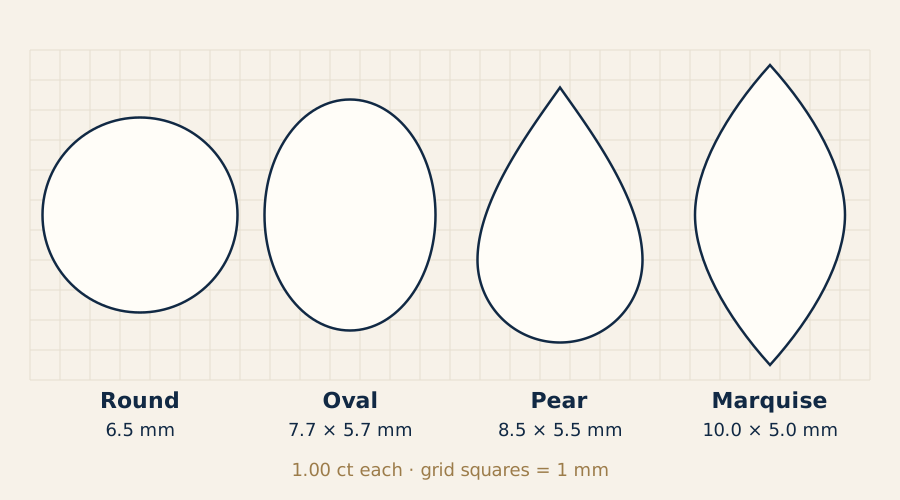
So a 1.00 ct round next to a 1.00 ct marquise will not look equal: the marquise is about 10 mm long against the round's 6.5 mm. To pair them so they look equal, you would compare their face-up area and length, and you might pair a 1.00 ct round with a marquise of about 0.70–0.80 ct. Our comparison of which shapes face up largest for their weight sets out these differences across every main cut.
Density makes things more complicated with coloured gems. Diamond has a specific gravity of about 3.52. Sapphire is about 4.00, so a 1.00 ct sapphire is roughly an eighth smaller in volume than a 1.00 ct diamond. Sapphires are also often cut deeper to hold colour, so a 1 ct sapphire can face up noticeably smaller than a 1 ct diamond. Emerald goes the other way: at about 2.72, a 1.00 ct emerald has close to a third more volume than a diamond of the same weight.
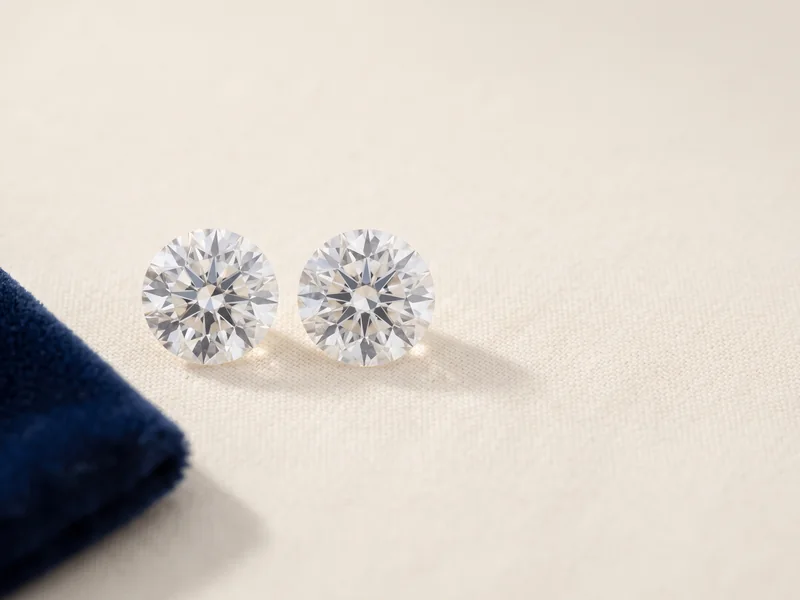
The practical rule: ask for the length, width and depth of each stone and compare those. The same discipline applies when choosing a matched pair of diamonds; our guide to comparing two diamonds side by side shows how to read the measurements on two reports at once.
Which two different shapes work well in a toi et moi ring?
Pairing two different shapes is the most popular modern choice. The pairs that work tend to have outlines that either echo or interlock with each other:
- Pear and oval: the most common toi et moi pairing. The pear's rounded end sits against the oval's side, and both are elongated, so they share a direction. Our guides to pear cut diamonds and their proportions and choosing an oval diamond cover each shape on its own.
- Pear and pear: set point-to-point on a diagonal or nested in opposite directions, like two teardrops. Needs well-matched outlines.
- Round and pear: soft and simple; the round anchors, the pear adds movement.
- Emerald cut and pear: a step cut (long, flat, parallel facets) against a brilliant cut (many triangular facets). Strong contrast in both outline and sparkle.
- Oval and emerald cut: similar length-to-width ratios make it easier to match size.
- Heart and pear: two shapes with points; both points need protection.
Mixing a brilliant cut with a step cut needs extra thought. Brilliants scatter light in quick flashes; step cuts show broader, glassier flashes and reveal body colour and inclusions more clearly. Neither is wrong, but the step cut will look calmer, so many people make it the slightly larger stone to keep the visual weight even. To see every outline you could pair, browse our overview of each diamond shape.
Points need care. A pear, marquise or heart has a thin tip, and in a toi et moi the tip often faces the other stone or the edge of the finger. Decide early where each point will sit, because that controls the angle and the claw layout.
Not sure which one is right?
Send us the stones you are looking at and our gemologist will tell you which to choose and why.
How should the two stones be angled, spaced and set at the right height?
Once the stones are chosen, the layout decides whether they look balanced. Three measurements matter most.
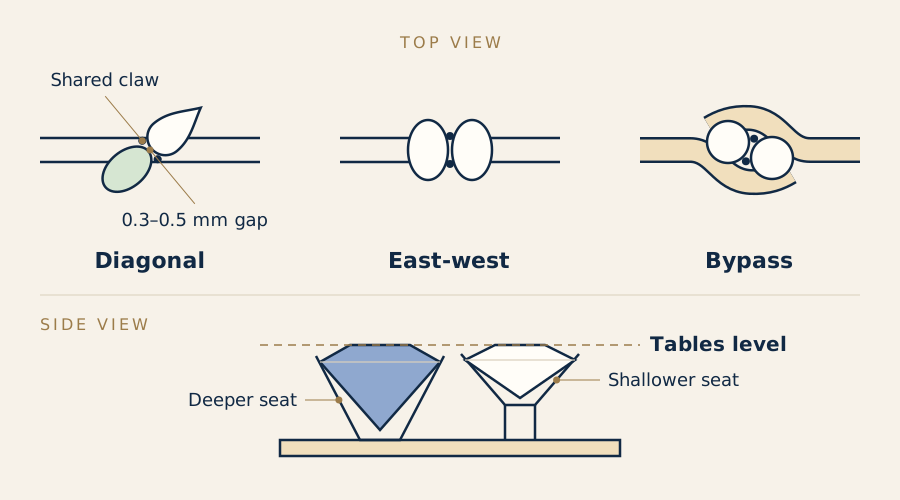
- Angle: the common layouts are diagonal (stones set along a line of about 30–45° across the finger), east-west (side by side across the finger) and bypass (the band splits and wraps around each stone from opposite directions). Diagonal layouts suit elongated shapes and look natural on most hands.
- Gap: stones usually sit about 0.3–0.5 mm apart, often sharing a claw between them. They should not rub. Diamond (10 on the Mohs hardness scale) will slowly wear a softer gem it touches, and two diamonds knocking together can chip at the girdle (the thin outer edge).
- Height: both tables (the large top facets) should sit at the same height above the finger, or the higher stone will look larger and catch more knocks. Different shapes and gems have different depths, so each stone needs its own seat cut to a different depth to bring the tables level.
Height is where most mass-produced toi et moi settings fall short. A setting made for two 6.5 mm rounds will not suit a deep sapphire next to a shallow diamond without adjusting the seats. In a custom piece, the CAD (computer-aided design) model is built around the actual measured depths of both stones, so the tables line up before any metal is cast.
Also think about the overall footprint. Two 1 ct stones on a diagonal typically span about 12–15 mm across the top of the finger. On a slim finger, two 0.50–0.75 ct stones may look more balanced than two 1 ct stones. The claw and bezel options are covered in our claw, bezel and halo setting basics.
How do you match colour and gem type in a toi et moi diamond and sapphire ring?
With two diamonds, match colour within one grade (for example G and H) and look at them together, face-up and from the side, under daylight. Fancy shapes hold colour at their points and ends, so a pear can look warmer than an oval of the same grade. Clarity matters less than colour as long as both stones are eye-clean, meaning no inclusions visible without magnification. Also check fluorescence (a glow under UV light): a strongly fluorescent stone next to a non-fluorescent one can look different in sunlight. Our guide to checking colour grades across a matched pair walks through this.
Pairing a diamond with a coloured gem is a deliberate contrast, so you are balancing brightness rather than matching colour. A diamond has a refractive index of about 2.42; sapphire is about 1.76–1.77 and emerald about 1.57–1.58. The diamond will always look brighter, so the coloured stone is often made slightly larger in face-up size to hold its own.
| Gem | Mohs hardness | Specific gravity | Everyday wear next to a diamond |
|---|---|---|---|
| Diamond (natural or lab-grown) | 10 | 3.52 | Very durable; can still chip on a thin edge |
| Sapphire or ruby | 9 | about 4.00 | Very durable; faces up smaller per carat |
| Moissanite | 9.25 | about 3.22 | Durable; stronger rainbow flashes than diamond |
| Spinel | 8 | about 3.60 | Good for daily wear |
| Emerald | 7.5–8 | about 2.72 | Brittle and usually included; needs a protective setting |
| Morganite | 7.5–8 | about 2.80 | Fine with care; scratches more easily than sapphire |
| Opal | 5.5–6.5 | about 2.15 | Soft; better suited to occasional wear |
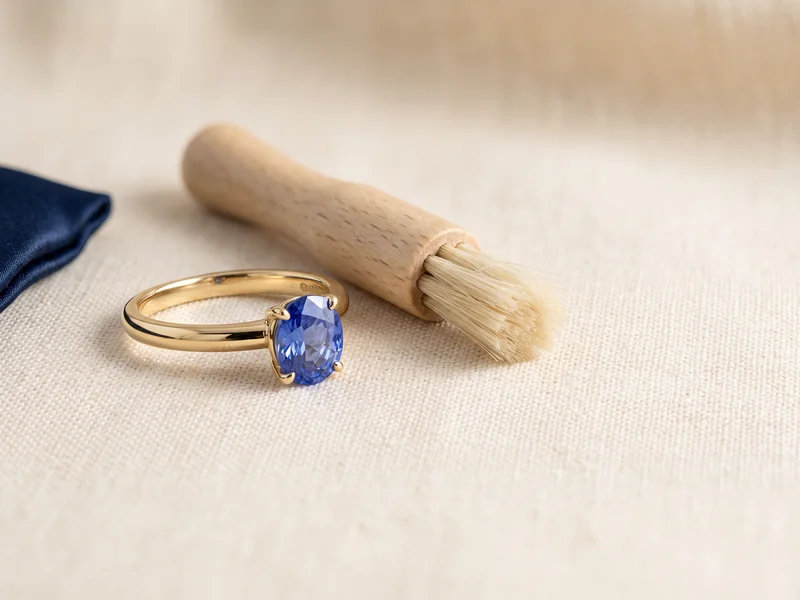
A pair can mix natural and lab-grown diamonds, or natural and lab-created gems, as long as each is clearly disclosed on its report and paperwork. The diamonds in a lab-grown toi et moi ring are real diamond, and lab-created sapphire is real corundum with the same hardness as natural. Each gem needs different cleaning; see our care advice for each gemstone.
Metal is part of the colour balance too. White metal makes a diamond look whiter; yellow gold warms a pink or peach stone. Some toi et moi rings use a different metal for each stone's claws, an approach covered in two-tone and mixed-metal settings.
What toi et moi setting holds up over years of wear?
From the repair bench, the same few issues come back on toi et moi rings. Knowing them in advance shapes a setting that lasts:
- Shared claws wear first. The claw between the two stones takes knocks from both sides. Make it slightly heavier than the outer claws and have it checked every 6–12 months.
- Points get caught. Pears, hearts and marquises need a V-claw (a V-shaped claw wrapping the tip) or a bezel.
- The ring spins. Two stones off-centre make the top heavy. A band of about 2.0–2.5 mm wide, with a slightly squared inner profile, helps it stay upright.
- Dirt builds up in the gap. Soap and lotion collect between the stones and dull both. A soft brush and warm soapy water every week or two keeps them bright.
- The wedding band does not sit flush. The diagonal footprint often clashes with a straight band; a contoured band is common.
Plan the wedding band alongside the engagement ring rather than after it; our guide to wedding bands that sit beside a toi et moi shows the shapes that fit. Softer gems also need more frequent checks for scratches and loosened stones, which is covered under how softer gems wear over time.
Related guideThree-Stone Engagement RingsDoes a toi et moi ring cost more than a solitaire?
Not necessarily. Diamond prices per carat rise sharply at bigger sizes, so two 1 ct diamonds usually cost less in total than one 2 ct diamond of the same colour and clarity. The setting can cost more than a simple solitaire, though, because it carries two seats at different depths, a shared claw and often custom CAD work.
Natural diamonds cost much more than lab-grown diamonds of the same grades. As a broad guide only, two lab-grown 0.75 ct diamonds might cost about AUD 1,500–4,000 together, while two natural 0.75 ct diamonds of similar grades might cost about AUD 6,000–15,000. Coloured gems vary widely by type, origin and treatment.
Matching adds cost too. Finding two stones that look equal in colour and cut can mean looking past lower-priced individual stones, and two diamonds with the same grades can still differ in price because of cut quality, fluorescence and proportions. Our guide to why two diamonds with identical 4Cs can differ in price explains what sits behind those gaps.
Create your toi et moi ring
How do you design a balanced toi et moi ring? Step by step
- Decide the relationship. Matched pair, equal size in different shapes, or a clear lead stone. Avoid near misses that are almost, but not quite, the same size.
- Choose the shapes. Pick outlines that echo or interlock, and decide where any points will face.
- Compare millimetres. Use length, width and depth from each report, not carat weight, especially when mixing diamond with a coloured gem.
- Match colour and brightness. View both stones together in daylight; for two diamonds, stay within one colour grade and check fluorescence.
- Set the layout. Choose diagonal, east-west or bypass; aim for a gap of about 0.3–0.5 mm and tables at the same height.
- Check the footprint. Make sure the pair suits the finger's width, and size the stones down if it overwhelms.
- Protect the weak points. V-claws for points, a heavier shared claw and a band thick enough to stop spinning.
- Plan the band. Look at choosing a band that sits flush and metal choices for each stone's colour before the design is finalised.
Free consultation
Talk to a gemologist
Compare stones in person or online with Raj Sood, Graduate Gemologist (GIA), AJP (GIA).
Book a consultationShop this shape
FAQ
Common questions
Do toi et moi stones have to be the same size?
No. They can match closely or one can be clearly larger, with the smaller about 60–80% of the larger's length. What looks wrong is a pair that is almost, but not quite, the same size.
Which shapes go well together in a toi et moi ring?
Pear and oval is the most common pairing, followed by pear and pear, round and pear, and emerald cut with pear. Shapes with similar lengths or interlocking outlines are easiest to balance.
Is a 1 carat sapphire the same size as a 1 carat diamond?
No. Sapphire is denser, about 4.00 against diamond's 3.52, so a 1 ct sapphire is roughly an eighth smaller in volume and often faces up smaller. Compare millimetre measurements instead.
Can you mix a natural diamond with a lab-grown diamond in a toi et moi ring?
Yes, as long as each stone is clearly disclosed as natural or lab-grown on its report. Both are real diamond and wear the same way.
Are toi et moi rings practical for everyday wear?
Yes, with a sound setting. The shared claw and any points need regular checks every 6–12 months, and softer gems such as opal or emerald need more care than diamond or sapphire.
What wedding band suits a toi et moi ring?
A contoured or curved band often sits closer to the diagonal footprint than a straight band. Plan it with the engagement ring so both sit flush.

Ask a gemologist
Not sure which diamond to choose?
Raj Sood is a Graduate Gemologist (GIA) and master jeweller. Bring the stones you are considering, or send the reports, and he will tell you honestly which one is better and why.
Keep learning
Related guides
 Engagement Rings & SettingsToi et Moi Engagement Rings
 Wedding Bands & EternityBest Wedding Band for Toi et Moi Rings
 Buying Knowledge & Custom ProcessHow to Compare Two Diamonds Side by Side
 Engagement Rings & SettingsSide-Stone Engagement RingsEngagement Rings & SettingsEngagement Ring Setting Styles GuideEngagement Rings & SettingsThree-Stone Engagement Rings
 GemstonesGemstone Care by Stone
 MetalsTwo-Tone and Mixed-Metal Rings
Explore more
More guides on this topic
Education