
- Education
- Wedding Bands & Eternity
- Toi et Moi Wedding Band Guide: Flush, Gap, Contour and Stacking
Wedding Bands & Eternity
Toi et Moi Wedding Band Guide: Flush, Gap, Contour and Stacking
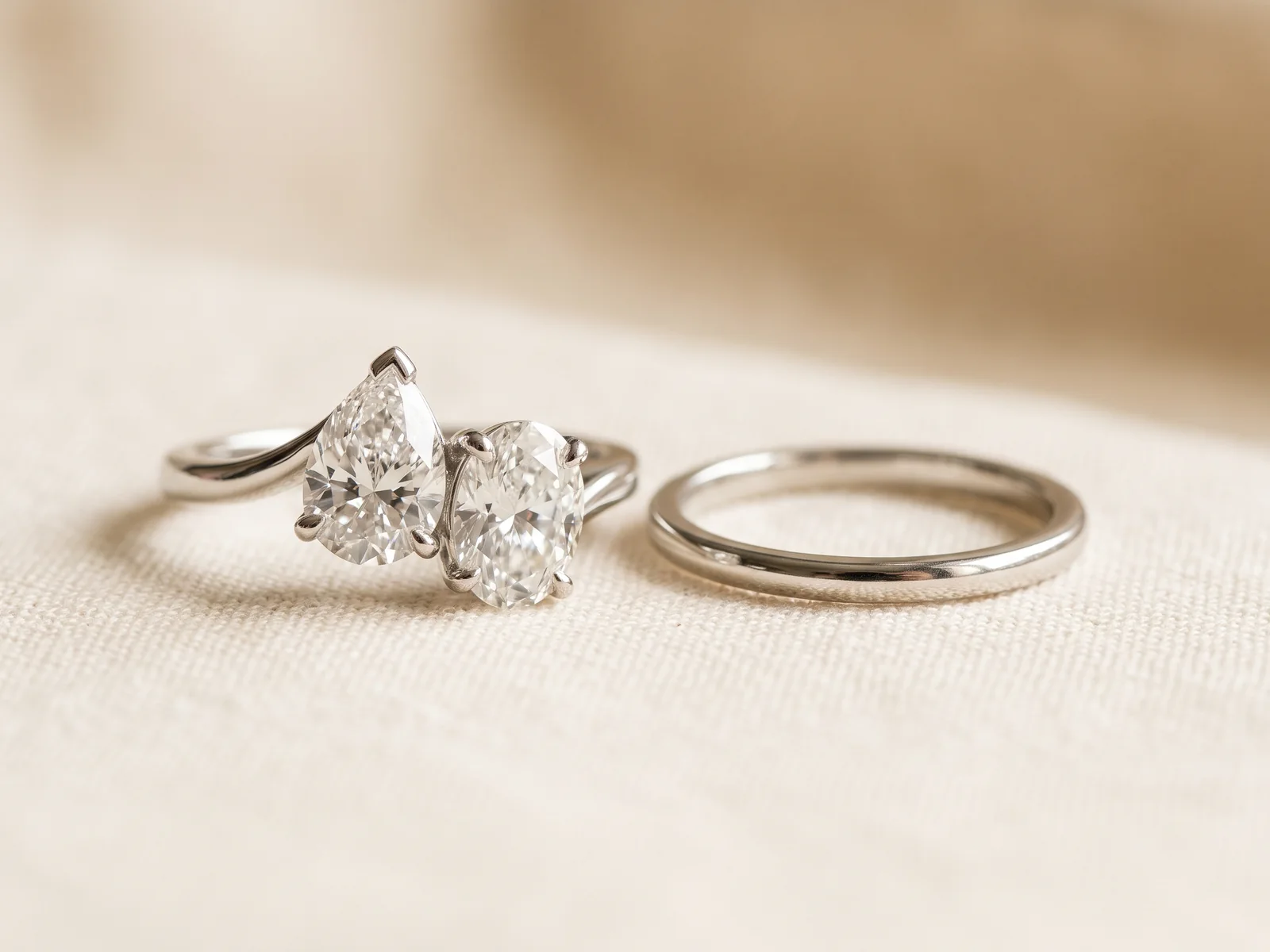
Two centre stones side by side make a toi et moi ring memorable, and they also make a toi et moi wedding band harder to fit than a band for a solitaire. Here is how to decide between flush, contoured and gapped bands, and how to get the width and metal right.
 Reviewed by Raj Sood, Graduate Gemologist (GIA), AJP (GIA)Master jeweller and Graduate Gemologist (GIA) · reviewed 4 November 2026
Quick answer
A toi et moi wedding band has to work around two centre stones sitting side by side, so a straight band often cannot sit flush. Most people choose a contoured or notched band that curves under the stones, a deliberate gap with a straight band, or a thin 1.5–2.5 mm band in the same metal as the engagement ring.
Why is a toi et moi wedding band tricky to pair?
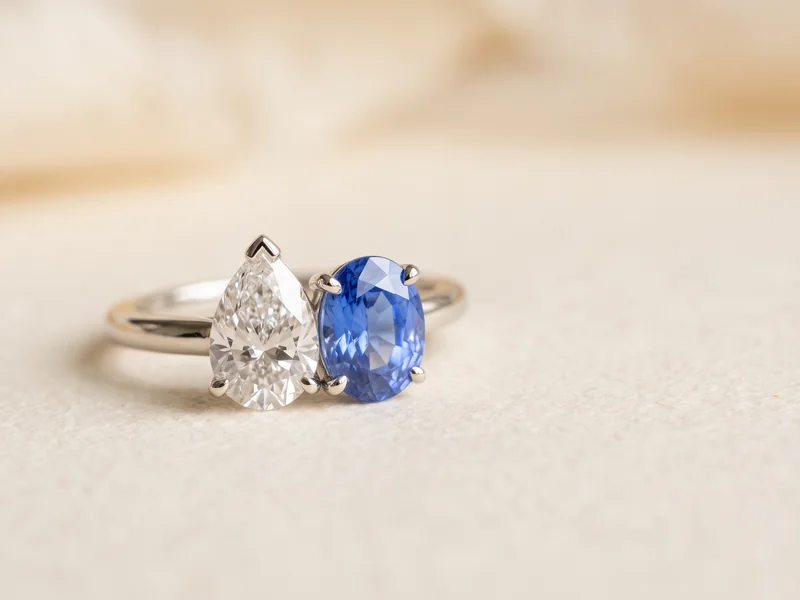
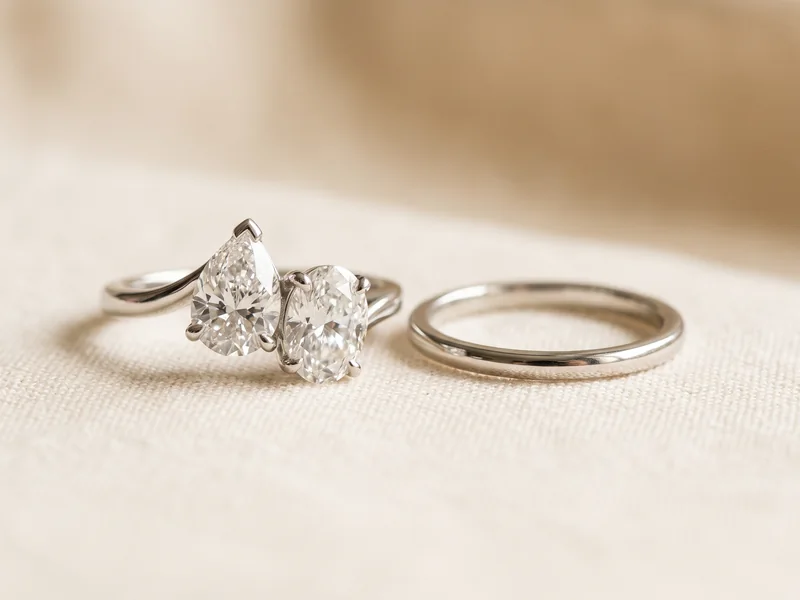
Toi et moi is French for “you and me”. In a ring it means two main stones set side by side instead of one centre stone. The two stones can be the same shape and size, or deliberately different: a pear beside an oval, an emerald cut beside a round, a diamond beside a coloured gemstone. Our guide to toi et moi engagement rings and their history covers the style itself; this page is about what sits next to it on the finger.
A solitaire puts one stone in the middle with one gallery (the metal structure under the stone) and a predictable gap underneath. A toi et moi changes three things at once:
- Width: two stones side by side usually span more of the finger than one, so the lower edges of both stones, and their claws, can reach across the line where a wedding band would sit.
- Angle: many toi et moi rings set the stones on a diagonal, often on a bypass shank (a band whose two ends pass each other instead of meeting). A straight band then touches the ring at one point and leaves a wedge-shaped gap elsewhere.
- Asymmetry: when the stones differ in size or shape, one side of the ring sits higher or wider than the other, so the gap beside a straight band is uneven.
None of this is a problem; it simply means the wedding band needs more thought. If your two stones are of noticeably different sizes, our page on balancing two stones of different sizes explains how that affects the profile of the ring. If you are still sorting out terminology, we explain the difference between a wedding ring and a wedding band, and any other unfamiliar word is in our full jewellery glossary.
Should a toi et moi wedding band sit flush or leave a gap?
This is the first decision, and it is mostly a matter of taste. A flush fit means the band touches the engagement ring along its whole length, so the two read as one piece. A gap fit means you accept a visible space, usually at the stones, between a straight band and the engagement ring. Both are correct; what matters is that the gap looks intentional rather than accidental.
| Fit | How it looks | Strengths | Watch for |
|---|---|---|---|
| Straight band, flush | Clean line, one stacked unit | Simple, easy to resize, lowest cost | Only works if the stones sit high enough or low enough to clear it |
| Straight band, gap | Space of roughly 1–4 mm under the stones | Keeps the engagement ring the hero; easy to swap bands | Gap can look uneven on a diagonal or asymmetric pair |
| Contoured (curved) band | Band bends to follow the stones | Sits close all the way; suits bypass shanks | Harder to resize; only fits that one ring |
| Notched band | Straight band with a small cut-out | Keeps a mostly straight look | Notch must line up with the lowest point of the stones |
| Custom shadow band | Made to mirror the ring's outline exactly | The closest possible fit | Highest cost; needs the engagement ring for fitting |
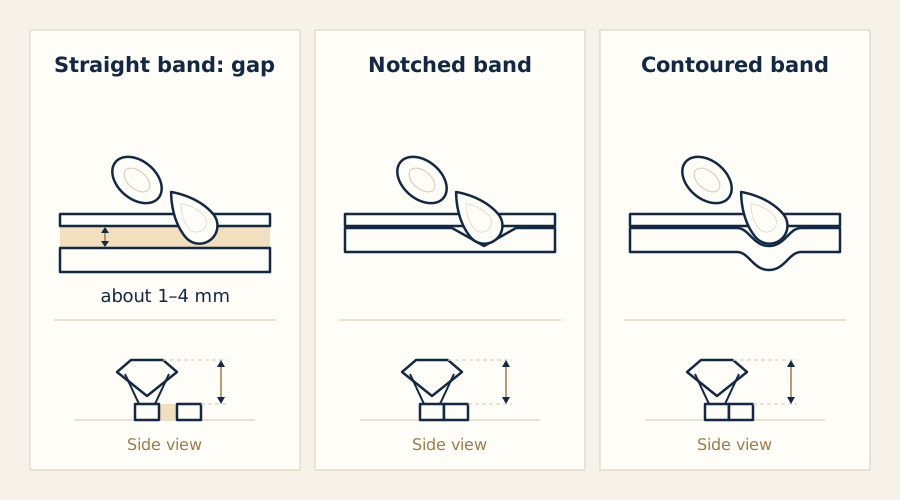
A rough rule: if the stones sit low and are set in bezels (a rim of metal around each stone), a straight band often sits flush. If the stones sit high on claws with open space beneath, a straight band may also slide under them and sit flush. It is the mid-height settings, and anything on a diagonal, where the contoured wedding band comes into its own. Our wider wedding ring buying guide covers sizing and profiles that apply to any band.
What is a contoured or curved wedding band for a two stone ring?
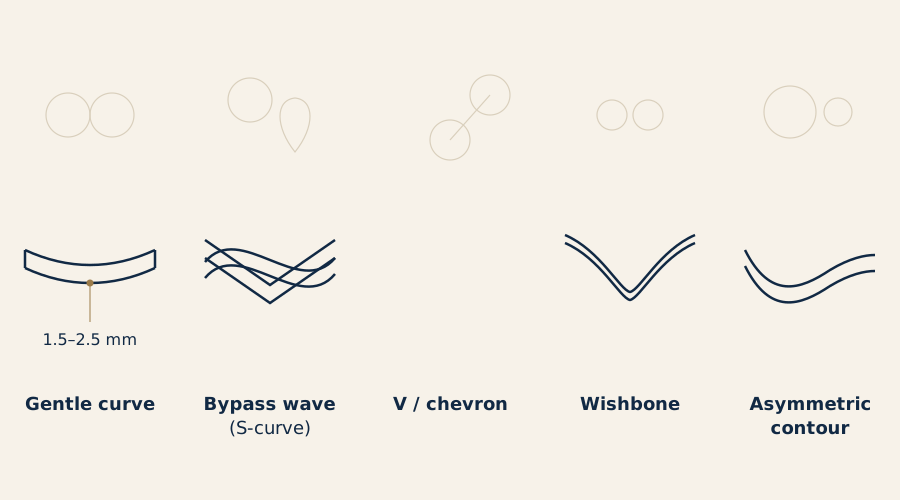
A contoured wedding band is shaped to follow the outline of the engagement ring next to it. For a toi et moi, it is the most common way to get a close fit. There are several styles, and the right one depends on where the stones meet the band line:
- Gentle curve: a soft arc that dips under both stones. Suits two stones of similar size set side by side.
- Wave or bypass curve: an S-shaped band that follows the crossover of a bypass shank. The most natural partner for a diagonal toi et moi.
- V or chevron: a band with a point in the middle, often used when one stone is a pear or marquise pointing towards the band.
- Notched wedding band: a straight band with a small U or V cut-out where the lowest stone sits.
- Wishbone: a thin V-shaped curve, usually 1.5–2 mm wide, that can sit either above or below the stones.
- Asymmetric custom contour: deeper on one side than the other, for a large stone paired with a smaller one.
Many of these shapes come from single-stone pairings. If one of your stones is a pear, the logic behind notched bands for pear engagement rings applies to that side of the ring. A marquise half follows the same thinking as chevron bands that frame a marquise, and a heart stone works like the curved bands made for heart engagement rings, where the lobes push outward.
How wide should a wedding band be next to a toi et moi ring?
Band width is measured across the top of the band, in millimetres. The usual goal is a band the same width as the engagement ring's shank, or slightly narrower, so the stones stay the focus. Because a toi et moi is already busier than a solitaire, thinner bands generally look more balanced.
| Engagement ring shank | Band width that usually balances | Effect |
|---|---|---|
| 1.5–1.8 mm (fine) | 1.5–2 mm | Delicate stack; stones look larger |
| 2–2.5 mm (standard) | 2–2.5 mm | Even, matched pair; most common choice |
| 2.5–3 mm (solid) | 2.5–3 mm | Bolder look; suits larger stones |
| Bypass shank | Match the narrower arm | Keeps the curve consistent through the crossover |
Thickness matters too. Thickness is the depth of the metal from the inside of the band to the top surface, and for everyday wear most bands sit around 1.3–1.8 mm. A band that is much thicker than the engagement ring makes the stones look as if they are sinking; one much thinner can look flimsy and will wear through sooner. A comfort fit profile, where the inside is gently rounded, makes a stack of two rings easier to slide over the knuckle.
Remember the total. A 2 mm engagement shank and a 2 mm band give you about 4 mm of metal on the finger, plus whatever width the two stones add. On shorter fingers, a 1.5–1.8 mm band often keeps the whole set from looking crowded.
Not sure which one is right?
Send us the stones you are looking at and our gemologist will tell you which to choose and why.
Should your wedding band match your engagement ring metal?
Rings that sit together rub together. When two different alloys touch every day, the harder one gradually wears the softer one. That is why the usual advice is to match not just the colour but the alloy and purity: 18ct white gold with 18ct white gold, platinum with platinum. 18ct gold is 75% pure gold; 9ct is 37.5%. Platinum used in jewellery is usually 950, meaning 95% platinum.
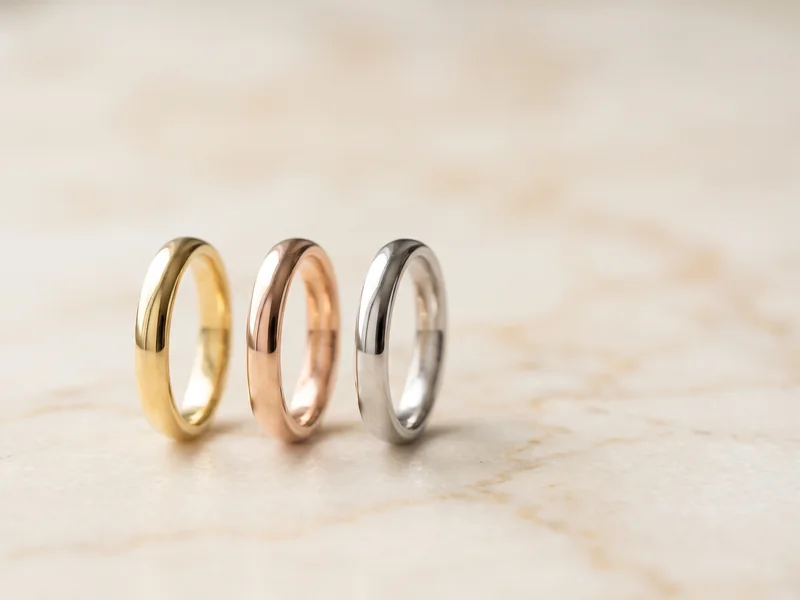
- Platinum 950: naturally white and dense. It scratches, but the metal mostly moves rather than wearing away, which suits contoured bands that touch the engagement ring along their length.
- 18ct white gold: usually finished with rhodium plating, a thin bright white coating that wears off over time and is typically renewed every one to two years, depending on wear.
- 18ct yellow or rose gold: colour runs right through, so there is no plating to wear. Rose gold gets its colour from copper and is slightly harder than yellow.
- Mixing colours: a yellow band beside a white engagement ring is a perfectly good look; try to keep the same purity (18ct with 18ct) so wear stays even.
For a deeper look at wear, hardness and upkeep, see how platinum and gold alloys compare for bands. If you are choosing a partner's band at the same time, our guide to men's wedding band widths, profiles and finishes covers the other half of the set.
Plain band or diamond band with a toi et moi ring?
A toi et moi already has two focal stones, so many people prefer a plain band that lets them stand apart. A diamond band adds sparkle along the finger and can tie two different stones together. Both work; the practical points are about setting style and wear.
- Claw-set or pavé bands: small diamonds held by tiny beads or claws. Very bright, but the claws can catch and rub against the engagement ring's claws. A contoured pavé band needs especially careful fitting.
- Channel-set bands: stones sit between two walls of metal, so the sides are smooth and rub less against the engagement ring.
- Bezel-set bands: each stone in its own rim. Smooth and secure, a good choice for active hands.
- Half eternity vs full eternity: a half eternity has stones across the top only and can be resized; a full eternity runs all the way round and is very hard to resize, which matters if your finger size changes.
Diamonds in bands are usually about 1.3–2 mm across, roughly 0.01–0.03 carat each. Diamond is 10 on the Mohs hardness scale, so a diamond band edge that rubs against a gold or platinum engagement ring will mark the metal over time. That is another reason a smooth-sided band is often the safer partner. Band diamonds can be natural or lab-grown; laboratory-grown diamonds are real diamond and cost much less, and the band's paperwork should say which you have. Coloured options include natural or lab-created sapphires (Mohs 9), which can echo a coloured stone in the toi et moi.
If your toi et moi has a halo around one or both stones, the band also has to clear the halo's outer edge; our notes on pairing bands with halo rings explain how much extra room that needs.
Which band suits each toi et moi layout?
Toi et moi rings vary more than any other style, so it helps to start from the layout of the two stones rather than the shapes alone.
| Toi et moi layout | Band that usually works | Why |
|---|---|---|
| Two stones east-west on a straight shank | Straight band, flush or small gap | Stones sit in line, so the gap is even |
| Diagonal pair on a bypass shank | Wave or bypass-curve band | Follows the crossover instead of fighting it |
| Pear or marquise pointing towards the band | Notched or V band | Leaves room for the point |
| Two pears pointing away from each other | Gentle curve | Rounded ends sit together in the centre |
| One large stone, one small | Asymmetric custom contour | Deeper dip under the larger stone |
| Low bezel-set stones | Straight band, flush | Bezels sit close to the finger and leave a clean line |
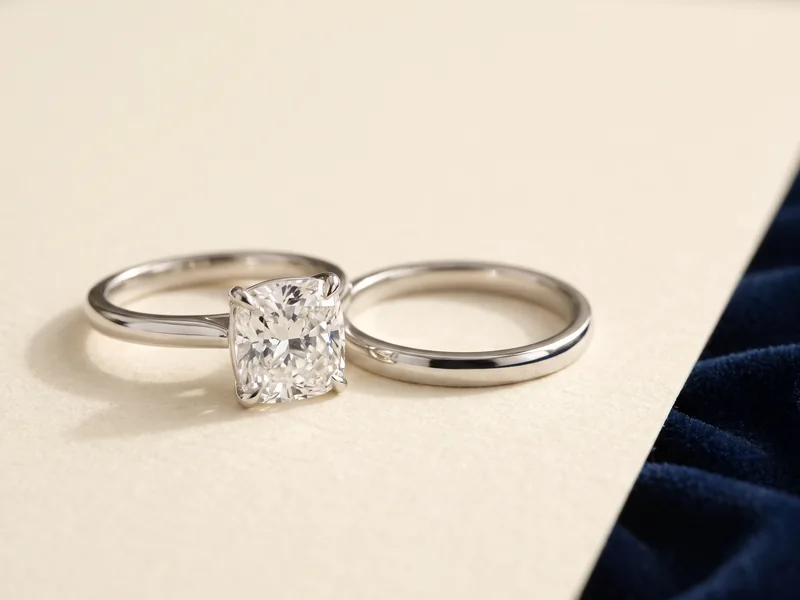
Each stone also brings habits from its own shape. A round half behaves much like the bands for round solitaires, which often sit flush. An oval half pushes outward along its length, as in our oval engagement ring band pairings. Squarer stones have corners that can catch: see the cushion cut band guide, radiant cut pairings and step-cut Asscher pairings for how corners change the fit.
How do you stack rings with a toi et moi?
Stacking means wearing more than one band with the engagement ring. With a toi et moi, the stones already create a strong focal point, so stacks work best when they stay simple. A few combinations that wear well:
- One contoured band below: the classic toi et moi bridal set. The curve fills the space and the ring reads as one unit.
- Bands either side: a straight band above and a contoured band below, or two thin curves that frame the stones like brackets.
- Gap with a slim plain band: a 1.5 mm band with a deliberate gap. Understated, and the toi et moi stays visually separate.
- Mixed metals: a yellow gold contour beside a platinum toi et moi, keeping the purities matched as far as possible.
- Anniversary addition: a diamond half eternity added later, often on the other side of the engagement ring.
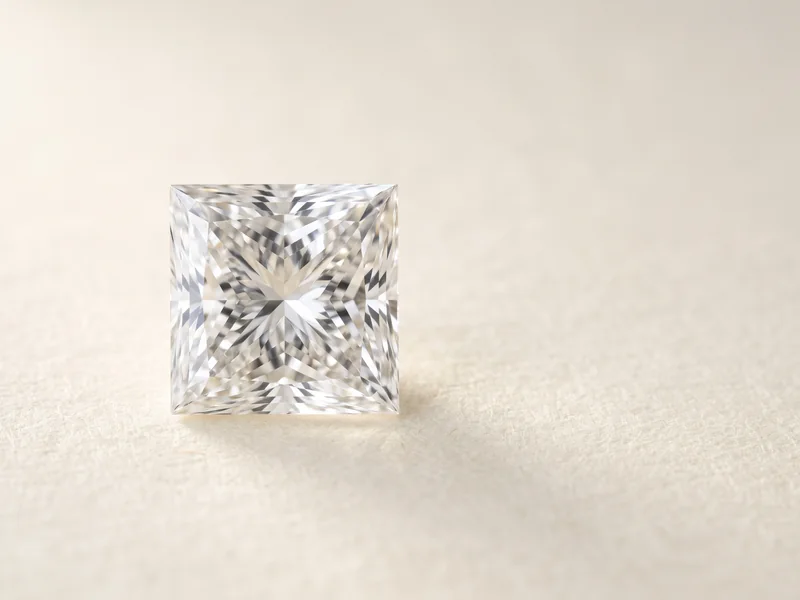
Square and rectangular stones in a toi et moi stack more neatly with straight lines, as with square princess cut bands, while pears and ovals suit curves. Order matters too: the wedding band is traditionally worn closest to the heart, below the engagement ring, nearer the base of the finger, but plenty of people swap them for comfort or looks.
Related guideHow to Balance Two Stones in a Toi et Moi RingAs a rough guide only, a plain 2 mm band in 18ct gold is often around AUD $800–$1,800, platinum around $1,200–$2,500, and a custom contoured band around $1,200–$3,500 depending on metal, width and stones. A diamond band costs more, and lab-grown diamond bands cost much less than natural ones of the same size.
Create your ring or wedding band
How do you choose a toi et moi wedding band? Step by step
- Look at the ring from the side. Note how high the stones sit and whether their claws or edges reach below the shank line.
- Decide flush or gap. Try a straight band against the ring and judge whether the space looks intentional.
- Find the lowest point. On a diagonal or asymmetric pair, mark where each stone comes closest to the band line; that sets the curve or notch.
- Match the width. Choose a band the same as the shank, or about 0.2–0.5 mm narrower; for a bypass shank, match the narrower arm.
- Match the alloy. Same metal and purity to even out wear, even if you choose a different colour.
- Choose the edge. Plain, channel or bezel edges rub less than claw-set ones against the engagement ring.
- Fit with both rings together. Check size and comfort with the stack on, over the knuckle, before the band is finished.
A custom contoured band is usually designed from measurements or a scan of the engagement ring, then made to follow its outline. Allow extra time for this, especially if the engagement ring was made elsewhere and needs to be seen in person.
Free consultation
Talk to a gemologist
Compare stones in person or online with Raj Sood, Graduate Gemologist (GIA), AJP (GIA).
Book a consultationShop this shape
FAQ
Common questions
Can you wear a straight wedding band with a toi et moi ring?
Yes. A straight band works well when the stones sit in line on a straight shank, or sit high enough to clear it. On diagonal or bypass designs it will usually leave a gap, which many people like.
What is a contoured wedding band?
It is a band shaped to follow the outline of the engagement ring beside it, usually curving or notching under the stones. For a toi et moi it is the most common way to get a close, flush fit.
How wide should my wedding band be?
Most toi et moi rings pair well with a band of 1.5–2.5 mm, about the same as the engagement ring's shank or slightly narrower. Thinner bands keep the focus on the two stones.
Do my wedding band and engagement ring need to be the same metal?
It is recommended to match the alloy and purity, such as 18ct with 18ct, because the harder metal wears the softer one when they rub. Colours can differ if you like a mixed-metal look.
Can a contoured band be resized?
Usually only by a small amount, because resizing changes the curve. Full eternity bands are also very hard to resize, so it is worth confirming your size carefully first.
Can I get a wedding band made for a toi et moi ring I bought elsewhere?
Yes. A jeweller can design a band around an existing ring, but they will normally need to see or scan the ring to match the curve accurately.

Ask a gemologist
Not sure which diamond to choose?
Raj Sood is a Graduate Gemologist (GIA) and master jeweller. Bring the stones you are considering, or send the reports, and he will tell you honestly which one is better and why.
Keep learning
Related guides
 Engagement Rings & SettingsToi et Moi Engagement RingsEngagement Rings & SettingsHow to Balance Two Stones in a Toi et Moi Ring
 Wedding Bands & EternityBest Wedding Band for Pear Engagement Rings
 MetalsBest Metal for Wedding BandsWedding Bands & EternityWedding Ring Buying Guide
 Wedding Bands & EternityBest Wedding Band for Princess Engagement Rings
 Wedding Bands & EternityWedding Ring vs Wedding Band
 Wedding Bands & EternityMen’s Wedding Band Guide
Explore more
More guides on this topic
Education