
- Education
- Engagement Rings & Settings
- Toi et Moi Engagement Ring Guide: Stones, Settings, Security and Bands
Engagement Rings & Settings
Toi et Moi Engagement Ring Guide: Stones, Settings, Security and Bands
A toi et moi engagement ring puts two centre stones side by side, which makes it more personal than a solitaire and more demanding to get right. Here is how the setting is built, which gems and shapes pair well, and how it wears over years.
 Reviewed by Raj Sood, Graduate Gemologist (GIA), AJP (GIA)Master jeweller and Graduate Gemologist (GIA) · reviewed 4 November 2026
Quick answer
A toi et moi engagement ring sets two centre stones side by side or on a diagonal, in contrasting shapes like a pear and oval. Choose stones of similar visual weight, leave a hairline gap so they do not rub, favour gems of Mohs 8 or harder for daily wear and plan for a curved or gapped wedding band.
What is a toi et moi engagement ring?
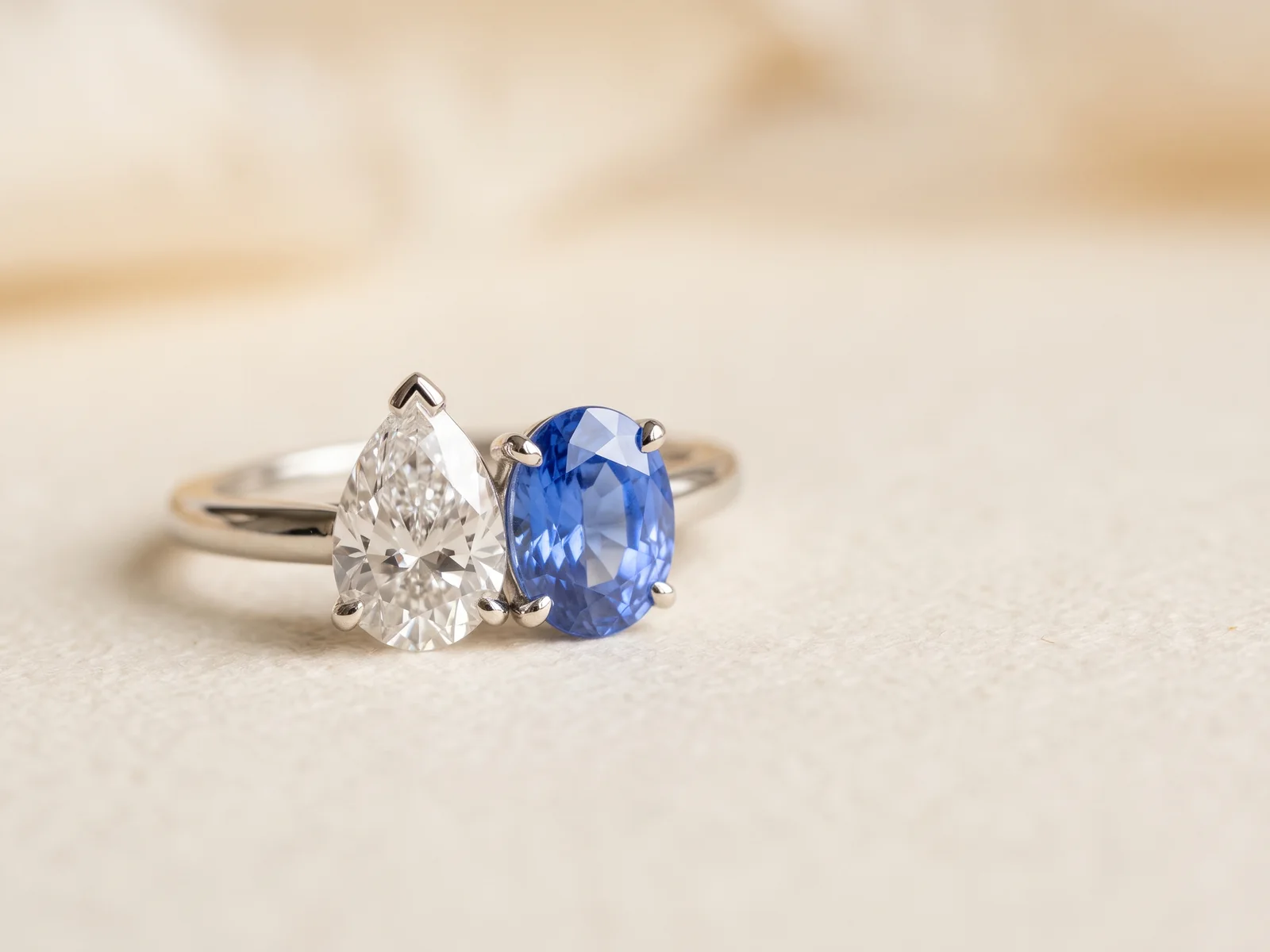
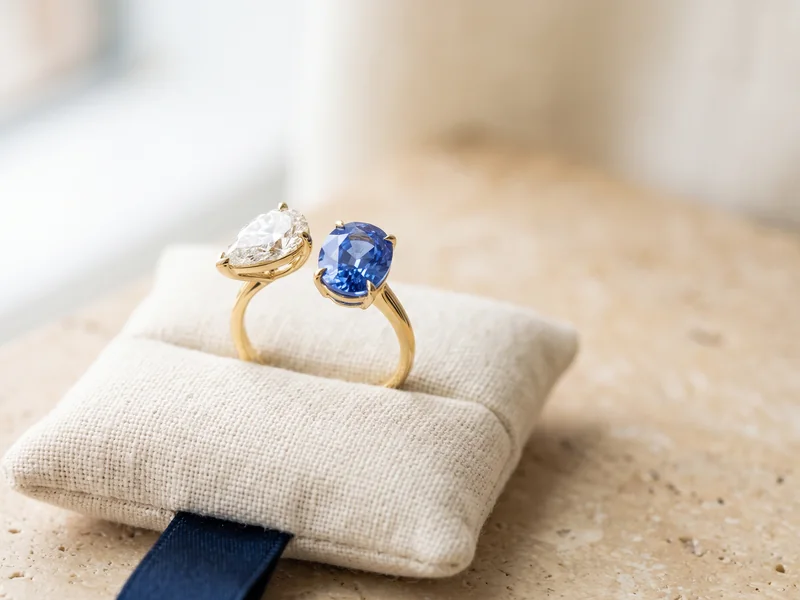
Toi et moi is French for 'you and me'. A toi et moi engagement ring holds two centre stones of roughly equal importance, set close together on one band, instead of a single centre stone. The two stones can match in shape and size, or be deliberately different: a pear beside an oval, a diamond beside a sapphire, a round beside an emerald cut. That is the toi et moi ring meaning in one line: two people, side by side, each still distinct.
It belongs to the multi-stone family, but it is not a three-stone ring with one stone missing. In a three-stone ring the middle stone leads and the side stones support it. In a toi et moi, neither stone is a side stone. That changes how the head (the part of the ring that holds a stone) is built, how the band sits on the finger and how the ring wears over time. Our overview of engagement ring setting styles shows where the toi et moi sits among the other options, and any unfamiliar word in this guide is defined in the GemTrove jewellery glossary.
People also search for this style as a two stone engagement ring, a 'you and me' ring or a crossover ring. The names overlap, though crossover and bypass usually describe a particular way of building the band, covered below.
Where did the toi et moi ring come from?
The best-known early example is the ring Napoleon Bonaparte gave Joséphine de Beauharnais in 1796: a pear shaped diamond and a pear shaped sapphire, each close to one carat, set on a slim gold band. It set the template many designers still follow, with two contrasting stones of similar size and opposite colour.
Through the nineteenth and early twentieth centuries, two-stone and crossover rings were common gifts, often pairing a diamond with a pearl or a coloured gem. You will see them in Edwardian and Victorian ring designs, where the band often swept around each stone in a gentle S-curve, and in the more geometric Art Deco engagement rings of the 1920s and 30s, which favoured step cuts, sharp lines and contrasting colour. Some antique pieces also carry fine openwork metal around each head, a technique explained in our page on filigree metalwork in engagement rings.
The style has returned strongly in recent years, partly because people like a ring that tells a story and partly because lab-grown diamonds and lab-created coloured gems make a well-matched pair more affordable than it once was.
How is a toi et moi engagement ring built?
Every toi et moi has the same basic parts: two heads, one for each stone, joined to the shank (the band that goes around the finger). Each head holds its stone with claws (small metal prongs folded over the stone's edge) or a bezel (a thin rim of metal around the whole edge). The way the two heads are arranged gives three main layouts:
- Side by side: both stones sit in a line across the finger, nearly touching. Symmetrical and bold, but it makes the widest footprint.
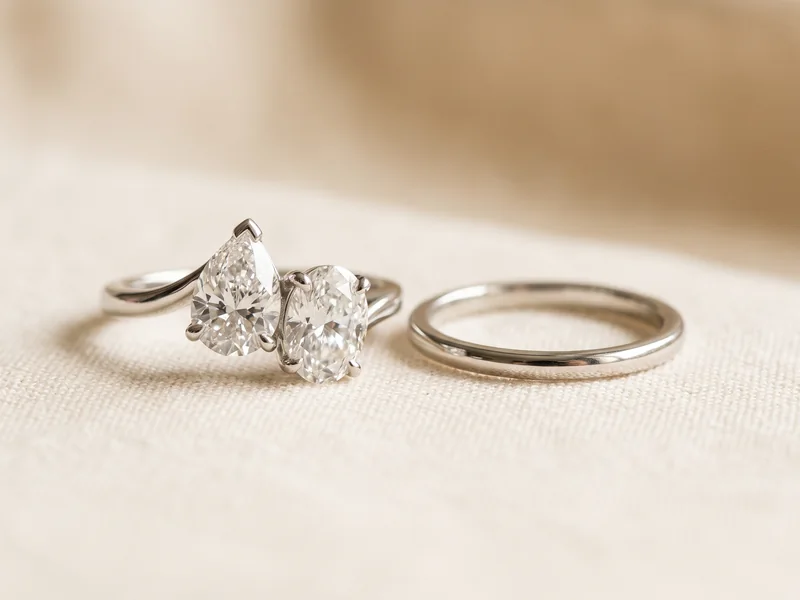
- Diagonal or offset: the stones sit at an angle, one nearer the knuckle and one nearer the hand. It looks slimmer, follows the finger and is the most common layout for a pear and oval toi et moi.
- Bypass or crossover: the shank splits and each end curves around to hold one stone, so the band appears to wrap the pair. A bypass engagement ring often sits lower and softer on the hand.
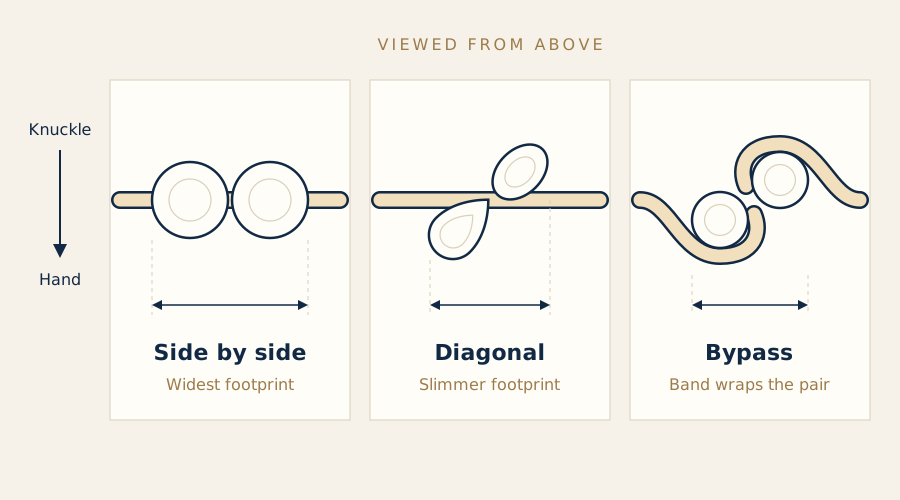
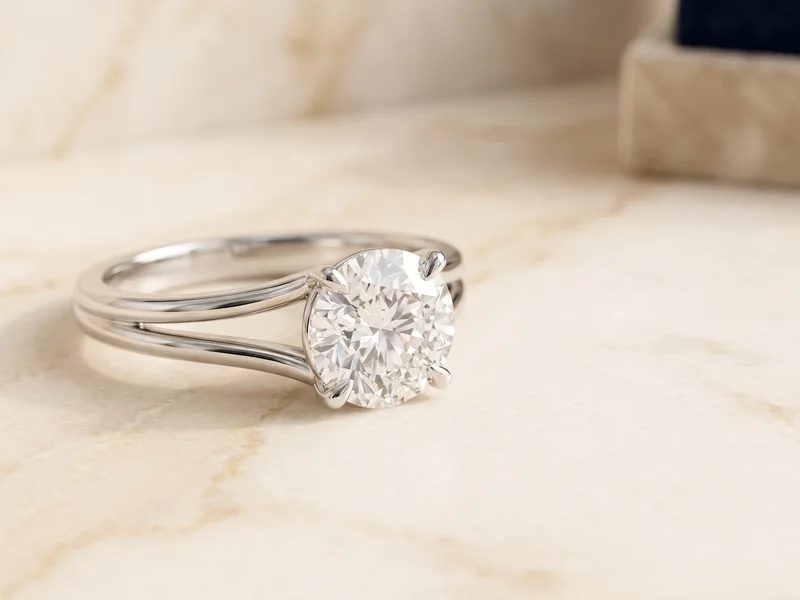
Bypass designs share a lot with split shank engagement rings, where the band divides as it approaches the stones. Because the two stones rarely mirror each other exactly, the toi et moi also overlaps with asymmetrical engagement ring designs, which use imbalance on purpose.
Because the shank carries two heads, it usually needs a little more metal than a solitaire band. A shank of about 2.0–2.5 mm wide is common; much thinner than about 1.8 mm and a bypass can flex or distort over years of wear. Head height matters too. A lower setting keeps the pair from catching on clothing, while a higher one lets more light into the stones and leaves room for a wedding band underneath.
Which stones and shapes suit a toi et moi ring?
Contrasting shapes are the signature of the style. Pear and oval is the most popular pairing, because the pear's point can tuck in beside the oval's curve. Pear and emerald cut contrasts soft and geometric. Two mirrored pears, points going opposite ways, feel balanced and romantic. Two rounds read classic and neat. Marquise and heart shapes appear too, though each adds another fragile point to protect.
The bigger question for everyday wear is hardness, measured on the Mohs scale (1 is talc, 10 is diamond). In a toi et moi the two stones sit so close that the harder one can scratch the softer one if they ever touch, and both are exposed at the top of the ring.
| Pairing | Hardness (Mohs) | Everyday wear notes |
|---|---|---|
| Diamond + diamond | 10 / 10 | Hardest pairing. Match colour closely, and keep a gap so the girdles (outer edges) cannot chip each other. |
| Diamond + sapphire (natural or lab-created) | 10 / 9 | Durable and traditional; the Napoleon and Joséphine pairing. |
| Diamond + ruby | 10 / 9 | Ruby is the same mineral as sapphire (corundum), so it wears just as well. |
| Diamond + lab-created moissanite | 10 / 9.25 | Durable; moissanite shows more rainbow-coloured fire than diamond, which is visible side by side. |
| Diamond + emerald | 10 / 7.5–8 | Emerald is brittle and usually oil-treated. Use a bezel or protective claws, and clean gently. |
| Diamond + morganite or aquamarine | 10 / 7.5–8 | Wearable with care; expect the softer stone to need re-polishing after some years. |
| Diamond + pearl | 10 / 2.5–4.5 | A lovely vintage look, but too soft for daily hard wear on the hand. |
Natural and laboratory-grown diamonds both work. A lab-grown toi et moi ring uses real diamond grown in a laboratory rather than mined, with the same hardness of 10 and refractive index of about 2.42, and the grading report says it is lab-grown. Coloured gems can be natural or lab-created; a lab-created sapphire is real corundum with the same hardness as a natural one, but the report and the description must say lab-created.
Not sure which one is right?
Send us the stones you are looking at and our gemologist will tell you which to choose and why.
How do you balance the sizes of two stones in a toi et moi?
Carat weight is a poor guide here, because shapes spread their weight differently. A 1.00 ct round is about 6.4 mm across, but a 1.00 ct pear is about 8.5 × 5.5 mm and a 1.00 ct oval about 7.7 × 5.7 mm, so both look longer and larger face-up (seen from above). What you are really balancing is visual weight: how much each stone holds the eye, which depends on face-up area, colour and brightness.
There are two honest approaches. Equal partners, two stones of near-identical face-up size, give a calm, symmetrical look. A deliberate big-and-small pairing, such as a 1.00 ct pear with a 0.70 ct emerald cut, feels more personal and asymmetric; it usually reads well when the smaller stone is around two-thirds to three-quarters the length of the larger one. Our guide to matching the visual weight of two stones works through common pairings in millimetres.
| Stones and layout | Approximate footprint across the finger | How it looks |
|---|---|---|
| Two 0.50 ct rounds, side by side | about 10.5–11 mm | Neat and easy to wear on most fingers |
| Two 1.00 ct rounds, side by side | about 13–14 mm | Wide; covers most of a slim finger |
| 1.00 ct pear + 1.00 ct oval, diagonal | about 11–13 mm | Longer and slimmer, follows the finger |
| 1.00 ct pear + 0.70 ct emerald cut, offset | about 10–12 mm | Asymmetric, with a clear lead stone |
Colour and clarity matter more than usual, because the stones are compared side by side all day. With two white diamonds, keep them within about one colour grade (G and H, for example) and check that they share similar fluorescence, the soft glow some diamonds show under UV light. Aim for both to be eye-clean, meaning no inclusions you can see without magnification. Lab-grown pairs are easier to match closely because more stones of each size are available.
There is a price logic too. Natural diamond prices per carat jump at popular weights such as 1.00 ct, so two 0.70 ct natural stones often cost less in total than a single 1.40 ct stone of the same grades, while covering a similar area on the hand.
Are toi et moi rings secure for everyday wear?
They can be, but the design asks more of the setting than a solitaire does. Three things cause most problems: the two stones touching and rubbing, a single claw shared between both stones, and a wide side-by-side footprint that catches on knitwear, gloves and bag straps.
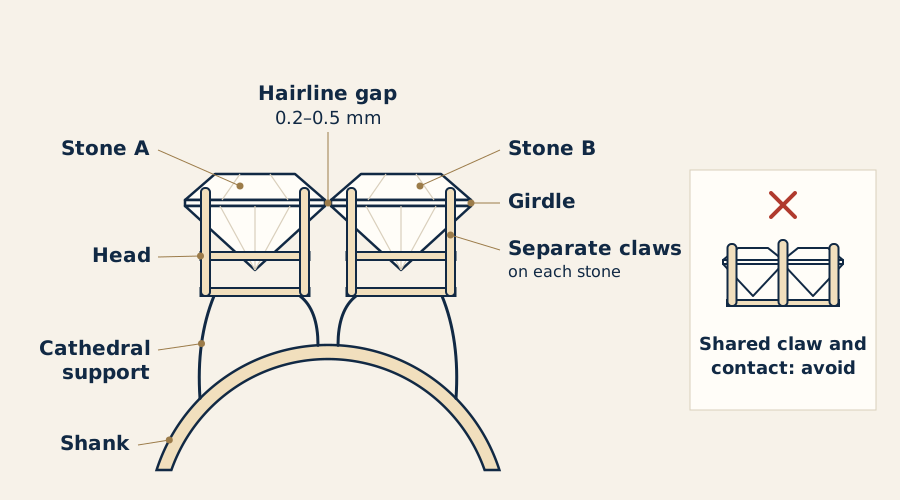
- Separate claws: at least four per round or oval, and a V-claw (a V-shaped claw) wrapping any pear or marquise point.
- A hairline gap: about 0.2–0.5 mm between the stones, so they cannot grind against each other.
- Bezel for the softer stone: a full or half bezel protects an emerald or morganite edge.
- A lower profile: heads set closer to the finger snag less often.
- Support underneath: arches rising from the shank to the heads, as in cathedral-style ring supports, add strength.
Small accent diamonds can protect and decorate at the same time. Some toi et moi designs frame each stone, using ideas from halo engagement rings, or tuck a ring of tiny stones beneath each head, as with a hidden halo under the head. Our page comparing a full halo against a hidden halo sets out the trade-offs, and a few bolder designs go as far as two rows of halo stones. Every extra small stone is another one to check, so weigh the sparkle against the upkeep.
How does a toi et moi ring wear over the years?
From the repair bench, the same patterns come up again and again. The claws on the inside, where the two stones meet, flatten first, because they take knocks from both sides. On bypass and crossover designs, the shank wears thin at the base of the band (the palm side) after many years of daily wear, and the curve can slowly open out if the ring is squeezed or caught. Softer stones next to a diamond show fine scratches and rounded facet edges. And the space under and between the two heads traps soap, lotion and dust, which dulls both stones faster than in a solitaire.
Resizing is also more involved. Changing the size alters the curve of the band, which can shift the angle between the two heads or the gap between the stones. Most toi et moi rings can be resized by a size or two; beyond that, part of the shank may need to be rebuilt.
- At home, weekly: warm water, a drop of mild detergent and a soft toothbrush, working carefully between and under the stones.
- Every 6–12 months: a professional check of every claw, the gap and the shank.
- Every few years: re-tipping (adding fresh metal to worn claw tips) for a ring worn every day.
- Avoid ultrasonic cleaners for emeralds, pearls and other treated or fragile stones.
- Take it off for the gym, gardening and heavy lifting.
What wedding band fits a toi et moi engagement ring?
This is the part people most often forget to plan. Because the two stones spread across or along the finger, and a diagonal pair overhangs the shank on both sides, a straight wedding band often leaves a visible gap or rubs against the heads. The usual answers for a toi et moi wedding band:
- Contoured band: curved to follow the outline of the pair. Often made to fit the exact ring.
- Notched band: a straight band with a small dip where the heads sit.
- Straight band with a gap: simple and timeless in its own way; many people like the space.
- Open or bypass band: a band whose ends do not meet, which can wrap around the pair.
- Other hand: wearing the wedding band on the right hand avoids the fit problem entirely.
Our guide to the wedding bands that pair with a toi et moi shows each option side by side. A higher head or a cathedral support leaves more room for a straight band underneath, so decide on the band before the engagement ring is finished.
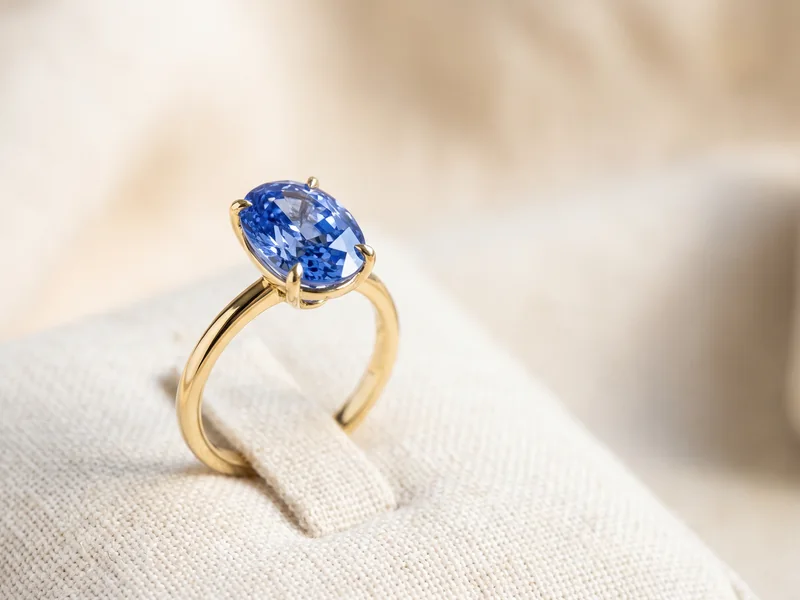
Not every toi et moi is an engagement ring. The style is also a favourite dress ring, and many people choose to wear a toi et moi as a right-hand ring, where band fit does not matter at all.
How does a toi et moi compare with a solitaire, and what does it cost?
| Toi et moi | Solitaire | Three-stone | Halo | |
|---|---|---|---|---|
| Centre stones | Two equal partners | One | One lead, two supporting | One, framed by small stones |
| Footprint | Wide or diagonal | Narrowest | Wide, across the finger | Larger face-up |
| Claws to check | Usually 7–10 | Usually 4–6 | Usually 10–12 | 4–6, plus many small stones |
| Wedding band fit | Usually contoured or gapped | Sits flush on most designs | Often a straight band works | Depends on halo height |
| Upkeep | Medium to high | Low | Medium | Medium to high |
If you want simplicity, the lowest upkeep and the easiest band fit, a classic solitaire ring is hard to argue with. A toi et moi asks for more planning, but gives two stones with their own meaning.
Toi et moi ring prices in Australia vary widely because you are choosing two stones and a setting that is often custom made. As broad guides only: a custom setting in 18 carat gold or platinum is about AUD $2,000–$5,000; a pair of lab-grown diamonds of 0.75–1.00 ct each is about $1,200–$4,000; and a pair of natural diamonds around 0.70 ct each, G–H colour and VS clarity, is about $6,000–$14,000. A natural coloured gem changes the figure most, since a fine sapphire or emerald can cost more than the diamond beside it. Lab-grown diamonds and lab-created coloured gems cost much less than natural ones.
Because the gap, claw positions and head angles decide how a toi et moi wears, a CAD render (a computer model of the ring) is the time to check them, before any metal is cast.
Create your ring: settings for two stones
How do you choose a toi et moi engagement ring? Step by step
- Pick a layout. Side by side for symmetry, diagonal for a slimmer look, bypass for a softer wrap around the finger.
- Choose the two stones. Favour Mohs 8 or harder for daily wear; if one stone is softer, plan a bezel for it.
- Balance visual weight. Compare millimetre measurements and face-up area, not just carat weight.
- Match colour and clarity. Keep two white diamonds within about one colour grade, both eye-clean, and confirm on each report whether the stone is natural, lab-grown or lab-created.
- Check the footprint. Make sure the pair suits your finger width and daily life.
- Review the CAD render. Look for separate claws on each stone, a hairline gap and solid support under the heads.
- Plan the wedding band. Decide on contoured, notched, gapped or other-hand before the ring is finished.
- Book regular checks. Every 6–12 months, with re-tipping as the claws wear.
Free consultation
Talk to a gemologist
Compare stones in person or online with Raj Sood, Graduate Gemologist (GIA), AJP (GIA).
Book a consultationShop this shape
FAQ
Common questions
What does toi et moi mean?
It is French for 'you and me'. A toi et moi ring sets two centre stones together to represent two people, usually in contrasting shapes or colours.
Are toi et moi rings practical for everyday wear?
Yes, if the setting is built for it. Ask for separate claws on each stone, a hairline gap between them, durable gems such as diamond or sapphire, and a check every 6–12 months.
Can you wear a wedding band with a toi et moi ring?
Yes, but a straight band often leaves a gap because the stones overhang the shank. A contoured or notched band fits closer, or you can wear the band on the other hand.
Should the two stones in a toi et moi be the same size?
Not necessarily. Equal sizes look symmetrical, while a larger and smaller stone, often with the smaller around two-thirds to three-quarters the length of the larger, gives a more personal, asymmetric look.
Can a toi et moi ring use lab-grown diamonds?
Yes. Lab-grown diamonds are real diamond grown in a laboratory, cost much less than natural diamonds and are easier to match as a pair. The grading report states that each stone is lab-grown.
Is an emerald a good choice for a toi et moi?
It can be, with care. Emerald is 7.5–8 on the Mohs scale, brittle and usually oil-treated, so a bezel or protective claws, gentle cleaning and no ultrasonic cleaner are wise.

Ask a gemologist
Not sure which diamond to choose?
Raj Sood is a Graduate Gemologist (GIA) and master jeweller. Bring the stones you are considering, or send the reports, and he will tell you honestly which one is better and why.
Keep learning
Related guides
 Engagement Rings & SettingsHow to Balance Two Stones in a Toi et Moi Ring
 Wedding Bands & EternityBest Wedding Band for Toi et Moi RingsEngagement Rings & SettingsEngagement Ring Setting Styles Guide
 Engagement Rings & SettingsAsymmetrical Engagement Rings
 Engagement Rings & SettingsSplit Shank Engagement Rings
 Engagement Rings & SettingsRight-Hand Rings Explained
 Engagement Rings & SettingsDouble Halo Engagement Rings
 Engagement Rings & SettingsArt Deco Engagement Rings
Explore more
More guides on this topic
Education