
Metals
Two Tone Rings and Mixed-Metal Rings: How They Are Made, Worn and Cared For
Two tone rings let you have warm yellow gold on the hand and a crisp white setting around the diamond. But two metals in one ring means two alloys, two wear rates and two sets of stamps, so it pays to know how they are put together.
 Reviewed by Raj Sood, Graduate Gemologist (GIA), AJP (GIA)Master jeweller and Graduate Gemologist (GIA) · reviewed 4 November 2026
Quick answer
Two tone rings combine two metal colours in one piece, usually a yellow gold band with a white gold or platinum head holding the diamond. Match the gold purity across both colours, expect the white parts to need rhodium replating if they are white gold, and check each metal is stamped and nickel-free if you react to jewellery.
What are two tone rings?
A two tone ring is any ring that shows two metal colours. The classic Australian example is a yellow gold band with a white head (the part of the setting that holds the centre stone). A mixed-metal ring is the broader term: it can mean two colours of gold, gold with platinum, three colours of gold (tri-colour), or a precious metal combined with a modern one such as titanium.
The colour of gold comes from what it is mixed with. Pure gold (24ct) is deep yellow and too soft for rings, so it is alloyed with silver, copper, zinc, palladium or nickel. More copper pushes it towards rose; palladium or nickel bleaches it towards white. Our guide to how yellow, white and rose gold differ covers each colour on its own; this page is about what happens when you put them together.
Two tone rings are not plated novelties when they are made properly. Each colour is a solid alloy, cast or fabricated separately and then joined by soldering or laser welding. A cheaper approach is to plate part of a yellow gold ring with rhodium so it looks white, which works but wears off. If any term here is new to you, our glossary of jewellery terms explains it.
What styles of mixed-metal ring are there?
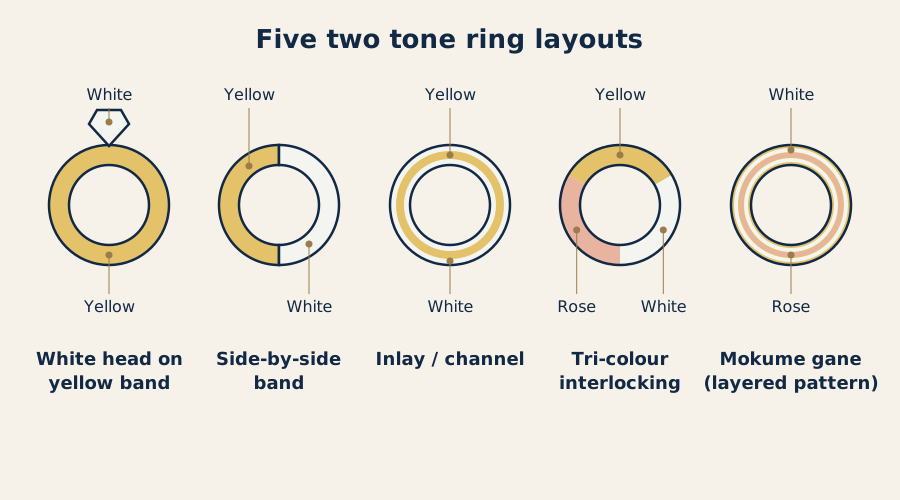
There are more ways to combine metals than most people expect. The main styles:
- White head on a yellow band: a platinum or white gold claw setting on a yellow or rose gold shank (the band). The diamond sits in white metal, which keeps it looking whiter.
- Split or side-by-side bands: two colours fused along the length of the band, often with a groove or polished line where they meet.
- Inlay or channel: a strip of one metal set into a groove in another, such as a yellow gold line through a white band.
- Tri-colour or interlocking rings: three bands of yellow, white and rose gold that roll around each other, sometimes called a Russian wedding ring.
- Patterned metal: layers of different metals forged together and carved to show a wood-grain pattern, known as mokume gane.
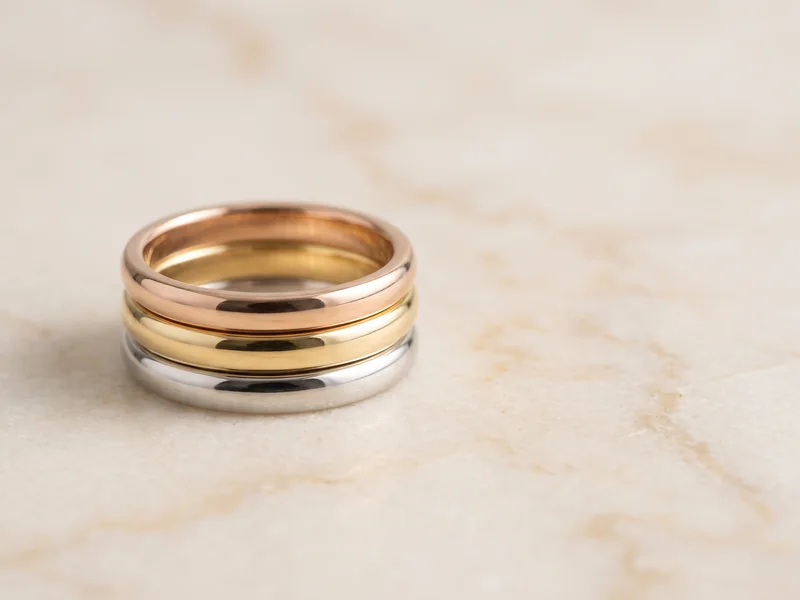
- Mixed stacks: separate rings in different metals worn together, such as a platinum engagement ring beside a rose gold band.
Mokume gane is its own craft, with its own care needs; our page on mokume gane rings made in Melbourne explains how the layers are bonded. Two colours of metal also suit two-stone designs, where each stone sits in the metal that flatters it most, which we cover in balancing the two stones in a toi et moi ring.
Which metals can be combined in one ring?
Almost any two precious metals can be joined, but some pairs work far better than others. The key rule is to keep the hardness and purity similar, so one side does not wear away faster than the other. The figures below are typical for the alloys jewellers use; hardness is given on the Vickers scale (HV), where a higher number means harder metal.
| Metal | Purity stamp | Colour | Approx. hardness (HV) | Needs plating? | Allergy notes |
|---|---|---|---|---|---|
| 9ct yellow gold | 375 | Pale yellow | 110–150 | No | High in silver and copper; can irritate some sensitive skin |
| 14ct yellow gold | 585 | Mid yellow | 120–160 | No | Rarely a problem |
| 18ct yellow gold | 750 | Rich yellow | 120–160 | No | Very low risk |
| 18ct rose gold | 750 | Pink | 140–180 | No | Copper sensitivity is rare |
| 18ct white gold (nickel) | 750 | Greyish white | 170–220 | Usually rhodium | Can trigger nickel allergy |
| 18ct white gold (palladium) | 750 | Soft grey-white | 120–160 | Usually rhodium | Nickel-free |
| Platinum | Pt950 / PLAT | Naturally white | 110–140 | No | Very low risk |
| Palladium | Pd950 | Naturally grey-white | 100–120 | No | Very low risk |
Gold sits at about 2.5–3 on the Mohs hardness scale and platinum at about 4–4.5, but Mohs is a scratch test designed for minerals and tells you little about how a ring wears. Vickers hardness, and how the metal behaves when it is knocked, matter more.
Matching purity: if the yellow is 18ct, the white should normally be 18ct too. Mixing 9ct and 18ct in one ring gives uneven colour depth and wear. Our guide to what 14 carat gold is made of explains the middle option, which some makers use for both colours to keep the ring harder.
Gold with platinum: the most common precious pairing, because platinum keeps a diamond white without plating. The platinum is usually Pt950; the difference between alloys is covered in Pt950 compared with Pt900. Gold with palladium: palladium is lighter and naturally white, and our guide to palladium as a ring metal explains why it is harder to repair than platinum.
Why put a platinum head on a yellow gold ring?
A diamond picks up colour from the metal around it. Set in yellow gold claws, a colourless diamond can look slightly warm, because light passes through the stone and reflects off the yellow metal underneath. A white head stops that, while the yellow band keeps the warm look most people want on the finger.
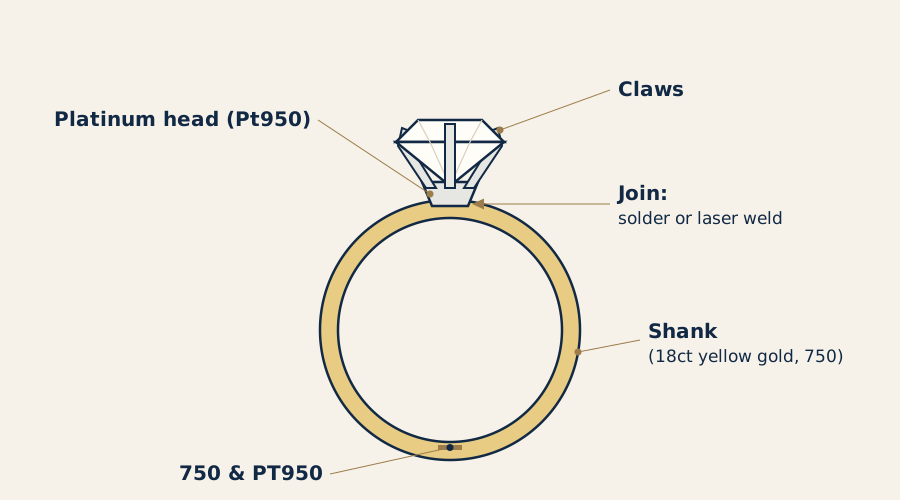
Platinum also behaves differently under wear. When platinum is scratched, the metal is mostly pushed aside rather than lost, so claws keep their bulk for longer. Gold wears away a little at a time. That is why a platinum head on a gold shank is a common choice for a diamond worn every day; see our guide to choosing a metal for an engagement ring for the full comparison, and our platinum jewellery guide for how platinum is worked.
Joining the two is skilled work. Platinum melts at about 1,768°C and 18ct gold alloys at roughly 900–1,000°C, so the jeweller cannot simply heat them together. The head is finished first, then attached with gold solder or a laser weld that melts only a tiny spot. A good join is invisible apart from the colour change; a poor one shows a dull line or a pit that can catch dirt.
Not sure which one is right?
Send us the stones you are looking at and our gemologist will tell you which to choose and why.
Do two tone rings wear unevenly?
They can, and this is the single biggest difference between a two tone ring and a single-metal one. Three things cause it:
- Different wear behaviour: metals of different hardness, or that wear in different ways, lose surface at different rates. Over years, gold beside platinum can sit slightly lower, leaving a small step at the join you can feel with a fingernail.
- Plating wear: white gold is usually coated with rhodium, a very white, hard metal from the platinum group. On the palm side of a band it can start to wear through within a year, showing the slightly yellow-grey white gold underneath.
- Polishing: each polish removes a thin layer. Jewellers polish two tone rings carefully so the softer colour is not taken back more than the harder one.
Replating a two tone ring is harder than replating a plain white one. The yellow or rose parts must be masked with a lacquer, or the rhodium applied with a small pen-plating tool, so the plating only lands on the white sections. Our page on how rhodium plating is applied and renewed explains the process. Choosing platinum or palladium for the white part avoids plating altogether.
For a plain band worn every day, the wear question matters even more because the whole surface takes contact. Our guide to picking a metal for a wedding band compares how each metal holds up on the hand, which is useful when you are planning a two tone wedding band.
Are mixed-metal rings safe if you have a metal allergy?
Most jewellery reactions are to nickel, which is used in some white gold alloys because it is a strong whitener and hardener. A two tone ring is only as gentle as its least friendly metal, so if you react to jewellery, ask what each colour is alloyed with, not just the gold purity.
- Choose palladium white gold or platinum for the white part; both are nickel-free.
- Remember rhodium plating hides nickel only while it lasts; once it wears through, the alloy touches your skin.
- Yellow and rose gold at 14ct and 18ct rarely cause problems; 9ct contains more base metals and suits some sensitive skin less well.
- Solder is an alloy too. Ask for solder that matches the purity of the ring.
Our guide to nickel-free ring options for sensitive skin goes through the alloys in detail. Some people with strong allergies choose modern metals instead: titanium, which is light and biocompatible, or the alternative materials in our page on cobalt, tantalum and carbon fibre bands. These can carry a precious metal inlay, but they cannot be resized the usual way, so check before you commit.
Sterling silver is sometimes paired with gold in fashion pieces. It is softer than the gold alloys used in rings and tarnishes, so the silver side darkens while the gold stays bright; our page on why silver tarnishes and how patina forms explains what to expect.
How are two tone rings hallmarked in Australia?
Australia has no government assay office and no compulsory hallmarking. Instead, jewellers stamp the purity of the metal and usually a maker's mark, and Australian Consumer Law requires those stamps to be accurate. A two tone ring should show the purity of each metal, not just the one that sounds best.
| Stamp you might see | What it means |
|---|---|
| 750 or 18ct | 18 carat gold, 75% pure, any colour |
| 585 or 14ct | 14 carat gold, 58.5% pure |
| 375 or 9ct | 9 carat gold, 37.5% pure |
| 750 & PT950 (or 18ct & Plat) | 18ct gold band with a 95% platinum part |
| Pd950 | 95% palladium |
| Maker's mark | Initials or a symbol identifying the jeweller |
Stamps are small and usually sit inside the band, at the back of the shank. On a two tone ring you may see both stamps side by side, or one on each metal. Our full guide to reading Australian metal stamps and hallmarks shows what genuine marks look like and what older or imported marks mean.
How much do two tone rings cost in Australia?
A two tone ring costs more than the same design in one metal, for two reasons: two separate castings or fabrications, and the skilled joining and finishing. If one of the metals is platinum, the head also weighs more, because platinum is about 21.4 g/cm³ compared with about 15.5 g/cm³ for 18ct yellow gold.
| Ring (setting only, no centre stone) | Approximate price range (AUD) |
|---|---|
| 18ct yellow gold solitaire, single metal | about $1,200–$2,500 |
| 18ct yellow gold solitaire with platinum head | about $1,500–$3,000 |
| 18ct two tone wedding band, 4 mm | about $1,500–$3,500 |
| Tri-colour 18ct interlocking band | about $2,000–$4,500 |
| Rhodium replate of a two tone ring (masked) | about $60–$150 per visit |
These are broad ranges only. Gold and platinum prices move daily, and the weight of metal, the width of the band and the complexity of the join change the figure a lot. Selective plating also costs a little more than plating a plain white gold ring, because of the masking.
Ring settings by metal
How do you choose and care for a two tone ring?
- Decide which part needs to be white. Usually the head, so the diamond looks whiter; sometimes the whole band for a modern look.
- Match the purity. Keep both colours at the same carat, typically 18ct, so they wear and look similar.
- Choose a naturally white metal if you can. Platinum or palladium avoids rhodium replating; palladium white gold avoids nickel.
- Ask how the metals are joined. Solder or laser weld, and where the join sits; check it with a loupe if possible.
- Check the stamps. Both metals should be marked with their purity.
- Plan the care. Take the ring off for swimming in chlorinated pools, gardening and the gym; clean it in warm water with mild detergent and a soft brush.
- Book regular checks. Have the claws and the join inspected every 12 months, and the white parts replated when the colour starts to warm.
Chlorine deserves a special mention in Australia. Repeated soaks in pools and spas can attack gold alloys over time, especially at stressed areas such as joins and claws, so it is worth taking any ring off before you swim.
Related guideYellow Gold vs White Gold vs Rose GoldFree consultation
Talk to a gemologist
Compare stones in person or online with Raj Sood, Graduate Gemologist (GIA), AJP (GIA).
Book a consultationShop this shape
FAQ
Common questions
Are two tone rings out of fashion?
No. White heads on yellow gold bands have been made for decades, and mixed stacks and tri-colour bands are common today. The look suits people who like warm gold but want a whiter-looking diamond.
Can a two tone ring be resized?
Usually yes, as long as the cut is made in the band and away from the join. Side-by-side and inlaid bands are harder, because both colours must be cut and rejoined, so ask before you buy.
Does a two tone ring need rhodium plating?
Only if the white part is white gold. Platinum and palladium are naturally white and need no plating, while white gold sections are usually replated every 12–24 months with the yellow parts masked.
Can I wear a white gold engagement ring with a yellow gold wedding band?
Yes. Mixed stacks are common. Choose metals of similar hardness so the rings do not wear each other unevenly where they touch.
Is a platinum head on a gold ring worth it?
For a diamond worn every day, many people find it is. Platinum claws hold their bulk well and keep the stone looking white without plating, though they add some cost.
Are two tone rings nickel-free?
Only if every metal in them is. Ask whether the white part is nickel white gold, palladium white gold, platinum or palladium, and check the solder.
Terms in this guide

Ask a gemologist
Not sure which diamond to choose?
Raj Sood is a Graduate Gemologist (GIA) and master jeweller. Bring the stones you are considering, or send the reports, and he will tell you honestly which one is better and why.
Keep learning
Related guides
 MetalsYellow Gold vs White Gold vs Rose Gold
 MetalsRhodium Plating and Replating
 MetalsAustralian Hallmarks and Metal Stamps
 MetalsMetal Allergies and Nickel-Free OptionsMetalsBest Metal for Engagement RingsMetalsBest Metal for Wedding Bands
 Engagement Rings & SettingsHow to Balance Two Stones in a Toi et Moi RingMetalsTitanium Rings
Explore more
More guides on this topic
Education