
- Education
- Lab-Grown Diamonds
- How to Read an IGI Lab-Grown Diamond Report, Section by Section
Lab-Grown Diamonds
How to Read an IGI Lab-Grown Diamond Report, Section by Section
Many lab-grown diamonds sold in Australia come with an IGI lab-grown diamond report. Knowing how to read it lets you check what the stone is, how it was made and whether the paper really belongs to the diamond in front of you.
 Reviewed by Raj Sood, Graduate Gemologist (GIA), AJP (GIA)Master jeweller and Graduate Gemologist (GIA) · reviewed 4 November 2026
Quick answer
An IGI lab-grown diamond report confirms the stone is laboratory-grown, then lists its shape, measurements, carat, colour, clarity, cut, polish and symmetry, fluorescence and laser inscription. It also states the growth method (CVD or HPHT) and any post-growth treatment. Check the report number on IGI's website and match it to the girdle inscription before you rely on it.
What is an IGI lab-grown diamond report?
An IGI report is an independent grading document from the International Gemological Institute, a gem laboratory founded in Antwerp in 1975 that now runs labs in many countries. For laboratory-grown stones it issues a Laboratory-Grown Diamond Report. IGI grades a large share of the lab-grown diamonds sold around the world, so if you are shopping for one in Australia, this is the document you are most likely to be handed. Our complete guide to lab-grown diamonds covers how the stones themselves are made and priced.
A lab-grown diamond is real diamond: the same carbon crystal, 10 on the Mohs hardness scale, with the same refractive index of about 2.42 as a mined diamond. It simply formed in a laboratory over weeks rather than in the earth over billions of years. Because the two look the same, even to a trained eye with a loupe (a small 10× magnifier), the report does two jobs. First it confirms what the stone is. Then it describes it, using broadly the same colour and clarity scales applied to natural diamonds.
People often call it a 'certificate', but IGI calls it a report, and the difference matters. A report describes and grades the stone on the day it was examined. It does not put a dollar value on the diamond, it is not an insurance valuation and it makes no promise about future price. How IGI's approach sits beside the other major labs is set out in our comparison of GIA, IGI and HRD grading, and any unfamiliar word below is defined in the GemTrove jewellery glossary.
What does each section of an IGI lab-grown diamond report mean?
IGI updates its layout from time to time, and the small card, the full-size report and the online version look a little different, but the same fields appear on all of them. Here is what each one means, using an illustrative 1.01 carat round as the example. The shape line uses standard trade names; our overview of diamond shapes and cutting styles explains what each one looks like.
| Field | Example entry | What it tells you |
|---|---|---|
| Report number | LG followed by digits | The stone's unique ID; should match the girdle inscription and IGI's online record |
| Description | Laboratory-grown diamond | Confirms the stone is not natural. This line should always be there |
| Shape and cutting style | Round brilliant | The outline and the facet arrangement |
| Measurements | 6.45 – 6.48 × 3.98 mm | Minimum and maximum diameter × depth (fancy shapes: length × width × depth) |
| Carat weight | 1.01 ct | Weight to two decimal places; 1 carat = 0.2 grams |
| Colour grade | G | Position on the D–Z colour scale |
| Clarity grade | VS1 | Size, number and visibility of inclusions at 10× magnification |
| Cut grade | Ideal | How well the proportions return light (mainly rounds) |
| Polish / Symmetry | Excellent / Excellent | Finish of the facet surfaces and how precisely they line up |
| Fluorescence | None | Any glow under ultraviolet light |
| Inscription | LG plus the report number | Tiny laser text on the girdle (the thin outer edge) |
| Comments | CVD growth process; As Grown | How the stone was grown and whether it was treated afterwards |
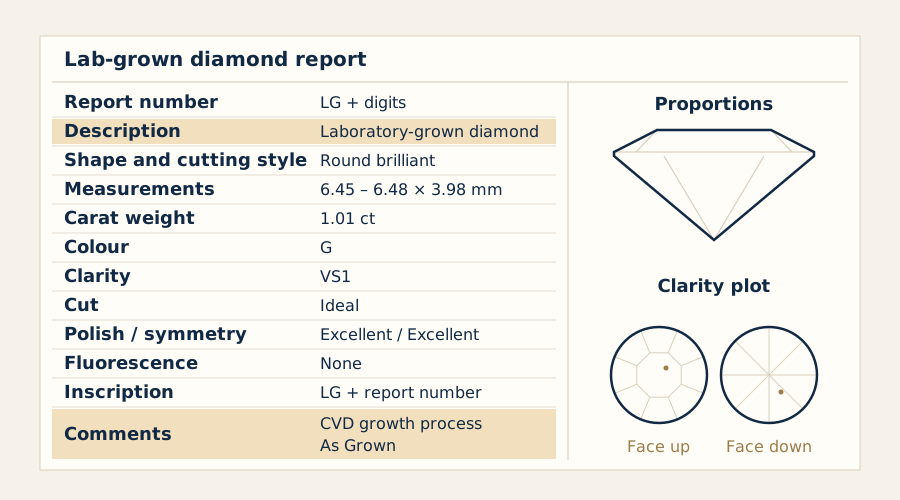
Two lines deserve the most attention: the description and the comments. The grades describe the diamond's appearance, but those two lines tell you what it is and what has been done to it. If you have read a mined-diamond report before, the layout will feel familiar; our page on the IGI report for natural diamonds walks through the natural version field by field.
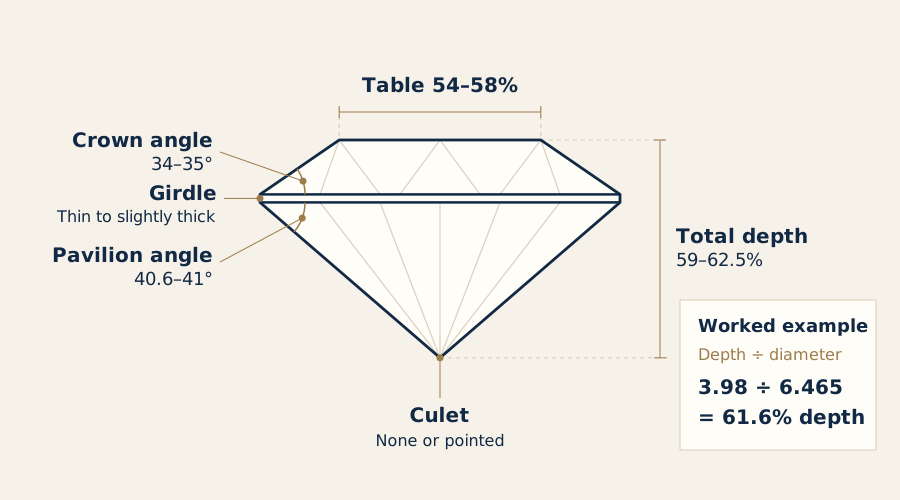
The measurements line is worth reading slowly. Divide the depth by the average diameter and you get the total depth percentage: 3.98 ÷ 6.465 = 61.6%. Compare the minimum and maximum diameters to see how round the stone is; a difference of a few hundredths of a millimetre is normal. For fancy shapes, divide length by width to get the length-to-width ratio, which decides whether an oval diamond looks slim or full. The millimetre figures also tell you face-up size, which matters more to the eye than the carat weight: two 1.00 carat rounds can differ by 0.2 mm or more in diameter if one is cut deeper.
What do CVD, HPHT and 'as grown' mean on an IGI report?
Lab-grown diamonds are made in one of two ways, and IGI states which one in the comments section. This is information you rarely get for a natural diamond, because nobody watched it form.
| CVD | HPHT | |
|---|---|---|
| Full name | Chemical vapour deposition | High pressure, high temperature |
| How it grows | Carbon from a gas such as methane settles layer by layer onto a thin diamond seed plate | A diamond seed sits in molten metal under about 5–6 GPa of pressure and roughly 1,300–1,600 °C, recreating conditions deep in the earth |
| Rough crystal shape | Flat, tabular blocks | Cube-octahedral crystal |
| Common inclusions | Dark pinpoints and fine clouds | Metallic flux inclusions |
| Post-growth treatment | Often heat-treated to reduce a brownish tint | Usually sold as grown |
| Look and wear | Same as any diamond | Same as any diamond |
Neither method is better in itself. A well-grown, well-cut stone from either process can reach top colour and clarity, and the method doesn't change hardness, brilliance or how the diamond wears. The grades are what describe its appearance, so compare stones on those, not on the growth method.
Post-growth treatment means anything done to the crystal after it leaves the grower. The most common is HPHT annealing of CVD diamonds: heating them under pressure to remove or reduce a brown or grey tint. IGI's comments usually read either 'As Grown – No indication of post-growth treatment' or 'Indications of post-growth treatment'. A treated lab-grown diamond is still a lab-grown diamond with stable colour; the point is that the report tells you, so you can compare like with like.
Some reports also note the stone is Type IIa, a scientific class of diamond containing almost no nitrogen. Only a small minority of natural diamonds are Type IIa, but most lab-grown diamonds are, so on a lab report it tells you little about quality. For more on how gem labs work out where a diamond came from, see how origin reports separate natural from laboratory-grown stones.
How are colour, clarity and cut graded on a lab-grown diamond?
Colour. IGI grades lab-grown diamonds on the same D–Z scale used for natural stones. D to F is colourless; G to J is near colourless, with only a faint warmth you would notice side by side with a D. Most lab-grown diamonds on the market fall between D and H. In white gold or platinum, G or H faces up white for most people; in yellow or rose gold, I or J can look just as white because the metal warms everything around it.
Clarity. Clarity describes inclusions (internal features) and blemishes (surface marks), judged by a grader at 10× magnification:
- FL / IF: Flawless or Internally Flawless; nothing inside visible at 10×.
- VVS1–VVS2: very, very slightly included; very hard to see even at 10×.
- VS1–VS2: very slightly included; minor features at 10×, almost always eye-clean.
- SI1–SI2: slightly included; noticeable at 10×, sometimes visible to the eye, especially in step cuts like emerald cuts.
- I1–I3: included; inclusions usually visible without magnification.
The inclusions themselves are different from those in mined diamonds. CVD stones can show small dark pinpoints of non-diamond carbon; HPHT stones can carry metallic flux from the growth cell, which is why some are weakly drawn to a strong magnet. Neither affects durability at VS clarity and above.
Cut. IGI gives an overall cut grade for round brilliants on a scale of Ideal, Excellent, Very Good, Good, Fair and Poor, with Ideal at the top. GIA's top cut grade is Excellent instead, as you can see in our guide to how GIA lays out its grades, and AGS used a 0 to 10 system, explained in AGS reports and their light-performance grading. For fancy shapes, lean on polish, symmetry, the proportions and your own eye.
Fluorescence. This is a glow under ultraviolet light, graded None, Faint, Medium, Strong or Very Strong. Most CVD diamonds show none. HPHT diamonds can fluoresce and sometimes glow briefly after the UV is switched off (phosphorescence). In normal light it almost never changes how a lab-grown diamond looks.
Not sure which one is right?
Send us the stones you are looking at and our gemologist will tell you which to choose and why.
How do you read the proportions diagram and clarity plot?
The full-size report includes a side-profile drawing with the stone's proportions. These numbers explain the cut grade. For a round brilliant, well-cut stones commonly fall in these ranges:
- Table: about 54–58% of the diameter (the large flat top facet).
- Total depth: about 59–62.5%.
- Crown angle: about 34–35° (the slope of the upper section).
- Pavilion angle: about 40.6–41° (the slope of the lower section, which does most of the light return).
- Girdle: thin to slightly thick; very thin edges chip more easily, very thick ones add hidden weight.
- Culet: none or pointed on most modern rounds.
The clarity plot is a map of the diamond seen from the top and the bottom, with symbols for each inclusion: usually red for internal features and green for surface ones, with a key beside it. The smaller card-style reports may leave the plot out, so ask for the full report if you want it. Use the plot to see where the inclusions sit. One near the edge can often be hidden under a claw; one under the table is the first place your eye goes.
What the plot cannot show is how visible an inclusion is in real life, how bright the stone is in daylight or whether a fancy shape has a dark bow-tie. That is why a 360° video or seeing the stone matters as much as the paper. We cover these blind spots in the limits of what any grading report shows.
How is an IGI lab-grown report different from a natural diamond or GIA report?
| Feature | IGI lab-grown report | IGI natural report | GIA lab-grown report |
|---|---|---|---|
| Description line | Laboratory-grown diamond | Natural diamond | Laboratory-grown diamond |
| Report number | LG prefix | Number only | Number only |
| Colour and clarity | D–Z and FL–I3 | D–Z and FL–I3 | Moving to simpler descriptions rather than full D–Z and FL–I3 grades |
| Growth method | Stated (CVD or HPHT) | Not applicable | Stated |
| Treatment | As grown, or indications of post-growth treatment | Noted if detected | Noted |
| Girdle inscription | LG plus report number | Report number, if inscribed | Laboratory-grown wording plus report number |
The most important difference is in the first line. A natural report says natural; a lab-grown report says laboratory-grown, and the inscription repeats it on the stone. That is the whole point of the document: two diamonds that look the same can be told apart on paper and on the girdle. Our page on how natural and lab-grown reports differ shows real examples side by side, and the natural IGI report layout is worth comparing if you are weighing up both.
Related guideNatural vs Lab-Grown Diamond ReportsAn honest view from a store that sells both: grading is done by people and instruments, and two labs can land a grade apart on the same stone, especially on colour. That is not a flaw in either lab; it is the nature of grading. The practical answer is to compare diamonds graded by the same lab. Because so many lab-grown stones carry IGI paper, comparing IGI with IGI is usually easy. Our guide on why most lab-grown buyers see IGI rather than GIA explains how the main labs' approaches differ.
What do Australian rules mean for a lab-grown diamond report?
Under the Australian Consumer Law, a business must not mislead you about what a product is, what it is made of or where it comes from. For diamonds, that means a seller has to make it clear when a stone is lab-grown, using words such as 'lab-grown' or 'laboratory-grown', not just 'diamond' with the origin buried in the fine print. An IGI report backs that disclosure in writing, and the LG inscription carries it on the stone itself.
The report is not a valuation. For insurance, you need a separate written valuation from a qualified jewellery valuer, for example a member of the National Council of Jewellery Valuers. A valuer will usually refer to the IGI report but sets a replacement value based on current retail prices. Keep both documents together.
Nor does the report state a price. As a broad guide, here is what IGI-graded round lab-grown diamonds have tended to cost in Australia, with a natural diamond for comparison. Lab-grown prices have fallen considerably over recent years and keep moving, so treat these as ranges only.
| Round brilliant, G–H, VS | Approximate price range (AUD) |
|---|---|
| 0.50 ct lab-grown | about $400–$1,200 |
| 1.00 ct lab-grown | about $900–$2,500 |
| 1.50 ct lab-grown | about $1,500–$4,000 |
| 2.00 ct lab-grown | about $2,000–$6,000 |
| 1.00 ct natural, for comparison | about $7,000–$15,000 |
Lab-grown costs much less than natural at the same grades, which is why many buyers choose a larger or higher-colour lab-grown stone. It is a diamond to wear and enjoy, not something to buy with resale in mind; the same is true of most jewellery. Our guide to choosing a lab-grown diamond covers how to balance size, colour and clarity within a budget.
Browse lab-grown diamonds graded by IGI
What doesn't an IGI report tell you about a lab-grown diamond?
A report is the starting point, not the full picture. It leaves out several things that matter when you choose a stone:
- Price or value: no dollar figure appears anywhere on it.
- Real-world appearance: brightness, sparkle pattern and, in fancy shapes, how strong the bow-tie is.
- Eye-cleanliness: an SI1 can be clean to the eye or not, depending on where the inclusion sits.
- Who grew it: the grower and country of growth are not usually listed.
- Environmental claims: the report makes no statement about energy use or sustainability.
- Identity, unless you check: paper alone doesn't prove which stone it belongs to; the inscription and the online record do.
For the complete picture, read our full list of the gaps in a grading report. Once the stone is chosen, the next document you will usually see is a design file for the ring. Our guide on reading an engagement ring CAD render explains how to check claw placement, band width and the height of the setting before anything is made.
How to read an IGI lab-grown diamond report: step by step
- Find the description. It should say laboratory-grown diamond. If it does not, it is not a lab-grown report.
- Read the comments. Note the growth method (CVD or HPHT) and whether it says as grown or indicates post-growth treatment.
- Check it online. Enter the report number on IGI's website and confirm every detail matches the paper.
- Match the inscription. Look at the girdle under a loupe or microscope and confirm the LG number matches the report.
- Work through the measurements. Note the millimetre size, calculate depth percentage and, for fancy shapes, the length-to-width ratio.
- Compare the grades. Colour, clarity, cut, polish, symmetry and fluorescence, against other stones graded by the same lab.
- Look at the stone. Use the clarity plot to find inclusions, then check them in a 360° video or in person.
- File it safely. Keep the report with your valuation and receipt for insurance and future servicing.
Steps three and four are the ones people skip, and they matter most. Our guide on checking an IGI report number and girdle inscription shows exactly what to look for on screen and under magnification. If you want to understand the science behind the growth-method line, revisit how gem labs identify a diamond's origin.
Free consultation
Talk to a gemologist
Compare stones in person or online with Raj Sood, Graduate Gemologist (GIA), AJP (GIA).
Book a consultationShop this shape
FAQ
Common questions
Is an IGI report for a lab-grown diamond reliable?
IGI is one of the main independent labs grading lab-grown diamonds, and its reports use the standard D–Z colour and FL–I3 clarity scales. Grades between labs can differ slightly, so compare stones graded by the same lab and always verify the report number online.
Is an IGI certificate the same as a valuation?
No. An IGI report describes and grades the diamond but gives no price. For insurance in Australia you need a separate written valuation from a qualified jewellery valuer.
What does 'As Grown' mean on an IGI report?
It means IGI found no indication that the diamond was treated after growth, for example by heating to improve its colour. If treatment was detected, the comments say there are indications of post-growth treatment.
Is a CVD or HPHT lab-grown diamond better?
Neither is better in itself. Both produce real diamond with the same hardness and sparkle; compare the colour, clarity and cut grades rather than the growth method.
How do I check an IGI lab-grown report number?
Enter the number on IGI's online report check and confirm the details match your paper report. Then match it to the LG laser inscription on the diamond's girdle using a loupe.
Does every lab-grown diamond have an inscription?
Most IGI-graded lab-grown diamonds are laser-inscribed on the girdle with LG and the report number. If you can't find it, ask your jeweller to show you under a microscope before you buy.

Ask a gemologist
Not sure which diamond to choose?
Raj Sood is a Graduate Gemologist (GIA) and master jeweller. Bring the stones you are considering, or send the reports, and he will tell you honestly which one is better and why.
Keep learning
Related guides
 Lab-Grown DiamondsHow to Verify a Lab-Grown Diamond Report and Inscription
 Certificates & ValuationsNatural vs Lab-Grown Diamond ReportsCertificates & ValuationsGIA vs IGI vs HRD Diamond Certificates
 Certificates & ValuationsWhat a Diamond Report Doesn't Tell YouLab-Grown DiamondsLab-Grown Diamonds Guide
 Certificates & ValuationsIGI Natural Diamond Report ExplainedCertificates & ValuationsDiamond Origin Reports Explained
 Certificates & ValuationsHow to Read a GIA Diamond Report
Explore more
More guides on this topic
Education