
- Education
- Certificates & Valuations
- IGI Natural Diamond Report Explained: Every Line, What It Proves and How to Verify It
Certificates & Valuations
IGI Natural Diamond Report Explained: Every Line, What It Proves and How to Verify It
An IGI natural diamond report is the document many people rely on before buying a mined diamond, yet few read past the colour and clarity. Here is what every line means, what the report does and doesn't prove, and how to check it belongs to your stone.
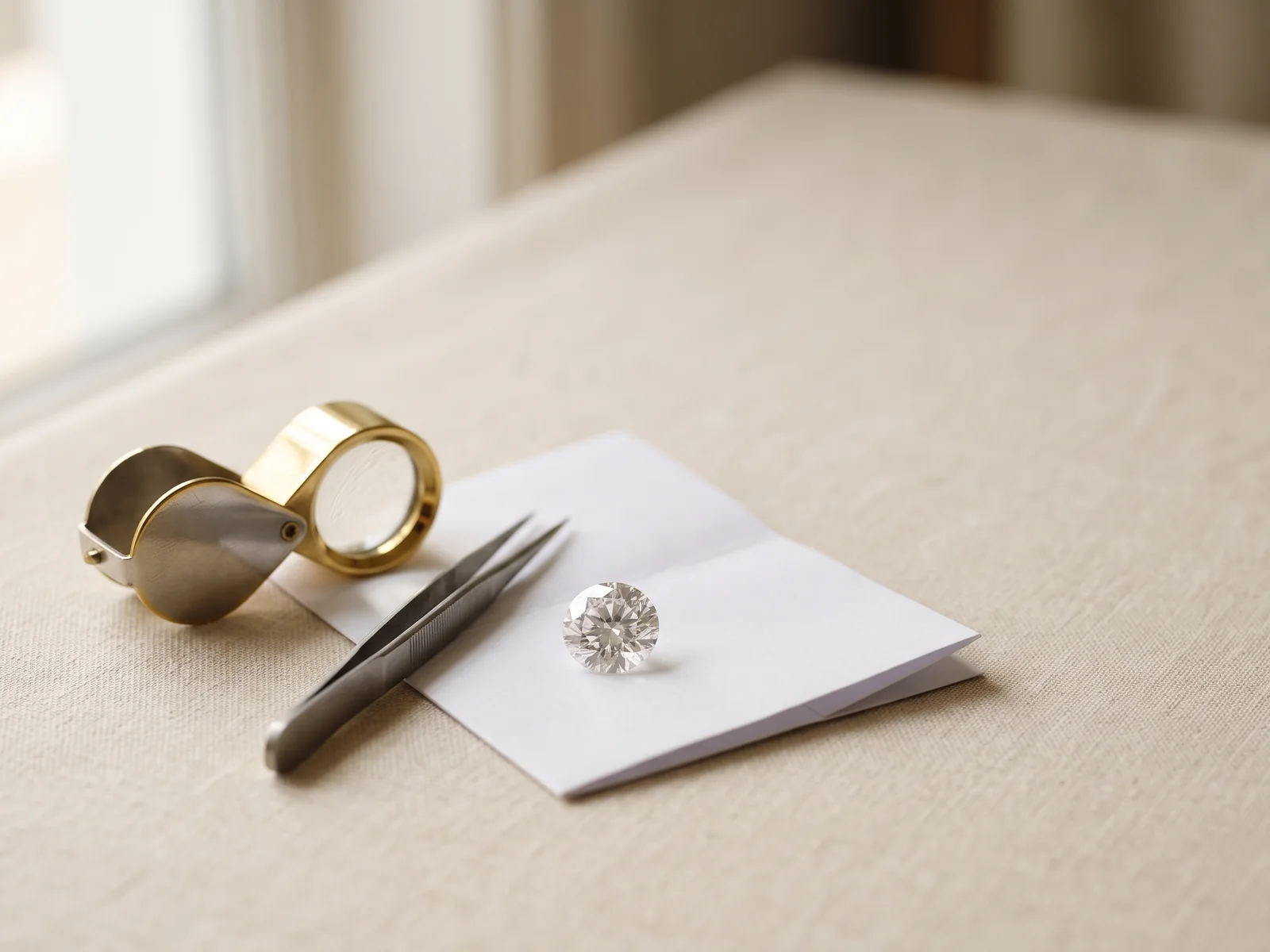
 Reviewed by Raj Sood, Graduate Gemologist (GIA), AJP (GIA)Master jeweller and Graduate Gemologist (GIA) · reviewed 4 November 2026
Quick answer
An IGI natural diamond report is an independent grading document from the International Gemological Institute confirming a diamond is natural and recording its shape, measurements, carat weight, colour, clarity, cut, polish, symmetry and fluorescence. It doesn't state value, ownership or mine origin. Verify it by entering the report number on IGI's website and matching the girdle laser inscription.
What is an IGI natural diamond report?
An IGI natural diamond report is a grading document from the International Gemological Institute (IGI), an independent gem laboratory founded in Antwerp in 1975. It records what the lab found when it examined one specific mined diamond: that it is natural diamond, its shape and cutting style, its measurements in millimetres, its carat weight, its colour and clarity grades, its polish and symmetry, its fluorescence and, for round brilliants, an overall cut grade. Most people call it a certificate. Our guide to diamond certificates and jewellery reports explains why gemmologists prefer the word report: it records findings, it does not certify value.
IGI grades a very large share of the world's lab-grown diamonds, so many Australians first meet the name on a lab-grown stone. The natural report looks similar but carries different wording in key places, and our side-by-side look at natural and lab-grown reports sets those differences out. If your stone is lab-grown, use our walkthrough of reading an IGI lab-grown diamond report instead, because the origin wording and inscription are not the same.
Keep one idea in mind as you read: a report is the lab's expert opinion of the diamond's quality on the day it was graded. It is not a valuation, a proof of ownership or a statement of where the diamond was mined. Each of those needs a different document, and we cover them all below.
What does each line on an IGI natural diamond report mean?
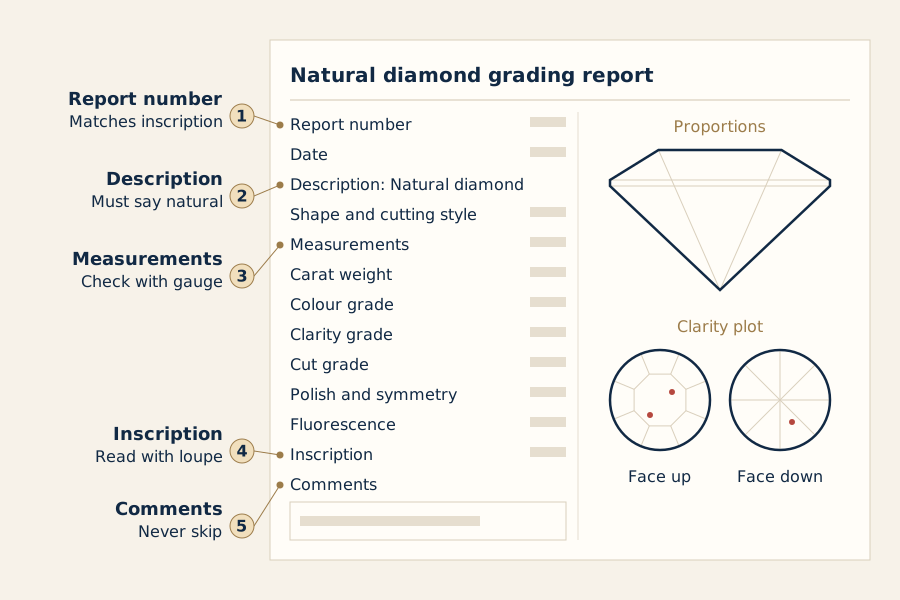
Most IGI natural diamond reports follow the same order: report details at the top, grading results in the middle, and the proportion diagram and clarity plot to the side or on the back. The exact layout varies between report versions and formats, and IGI also issues shorter formats for smaller stones, so treat the order below as a guide rather than a template.
| Report line | What it means | What to check |
|---|---|---|
| Report number | A unique number linking the report to one diamond | Matches IGI's online record and the laser inscription |
| Date | When the lab graded the stone | An old date may predate damage, wear or recutting |
| Description | States the stone is a natural diamond | Must say natural; any detected treatment is disclosed |
| Shape and cutting style | For example Round Brilliant or Oval Modified Brilliant | Matches the stone in front of you |
| Measurements | Millimetres: minimum–maximum diameter × depth for rounds; length × width × depth for other shapes | Re-measure an unset stone with a gauge; figures should agree closely |
| Carat weight | Weight to two decimal places; 1 carat = 0.200 g | Weigh an unset stone on a calibrated carat scale |
| Colour grade | A letter from D (colourless) to Z (light yellow or brown) | Judge it against your metal colour |
| Clarity grade | FL to I3, judged at 10× magnification | Compare with the clarity plot |
| Cut grade | Overall cut quality, rounds only | Read alongside proportions |
| Polish and symmetry | Finish and facet alignment, Excellent to Poor | Excellent or Very Good is typical for well-made stones |
| Fluorescence | Glow under ultraviolet light, None to Very Strong, with colour | Look at the stone in daylight if it is Strong or Very Strong |
| Inscription | Text laser-written on the girdle | Read it with a loupe |
| Comments | Extra notes, such as inclusions not shown or treatments | Never skip this box |
Two numbers deserve a second look. The measurements tell you face-up size (the size you see from above) better than carat weight does. A well-cut 1.00 carat round brilliant usually measures about 6.3–6.5 mm across, but a stone cut too deep can carry the same weight in a 6.1 mm spread. The depth percentage, total depth divided by average diameter, is where that shows up: many well-cut rounds sit at roughly 59–62.5%.
Carat weight matters for price because natural diamonds become much rarer as they get larger, and prices tend to step up at round weights such as 0.50, 0.90 and 1.00 carat. A 0.98 carat stone can look almost identical to a 1.00 carat on the hand, which is why it pays to read the millimetres rather than just the weight.
How are colour, clarity and cut graded on an IGI report?
IGI uses the same D-to-Z colour letters that most major labs use. Graders compare the diamond, face-down, against a set of master stones under controlled lighting. In broad groups: D–F is colourless, G–J near colourless, K–M faint, N–R very light and S–Z light yellow or brown. Diamonds with stronger colour than Z are graded as fancy colours on a separate scale.
Clarity describes inclusions (internal features) and blemishes (surface features) as seen by a trained grader at 10× magnification. The grades run:
- FL (Flawless): no inclusions or blemishes visible at 10×.
- IF (Internally Flawless): no inclusions, only minor surface blemishes.
- VVS1–VVS2 (Very, Very Slightly Included): extremely difficult to see at 10×.
- VS1–VS2 (Very Slightly Included): minor inclusions, usually invisible to the naked eye.
- SI1–SI2 (Slightly Included): noticeable at 10×, sometimes visible to the eye, especially in larger stones and step cuts.
- I1–I3 (Included): obvious inclusions that may affect brightness or, at I3, durability.
For round brilliants, IGI gives an overall cut grade based on proportions, polish and symmetry. The top grade may appear as Ideal or Excellent depending on the report version, so check the scale printed on the report itself. Fancy shapes such as ovals, pears and cushions receive polish and symmetry grades but usually no overall cut grade, so you judge their cut from the proportions and from the stone itself.
The proportion diagram shows the stone in profile with its table percentage (the large top facet as a share of the width), crown angle, pavilion angle, girdle thickness and culet (the point or tiny facet at the bottom). As a rough guide, many well-cut rounds show a table of about 54–58%, a crown angle of about 34–35° and a pavilion angle of about 40.6–41.0°. A report records these numbers but does not measure how much light the diamond actually returns; for that, see how AGS builds light performance into its cut grade and GCAL's light performance imaging.
Fluorescence is a glow, usually blue, that some diamonds give off under ultraviolet light, including the UV in daylight. Roughly a quarter to a third of natural diamonds show some. Faint or medium fluorescence rarely changes how a stone looks, and in lower colours blue can even offset a slight warm tint. In a small number of stones, very strong fluorescence makes the diamond look a little hazy, which the report cannot tell you; only looking at the stone can.
What do the clarity plot and comments tell you?
The clarity plot is a map of the diamond, drawn face-up and face-down, showing where the main clarity characteristics sit. Internal features are typically drawn in red and surface features in green, each with a symbol explained in the key. Common symbols include:
- Crystal: a mineral crystal trapped inside the diamond as it grew, sometimes another diamond.
- Feather: a small internal break. Usually harmless, but one that reaches the surface near the girdle or a point deserves a closer look.
- Cloud: a group of tiny pinpoints that can, in larger numbers, make a stone look slightly milky.
- Pinpoint and needle: tiny dot-like and thin rod-like inclusions.
- Natural and indented natural: a small patch of the original crystal surface left on the finished stone.
- Extra facet, chip or nick: surface features, often at the girdle.
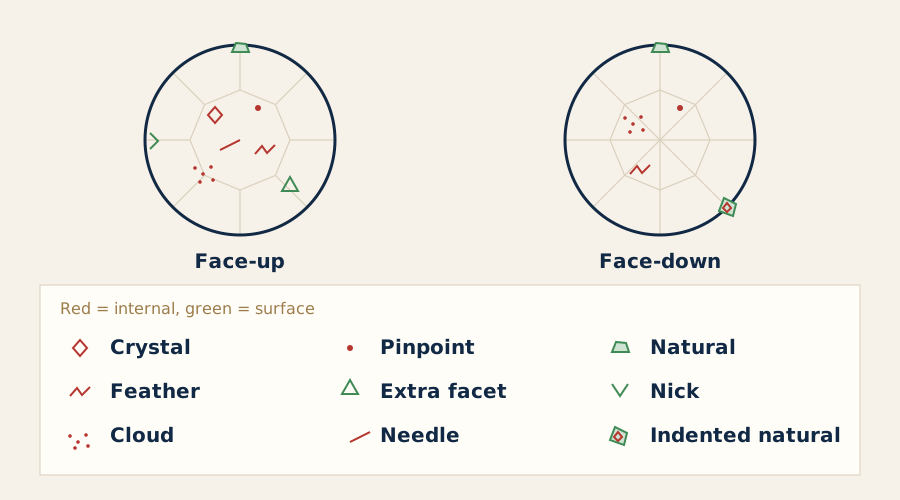
A natural left on the girdle is common in carefully cut natural diamonds, because the cutter has kept as much weight as possible from the rough. When that patch dips below the surface it is called an indented natural, and our page on what an indented natural is and when it matters explains how it affects clarity and durability. Its presence on a plot is one small clue that the stone was cut from mined rough, though it is not proof on its own.
The comments box is easy to skip and often the most useful line. Typical notes include 'Additional pinpoints are not shown', 'Surface graining is not shown' or 'Clarity grade is based on clouds that are not shown'. That last one is worth taking seriously: when clouds are the grade-setting feature, ask to see the diamond in person or on a clear video, because heavy clouds can soften a stone's brightness. Any treatment IGI detects, such as laser drilling or HPHT (high pressure, high temperature) colour treatment, should also be disclosed on the report, usually here or in the description.
Not sure which one is right?
Send us the stones you are looking at and our gemologist will tell you which to choose and why.
How is an IGI natural report different from an IGI lab-grown report?
Both diamonds are real diamond, with the same hardness (10 on the Mohs scale) and refractive index (about 2.42). The difference is origin. A natural report means IGI found the stone was formed deep in the earth over hundreds of millions to billions of years, while a laboratory-grown diamond is grown over weeks by CVD (chemical vapour deposition) or HPHT. The reports make that difference obvious in several places.
| Feature | IGI natural diamond report | IGI lab-grown diamond report |
|---|---|---|
| Report title | Natural diamond report | Laboratory-grown diamond report |
| Origin statement | Natural diamond | Laboratory-grown diamond, often with growth method (CVD or HPHT) |
| Report number | Usually numeric | Usually prefixed with LG |
| Girdle inscription | IGI and the report number | LG number, often with the words LAB GROWN |
| Treatments | Any detected treatment disclosed | Post-growth treatment usually noted |
| Colour and clarity scales | D–Z and FL–I3 | Same D–Z and FL–I3 scales |
| Typical price of the stone | Much higher for the same grades | Much lower for the same grades |
Because the grading scales are shared, a G VS1 lab-grown diamond and a G VS1 natural diamond can look the same to the eye. What differs is rarity and price, so always confirm the origin line before you compare grades or prices between two stones.
Browse diamonds graded by IGI: natural and lab-grown
What does an IGI report prove, and what doesn't it?
Read fairly, an IGI natural diamond report tells you four solid things: the stone is natural diamond, it weighed what the report says when graded, an independent lab assigned these grades on that date, and the lab found (or did not find) the treatments listed. That is a lot of useful information, and it is why you should expect a report for any significant diamond.
What it does not tell you is just as important:
- Value: a report never states a price or replacement value.
- Ownership: it describes a stone, not who owns it. Keep your receipt and valuation.
- Mine or country of origin: a standard grading report does not say where the diamond came from; that needs one of the separate diamond origin reports and traceability documents.
- How it looks: two stones with the same grades can differ in brightness, fire and where the inclusions sit.
- Its condition today: chips, wear or a recut after the report date will not appear.
- The setting: metal, claws and workmanship are outside the report entirely.
- That this is the stone: unless you match the inscription, measurements and plot, the paper could belong to another diamond.
Our guide to the gaps every diamond report leaves goes through each of these with real examples, including why the photo on the report is not the stone you are buying.
Is an IGI report the same as an insurance valuation in Australia?
No. In Australia, insurers usually ask for a valuation before covering jewellery, and an IGI report is not one. A valuation is written by a jewellery valuer, describes the whole piece (the diamond, any other stones, the metal and the setting) and states a replacement value in Australian dollars. A good valuation will often quote the report number and grades, which is one reason a report is so useful when it comes time to insure.
| IGI grading report | Australian insurance valuation | |
|---|---|---|
| Written by | Independent gem laboratory | Jewellery valuer |
| Covers | The loose diamond | The whole piece, including metal and setting |
| States a value in AUD | No | Yes, usually retail replacement value |
| Main purpose | Identify and grade the diamond | Insurance and replacement |
| Changes over time | Grades are fixed at the date of grading | Should be updated every few years as prices move |
| What insurers usually want | Helpful supporting document | Usually required for higher-value items |
A replacement valuation is often higher than the price you paid, because it reflects what it would cost to replace the item new at full retail. That is normal and does not mean the piece would sell for that amount second-hand. Many valuers suggest updating a valuation every two to three years, or sooner after a repair or a big change in gold or diamond prices. Ask whether your valuer belongs to a recognised body such as the National Council of Jewellery Valuers (NCJV), and whether they examined the diamond against its report rather than copying the grades across.
Is an IGI natural diamond report as reliable as GIA?
Related guideGIA vs IGI vs HRD Diamond CertificatesIGI is a long-established, independent lab, and its reports are widely accepted around the world. For natural diamonds, though, GIA (Gemological Institute of America) reports are the most common reference in the trade, and dealers often price an IGI-graded natural stone with an eye on how it might grade at GIA. Opinions differ on how closely the two labs agree on natural stones; some in the trade find IGI colour or clarity grades can occasionally sit a grade softer, others find them consistent. The fair advice is to compare stones on their merits and look at the diamond, not just the paper.
If you are weighing up labs, our comparison of GIA, IGI and HRD grading sets out the differences. You may also find it useful to read our line-by-line GIA report guide and the HRD Antwerp report explainer, since the layouts are similar enough that you can compare two stones side by side. For smaller natural diamonds, labs often issue shorter formats; GIA's version is covered in the GIA dossier versus full grading report.
Some reports deserve more caution. Grading standards vary between labs, and older or less widely used reports can be looser; our page on what to know about GSI and EGL reports explains how to treat them. Whatever the lab, a report is only as useful as your check that it matches the stone.
How do you verify an IGI natural diamond report? Step by step
- Find the report number. It is printed near the top of the report and on the QR code or security features, depending on the version.
- Check it online. Enter the number in the report verification tool on IGI's official website and compare every detail: shape, measurements, carat weight, colour, clarity and the origin statement saying natural diamond.
- Read the inscription. Use a 10× loupe to find the laser inscription on the girdle (the thin outer edge) and confirm it matches the report number. Not every stone is inscribed, so if there is none, the next checks matter more.
- Re-measure the stone. If it is unset, a jeweller can measure it with a millimetre gauge; the figures should agree closely with the report.
- Weigh it if unset. A calibrated carat scale should match the stated weight to the hundredth of a carat.
- Match the clarity plot. Under a loupe or microscope, find one or two of the larger plotted inclusions in the same positions.
- Look at the diamond itself. Check brightness, any haziness and inclusions near the girdle that the grades alone cannot show.
- Arrange a valuation. For insurance in Australia, have the finished piece valued in AUD, with the report number recorded on the valuation.
Do these checks before you pay, not after. If any detail does not match, ask why before going further. Any term in this guide you have not met before is explained in our plain-English jewellery glossary.
Free consultation
Talk to a gemologist
Compare stones in person or online with Raj Sood, Graduate Gemologist (GIA), AJP (GIA).
Book a consultationFAQ
Common questions
Is an IGI natural diamond report the same as a certificate?
Yes, in everyday speech people call it a diamond certificate, but labs call it a grading report. It records the lab's findings about the diamond on the date it was graded and does not certify a value.
How do I check if an IGI report is real?
Enter the report number in the verification tool on IGI's official website and compare every detail with the paper copy. Then confirm the laser inscription on the girdle and the measurements match the stone itself.
Does an IGI report say where my diamond was mined?
No. A standard IGI grading report confirms the diamond is natural but does not state its mine or country of origin. That needs a separate origin or traceability document.
Can I use an IGI report for insurance in Australia?
It helps, but most insurers want a valuation that states a replacement value in AUD for the whole piece. A valuer will usually refer to the report number and grades in that valuation.
Is IGI less strict than GIA on natural diamonds?
Opinions in the trade differ, and GIA reports are the more common reference for natural diamonds. The safest approach is to compare the actual stones, not just the grades on paper.
What does LG mean on an IGI report number?
LG indicates a laboratory-grown diamond. An IGI natural diamond report should describe the stone as natural diamond and will not carry the LG prefix or the words lab grown.

Ask a gemologist
Not sure which diamond to choose?
Raj Sood is a Graduate Gemologist (GIA) and master jeweller. Bring the stones you are considering, or send the reports, and he will tell you honestly which one is better and why.
Keep learning
Related guides
 Certificates & ValuationsGIA vs IGI vs HRD Diamond Certificates
 Lab-Grown DiamondsHow to Read an IGI Report for a Lab-Grown Diamond
 Certificates & ValuationsWhat a Diamond Report Doesn't Tell YouCertificates & ValuationsDiamond Origin Reports ExplainedCertificates & ValuationsDiamond Certificates & Jewellery ReportsCertificates & ValuationsNatural vs Lab-Grown Diamond Reports
 Certificates & ValuationsAGS Diamond Reports Explained
 Diamond 4Cs & GradingIndented Naturals in Diamonds
Explore more
More guides on this topic
Education