
- Education
- Diamond 4Cs & Grading
- Diamond Fluorescence Strengths: None, Faint, Medium, Strong and Very Strong
Diamond 4Cs & Grading
Diamond Fluorescence Strengths: None, Faint, Medium, Strong and Very Strong
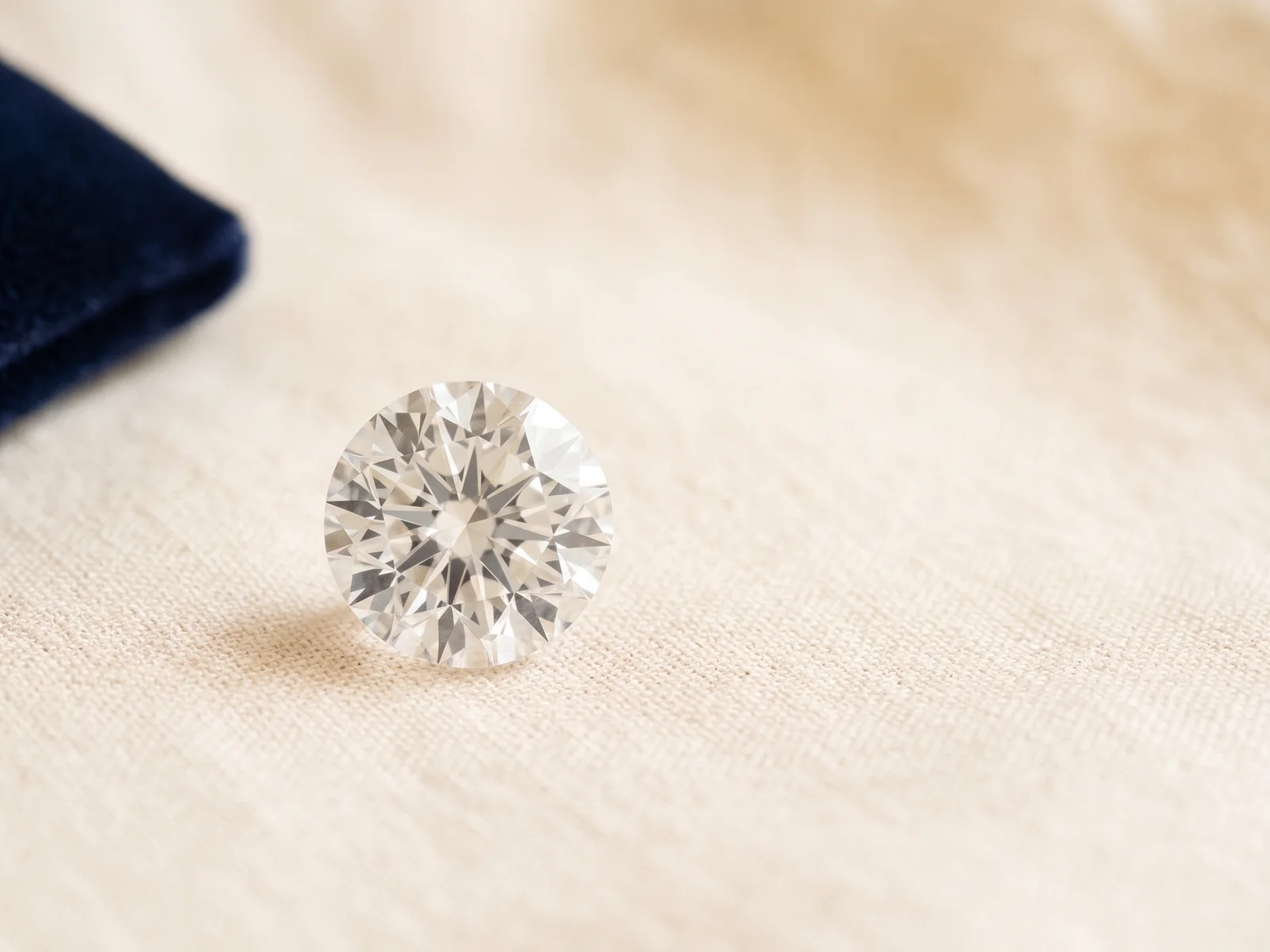
Diamond fluorescence is the line on a grading report that worries people most and, most of the time, matters least. Here is what each strength means, how the lab measures it, and when it really changes the look or the price.
 Reviewed by Raj Sood, Graduate Gemologist (GIA), AJP (GIA)Master jeweller and Graduate Gemologist (GIA) · reviewed 4 November 2026
Quick answer
Diamond fluorescence is a glow, usually blue, that some diamonds give off under ultraviolet light. Labs grade it None, Faint, Medium, Strong or Very Strong. It rarely shows in normal daylight. Faint to Medium is seldom a concern, Strong blue can make I–K colours look whiter, and only a small share of Very Strong stones look hazy.
What is diamond fluorescence?
Fluorescence is visible light that a material gives off while it is exposed to ultraviolet (UV) radiation. In diamond, the glow usually comes from tiny structural features in the crystal, most often a cluster of three nitrogen atoms around a missing carbon atom, called an N3 centre. These centres absorb invisible UV energy and release it as visible blue light. Switch the UV off and the glow stops almost instantly. If it lingers for a few seconds, that afterglow is called phosphorescence, which is rare in natural diamonds and more common in some lab-grown ones.
Fluorescence is not one of the four Cs of cut, colour, clarity and carat, but every major grading report records it, and it can nudge both appearance and price. Our short definition of fluorescence across gemstones covers rubies, emeralds and other stones that glow as well; this page is about diamonds only, and how to read the five strengths a lab uses. Any term you have not met before is explained in the GemTrove jewellery glossary.
Roughly a quarter to a third of natural gem diamonds show some fluorescence under a lab lamp, and most of that is Faint or Medium. Blue accounts for the vast majority. Yellow, green, orange and white glows also occur but are uncommon. Daylight contains some UV, which is why fluorescence is not purely a lab curiosity: in strong outdoor sun, a Strong or Very Strong blue stone can show a faint bluish cast, while indoors under LED or warm lighting it usually looks no different from a stone with None.
What do the diamond fluorescence grades None to Very Strong mean?
GIA and IGI both use five strengths: None, Faint, Medium, Strong and Very Strong. Some labs word them differently. HRD Antwerp, for example, uses four grades: Nil, Slight, Medium and Strong, and some older reports say Negligible. They all describe the same thing: how bright the glow is compared with a set of reference stones under the same lamp. Think of this table as a plain-English diamond fluorescence chart.
| Grade | What the lab sees under UV | Effect in normal light | How common |
|---|---|---|---|
| None | No glow above the weakest reference stone | Nothing to notice | Most natural diamonds |
| Faint | A weak glow, only just visible | None you could see | Common |
| Medium | A clear, moderate glow | Almost always none | Fairly common |
| Strong | A bright glow | Possibly a slight bluish tint in direct sun; can make I–K colours look whiter | Less common |
| Very Strong | An intense glow | As for Strong; a small minority look hazy or oily | Uncommon |
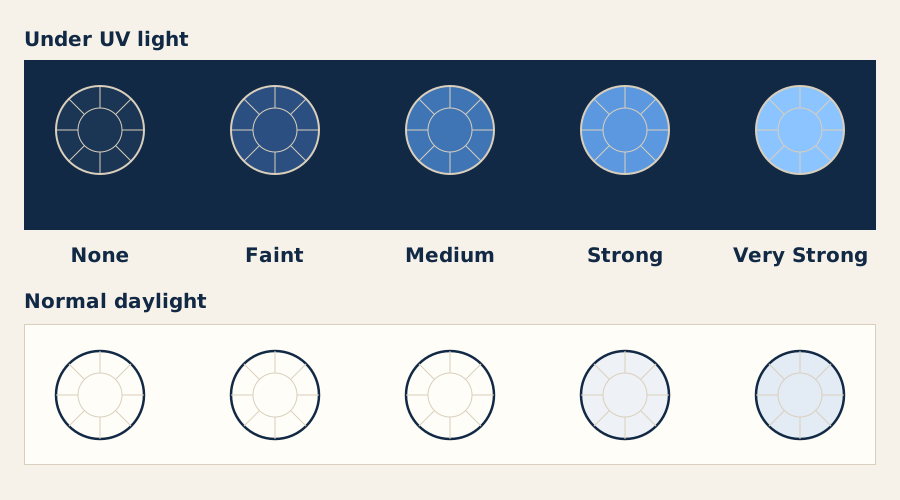
On a GIA report, Faint is listed on its own, while Medium and above also name the colour, for example 'Medium Blue' or 'Strong Yellow'. IGI reports follow a similar pattern. A report that says None means the glow was below the level of the weakest reference stone, not that the crystal has no fluorescent centres at all.
Fluorescence sits in the same part of the report as polish and symmetry, but it is an observation, not a quality grade. None is not 'better' than Strong in the way Excellent polish is better than Good polish. For the grades that really do rank quality, see our pages on what polish grades mean on a report and how Excellent, Very Good and Good cut grades differ. Cut has far more effect on how a diamond looks than fluorescence ever will.
How does a lab test diamond fluorescence?
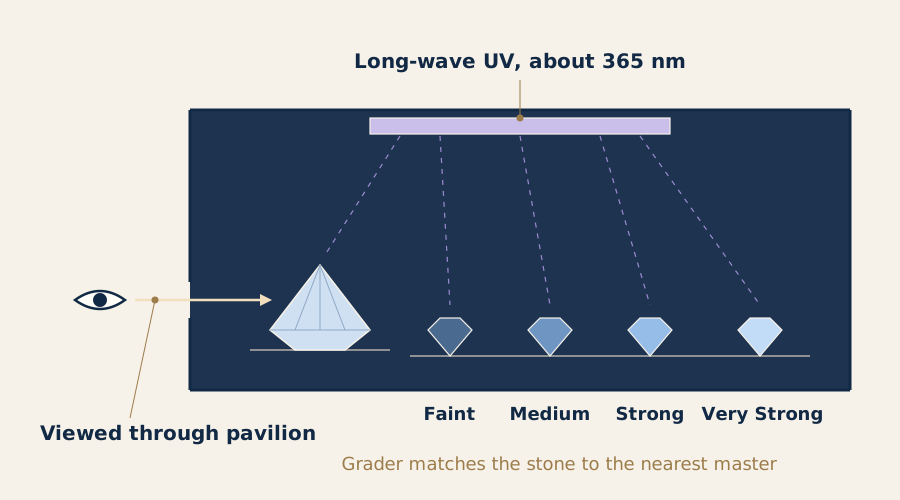
The test is simple and takes a minute or two. The grader places the loose diamond in a darkened viewing box under a long-wave UV lamp at about 365 nanometres (nm), the same kind of light as a party 'black light'. The stone is viewed table-down, through the pavilion (the lower cone of the diamond), and from the side, next to a set of master stones of known strength. The grader decides which master it most closely matches and records that strength, plus the colour of the glow.
- Loose stones only: metal blocks UV and reflects light, so a set diamond cannot be graded accurately for fluorescence.
- Long-wave, not short-wave: short-wave UV (about 254 nm) is used for identification work, not for the report's fluorescence grade.
- Master stones: comparing against physical references keeps grades consistent between graders and between labs.
- Colour of glow: recorded because blue, yellow and other glows affect appearance differently.
Labs also use UV for other jobs. Short-wave UV and specialist imaging help separate natural from laboratory-grown diamonds and help spot treatments. A fracture-filled stone, for example, may show a coloured 'flash effect' in the filler under magnification; our guide to how laser drilling and fracture filling are disclosed explains what to look for. None of that changes the fluorescence grade, which is only about the long-wave glow.
While you have the report open, read it as a whole. The plot and comments may also mention finish features such as small pits and extra facets. These are separate from fluorescence, but together they give you the full picture of the stone.
Does fluorescence make a diamond look cloudy?
Usually not. The concern comes from a small number of diamonds with Very Strong, and occasionally Strong, blue fluorescence that look slightly hazy, milky or 'oily' in daylight. The trade calls these stones overblues. The haze is thought to come from submicroscopic features in the crystal linked to the strong glow, and the UV in sunlight makes it more noticeable outdoors than indoors.
GIA researchers published a well-known study in 1997 in which trained graders and ordinary observers compared diamonds with different fluorescence strengths. For most stones, observers could not reliably see a difference in transparency face-up. Where they noticed a difference in colour, strongly blue stones were often judged to look slightly better, not worse. Since then, most gemmologists give the same advice: judge the individual stone, not the word on the report.
- Signs of an overblue: a soft, foggy look across the whole stone, reduced contrast between bright and dark facets, worse in sunlight than indoors.
- Not a sign: a bright blue glow in a UV photo. That only confirms the grade, not whether the stone looks hazy in daylight.
- Ask for: a viewing in natural light, or a photo taken near a window, for any Strong or Very Strong stone.
If a diamond does look hazy, fluorescence is not the only possible cause. Clouds of tiny pinpoint inclusions, internal graining from uneven crystal growth and twinning wisps along twin planes can all soften transparency. On the surface, a poorly finished stone with burn marks or a lizard skin texture can look dull too. A gemmologist can usually tell these causes apart with a 10× loupe and a UV torch.
Not sure which one is right?
Send us the stones you are looking at and our gemologist will tell you which to choose and why.
Does fluorescence affect diamond colour grades?
Colour grading is done under controlled, daylight-equivalent lighting that is low in UV, and the grader looks at the stone table-down, so fluorescence should not shift the colour grade itself. Where it matters is in how the stone looks afterwards, in real light. Blue sits opposite yellow on the colour wheel, so a blue glow can partly cancel a faint yellow body colour (the diamond's own colour) when there is UV around.
| Colour grade | Faint to Medium blue | Strong to Very Strong blue |
|---|---|---|
| D–F (colourless) | No visible effect | Little visible benefit; check carefully for haze |
| G–H (near colourless) | No visible effect | Can look a touch whiter in sunlight; check for haze |
| I–K (faint warmth) | No visible effect | Often looks whiter outdoors; a common way to get a whiter look for less |
| L–M and below | Little visible effect | Can offset a noticeable tint; check transparency |
Yellow fluorescence works the other way. A 'Strong Yellow' glow can make a stone look a little warmer in sunlight, so it deserves more caution if you plan a white gold or platinum setting. Green, orange and white glows are uncommon in natural stones and are best judged in person.
Australian light is worth a mention. Our sun has a high UV level, especially in summer, so a Strong or Very Strong blue stone is more likely to show a slight bluish lift outdoors here than under an overcast northern sky. Indoors, behind glass and under most LED lighting, the effect largely disappears. Faint and Medium stones look the same in either setting.
What does the fluorescence grade change in photos and videos?
Most online diamond photos and 360° videos are shot in studio light boxes using LED lighting that contains very little UV. Under that light, a None and a Strong Blue diamond of the same colour and cut usually look identical. That is useful when you are comparing sparkle and symmetry, but it means a studio video will not tell you whether a Very Strong stone looks hazy in sunlight.
- Studio photos and videos: show cut, sparkle and inclusions well; show almost nothing of fluorescence.
- UV torch photos: show the glow clearly, even for Medium stones, and can look more dramatic than anything you would see in daily wear.
- Natural light photos: the most useful check for Strong and Very Strong stones, because they show any bluish cast or haze.
Close-up photos can also be misread. A bright spot or line in a magnified image is more often an inclusion or a finish feature than fluorescence, for example a tunnel left by laser drilling to remove a dark inclusion, fine bearding along the girdle edge or etch channels left by natural dissolution. None of these are caused by fluorescence, and the report's plotting diagram will show where each one sits.
When comparing stones, ask for the full grading report, the studio video and, for anything graded Strong or Very Strong, a photo or viewing in natural daylight. Those three together tell you more than the fluorescence grade alone.
Do lab-grown diamonds have fluorescence?
Yes, some do. Lab-grown diamonds are real diamond, graded on the same fluorescence scale, but their glow follows different patterns because they grow in different conditions. Most contain far less nitrogen than natural diamonds, so many are graded None or Faint. The two growth methods, HPHT (high pressure, high temperature) and CVD (chemical vapour deposition), each tend to leave their own signature.
| Natural diamond | Lab-grown (HPHT) | Lab-grown (CVD) | |
|---|---|---|---|
| Typical glow colour | Blue, from N3 centres | Greenish-blue or yellowish when present | Orange to red when present |
| Usual strength range | None to Very Strong | Mostly None to Medium | Mostly None to Medium |
| Phosphorescence | Rare | More common, often blue | Occasional |
| Long-wave vs short-wave | Usually stronger under long-wave | Often stronger under short-wave | Varies |
| Effect on price | Can matter in D–H colours | Little | Little |
These patterns are one of the clues labs use, alongside specialist imaging, to confirm whether a diamond is natural or laboratory-grown. You cannot identify a lab-grown diamond from its fluorescence grade alone, so always rely on the report, which states the origin clearly. For the detail on why HPHT and CVD stones glow the way they do, read our guide to fluorescence in lab-grown diamonds.
Related guideLab-Grown Diamond Fluorescence ExplainedIs a diamond with strong fluorescence cheaper?
In natural diamonds, often yes, mainly in the higher colours. Buyers paying for a D, E or F stone tend to want nothing on the report that could affect appearance, so Strong and Very Strong stones in those colours usually trade below the same stone with None. In the I–K range the effect is small, because a blue glow can help the stone look whiter. Treat the patterns below as broad market tendencies only.
| Natural 1 ct, compared with None | Faint | Medium | Strong to Very Strong |
|---|---|---|---|
| D–F colour | Little or no discount | Small discount | Noticeable discount, usually the largest |
| G–H colour | Little or no difference | Little or a small discount | Small to moderate discount |
| I–K colour | No difference | Little or no difference | Little or no discount |
| Lab-grown, any colour | Little or no difference | Little or no difference | Little difference |
To put that in dollars: if a natural 1 carat G VS2 round with None sat somewhere around AUD $8,000–$14,000, the same stone with Strong blue might sit several hundred to over a thousand dollars lower. Prices move with the market and with every grade on the report, so use this as a rough guide, not a quote.
That difference can be put to work elsewhere. If your budget is fixed, a Medium or Strong blue stone in H–J colour can free up money for a little more carat weight or a better cut. Our guide to choosing between a bigger diamond and better grades walks through those trade-offs. In earrings and multi-stone rings, matching matters: pair stones with similar fluorescence so one does not look bluer in sunlight, and check how the weight is quoted using our explainer on ct, ctw and tcw weight terms.
Browse diamonds by fluorescence: natural and lab-grown
How do you choose a fluorescence grade? Step by step
- Read the report first. Note the fluorescence strength and colour, and confirm whether the diamond is natural or lab-grown.
- Weigh it against the colour grade. In D–F, None to Medium keeps resale and appearance questions simple; in I–K, Medium to Strong blue can look whiter.
- Treat Faint and Medium as neutral. They almost never change how a diamond looks, so do not pay extra to avoid them.
- Check Strong and Very Strong stones in daylight. Ask for a natural-light photo or viewing and look for any foggy or oily look.
- Be more careful with yellow glows. Strong Yellow can warm a stone, especially in white metal.
- Match stones in pairs and clusters. Keep fluorescence similar across earrings and multi-stone rings.
- Put cut ahead of fluorescence. A well-cut stone with Medium Blue will look livelier than a poorly cut stone with None.
Free consultation
Talk to a gemologist
Compare stones in person or online with Raj Sood, Graduate Gemologist (GIA), AJP (GIA).
Book a consultationShop this shape
FAQ
Common questions
Is fluorescence bad in a diamond?
Not usually. Faint and Medium fluorescence almost never affect appearance, and Strong blue can even make lower colours look whiter. Only a small share of Very Strong stones look hazy, which you can check in daylight.
Can you see diamond fluorescence with the naked eye?
Under a UV lamp or black light, yes, the glow is obvious from Medium upwards. In normal indoor light you cannot see it, and in strong sunlight only Strong or Very Strong stones may show a slight bluish tint.
What is the difference between Faint and None fluorescence?
Under a lab lamp, Faint shows a weak glow and None shows no glow above the weakest reference stone. In everyday light, the two look the same.
Does fluorescence affect a diamond's sparkle?
For almost all stones, no. Sparkle comes from the cut. Only a rare overblue with Very Strong fluorescence can look slightly hazy, which reduces contrast.
Do lab-grown diamonds glow under UV light?
Some do. Many lab-grown diamonds are graded None or Faint, while others show greenish-blue, yellowish or orange-red glows and sometimes phosphorescence, depending on how they were grown.
Should I pay more for a diamond with no fluorescence?
Only if you want D–F colour and prefer a clean report line, or if you are matching stones. In G and below, a Faint or Medium stone usually looks identical and often costs a little less.

Ask a gemologist
Not sure which diamond to choose?
Raj Sood is a Graduate Gemologist (GIA) and master jeweller. Bring the stones you are considering, or send the reports, and he will tell you honestly which one is better and why.
Keep learning
Related guides
 Diamond 4Cs & GradingFluorescence
 Lab-Grown DiamondsLab-Grown Diamond Fluorescence Explained
 Diamond 4Cs & GradingDiamond Polish Grades ExplainedDiamond 4Cs & GradingDiamond 4Cs
 Diamond 4Cs & GradingExcellent vs Very Good vs Good Cut DiamondsDiamond 4Cs & GradingTwinning Wisps in DiamondsDiamond 4Cs & GradingEtch Channels in Diamonds
 Diamond 4Cs & GradingGraining in Diamonds
Explore more
More guides on this topic
Education