
- Education
- Diamond 4Cs & Grading
- Diamond Fluorescence: What It Is and When It Matters
Diamond 4Cs & Grading
Diamond Fluorescence: What It Is and When It Matters
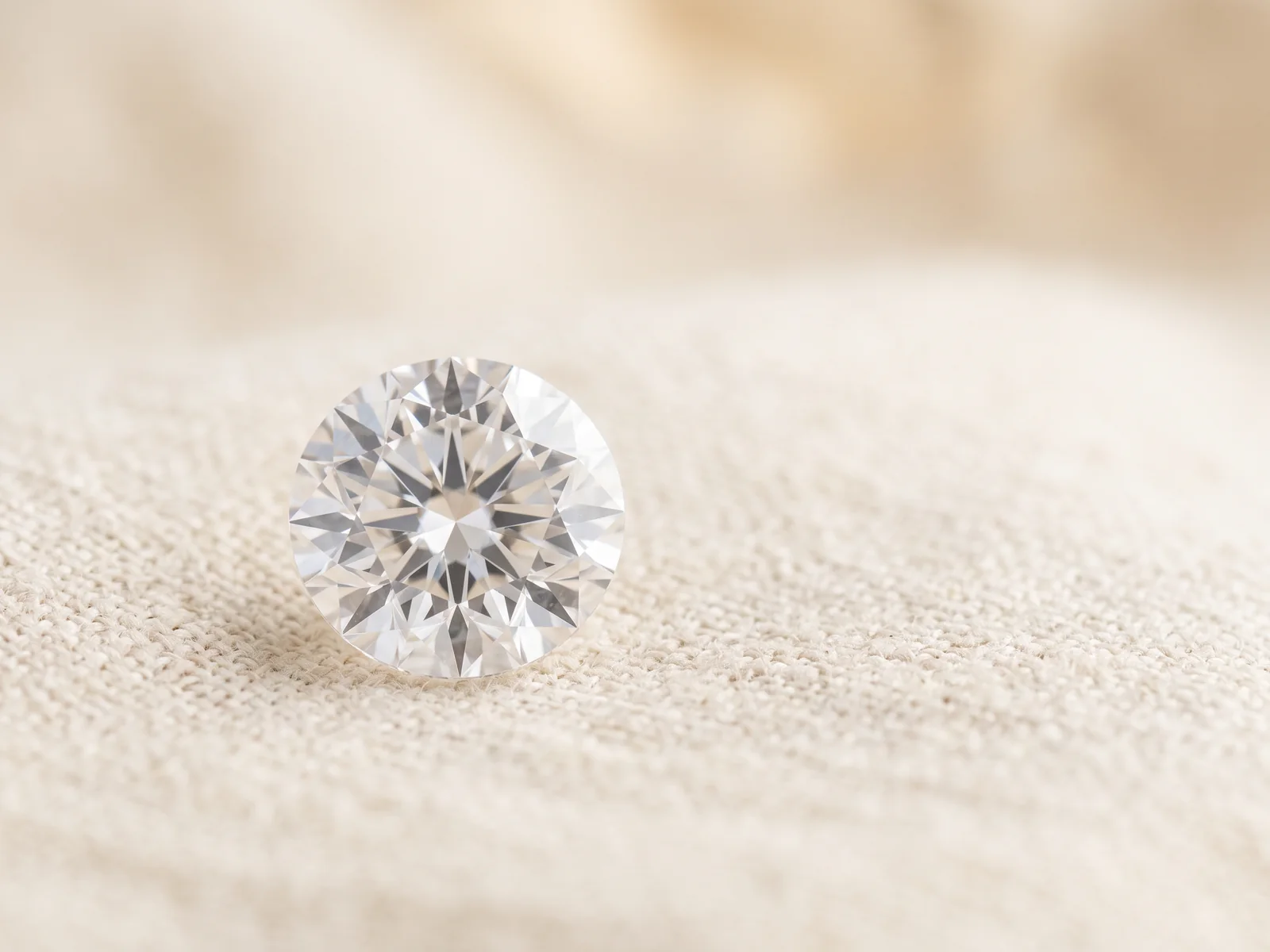
Diamond fluorescence is the line on a grading report most people skip, yet it can change the price of two stones that look the same. Here is what it is, when you can actually see it, and when it quietly works in your favour.
 Reviewed by Raj Sood, Graduate Gemologist (GIA), AJP (GIA)Master jeweller and Graduate Gemologist (GIA) · reviewed 4 November 2026
Quick answer
Diamond fluorescence is a glow, usually blue, that roughly a quarter to a third of natural diamonds give off under ultraviolet light. Labs grade it None, Faint, Medium, Strong or Very Strong. In normal light you rarely see it. Faint and Medium seldom matter; Strong blue usually lowers the price in higher colours and can make I–M colours look whiter.
What is diamond fluorescence?
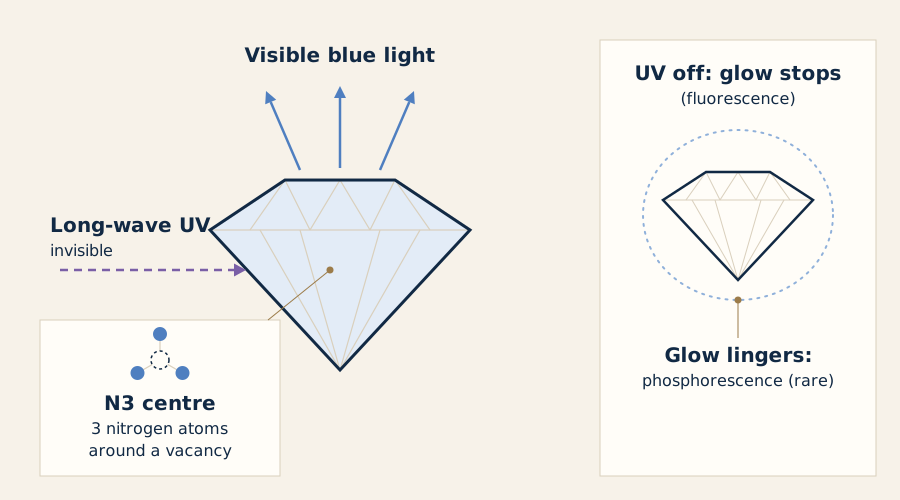
Diamond fluorescence is visible light that some diamonds give off when they are hit by ultraviolet (UV) light, the invisible part of sunlight just beyond violet. Under a blacklight a fluorescent diamond glows, most often blue. Switch the UV off and the glow stops almost instantly. It comes from the diamond's own atomic structure, not a coating or a treatment, and it has no effect on hardness, durability or how long the stone lasts.
Fluorescence is not one of the 4Cs of diamond grading (cut, colour, clarity and carat). Labs record it as an extra characteristic on the report, usually near polish and symmetry. That is why so many people overlook it, and why two stones with identical 4Cs can carry noticeably different prices.
It is common. Published GIA figures suggest roughly 25–35% of natural diamonds show some reaction under long-wave UV, and only a smaller share of those reach Strong or Very Strong. Blue accounts for the great majority of fluorescent stones. Yellow, white, orange and green glows exist but are much rarer, and they matter more because they do not offset a yellowish body colour the way blue can.
What causes fluorescence in a diamond?
Natural diamond is almost pure carbon, but most stones trap small amounts of nitrogen as they grow deep in the earth. When three nitrogen atoms sit around a missing carbon atom (a vacancy), they form what gemmologists call the N3 centre. The N3 centre absorbs UV energy and releases it as blue light. The same nitrogen is also what gives many diamonds their faint yellow tint, which is why blue fluorescence and lower colour grades often turn up together.
Diamonds with almost no nitrogen (known as Type IIa) usually show little or no fluorescence. Other defects create other colours: some produce yellow or green, and a few rare stones glow orange or red. If you meet a term here you have not seen before, our jewellery glossary of gem terms explains it in plain words.
A related effect is phosphorescence, where the glow lingers for seconds or longer after the UV is switched off. It is rare in natural diamonds. The famous Hope diamond, a blue Type IIb stone, phosphoresces red. Phosphorescence is more often seen in some lab-grown diamonds, which is one of the clues laboratories use to identify them.
Labs grade fluorescence under long-wave UV at about 365 nanometres (nm), the same kind of light a blacklight gives off. Short-wave UV at about 254 nm is used for identification work, not for the strength grade you see on a consumer report.
How is diamond fluorescence graded?
The grader places the diamond face-down under a long-wave UV lamp in a dark room and compares its glow with a set of master stones of known strength. The result is one of five strengths. On GIA reports a colour, such as "Medium Blue", is usually added from Medium upwards. IGI and other labs use very similar wording, while some older or smaller lab reports say "Negligible" or "Slight" instead of None or Faint.
| Strength | Under a UV lamp | Visible in normal daylight? | What it usually means |
|---|---|---|---|
| None | No reaction | No | No effect on look or price |
| Faint | Very slight glow, easy to miss | No | Treated almost the same as None |
| Medium | Clear but soft glow | Rarely, and only in strong sun | Small price effect in high colours; often neutral in lower colours |
| Strong | Bright, obvious glow | Sometimes, as a slight blue tint in direct sun | Noticeable discount in D–H; can help I–M look whiter |
| Very Strong | Intense glow | More often, especially outdoors | Largest discount; a small minority can look hazy |
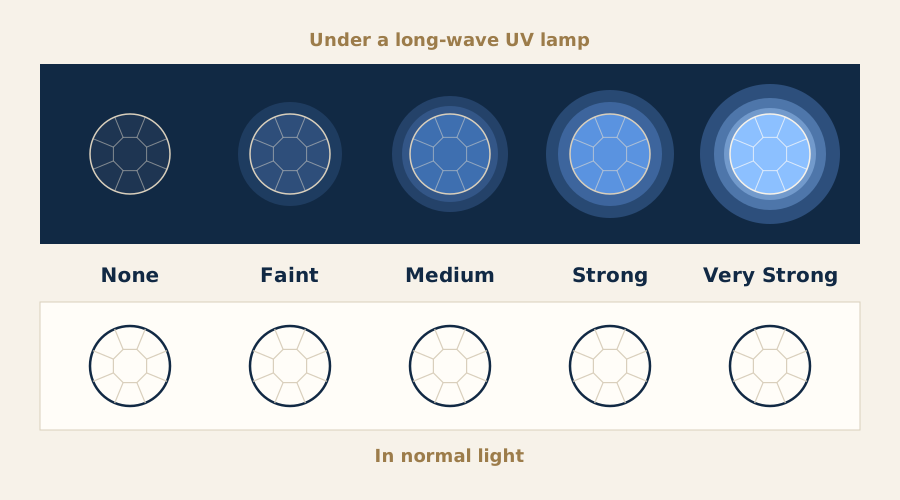
Our guide to each fluorescence strength from None to Very Strong shows photographs of stones at every level side by side. Keep in mind that fluorescence sits in the same part of the report as polish and symmetry, but it measures something completely different; how polish grades work is a separate question about surface finish.
Does fluorescence make a diamond look cloudy or milky?
This is the worry most people bring to the counter, and the honest answer is: very rarely. A small minority of diamonds with Very Strong (and occasionally Strong) blue fluorescence can look slightly hazy, oily or "overblue" in bright sunlight, because the glow scatters through the stone and softens its contrast. The trade calls these stones milky.
A GIA study published in 1997 asked trained graders and ordinary observers to compare fluorescent and non-fluorescent diamonds. For most observers, fluorescence made no noticeable difference to transparency, and in face-up viewing strongly blue stones were often judged to have slightly better colour. The study did not find that fluorescence routinely makes diamonds look cloudy.
When a diamond does look hazy, fluorescence is often not the cause. More common culprits are:
- Clouds: clusters of tiny pinpoint inclusions spread through the stone. They are common in lower clarity grades such as SI2 stones and in I1 to I3 clarity, and can soften brilliance even when no single inclusion stands out.
- Weak cut: a stone that leaks light looks dull whatever its fluorescence. Our cut grade comparison shows the difference.
- Dirt and oil: a film of hand cream on the pavilion makes any diamond look grey until it is cleaned.
An eye-clean stone, one with no inclusions you can see at normal viewing distance, is not automatically free of haze, because a cloud can be invisible as a spot yet still dull the light. If you are weighing up a Strong or Very Strong stone, ask how it looks in daylight as well as under shop lights, and read our guide to choosing an eye-clean diamond for what else to check.
Not sure which one is right?
Send us the stones you are looking at and our gemologist will tell you which to choose and why.
Is diamond fluorescence good or bad for colour?
It depends on where the stone sits on the colour scale. Blue is the opposite of yellow on the colour wheel, so a blue glow can partly cancel a faint yellow body colour when the stone is in light that contains UV, such as daylight. In a colourless stone there is no yellow to cancel, so the blue has nothing to correct and can only, in rare cases, take something away.
| Colour grade | Effect of Medium to Strong blue | Typical view in the trade |
|---|---|---|
| D–F (colourless) | No yellow to offset; occasionally a slight blue or hazy cast | Usually seen as a negative; priced lower |
| G–H (near colourless) | Little visible effect either way | Mild negative; modest discount |
| I–K (near colourless to faint) | Can make the stone face up a little whiter in daylight | Neutral to slightly positive |
| L–M (faint yellow) | Often noticeably whiter-looking face-up | Neutral, sometimes preferred |
This is why fluorescence is worth a second look if you are shopping in the warmer grades. L and M faint yellow diamonds with Medium or Strong blue can look closer to a J or K in sunlight, while costing a fraction of a colourless stone. Indoors, under lights with little UV, the effect is smaller.
Size plays a part too. The bigger the stone, the more of it there is to glow and to show body colour, so both the benefit in warm grades and the rare haze in high grades are easier to see in larger stones around 4 carats than in a small centre stone.
Australia's strong sun matters here. Outdoors on a bright day there is plenty of UV, so a Strong blue stone is more likely to show a faint blue tint at a barbecue or the beach than in an office. Most people find this pleasant, not a fault, but it is worth seeing for yourself.
How does diamond fluorescence affect price?
Fluorescence changes price far more than it changes appearance. The discount is largest where buyers expect perfection, in the top colours and clarities, and shrinks or disappears in the warmer colours. This is a general picture of the natural diamond market, not a fixed rule, and it varies with size, shape and demand.
| Fluorescence | D–F colour | G–H colour | I–M colour |
|---|---|---|---|
| None | Full price | Full price | Full price |
| Faint | Little or no discount | Little or no discount | About the same |
| Medium | Small discount | Slight discount | About the same, occasionally slightly more |
| Strong | Noticeable discount | Moderate discount | Little or no discount |
| Very Strong | Largest discount | Clear discount | Small discount at most |
As a rough AUD example, on a well-cut 1 carat natural round in G colour and VS2 clarity, a Strong blue stone might cost in the region of AUD 700–2,000 below a comparable stone with None. That money can go towards size, cut or the setting. We show the actual price steps between neighbouring stones on each grade page using current stock.
The discount bites hardest in stones bought for their technical grades. A colourless diamond graded Flawless and Internally Flawless, or one at VVS1 or VVS2, is usually chosen by people who want every line of the report to read top-tier, so Strong fluorescence there is penalised heavily even though it rarely shows.
Do lab-grown diamonds have fluorescence?
Some do, but it behaves differently. Laboratory-grown diamonds are made by one of two methods: CVD (chemical vapour deposition, where carbon builds up layer by layer from a gas) or HPHT (high pressure, high temperature, which recreates the conditions deep in the earth). Most lab-grown diamonds show None or Faint fluorescence under the long-wave UV used for grading.
Under short-wave and deep UV, the picture changes. CVD lab-grown stones often glow orange or red, and HPHT lab-grown stones can glow greenish-blue or yellowish and may phosphoresce. Laboratories use these patterns, seen through specialist instruments, to confirm whether a diamond is natural or laboratory-grown. Our guide to how lab-grown diamonds fluoresce covers this in more depth.
For lab-grown diamonds, fluorescence has little effect on price, because their pricing is driven mainly by size, cut, colour and clarity, and they already cost much less than natural diamonds of the same grades. Natural and lab-grown are both real diamond with the same hardness and sparkle; they simply differ in origin, rarity and price.
Browse natural and lab-grown diamonds in our stock
When is a fluorescent diamond the smart pick?
Fluorescence is not something to chase, but it is a useful way to get more diamond for the same budget when you know where it helps. It tends to make sense in these situations:
- Warm colour grades: in I to M, Medium or Strong blue can make the stone face up whiter while costing about the same as None.
- Yellow or rose gold settings: the metal warms the stone anyway, so a slight blue cast is invisible and any discount is a straightforward gain.
- Budget stretched towards size: a Strong blue G or H can free up money to move from half-carat diamonds up to three-quarter carat stones.
- Sensible clarity choices: buyers already weighing when SI1 clarity makes sense are usually the same people who benefit from judging fluorescence by eye rather than by the report.
- Earrings and side stones: small stones seen from a distance show fluorescence least of all.
It makes less sense in a D–F colour, Very Strong stone, particularly above 2 carats, unless you have seen it in daylight and like it. It also makes little sense to pay extra to avoid Faint: Faint and None look the same in every normal light.
Related guideDiamond Fluorescence Strengths: None to Very StrongHow to choose a diamond with fluorescence: step by step
- Find the fluorescence line on the report. Note the strength and, from Medium up, the colour. Blue is the norm; treat yellow, green or orange with more care.
- Match it to the colour grade. In D–H, expect a discount for Strong or Very Strong. In I–M, Medium or Strong blue is often neutral or helpful.
- Check clarity for clouds. If the report lists clouds as a main inclusion, haze is more likely to come from them than from fluorescence. Learn what eye-clean really means before you judge.
- View it in daylight and indoors. Look at the stone near a window and under ordinary room lights, beside a non-fluorescent stone if possible. Ask for a video taken outdoors if you are buying remotely.
- Compare the price step. Set the fluorescent stone against near-identical stones with None and Faint and see what the difference buys you in cut, size or setting.
- Decide by eye, not by fear. If it looks bright and clear to you in both lights, the fluorescence grade is doing nothing but lowering the price.
Free consultation
Talk to a gemologist
Compare stones in person or online with Raj Sood, Graduate Gemologist (GIA), AJP (GIA).
Book a consultationShop this shape
FAQ
Common questions
Is diamond fluorescence bad?
Usually not. Most fluorescent diamonds look the same as non-fluorescent ones in normal light, and blue fluorescence can make lower colour grades look whiter. Only a small minority of Very Strong stones look hazy.
Can you see fluorescence in a diamond in normal light?
Generally no. Faint is invisible without a UV lamp and Medium almost always is, while Strong or Very Strong may show only as a faint blue tint in bright sunlight.
Does fluorescence make a diamond cheaper?
In colourless and near-colourless natural diamonds, yes: Strong and Very Strong stones typically sell for noticeably less than those with None. In I–M colours the effect on price is small.
Should I avoid strong blue fluorescence?
Not automatically. In an I to M colour it can be an advantage, and in G or H it often brings a discount with no visible downside. View the stone in daylight before deciding, especially in D–F colours.
Does fluorescence affect a diamond's clarity or durability?
No. Fluorescence is graded separately from clarity and has no effect on hardness, strength or how the diamond wears over time.
Do lab-grown diamonds glow under UV light?
Most show None or Faint fluorescence under the long-wave UV used for grading. Under short-wave UV many glow orange, red, green or blue, which helps laboratories identify them as lab-grown.

Ask a gemologist
Not sure which diamond to choose?
Raj Sood is a Graduate Gemologist (GIA) and master jeweller. Bring the stones you are considering, or send the reports, and he will tell you honestly which one is better and why.
Keep learning
Related guides
 Diamond 4Cs & GradingDiamond Fluorescence Strengths: None to Very Strong
 Lab-Grown DiamondsLab-Grown Diamond Fluorescence Explained
 Diamond 4Cs & GradingL and M Colour Diamonds (Faint Yellow)Diamond 4Cs & GradingDiamond 4CsDiamond 4Cs & GradingEye Clean DiamondsDiamond 4Cs & GradingFL and IF Clarity Diamonds
 Diamond 4Cs & GradingVVS1 Clarity Diamonds
 Diamond 4Cs & GradingVVS2 Clarity Diamonds
Explore more
More guides on this topic
Education