
- Education
- Lab-Grown Diamonds
- Lab-Grown Diamond vs Moissanite: Sparkle, Hardness, Price and Rules
Lab-Grown Diamonds
Lab-Grown Diamond vs Moissanite: Sparkle, Hardness, Price and Rules
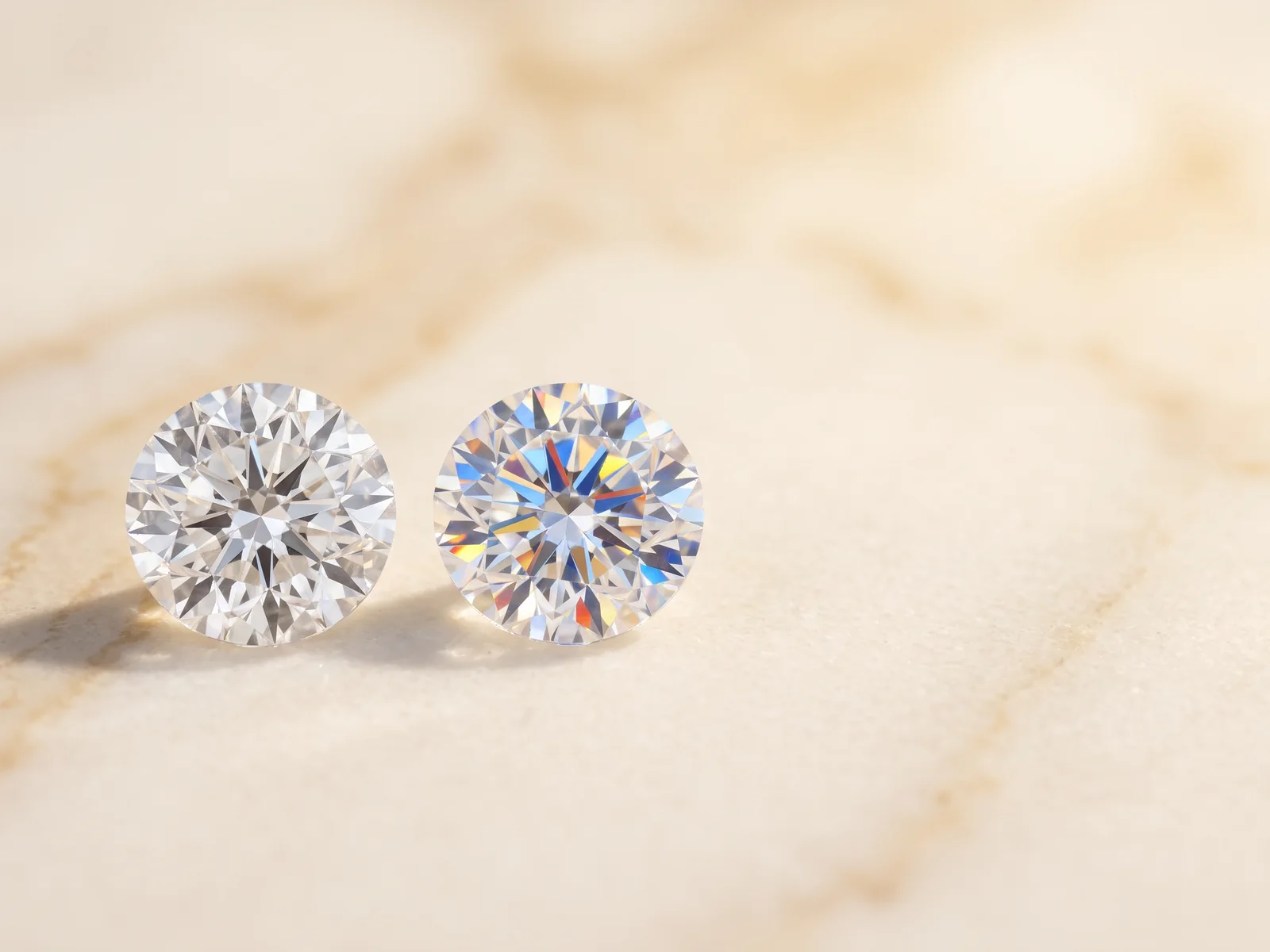
Lab-grown diamond vs moissanite is one of the most common comparisons people bring to the counter. Both are made in a laboratory and both cost far less than natural diamond, but they are different materials that look, test and age differently.
 Reviewed by Raj Sood, Graduate Gemologist (GIA), AJP (GIA)Master jeweller and Graduate Gemologist (GIA) · reviewed 4 November 2026
Quick answer
A lab-grown diamond is real diamond (carbon, Mohs 10, refractive index 2.42) grown in a laboratory; moissanite is lab-created silicon carbide (Mohs 9.25, refractive index 2.65–2.69). Moissanite shows more rainbow fire and costs less. A lab-grown diamond is harder, shows a whiter, calmer sparkle and is graded by independent labs such as IGI and GIA.
Lab-grown diamond vs moissanite: what is the actual difference?
The short version: a lab-grown diamond is diamond, and moissanite is not. A lab-grown diamond is pure carbon arranged in the same cubic crystal structure as a mined diamond. It has the same hardness, the same refractive index and the same chemistry, which is why most labs grade it on the same scales. Our explainer on why lab-grown diamonds are real diamond goes into the science, and how CVD and HPHT diamonds are grown covers the two production methods.
Moissanite is silicon carbide (SiC), a completely different mineral. It was first found by the French chemist Henri Moissan in 1893, in fragments from the Canyon Diablo meteorite crater in Arizona. Natural moissanite is so rare that it is not used in jewellery, so every moissanite you will see in a ring is lab-created moissanite. Gem-quality lab-created moissanite has been sold since the late 1990s.
So when someone asks "is moissanite a lab-grown diamond?", the answer is no. Both are made in a laboratory, but only one is diamond. In trade terms, lab-created moissanite is a diamond simulant: a material that looks similar to diamond but has different properties. A lab-grown diamond is not a simulant; it is a laboratory-grown version of the real thing.
For the wider picture on price, grading and growth methods, start with our complete lab-grown diamonds guide. Any unfamiliar word on this page is also defined in our glossary of jewellery terms.
How do hardness, sparkle and weight compare?
Here are the measurable differences side by side. These are properties of the materials, so they hold for every well-cut stone of each type.
| Property | Lab-grown diamond | Lab-created moissanite |
|---|---|---|
| Material | Carbon (C) | Silicon carbide (SiC) |
| Mohs hardness | 10 | 9.25 |
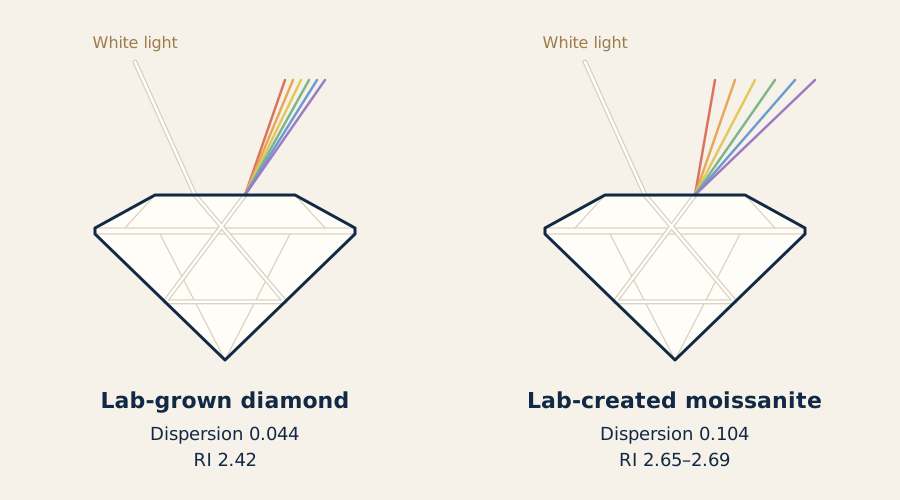
| Refractive index | 2.42 | 2.65–2.69 |
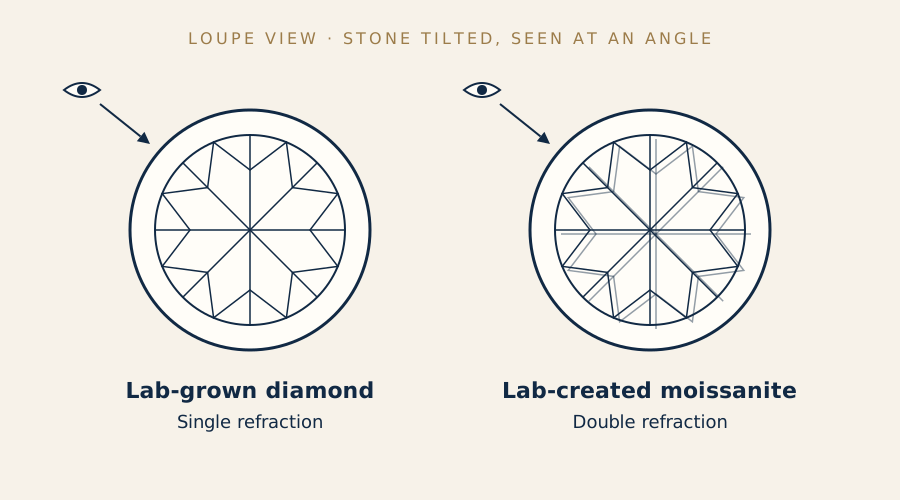
| Refraction | Single (isotropic) | Double (birefringent, about 0.043) |
| Dispersion (fire) | 0.044 | 0.104 |
| Specific gravity (density) | 3.52 | 3.21–3.22 |
| Weight of a 6.5 mm round | about 1.00 ct | about 0.9 ct |
| Heat resistance | Can burn on the surface under a jeweller's torch | Very high; tolerates repair heat well |
| Independent grading | IGI, GIA and other labs | Mostly manufacturer or seller certificates |
Refractive index is how strongly a material bends light. Moissanite bends it more than diamond, so a well-cut moissanite returns a lot of light. Dispersion is how much white light is split into rainbow colours, which jewellers call fire. At 0.104, moissanite has more than twice the dispersion of diamond, and that is the single biggest visual difference between them.
Moissanite is also less dense. A 6.5 mm round moissanite weighs about 0.9 carat, while a diamond of the same size weighs about 1.00 carat. That is why moissanite is usually sold by millimetre size or by diamond equivalent weight (DEW), meaning the carat weight a diamond of that size would have. If you are comparing listings, compare millimetres, not carats; shape changes face-up size too, as our look at which shapes face up largest for their weight shows. Our page on how moissanite compares with natural diamond uses the same figures against mined stones.
Can you tell moissanite from a lab-grown diamond by eye?
At arm's length, in a ring on a hand, most people cannot tell. Up close, and especially in larger sizes, a trained eye usually can. These are the giveaways:
- Rainbow fire: moissanite throws bigger, stronger flashes of colour, particularly in sunlight or under spotlights. Some people love this; others find it reads as less like diamond. Above about 8 mm (2 ct DEW) the effect becomes much more obvious.
- Doubled facet edges: because moissanite is doubly refractive, each ray of light splits in two. Look through the stone at an angle with a loupe and the back facet edges can appear doubled or slightly fuzzy. Cutters orient the table to minimise this when looking straight down, so tilt the stone.
- Body colour: today's colourless moissanite looks white face-up, but in some lighting it can show a faint grey or yellow-green tint. Older moissanite, made before the colourless grades became common, often looks noticeably warmer.
- Sparkle pattern: a lab-grown diamond shows crisper, more contrasting white sparkle (brilliance) with smaller points of colour. Moissanite looks brighter and more colourful but slightly softer in pattern.
Cut quality matters as much as material. A poorly cut lab-grown diamond can look glassier than a well-cut moissanite. For what to check, see what cut grades mean for lab-grown diamonds. And if you are also weighing cheaper simulants, our guide to moissanite against cubic zirconia explains why CZ (Mohs about 8–8.5) scratches and clouds much sooner.
Does moissanite pass a diamond tester?
It depends on the tester, and the answer surprises many people.
- Thermal testers measure how quickly heat moves through the stone. Moissanite conducts heat almost as well as diamond, so a basic thermal tester will usually read it as diamond.
- Multi-testers add an electrical conductivity check. Moissanite conducts electricity, so these testers flag it as moissanite.
- The catch: some lab-grown diamonds, especially HPHT stones containing traces of boron, also conduct electricity and can be wrongly flagged as moissanite on a multi-tester.
- Lab-grown vs natural: standard thermal and multi-testers cannot separate lab-grown from natural diamond. That needs specialist screening devices or laboratory instruments such as spectroscopy and fluorescence imaging.
In practice, a gemmologist confirms moissanite by looking for double refraction under magnification and checking specific gravity or spectroscopy if needed. Our article on what thermal and multi-testers really show covers the tester types in detail.
Related guideDoes Moissanite Pass a Diamond Tester?Not sure which one is right?
Send us the stones you are looking at and our gemologist will tell you which to choose and why.
How are lab-grown diamonds and moissanite graded?
This is where the two differ most on paper. Lab-grown diamonds are graded by independent gem laboratories, most of which (such as IGI) use the same 4Cs as natural diamonds: cut, colour, clarity and carat. Lab-created moissanite has no independent, industry-wide grading standard, so its "grades" usually come from the manufacturer or seller.
| What the paperwork shows | Lab-grown diamond report (e.g. IGI) | Lab-created moissanite certificate |
|---|---|---|
| Who issues it | Independent gem laboratory | Usually the manufacturer, brand or retailer |
| Identity statement | "Laboratory-Grown Diamond" | "Moissanite" or "lab-created moissanite" |
| Growth method | Often stated: CVD or HPHT | Rarely stated |
| Treatment | States "As Grown" or post-growth treatment where disclosed | Not usually covered |
| Colour | D–Z scale (some recent GIA reports use broader descriptive terms) | Brand terms such as colourless or near-colourless, sometimes D–F or G–I equivalents |
| Clarity | FL to I3 scale | Often VVS or VS equivalent |
| Laser inscription | Report number and "LG" or lab-grown wording on the girdle | Sometimes a brand mark or serial number |
For lab-grown diamonds, most buyers in white gold or platinum are happy from about G colour; see colour grades on lab-grown reports for the detail, including why some CVD stones are treated after growth to improve colour. For moissanite, read how moissanite colour and clarity are graded before trusting a D-equivalent label, because each brand uses its own scale.
A lab report is not a promise of value, but it does give you an independent description you can check against the stone, including the inscription on the girdle (the thin outer edge). That is useful if a ring is ever cleaned, repaired or insured.
What do Australian rules say about selling lab-grown diamonds and moissanite?
There is no separate Australian law just for gem names. The general Australian Consumer Law applies, enforced by the ACCC (Australian Competition and Consumer Commission). It bans misleading or deceptive conduct and false or misleading claims about what a product is or where it comes from. For gems, that means three practical things:
- "Diamond" on its own means natural. A laboratory-grown diamond should be clearly described as lab-grown, laboratory-grown or synthetic, in the listing and on the receipt, not only in fine print.
- Moissanite is not a diamond. It should be called moissanite or lab-created moissanite. Phrases such as "lab diamond" or "man-made diamond" for moissanite are misleading.
- Weights must be honest. If moissanite is sold by diamond equivalent weight, the listing should say so, because the actual carat weight is lower.
Overseas rules point the same way: the US Federal Trade Commission's guides for the jewellery industry, updated in 2018, accept "diamond" for laboratory-grown stones only with a clear qualifier such as lab-grown. Neither material should be sold as an investment, and neither should be called fake: a lab-grown diamond is real diamond, and lab-created moissanite is a real, durable gem material in its own right. If you are unsure what a stone is, ask for the report or certificate and look at it alongside the receipt. More on the identity question is in the case for calling lab-grown real diamond.
Lab-grown diamond vs moissanite price: what do they cost in Australia?
Both cost far less than natural diamond, and moissanite costs less again. Lab-grown diamond prices have fallen a long way in recent years, so the gap between the two is narrower than many older articles suggest.
| Loose round stone | Lab-created moissanite (AUD) | Lab-grown diamond, G–H, VS, excellent cut (AUD) | Natural diamond for reference (AUD) |
|---|---|---|---|
| 6.5 mm (about 1 ct) | about $300–$900 | about $800–$2,500 | about $6,000–$14,000 |
| 8.0 mm (about 2 ct) | about $600–$1,500 | about $1,800–$5,000 | about $20,000+ |
These are broad ranges only. Prices move with the market, the exact grades, the brand and the cut. The setting adds the same metal and labour cost whichever stone you choose, so on a finished ring the percentage difference between the two shrinks. Our lab-grown diamond prices and grades explained page shows how colour and clarity move the price.
On resale, be realistic with both. Lab-grown diamonds have limited resale value, and moissanite has very little. Choose either because you like how it looks and wears, not as a store of value.
Browse lab-grown diamonds
Is a lab-grown diamond or moissanite better for an engagement ring?
Both are hard and tough enough for an everyday engagement ring. Lab-created moissanite at 9.25 on the Mohs scale is harder than sapphire (9) and far harder than quartz dust (about 7), which is what scratches softer stones over time. Lab-grown diamond at 10 is harder still, so its facet edges stay sharp for decades.
- Choose lab-grown diamond if: you want diamond itself, a whiter look in large sizes, an independent lab report and the sharpest long-term polish.
- Choose lab-created moissanite if: you love strong rainbow fire, want a large look for the least money, or prefer to spend more on the setting.
- Either way: both attract skin oils and lotion, which dull sparkle. A soak in warm water with a drop of dishwashing liquid and a soft brush brings them back.
Neither stone chips easily, but both can chip on a hard knock at a thin edge or point, so pointed shapes such as the pear cut with its single tip and the two-pointed marquise, along with princess cuts, need protective claws. Moissanite's heat resistance makes it slightly easier to resize or retip around; with a diamond, the jeweller protects or removes the stone first. For comparisons with softer options, see cheaper simulants such as cubic zirconia, and for durability against mined stones, moissanite hardness next to natural diamond.
How do you choose between a lab-grown diamond and moissanite? Step by step
- Decide what matters most. Diamond itself and a white sparkle, or the most size and fire for the budget.
- See both in daylight. Compare stones of the same millimetre size near a window, not only under spotlights.
- Compare by millimetres. Match a 6.5 mm moissanite to a 1 ct diamond, not a 1 ct moissanite, which is larger.
- Read the paperwork. For lab-grown, check the lab report says laboratory-grown and matches the girdle inscription; for moissanite, note who issued the certificate.
- Set your grades. For lab-grown, see choosing a lab-grown colour grade and look for Excellent or Ideal cut lab-grown stones; for moissanite, pick a colourless grade if you want a white look.
- Check the description on the receipt. It should name the material clearly: lab-grown diamond or lab-created moissanite.
- Plan the setting. Choose claws or a bezel that protect any points, and ask about care and servicing.
Free consultation
Talk to a gemologist
Compare stones in person or online with Raj Sood, Graduate Gemologist (GIA), AJP (GIA).
Book a consultationShop this shape
FAQ
Common questions
Is moissanite a lab-grown diamond?
No. Moissanite is silicon carbide, a different mineral, while a lab-grown diamond is carbon with the same structure as natural diamond. Both are made in a laboratory, but only the lab-grown diamond is diamond.
Which sparkles more, moissanite or a lab-grown diamond?
Moissanite shows more rainbow fire because its dispersion is more than twice that of diamond. A lab-grown diamond shows crisper white brilliance with smaller flashes of colour; which looks better is personal preference.
Does moissanite pass a diamond tester?
It usually passes a basic thermal tester, because it conducts heat almost as well as diamond. A multi-tester with an electrical conductivity check will normally identify it as moissanite.
Will moissanite go cloudy over time?
No. Moissanite does not cloud or change colour with wear. If it looks dull, it is almost always a film of skin oil or soap, which cleans off with warm soapy water.
Is a lab-grown diamond worth more than moissanite?
A lab-grown diamond costs more to buy and comes with an independent grading report, but resale value is limited for both. Choose on looks, durability and budget rather than expected resale.
Can a jeweller tell moissanite from a lab-grown diamond?
Yes. Under a loupe a jeweller can see moissanite's doubled facet edges, and a multi-tester or density check confirms it. Telling a lab-grown diamond from a natural one needs specialist screening or laboratory equipment.

Ask a gemologist
Not sure which diamond to choose?
Raj Sood is a Graduate Gemologist (GIA) and master jeweller. Bring the stones you are considering, or send the reports, and he will tell you honestly which one is better and why.
Keep learning
Related guides
 Lab-Grown DiamondsMoissanite vs Diamond
 Lab-Grown DiamondsAre Lab-Grown Diamonds Real Diamonds
 Lab-Grown DiamondsDoes Moissanite Pass a Diamond Tester?Lab-Grown DiamondsLab-Grown Diamonds GuideLab-Grown DiamondsMoissanite vs Cubic ZirconiaLab-Grown DiamondsMoissanite Colour and Clarity Grades
 Lab-Grown DiamondsHow Are Lab-Grown Diamonds Manufactured?
 Lab-Grown DiamondsLab-Grown Diamond Cut Quality
Explore more
More guides on this topic
Education