
- Education
- Lab-Grown Diamonds
- Moissanite vs Cubic Zirconia: Hardness, Sparkle, Price and How to Tell Them Apart
Lab-Grown Diamonds
Moissanite vs Cubic Zirconia: Hardness, Sparkle, Price and How to Tell Them Apart
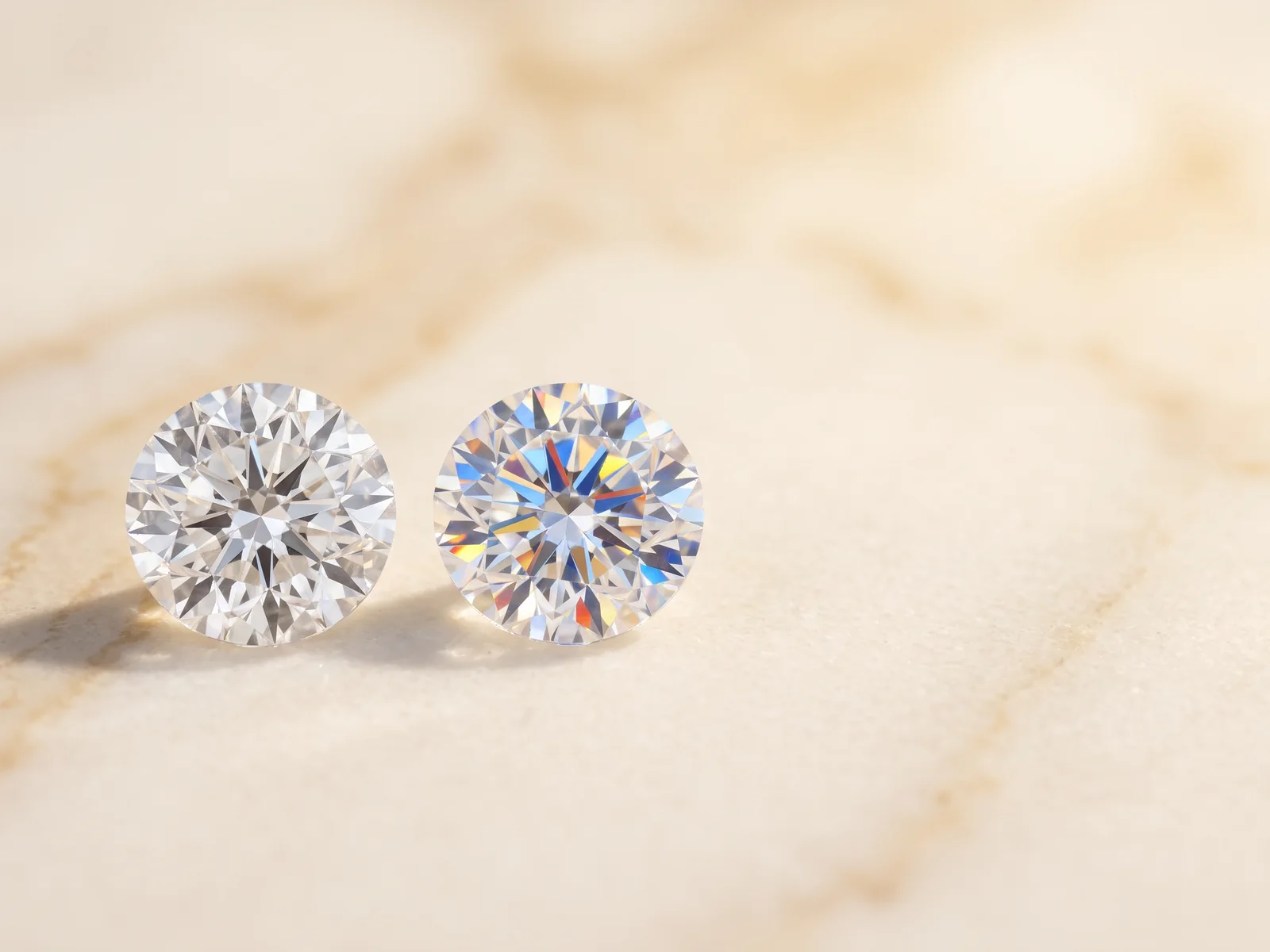
Moissanite and cubic zirconia are the two most common diamond alternatives, and they are often confused. Here is how they differ in hardness, sparkle, weight and price, and the simple gemmologist tests that tell them apart.
 Reviewed by Raj Sood, Graduate Gemologist (GIA), AJP (GIA)Master jeweller and Graduate Gemologist (GIA) · reviewed 4 November 2026
Quick answer
Moissanite vs cubic zirconia comes down to durability and fire. Lab-created moissanite (silicon carbide) is 9.25 on the Mohs scale, shows strong rainbow fire and keeps its polish for decades. Synthetic cubic zirconia (zirconium oxide) is 8–8.5, scratches and dulls within a few years, but costs a few dollars. A thermal tester, a loupe and weight tell them apart.
What is moissanite?
Moissanite is silicon carbide (SiC), a compound of silicon and carbon. It was first identified in 1893 by the French chemist Henri Moissan in fragments from the Canyon Diablo meteorite crater in Arizona, and it is named after him. In nature it turns up only as tiny grains, far too small to cut, so every moissanite you see in jewellery is lab-created. Gem-quality lab-created moissanite has been sold for jewellery since the late 1990s.
It is grown from vapour at very high temperatures, above about 2,000 °C, then cut and polished like any other gem. Its crystal structure is hexagonal, which matters for one of the tests later: light splitting into two rays as it passes through the stone. For the full background on its properties and history, see our guide to moissanite as a gem in its own right.
Moissanite is not diamond and is not a lab-grown diamond. It is a different material with its own hardness, sparkle and weight. If you are weighing it against the real thing, our moissanite vs diamond comparison covers that head to head. Any unfamiliar word on this page is also explained in our plain-English jewellery glossary.
What is cubic zirconia?
Cubic zirconia, usually shortened to CZ, is zirconium dioxide (ZrO2) stabilised with a small amount of yttrium oxide or calcium oxide so that it stays in a cubic crystal form at room temperature. Like moissanite, it occurs in nature only as microscopic grains, so all CZ in jewellery is synthetic. Mass production began in the late 1970s, and it quickly became the standard low-cost diamond look-alike.
CZ is made by a method called skull melting: zirconium oxide powder is melted at around 2,750 °C inside a shell of its own unmelted powder, then cooled slowly so crystals form. The process is cheap at scale, which is why a CZ costs a few dollars. Our explainer on whether you can grow a gem at home explains why even simple methods like this need industrial equipment.
Moissanite, CZ and lab-grown diamond are often lumped together, but only lab-grown diamond is actually diamond. Our complete guide to lab-grown diamonds explains the difference, and how lab-grown diamond compares with CZ sets those two side by side. Coloured lab-created stones such as sapphire and ruby are covered in our page on lab-created sapphire, ruby and emerald.
Moissanite vs cubic zirconia: how do they compare side by side?
The table below puts the key gemmological numbers for lab-created moissanite, synthetic CZ and diamond in one place. Diamond is the same material whether natural or lab-grown, so it has one column.
| Property | Lab-created moissanite | Synthetic cubic zirconia | Diamond (natural or lab-grown) |
|---|---|---|---|
| Chemistry | Silicon carbide (SiC) | Zirconium dioxide (ZrO2) | Carbon (C) |
| Mohs hardness | 9.25 | 8–8.5 | 10 |
| Refractive index | 2.65–2.69 | 2.15–2.18 | 2.42 |
| Dispersion (fire) | 0.104 | about 0.058–0.066 | 0.044 |
| Refraction | Double | Single | Single |
| Specific gravity | 3.22 | 5.6–6.0 | 3.52 |
| Weight of a 6.5 mm round | about 0.88 ct | about 1.6–1.7 ct | about 1.00 ct |
| Thermal diamond tester | Reads as diamond | Fails | Reads as diamond |
| Approx. price, 6.5 mm round (AUD) | about $250–$900 | about $5–$40 | lab-grown about $800–$2,500 |
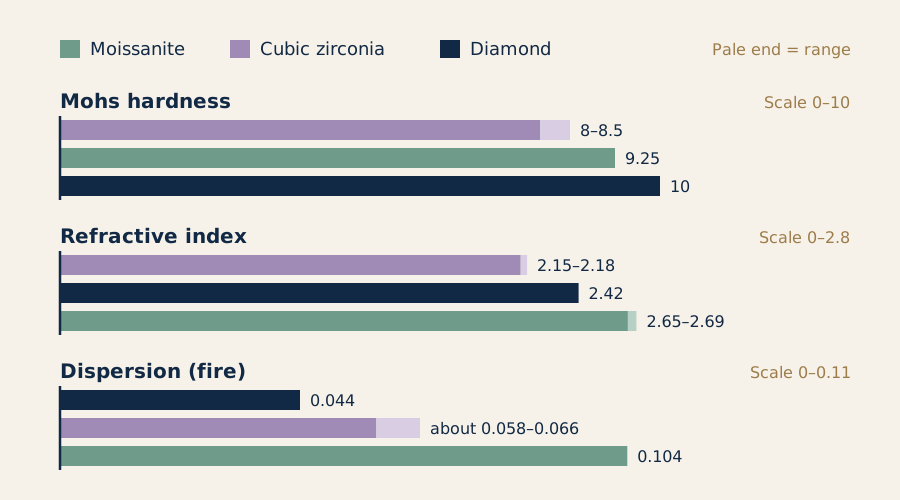
Specific gravity is how heavy a material is compared with the same volume of water. It explains the weight row: CZ is so dense that a stone the size of a 1 carat diamond weighs well over 1.5 carats, while moissanite is slightly lighter than diamond. For that reason moissanite and CZ are often sold by millimetre size or by diamond equivalent weight (DEW), the carat weight a diamond of the same size would have.
Which is harder, moissanite or cubic zirconia, and does it matter?
Hardness is resistance to scratching, measured on the Mohs scale from 1 (talc) to 10 (diamond). The scale is not even: the gap from 9 to 10 is far larger than the gap from 8 to 9. At 9.25, moissanite sits just above sapphire and ruby (9). CZ sits at 8–8.5, about the level of topaz.
Day to day, that difference shows up quickly. Household dust contains quartz, which is 7 on the Mohs scale, plus harder grit from concrete, sand and benchtops. CZ is only a step or so above that, so its facet edges gradually round off and the table (the large flat top facet) picks up fine scratches. On a ring worn every day, most CZ looks noticeably duller within about one to three years. Moissanite resists that wear much better, and with normal care its facet edges stay crisp for decades.
- Scratching: moissanite resists everyday abrasion well; CZ scuffs and loses its polish.
- Toughness: moissanite has good toughness (resistance to chipping); CZ is more brittle and can chip at the girdle or claw tips if knocked.
- Surface film: both pick up skin oils and soap, but a worn CZ surface holds grime more readily and looks cloudy sooner.
- Heat: moissanite can darken temporarily under a jeweller's torch and returns to its colour as it cools; always tell your jeweller what the stone is before any repair.
So for an engagement ring or anything worn daily, moissanite's hardness matters a lot. For costume jewellery, occasional earrings or a placeholder ring while you decide on a stone, CZ's softness is less of an issue.
Not sure which one is right?
Send us the stones you are looking at and our gemologist will tell you which to choose and why.
Does moissanite sparkle more than cubic zirconia?
Sparkle is really three effects. Brilliance is white light returned to your eye, and it rises with refractive index (how strongly a material bends light). Fire is flashes of rainbow colour, and it rises with dispersion (how strongly a material splits white light into colours). Scintillation is the on-off flashing as the stone or the viewer moves.
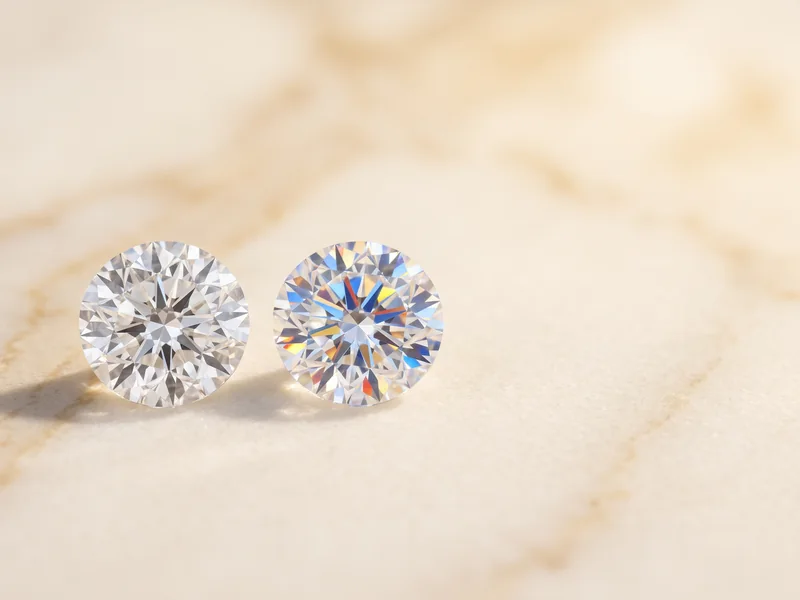
Moissanite wins on both numbers. Its refractive index of 2.65–2.69 is higher than diamond's 2.42, and far higher than CZ's 2.15–2.18, so a well-cut moissanite is very bright. Its dispersion of 0.104 is more than twice diamond's 0.044, so it throws strong rainbow flashes, especially in sunlight. Some people love that; others find it reads as a little too colourful, sometimes described as a disco-ball effect, particularly in stones above about 7 mm.
CZ has more fire than diamond (about 0.060) but noticeably less brilliance, so new CZ looks lively but slightly glassy next to diamond or moissanite. As its surface wears, that brilliance falls further. Diamond, whether natural or lab-grown (often a chemically pure type IIa diamond), sits between the two: less colour than moissanite, more white brightness than CZ.
What colour and clarity do moissanite and cubic zirconia come in?
Neither stone is graded by GIA on the diamond scale. Moissanite is graded by its makers and sellers, usually with letters that borrow from the diamond D–Z colour scale. Early moissanite from the late 1990s often had a grey, green or yellow tint; modern colourless moissanite is commonly sold as D–F or G–H equivalent, although larger stones can still show a faint warm or greenish tint in some lighting. Clarity is usually high, with occasional fine needle-like inclusions (internal features) running in one direction. Our guide to how moissanite colour and clarity are graded explains what the seller's grades mean.
CZ is made in almost any colour, from colourless to pink, blue and green, simply by adding small amounts of other metal oxides. Colourless CZ is typically completely clean to the eye and under a 10× loupe. Retailers sometimes label it A, AA, AAA or AAAAA, but these are marketing grades with no independent standard behind them.
That perfection is a clue in itself. A large, completely flawless, perfectly colourless stone is unusual in diamond, so a gemmologist will look harder at it. Lab-grown diamonds are often very clean too, which is why it helps to know what clarity is typical in lab-grown diamond before you assume a clean stone is a simulant.
How can you tell moissanite from cubic zirconia?
At the counter we use a handful of quick, non-destructive tests. None needs to remove the stone from its setting, and together they separate moissanite, CZ and diamond with confidence. Here is what each test typically shows.
| Test | Lab-created moissanite | Synthetic cubic zirconia | What it tells you |
|---|---|---|---|
| Thermal diamond tester | Reads as diamond | Fails (reads as simulant) | CZ is a poor heat conductor; moissanite conducts heat well enough to mimic diamond |
| Multi-tester (heat plus electrical) | Flags as moissanite | Fails | Moissanite conducts a small electrical current; diamond and CZ usually do not |
| 10× loupe through the crown | Doubled back facet edges at an angle | Single, sharp edges; often worn or rounded | Moissanite is doubly refractive; CZ is singly refractive |
| Loupe on facet edges | Crisp edges | Scratches, rounded edges after wear | Shows the hardness difference |
| Weight against size | Slightly lighter than diamond | Much heavier than diamond | A 6.5 mm CZ weighs about 1.6–1.7 ct |
| Shortwave UV lamp | Usually inert to weak | Often yellowish to orange glow | Supporting clue only, never proof on its own |
| Girdle under magnification | Often a maker's laser inscription | Usually none | Check the edge of the stone |
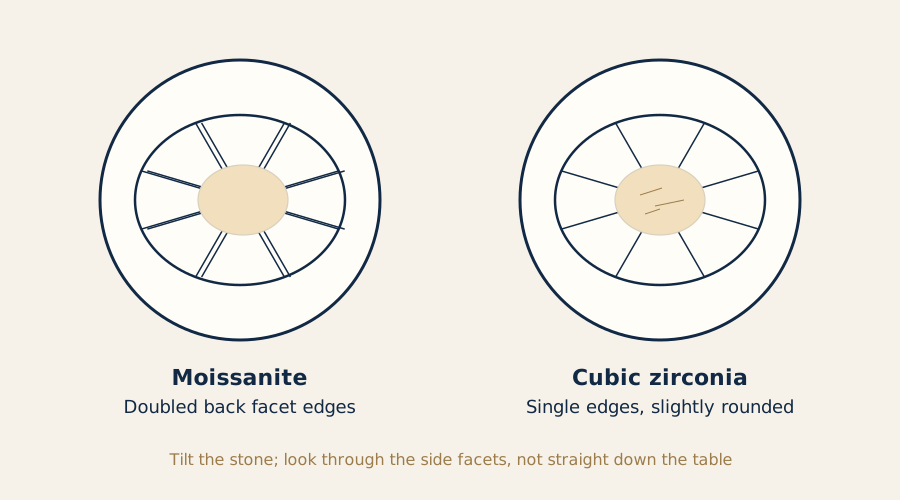
The doubling test is the most useful one you can learn. Moissanite is usually cut with its optic axis (the one direction with no doubling) running straight down through the table, so look in at an angle through the side facets instead. The edges of the facets at the back of the stone will appear as two parallel lines. In CZ and diamond they stay single.
Older home tricks, such as breathing on the stone or reading newsprint through it, can hint at CZ but are unreliable with moissanite. For the details on testing equipment, see why moissanite can fool a diamond tester, and for a wider checklist, our guide on telling whether a diamond is real.
Related guideLab-Grown Diamond vs MoissaniteMoissanite vs cubic zirconia: what do they cost in Australia?
Price is where the two are furthest apart. These are broad, approximate ranges for colourless round stones; actual prices vary with size, cut quality, maker and the setting.
| Item (about 6.5 mm, 1 ct diamond size) | Approximate price range (AUD) |
|---|---|
| Synthetic cubic zirconia, loose | about $5–$40 |
| CZ solitaire ring, sterling silver | about $30–$250 |
| Lab-created moissanite, loose, colourless | about $250–$900 |
| Lab-grown diamond, 1 ct, G–H VS | about $800–$2,500 |
| Natural diamond, 1 ct, G–H VS | about $6,000–$15,000 |
Because CZ is so inexpensive, it is usually set in sterling silver or plated metal. Moissanite costs enough, and lasts well enough, that it is normally set in 9 ct, 14 ct or 18 ct gold or platinum. Neither moissanite nor CZ has a meaningful resale market, so choose either for how it looks and wears, not as something to sell later.
Lab-grown diamond prices have fallen sharply in recent years, and many people now compare a 1 ct lab-grown diamond directly against moissanite. Lab-grown diamonds are made by two main methods, explained in HPHT versus CVD growth, and both produce real diamond. Another option some shoppers consider is white sapphire; see lab-grown diamond against white sapphire. Whatever you choose, Australian law requires clear disclosure of what a stone is, as set out in our page on ACCC rules for describing lab-grown stones.
Browse lab-grown diamonds
Is moissanite better than cubic zirconia for you? Step by step
Neither stone is right for everyone. Moissanite suits a ring worn daily where you want a diamond-like look and accept extra fire. CZ suits fashion pieces, travel jewellery or a temporary ring. If you want the stone to be actually diamond, a lab-grown diamond is the closer match in look and the one that behaves like diamond on every test.
- Decide how often you will wear it. Daily wear points to moissanite or diamond; occasional wear makes CZ workable.
- Compare by millimetre size, not carat. CZ is much heavier and moissanite slightly lighter than diamond, so match the face-up measurements.
- Look at the stone in daylight. Check whether moissanite's rainbow fire suits you, especially above about 7 mm.
- Check the colour. Ask for the seller's colour grade on moissanite and view it beside a white card for any grey, green or yellow tint.
- Ask for clear disclosure. The paperwork should say lab-created moissanite or synthetic cubic zirconia, never just diamond-look or simulant without the material name.
- Match the setting to the stone. Put moissanite in gold or platinum with secure claws; keep CZ for silver or fashion settings you will not mind replacing.
Free consultation
Talk to a gemologist
Compare stones in person or online with Raj Sood, Graduate Gemologist (GIA), AJP (GIA).
Book a consultationShop this shape
FAQ
Common questions
Is moissanite better than cubic zirconia?
For daily wear, moissanite is far more durable: 9.25 on the Mohs scale against 8–8.5, so it keeps its polish while CZ scratches and dulls. CZ costs much less, so it suits fashion jewellery and occasional wear.
Does cubic zirconia pass a diamond tester?
No. CZ is a poor conductor of heat, so a thermal diamond tester reads it as a simulant. Moissanite, by contrast, usually passes a basic thermal tester, which is why a multi-tester is needed.
Can you tell moissanite from cubic zirconia by eye?
Sometimes. Moissanite shows stronger rainbow fire and stays crisp, while worn CZ looks glassy with rounded facet edges. A 10× loupe showing doubled back facets confirms moissanite.
Does cubic zirconia go cloudy?
CZ does not change inside, but its softer surface scratches and holds oil and grime, so it looks cloudy after about one to three years of daily wear. Cleaning helps for a while; repolishing or replacing the stone restores it.
Is moissanite a lab-grown diamond?
No. Moissanite is lab-created silicon carbide, a different material from diamond. Lab-grown diamond is pure carbon with the same structure and properties as natural diamond.
Why is cubic zirconia so heavy?
CZ has a specific gravity of about 5.6–6.0, against 3.52 for diamond. A CZ the size of a 1 carat diamond weighs about 1.6–1.7 carats, so it is sold by millimetre size.

Ask a gemologist
Not sure which diamond to choose?
Raj Sood is a Graduate Gemologist (GIA) and master jeweller. Bring the stones you are considering, or send the reports, and he will tell you honestly which one is better and why.
Keep learning
Related guides
 Lab-Grown DiamondsMoissanite vs DiamondLab-Grown DiamondsLab-Grown Diamond vs MoissaniteLab-Grown DiamondsLab-Grown Diamonds vs Cubic Zirconia
 Lab-Grown DiamondsDoes Moissanite Pass a Diamond Tester?Lab-Grown DiamondsLab-Grown Diamonds GuideLab-Grown DiamondsMoissanite Colour and Clarity GradesGemstonesMoissanite as a Gemstone
 Lab-Grown DiamondsHow to Tell if a Diamond Is Real
Explore more
More guides on this topic
Education