
- Education
- Lab-Grown Diamonds
- Moissanite Colour and Clarity Grades: What They Mean and How to Check
Lab-Grown Diamonds
Moissanite Colour and Clarity Grades: What They Mean and How to Check
Moissanite colour and clarity grades look like diamond grades, but no independent lab sets them. Here is what the letters mean, how to check a stone yourself and how lab-created moissanite compares with diamond.
 Reviewed by Raj Sood, Graduate Gemologist (GIA), AJP (GIA)Master jeweller and Graduate Gemologist (GIA) · reviewed 4 November 2026
Quick answer
Lab-created moissanite is graded on borrowed diamond scales, usually by the maker or a report service such as GRA rather than an independent gem lab. Colourless (D–F) shows no tint; near-colourless (G–I) can look faintly grey-green, especially above 7 mm or in warm light. Most moissanite is VVS–VS clarity, so colour matters more than clarity.
What is moissanite?
Moissanite is silicon carbide (SiC), a crystal made of silicon and carbon. The French chemist Henri Moissan identified it in 1893 in fragments from the Canyon Diablo meteorite crater in Arizona, at first thinking the tiny crystals were diamond. Natural moissanite is so rare and so small that every moissanite you will see in jewellery is lab-created: grown in a furnace, then cut and polished like a diamond. Gem-quality lab-created moissanite reached the jewellery market in the late 1990s.
It is not a diamond, and it is not a lab-grown diamond either. A laboratory-grown diamond is pure carbon with exactly the same crystal structure as a mined diamond. Moissanite is a different material with its own hardness, sparkle and weight. It is also a long way from cubic zirconia, which is softer and much heavier; our moissanite and cubic zirconia comparison sets out those differences in full.
- Hardness 9.25 on the Mohs scale: very scratch-resistant, harder than sapphire (9) and just below diamond (10).
- Refractive index 2.65–2.69: it bends light more strongly than diamond (2.42), so it looks very bright.
- Dispersion 0.104: dispersion is how much a gem splits white light into rainbow colours (called fire). Moissanite has about 2.4 times diamond's 0.044.
- Double refraction: light entering the stone splits into two rays, which can make facet edges look doubled under magnification.
- Specific gravity about 3.22: it is lighter than diamond (3.52), so a moissanite weighs less than a diamond of the same size.
The last two points matter for both grading and identification, and they come up again below. If any word here is new to you, the GemTrove jewellery glossary explains it in plain terms.
How are moissanite colour and clarity graded?
This is the part most buyers do not realise. Major gem labs such as GIA can identify a stone as synthetic moissanite, but they do not grade moissanite colour and clarity on the D–Z and FL–I3 scales the way they grade diamonds. So the grades you see on a moissanite listing come from one of three places:
- Manufacturer scales. Producers sort their lab-created moissanite into broad bands, usually marketed as colourless (equivalent to D–F) and near-colourless (equivalent to G–I).
- Retailer grading. The seller looks at the stone and assigns a diamond-style letter and clarity grade.
- Bundled certificates. Many stones come with a report from a service such as GRA. These are issued in large volumes, often show D colour and VVS1 clarity on almost every stone, and are not independent gem lab reports in the way a GIA or IGI diamond report is.
The letters look identical to a diamond report, but they are not measured the same way. A diamond is colour graded face-down against a set of master stones under controlled light. A "D" moissanite has not been through that process, so treat the grade as the seller's description, not as a measurement. The kind of colour also differs: a diamond's tint is usually yellow or brown, while moissanite's tint tends to be grey, green or yellow-green. For how the real scales work, see our guides to how laboratory-grown diamond colour is graded on the D–Z scale and the full diamond clarity scale from FL to I3.
What do moissanite colour grades mean?
Because the grades are borrowed, it helps to think in bands rather than single letters. Early lab-created moissanite from the late 1990s and 2000s often had an obvious yellow-green or grey tint, roughly the J–K range on a diamond scale. Production has improved, and most stones sold today are described as colourless or near-colourless.
| Grade band | What you usually see | How it is often sold |
|---|---|---|
| D–F | No visible tint face-up; very little side-on in most lighting | "Colourless" or premium colourless lines |
| G–I | Face-up looks white; a faint grey, green or warm tint side-on, more in larger sizes | "Near-colourless" |
| J–K and below | Noticeable yellow-green or grey body colour | Older or budget stock, "classic" grades |
| Fancy colours | Yellow, green, blue, pink, grey or black on purpose | Coloured during growth or by a surface coating; ask which |
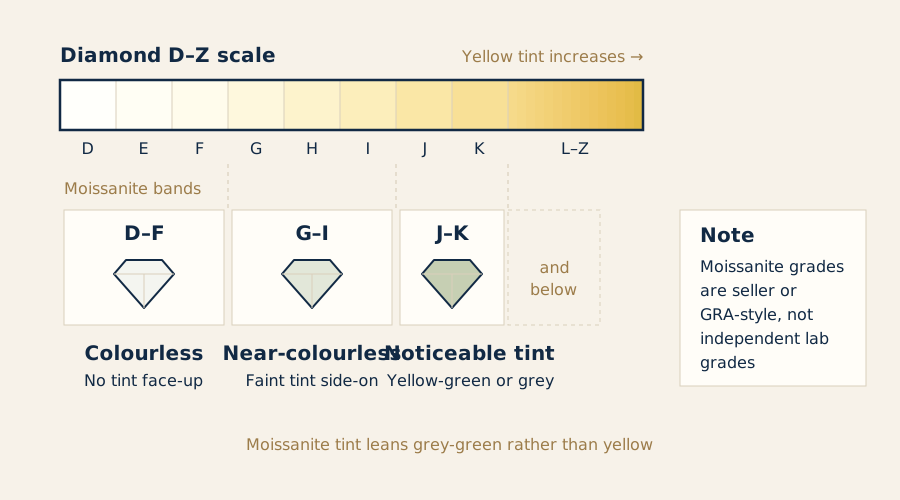
Two things make moissanite colour behave differently from diamond. First, its strong fire can distract the eye from body colour face-up, so the tint usually shows only side-on or in the corners of fancy shapes. Second, it can look warmer under incandescent or warm LED light than in daylight. If a coloured surface coating has been used for a fancy colour, it can wear over years and should be disclosed.
For a diamond you often weigh one grade against the other; our guide on whether colour or clarity deserves more of your budget covers that trade-off. With moissanite the answer is simpler: clarity is usually high anyway, so colour is where your choice makes a visible difference.
Which moissanite colour grade should you choose?
Size and metal decide most of it. In a small stone the tint has little depth to build up in, and yellow or rose gold warms everything around it. In a large stone set in white gold or platinum, a near-colourless moissanite has more room to show grey-green, and white metal shows it up.
| Round size | White gold or platinum | Yellow or rose gold |
|---|---|---|
| Up to 6.5 mm (about 1 ct diamond look) | G–I usually looks white | G–I or even J looks white |
| 6.5–8 mm (about 1–2 ct look) | D–F if you are sensitive to tint | G–I |
| 8 mm and over (2 ct look and up) | D–F | D–F or G–H |
Elongated and fancy shapes such as ovals, pears, emeralds and radiants show body colour more than rounds, because the tint gathers at the ends and in the corners. The same pattern holds for diamonds; our page on colour and clarity pairings for each diamond shape shows how much allowance each shape needs, and you can apply the same logic to moissanite by moving up one band for fancy shapes.
Not sure which one is right?
Send us the stones you are looking at and our gemologist will tell you which to choose and why.
What clarity is typical for moissanite?
Moissanite clarity is described with diamond terms, from FL (flawless) down to I (included). An inclusion is any internal feature, such as a crystal, needle or cloud. Because the material is grown under controlled conditions and stones with visible flaws are usually cut away or not sold as gems, most lab-created moissanite in jewellery sits between VVS1 and VS1.
| Grade | Meaning (diamond definition) | In moissanite |
|---|---|---|
| FL / IF | No inclusions at 10× magnification | Claimed occasionally; hard to verify without a lab |
| VVS1–VVS2 | Very, very slightly included; hard to find at 10× | The most common grades on listings |
| VS1–VS2 | Very slightly included; seen at 10×, eye-clean | Common, often in budget stock |
| SI1–SI2 | Slightly included; may be visible to the eye | Less common; look closely before buying |
Typical inclusions in moissanite are fine, parallel needles or growth tubes that run in one direction, small dark points and occasional clouds. Needles that line up with the facets can be hard to see face-up, but they can scatter a little light in a large stone. Unlike a diamond, where a feather (a small internal crack) near the girdle is the main worry, moissanite is tough enough that clarity rarely affects durability.
If you want to picture each grade, our diamond pages show them clearly: VVS1 clarity up close, VVS2 stones and their pinpoints, what a VS1 grade looks like, eye-clean VS2 diamonds and SI2 clarity and its trade-offs. Lab-grown diamonds are a useful reference point too, since they are also grown in controlled conditions; see what clarity is typical for lab-grown diamonds.
How does moissanite compare with diamond for hardness, sparkle and price?
| Lab-created moissanite | Lab-grown diamond | Natural diamond | Cubic zirconia (lab-created) | |
|---|---|---|---|---|
| Material | Silicon carbide | Carbon | Carbon | Zirconium oxide |
| Mohs hardness | 9.25 | 10 | 10 | 8–8.5 |
| Refractive index | 2.65–2.69 | 2.42 | 2.42 | 2.15–2.18 |
| Dispersion (fire) | 0.104 | 0.044 | 0.044 | about 0.060 |
| Refraction | Double | Single | Single | Single |
| Specific gravity | about 3.22 | 3.52 | 3.52 | 5.6–6.0 |
| Colour and clarity grading | Maker, retailer or GRA-style reports | GIA, IGI on D–Z and FL–I3 | GIA, IGI on D–Z and FL–I3 | Not graded |
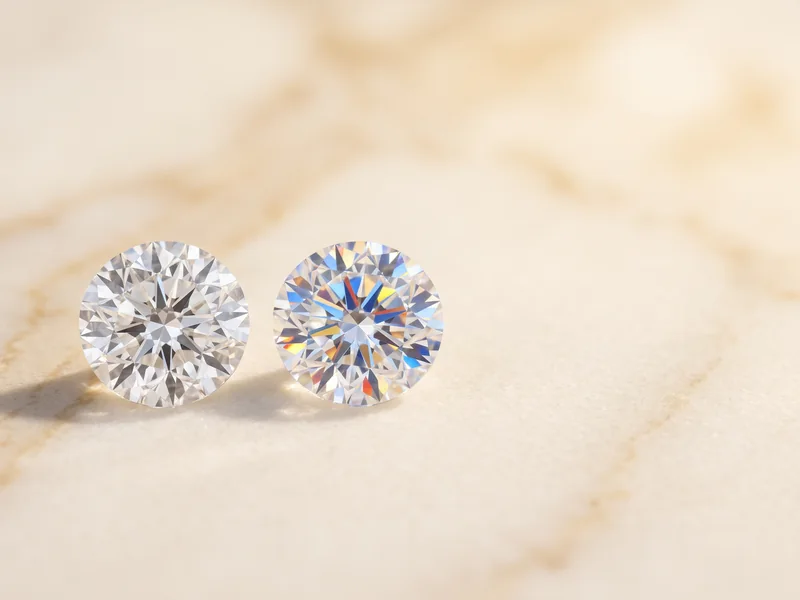
In practice, moissanite's higher refractive index and dispersion give it a different look: more rainbow flashes and a slightly glassy, high-energy sparkle, especially in sunlight. A diamond returns more white light (brilliance) with less rainbow fire. Neither is better; they are different, and many people can tell them apart at a glance once they have seen both side by side, particularly in stones above about 2 ct look.
For the full side-by-side on wear, appearance and resale, read our moissanite and diamond comparison, and if you have narrowed it to two lab-made options, our guide to choosing between lab-grown diamond and moissanite goes through each point.
Related guideMoissanite vs DiamondHow much does moissanite cost in Australia?
Moissanite is sold by size in millimetres, often with a diamond equivalent weight (DEW): the carat weight a diamond of the same size would have. Because moissanite is lighter, a 6.5 mm round sold as "1 ct DEW" actually weighs about 0.88 ct. Always compare millimetres, not carats.
| 6.5 mm round (about 1 ct look) | Approximate price range (AUD, loose stone) |
|---|---|
| Lab-created moissanite, unbranded, sold as D–F VVS | about $150–$600 |
| Lab-created moissanite, branded premium colourless | about $500–$1,500 |
| Lab-grown diamond, 1 ct G–H VS | about $800–$2,500 |
| Natural diamond, 1 ct G–H VS | about $6,000–$15,000 |
These are broad ranges only and move with the market. Within moissanite, the price gap between colourless and near-colourless is small compared with diamonds, and clarity barely moves it, so the extra cost of a D–F stone is usually modest. Remember that moissanite and lab-grown diamond are both made in a laboratory but are different materials; resale value for moissanite is low, and the same is increasingly true of lab-grown diamond.
Compare with lab-grown diamonds
How can you tell moissanite from a diamond?
Moissanite conducts heat far better than other simulants, close enough to diamond to fool simple thermal testers. A gemmologist uses several checks together rather than relying on one beep.
| Test | Lab-created moissanite | Diamond (natural or lab-grown) |
|---|---|---|
| Thermal tester only | Usually reads as diamond | Reads as diamond |
| Electrical conductivity (multi-tester) | Flags as moissanite | Reads as diamond, except some boron-bearing lab-grown and natural blue diamonds, which can also conduct |
| 10× loupe, tilted through the crown | Doubled facet edges at the back of the stone | Single, sharp facet edges |
| Inclusions at 10× | Parallel needles or growth tubes | Crystals, feathers, clouds; metallic flux in some HPHT lab-grown |
| Long-wave UV lamp | Usually inert or very weak | Natural: none to strong blue; lab-grown: often weak or inert, sometimes glows under short-wave |
| Weight for size | Lighter (SG about 3.22) | Heavier (SG 3.52) |
| Fire in daylight | Strong rainbow flashes | More white light, less rainbow |
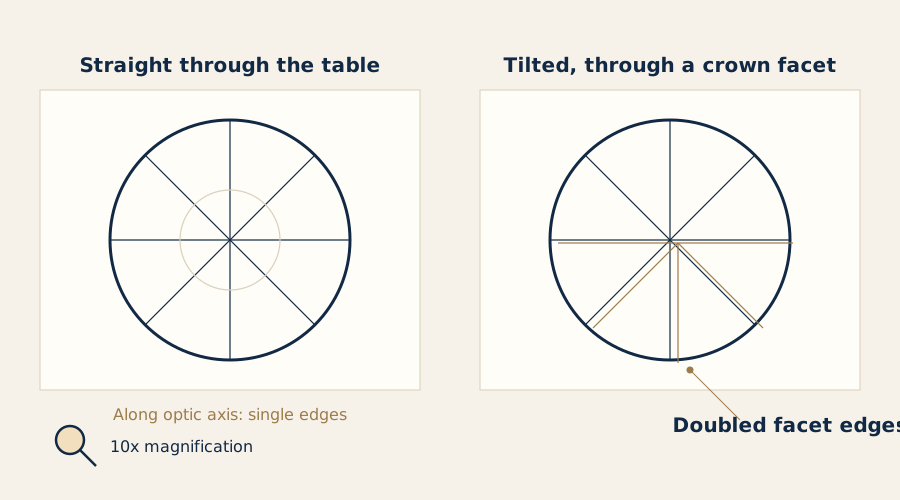
Doubling is the clearest loupe test, but it has a catch. Cutters usually orient moissanite so you look along its optic axis (the one direction with no double refraction) when viewing straight through the table. Tilt the stone and look through a side crown facet towards the back, and the pavilion edges split into two. Our guide to why moissanite can pass a basic diamond tester explains which tester types to trust.
What setting and metal suit moissanite?
At 9.25 on the Mohs scale and with good toughness, lab-created moissanite is durable enough for daily wear in any common setting, and it does not cleave as easily as diamond. Colour grade and metal should be chosen together:
- White gold or platinum: pair with D–F if the stone is above about 6.5 mm, because white metal shows grey-green tint.
- Yellow or rose gold: G–I moissanite looks white against warm metal and costs slightly less.
- Halo settings: if the halo uses diamonds, match the moissanite to colourless so the centre does not look greyer than the diamonds around it.
- Repairs and resizing: moissanite can change colour temporarily when heated by a jeweller's torch and returns once it cools, but tell your jeweller what the stone is before any work.
How do you check moissanite colour and clarity? Step by step
- Confirm what it is. The invoice and any report should say lab-created or synthetic moissanite (silicon carbide), never just "diamond" or "simulant".
- Check the size properly. Note the millimetre measurements and the actual carat weight, not only the diamond equivalent weight.
- Judge colour yourself. View the stone face-up and side-on against a white card, in daylight and in warm indoor light.
- Use a 10× loupe. Look for needles or dark points, check the girdle for chips and tilt the stone to see the doubled facet edges.
- Match colour to size and metal. D–F for larger stones in white metal; G–I is usually fine for smaller stones or yellow and rose gold.
- Get a multi-tester check when identity matters. For insurance, remounting or an inherited piece, ask a gemmologist to test electrical conductivity and check under magnification.
- Keep the paperwork. Make sure any valuation describes the stone as lab-created moissanite with its measurements.
Free consultation
Talk to a gemologist
Compare stones in person or online with Raj Sood, Graduate Gemologist (GIA), AJP (GIA).
Book a consultationShop this shape
FAQ
Common questions
Does moissanite look yellow?
Older and lower-grade moissanite can show a yellow-green or grey tint, especially side-on or in warm light. Stones sold as colourless (D–F) show very little tint, while near-colourless (G–I) may look faintly warm or grey in larger sizes.
Is VVS moissanite worth paying extra for?
Usually the extra is small, because most lab-created moissanite is already VVS–VS. Any VS or better stone should be eye-clean, so spend on colour and cutting before clarity.
Are GRA moissanite certificates reliable?
A GRA-style report records grades for the stone, but it is not an independent gem lab grading in the way a GIA or IGI diamond report is. Treat the grades as a description and check the colour yourself.
Which moissanite colour grade should I choose?
For stones over about 6.5 mm in white gold or platinum, colourless D–F avoids visible grey-green tint. For smaller stones or yellow and rose gold, near-colourless G–I usually looks white.
Is moissanite a lab-grown diamond?
No. Lab-created moissanite is silicon carbide, a different material, while a lab-grown diamond is pure carbon with the same structure as a natural diamond.
Can a diamond tester tell moissanite from diamond?
A basic thermal tester usually cannot, because moissanite conducts heat much like diamond. A multi-tester that also checks electrical conductivity, plus a loupe check for doubled facet edges, will normally identify it.

Ask a gemologist
Not sure which diamond to choose?
Raj Sood is a Graduate Gemologist (GIA) and master jeweller. Bring the stones you are considering, or send the reports, and he will tell you honestly which one is better and why.
Keep learning
Related guides
 Lab-Grown DiamondsMoissanite vs DiamondLab-Grown DiamondsLab-Grown Diamond vs Moissanite
 Lab-Grown DiamondsDoes Moissanite Pass a Diamond Tester?Lab-Grown DiamondsMoissanite vs Cubic ZirconiaLab-Grown DiamondsLab-Grown Diamonds Guide
 Diamond 4Cs & GradingColour vs Clarity: Which to Prioritise
 Diamond 4Cs & GradingUnderstanding Diamond Clarity Grades: FL to I3 Explained
 Lab-Grown DiamondsLab-Grown Diamond Colour Grades
Explore more
More guides on this topic
Education