
- Education
- Lab-Grown Diamonds
- Moissanite vs Diamond: How They Differ and How to Tell Them Apart
Lab-Grown Diamonds
Moissanite vs Diamond: How They Differ and How to Tell Them Apart
Moissanite vs diamond is one of the most common questions we hear across the counter, because the two look alike in a ring and cost very different amounts. Here is how they compare on hardness, sparkle, colour and price, and exactly how a gemologist separates them.
 Reviewed by Raj Sood, Graduate Gemologist (GIA), AJP (GIA)Master jeweller and Graduate Gemologist (GIA) · reviewed 4 November 2026
Quick answer
Moissanite is lab-created silicon carbide, not diamond. In the moissanite vs diamond comparison, diamond is harder (Mohs 10 against 9.25) and shows balanced white sparkle, while moissanite shows more rainbow fire and costs far less. A gemologist tells them apart by double refraction under a loupe, an electrical-conductivity tester and differences in weight.
What is moissanite, and is it a real diamond?
Moissanite is silicon carbide (SiC), a compound of silicon and carbon. It is not a diamond, and it is not a diamond simulant made of glass or plastic either: it is a separate mineral with its own crystal structure, hardness and optical properties. Our page on moissanite as a gemstone in its own right covers its history and properties in more depth.
The French chemist Henri Moissan first found it in 1893 in rock from the Canyon Diablo meteorite crater in Arizona, initially mistaking the crystals for diamond before confirming them as silicon carbide. Natural moissanite turned out to be extremely rare, found only as tiny grains, so every moissanite you see in jewellery is lab-created moissanite, grown in a laboratory. Gem-quality lab-created moissanite was commercialised in the late 1990s, and quality, especially colour, has improved a great deal since then.
A diamond, by contrast, is pure carbon arranged in a cubic crystal. It can be natural (formed deep in the earth over a very long time) or laboratory-grown. A lab-grown diamond is real diamond, with the same chemistry and physical properties as a natural one; lab-created moissanite is a different material altogether. If you want to understand how laboratories grow crystals, our guide on whether you could grow a diamond or gemstone at home explains why it takes industrial equipment. Any unfamiliar word in this guide is also defined in our plain-English jewellery glossary.
Moissanite vs diamond: what are the key differences?
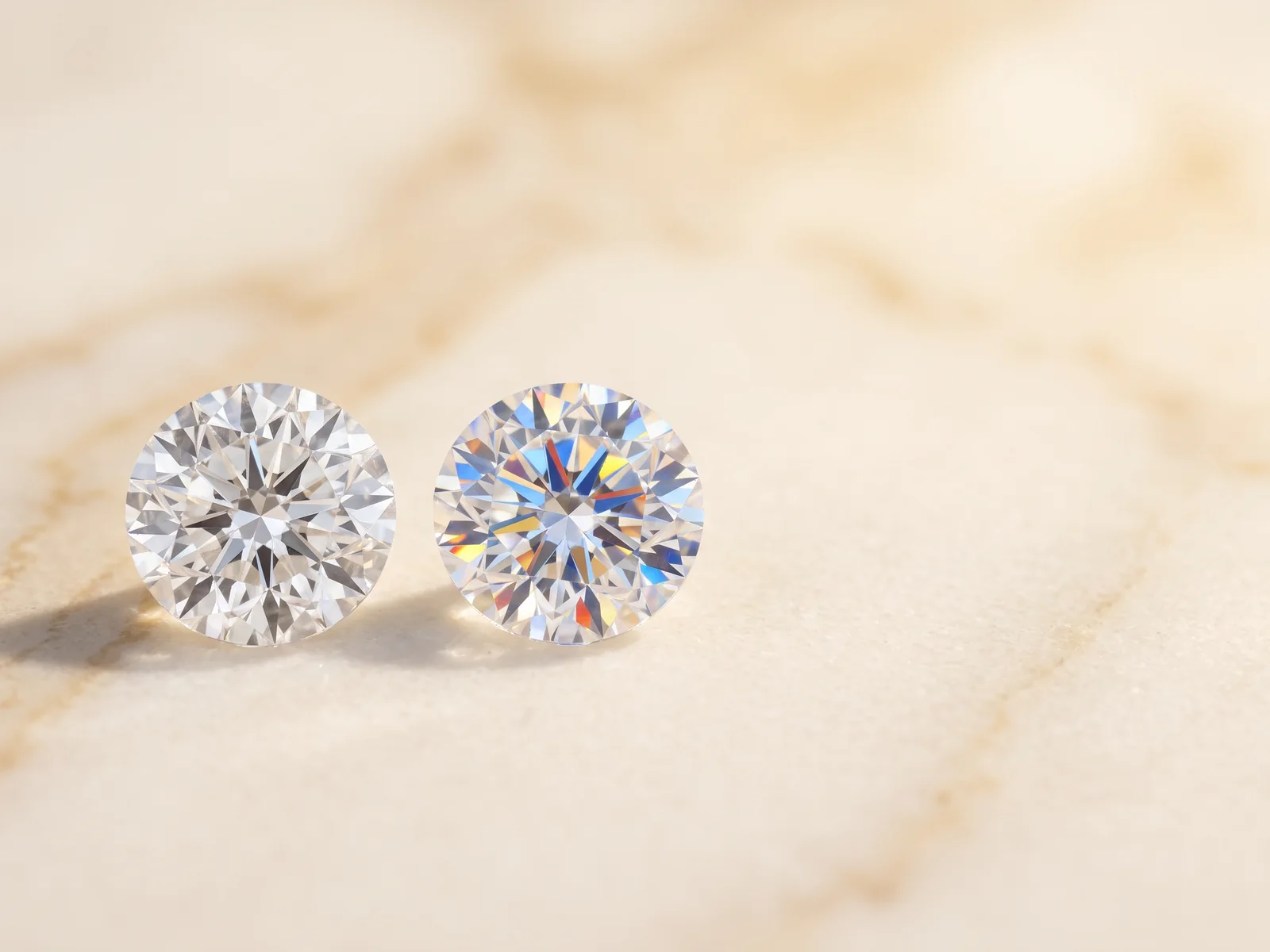
Side by side in a ring, a well-cut lab-created moissanite and a diamond look similar at arm's length. Up close, and under the gemologist's tools, the differences are clear. This table sets out the main physical and optical properties.
| Property | Diamond (natural or lab-grown) | Lab-created moissanite |
|---|---|---|
| Chemistry | Carbon (C) | Silicon carbide (SiC) |
| Hardness (Mohs) | 10 | 9.25 |
| Refractive index | 2.42 | 2.65–2.69 |
| Refraction | Single | Double (birefringence about 0.043) |
| Dispersion (fire) | 0.044 | 0.104 |
| Specific gravity | 3.52 | 3.22 |
| Weight of a 6.5 mm round | about 1.00 ct | about 0.88 ct |
| Cleavage | Perfect in four directions | Indistinct |
| Thermal tester reading | Diamond | Usually reads as diamond |
| Graded by | Independent labs such as GIA and IGI | Manufacturer's own grades, or diamond-style equivalents |
Two rows matter most for everyday wear and for identification. Hardness decides how well the polish survives years of knocks and dust. Double refraction means light splits into two rays inside moissanite, which is what a gemologist looks for with a loupe (a small 10× magnifier).
Everything in the diamond column applies equally to natural and lab-grown stones. If you are weighing those two against each other rather than against moissanite, start with our complete guide to lab-grown diamonds. Many colourless lab-grown diamonds are chemically very pure, the type explained in what Type IIa diamonds are and why they matter.
Is moissanite harder than diamond?
No. Diamond is the hardest natural material at 10 on the Mohs scale (a 1–10 ranking of scratch resistance). Lab-created moissanite is about 9.25, which places it above sapphire and ruby (9) and well above cubic zirconia (8–8.5) and quartz (7). The Mohs scale is not even: the gap between 9 and 10 is very large, so diamond resists scratching many times better than anything just below it.
In practice, 9.25 is very hard. Household dust contains quartz at 7, which is why softer stones go dull over time, and moissanite is comfortably above that. A moissanite ring worn daily keeps sharp facet edges for many years, though after a decade or more you may see faint wear on the facet junctions that a diamond would not show.
Hardness is not the whole story. Toughness is resistance to chipping and breaking. Diamond has perfect cleavage, meaning it can split along certain planes if hit hard at the wrong angle, while moissanite has no easy cleavage plane and is a tough material. Both still chip at thin edges such as marquise points if they take a sharp knock.
- Diamond: Mohs 10, perfect cleavage, burns at roughly 700–900 °C in open air, so jewellers protect it during repairs.
- Lab-created moissanite: Mohs 9.25, tough, very heat resistant, though it can temporarily change colour under a jeweller's torch.
- White sapphire: Mohs 9, durable but much less sparkle; see how lab-grown diamond compares with white sapphire.
- Other lab-created gems: colour options such as lab-created sapphire and ruby are covered in our guide to lab-grown sapphire, ruby and emerald.
Does moissanite sparkle more than a diamond?
It sparkles differently. A gem's sparkle has three parts: brilliance (white light returned to your eye), fire (flashes of rainbow colour) and scintillation (the on-off flicker as the stone moves). Moissanite's higher refractive index, 2.65–2.69 against diamond's 2.42, gives strong brilliance. Its dispersion, 0.104, is more than double diamond's 0.044, so it splits white light into far more colour.
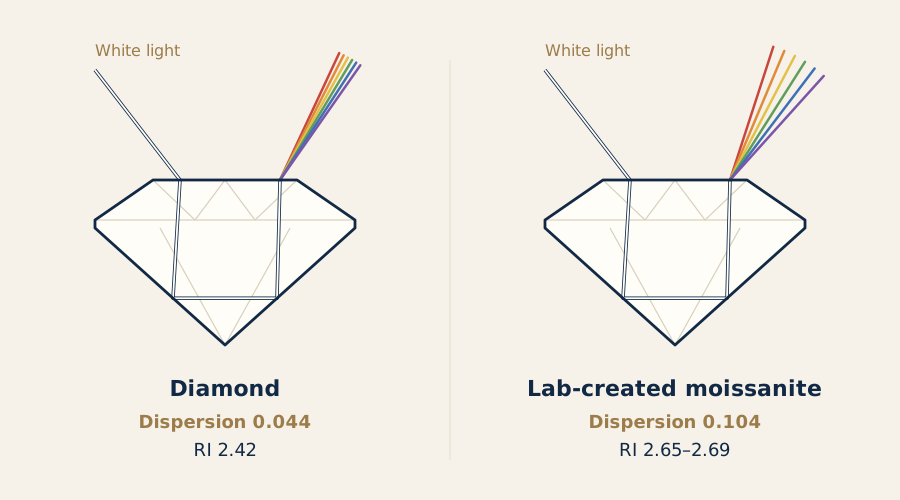
In soft indoor light the difference is modest. In direct sunlight or under bright spotlights, moissanite throws noticeably more rainbow flashes, and in larger stones, from about 7 mm (roughly a 1.25 ct diamond size) upwards, some people describe it as a disco-ball effect. Diamond's sparkle reads as crisper and whiter, with fire mixed into strong white flashes. Neither is better; it is a matter of taste, and it is worth seeing both in daylight before you decide.
Cubic zirconia sits in between on fire but well below both on brilliance, and it is much softer and heavier. Our moissanite vs cubic zirconia comparison goes through the numbers if you are considering the lower-priced simulant.
Not sure which one is right?
Send us the stones you are looking at and our gemologist will tell you which to choose and why.
What colour and clarity is moissanite?
Early lab-created moissanite had a clear yellowish or greenish tint. Today's colourless moissanite is usually sold as equivalent to D–F on the diamond colour scale, and near-colourless versions as G–I or similar. These are manufacturer grades, though, not independent laboratory grades, and they are not always consistent between brands. Some moissanite shows a faint grey or green tint under certain lights, especially in larger stones and when viewed from the side.
Clarity is usually high. Most moissanite sold for jewellery is eye-clean (no inclusions visible without magnification), and under a loupe you may see fine needle-like growth tubes running parallel to each other, which are typical of the material. Our guide to how moissanite colour and clarity grades work explains what each label actually means.
Diamonds are graded by independent laboratories such as GIA and IGI on the D–Z colour scale and the FL–I3 clarity scale (GIA now describes lab-grown diamonds with simpler quality terms instead). Lab-grown diamonds often sit in the VVS–VS clarity range, as described in what clarity to expect from a lab-grown diamond. That independent report is one of the clearest practical differences between buying a diamond and buying moissanite.
How do you tell moissanite from a diamond?
You often cannot tell by eye at normal distance, but a gemologist can separate them in minutes. No single quick test is foolproof, so at the bench we combine several. This is what each test shows.
| Test | Diamond | Lab-created moissanite | How reliable? |
|---|---|---|---|
| Thermal tester | Reads as diamond | Usually also reads as diamond | Cannot separate the two |
| Electrical conductivity (multi-tester) | Non-conductive (except blue Type IIb) | Conducts, triggers a moissanite alert | Good, with known exceptions |
| 10× loupe, tilted view | Single, sharp facet edges | Doubled back facet edges | Very good |
| Inclusions | Crystals, feathers, pinpoints | Fine parallel needles | Supporting evidence |
| Long-wave UV | Natural often blue fluorescence; varies | Usually inert to weak | Supporting only |
| Size vs weight (loose) | 6.5 mm round about 1.00 ct | 6.5 mm round about 0.88 ct | Good for loose stones |
| Laboratory spectroscopy | Confirms diamond, natural or lab-grown | Confirms silicon carbide | Definitive |
The best-known trap is the basic thermal tester. It measures how fast a stone draws heat away from a heated tip, and moissanite conducts heat well enough to give a similar reading, so it usually passes. Multi-testers add an electrical check, because moissanite conducts a small current and diamond normally does not. The catch: blue boron-bearing Type IIb diamonds, natural or lab-grown, also conduct and can trigger a false moissanite reading. We explain this in full in whether moissanite passes a diamond tester.
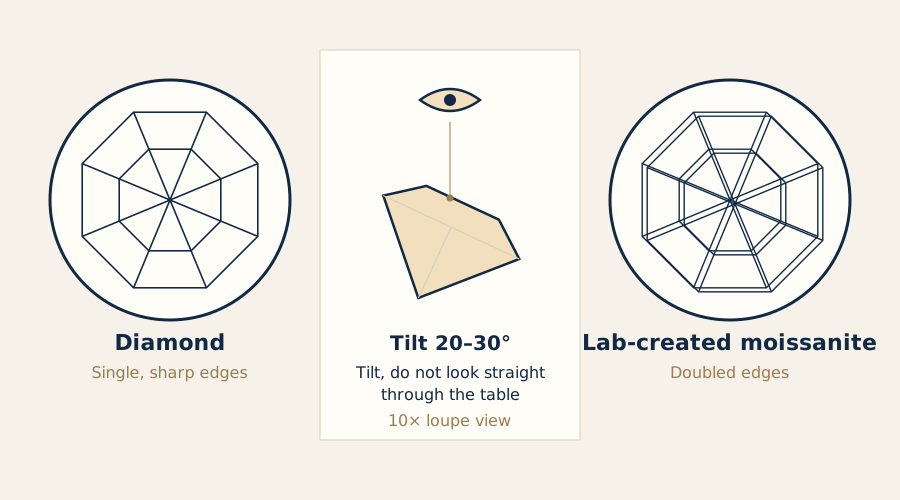
The loupe test is the most useful one you can learn. Moissanite is usually cut with its table perpendicular to its optic axis (the one direction with no doubling), so looking straight down shows nothing unusual. Tilt the stone and look through a side facet, and the pavilion facet edges appear as double lines.
Telling natural from lab-grown diamond is a different job that needs laboratory equipment; a loupe or handheld tester cannot do it. Growth methods leave different clues, as covered in how HPHT and CVD lab-grown diamonds differ. For the full set of home and gemologist checks, see our guide to checking whether a diamond is real.
Moissanite vs diamond price: how much does each cost in Australia?
Price is the main reason people consider lab-created moissanite. Because it is sold by millimetre size or by diamond equivalent weight (DEW, the carat weight a diamond of the same size would have), compare stones by their measurements rather than by carat.
| Round, about 6.5 mm (1 ct diamond size) | Approximate price range (AUD, loose) |
|---|---|
| Lab-created moissanite, colourless | about $300–$1,000 |
| Lab-grown diamond, G–H, VS | about $800–$2,500 |
| Natural diamond, G–H, VS | about $6,000–$15,000 |
These are broad ranges only; prices vary with cut quality, brand, grading and the market, and lab-grown diamond prices in particular have fallen over recent years. The gap widens with size: an 8 mm moissanite stays relatively affordable, while the matching 2 ct natural diamond costs many times more. Lab-grown diamond now sits in the middle, real diamond at a price much closer to moissanite than to natural. Our lab-grown diamond vs moissanite comparison looks at that choice directly.
Related guideLab-Grown Diamond vs MoissaniteUnder Australian Consumer Law, a seller must describe what a stone actually is. Moissanite must never be sold as diamond, and lab-grown diamonds must be clearly disclosed as lab-grown. The wording rules are set out in how the ACCC expects lab-grown and simulant stones to be described. Neither moissanite nor diamond should be bought expecting it to rise in value; choose for how it looks and wears.
Browse lab-grown diamonds
Is moissanite worth it for an engagement ring?
For many people, yes. Lab-created moissanite is hard and tough enough for daily wear, keeps its polish well, and lets you choose a larger look for a smaller budget. The trade-offs are the stronger rainbow fire, which some love and some find too much, the lack of an independent grading report, and the fact that it is not diamond, which matters to some couples and not at all to others.
- Choose moissanite if: you want maximum size and sparkle for the money, you enjoy colourful fire, and diamond itself is not important to you.
- Choose lab-grown diamond if: you want real diamond with its whiter sparkle and Mohs 10 hardness at a moderate price.
- Choose natural diamond if: its rarity and natural origin are what matter to you.
Settings work the same way for both. Claw, bezel, halo and three-stone designs all suit moissanite, and because moissanite tolerates heat well it is generally simple to size or repair a ring around it, though we still take care. For earrings and bracelets, where you want many matched stones, see lab-grown diamonds for studs and tennis bracelets for how the costs compare.
Moissanite vs diamond: how do you choose, step by step?
- Decide what matters most. Is it the material being diamond, the look, the size or the budget? Be honest about which comes first.
- Compare in daylight. View a moissanite, a lab-grown diamond and, if possible, a natural diamond of the same millimetre size, indoors and in sunlight.
- Compare by millimetres. Use face-up size or diamond equivalent weight, not carat weight, since moissanite is about 10% lighter.
- Check the paperwork. Diamonds should come with an independent report (GIA, IGI or similar) stating natural or lab-grown; moissanite should be clearly described as lab-created moissanite.
- Look through a loupe. Tilt the stone and check for doubled facet edges so you know what you are looking at.
- Plan the setting. Pick a claw or bezel design suited to everyday wear, and allow for the stronger fire of moissanite in larger sizes.
Free consultation
Talk to a gemologist
Compare stones in person or online with Raj Sood, Graduate Gemologist (GIA), AJP (GIA).
Book a consultationShop this shape
FAQ
Common questions
Is moissanite a real diamond?
No. Moissanite is silicon carbide, a different mineral, and all moissanite in jewellery is lab-created. A lab-grown diamond, by contrast, is real diamond made of carbon.
Does moissanite pass a diamond tester?
It usually passes a basic thermal tester, because it conducts heat well enough to give a diamond-like reading. A multi-tester with an electrical check normally flags it as moissanite, and a gemologist can confirm with a loupe.
Can you tell moissanite from a diamond by eye?
Not reliably at normal distance. In bright light moissanite shows more rainbow fire, and under a 10× loupe its back facet edges look doubled when you tilt the stone.
Will moissanite get cloudy or scratched over time?
Moissanite does not go cloudy; any dullness is usually dirt or oil and cleans off. At Mohs 9.25 it resists scratching very well, though after many years it may show slight wear on facet edges that diamond would not.
Is moissanite cheaper than a lab-grown diamond?
Usually, yes. A colourless 6.5 mm moissanite generally costs less than a 1 ct lab-grown diamond of good colour and clarity, though the gap has narrowed as lab-grown diamond prices have fallen.
Why is moissanite sold in millimetres instead of carats?
Moissanite is lighter than diamond (specific gravity 3.22 against 3.52), so the same size weighs less. Sellers use millimetres or diamond equivalent weight so you can compare sizes fairly.

Ask a gemologist
Not sure which diamond to choose?
Raj Sood is a Graduate Gemologist (GIA) and master jeweller. Bring the stones you are considering, or send the reports, and he will tell you honestly which one is better and why.
Keep learning
Related guides
 Lab-Grown DiamondsLab-Grown Diamond vs Moissanite
 Lab-Grown DiamondsDoes Moissanite Pass a Diamond Tester?Lab-Grown DiamondsMoissanite vs Cubic Zirconia
 Lab-Grown DiamondsHow to Tell if a Diamond Is RealLab-Grown DiamondsLab-Grown Diamonds GuideLab-Grown DiamondsMoissanite Colour and Clarity GradesGemstonesMoissanite as a GemstoneLab-Grown DiamondsLab-Grown Diamonds vs White Sapphire
Explore more
More guides on this topic
Education