
- Education
- Wedding Bands & Eternity
- Shared Prong vs Channel Set Wedding Band: Which Setting Is Right for You?
Wedding Bands & Eternity
Shared Prong vs Channel Set Wedding Band: Which Setting Is Right for You?
Choosing a shared prong vs channel set wedding band decides how much diamond you see, how the band wears day to day and what repairs look like in ten years. Here is how each style works, and who each one suits.
 Reviewed by Raj Sood, Graduate Gemologist (GIA), AJP (GIA)Master jeweller and Graduate Gemologist (GIA) · reviewed 4 November 2026
Quick answer
A shared-prong band holds each diamond between claws shared by neighbouring stones, so more of every diamond shows and it sparkles more, but claws can snag and wear. A channel-set band locks stones between two metal walls: smoother, more secure and lower-maintenance, with less sparkle and harder resizing. Choose by lifestyle and how it sits beside your engagement ring.
What is the difference between a shared prong vs channel set wedding band?
Both are ways of setting a row of small diamonds into a wedding band. The difference is what holds each stone. In a shared-prong band (in Australia usually called shared-claw), small metal claws sit between the diamonds, and each claw grips the edge of two neighbouring stones at once. In a channel-set band, the diamonds sit in a groove between two parallel walls of metal, with no claws at all.
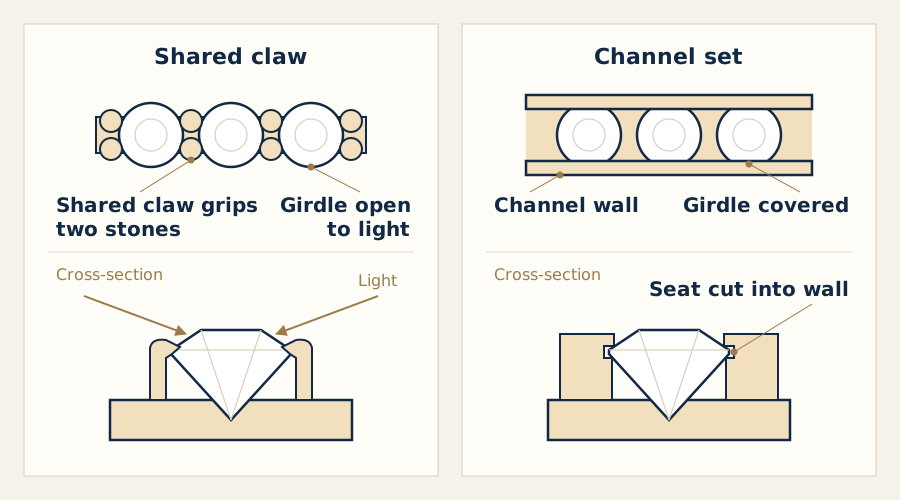
That one difference flows through to everything else: how much of each diamond you can see, how much light gets in from the side, whether the band catches on knitwear, how it sits against your engagement ring and how easily it can be resized or repaired. If you are still deciding whether you want stones at all, our page on plain and diamond wedding bands compared is a good starting point, and if the terms themselves are confusing, here is what separates a wedding ring from a wedding band.
A quick note on two words you will see throughout. The girdle is the thin outer edge around the widest part of a diamond, and it is what any setting grips. Melee (pronounced 'mel-ay') is the trade word for small diamonds, generally under about 0.18 carat, which is what most wedding bands use. Anything else unfamiliar is in our glossary of jewellery terms.
How does a shared-prong wedding band hold its diamonds?
The setter drills and cuts a seat for each diamond along the top of the band, leaving a thin post of metal between every pair of stones. Each post is then split or shaped so that its tip folds over the girdle of the diamond on each side. Because every claw does double duty, there are half as many claws as a band where each stone has its own four, so the diamonds can sit very close together and less metal shows between them.
The claws on a wedding band are small, typically around 0.6–0.8 mm across at the tip. That is what makes the style look so light, and it is also its weak point: small claws wear down faster than thick metal walls, and a claw that wears or bends loosens two stones, not one.
- Classic shared-claw: a single claw between each pair of stones, with the metal under the diamonds left fairly solid. Neat and strong.
- U-cut (scalloped) shared-claw: the metal under and beside each stone is cut away in a U shape, so you can see the side of each diamond. More light, more sparkle, slightly less metal supporting the stones.
- French-cut pavé: tiny V-shaped cuts beside each claw expose even more of the diamond. Delicate in look and in wear.
- Common claw (double claw): a heavier version where each post carries two separate beads or tips. More metal, more security.
Shared-claw bands are almost always set with round brilliant diamonds, because the round girdle sits evenly against the claws; our overview of the main diamond shapes explains why rounds behave differently from fancy cuts. Band width and the shape of its cross-section also change the look a lot; see band profiles such as court, flat and knife-edge.
How does a channel-set wedding band work?
In a channel setting, the band is made with a groove running along the top. The setter cuts a small notch, called a seat or bearing, into the inside of each wall for every diamond. The stones are lowered in edge to edge, their girdles slipped into the seats, and then the tops of the walls are gently pressed or hammered inwards so the metal closes over the girdle and locks the whole row in place.
The walls usually measure around 0.8–1.2 mm thick on a wedding band. With no claws sticking up, the top of the band is smooth, the diamonds sit lower and the stones are protected from side knocks. The trade-off is that the walls cover the girdle and part of the crown (the top facets) of every stone, so less light enters from the side and each diamond looks a little smaller than it would in claws.
- Round brilliants: the most common; gives a row of sparkle with a clean metal edge each side.
- Princess cuts: square stones sit edge to edge with almost no gap, making a continuous line of diamond. The square corners are thin, and the channel walls protect them.
- Baguettes: long rectangular step cuts give a sleek, Art Deco look with flashes of light rather than sparkle. Our page on straight and tapered baguette cuts explains the difference.
- Mixed rows: alternating baguettes and rounds, or graduated sizes, are possible but need very precise seat cutting.
Because the stones touch or nearly touch, a channel band relies on every seat being cut accurately. We cover the strengths and weak spots of the setting, including what happens when a stone loosens, in our guide to channel-set diamonds in more depth.
Shared prong vs channel set wedding band: which is more durable?
For most people, a well-made channel-set band is the more durable and lower-maintenance of the two. A shared-claw band is perfectly wearable every day, but it needs more regular checking. Here is how they compare across the things that matter in daily wear.
| Shared-prong (shared-claw) | Channel-set | |
|---|---|---|
| How stones are held | Small claws, each gripping two stones | Two continuous metal walls |
| Sparkle | More: girdle and sides open to light | Less: walls cover the girdle |
| Face-up look of each stone | Slightly larger | Slightly smaller |
| Snagging on clothes and hair | Can catch, especially when claws wear | Smooth; rarely catches |
| Protection from knocks | Stones more exposed at the sides | Stones well protected |
| Typical weak point | Worn or bent claws | Walls bent or spread by a side knock |
| Cleaning | Easier to clean under stones | Dirt collects under stones in the channel |
| Resizing | Possible within limits; claws must be checked after | More difficult; walls can distort and release stones |
| Suits stone shapes | Mainly rounds | Rounds, princess, baguettes |
| Maintenance | Claw check every 6–12 months | Check walls and stones about yearly |
Diamond rates 10 on the Mohs hardness scale, so the stones themselves resist scratching. But hardness is not toughness: a diamond can still chip at its girdle if it takes a hard knock, and in a shared-claw band the girdle is exposed. Metal choice matters too. Platinum tends to push aside when it wears rather than being lost, and it stays bright white without rhodium plating, which is why many setters like it for claws. 18 carat white and yellow gold are also very sound; 9 carat gold is harder but can be more brittle in fine claws.
Not sure which one is right?
Send us the stones you are looking at and our gemologist will tell you which to choose and why.
Which looks sparklier and bigger on the hand?
Shared-claw wins on sparkle. Light enters a diamond through its crown, but also through the sides near the girdle, and a shared-claw band leaves most of that open. A U-cut or French-cut style opens it further. The result is a band that looks almost entirely diamond from the top, with each stone reading at full size.
A channel band gives a different effect: a defined line of diamonds framed by bright metal. It looks tailored rather than glittery. Because the walls cover part of each stone, a channel band with 2.5 mm stones can look closer to a shared-claw band with 2.2 mm stones. If you want a channel band to hold its own beside a larger engagement diamond, it is worth going up one stone size.
| Round stone diameter | Approx. weight each | Approx. total, half eternity (size N) |
|---|---|---|
| 1.5 mm | 0.015 ct | about 0.25 ct (16–17 stones) |
| 2.0 mm | 0.03 ct | about 0.40 ct (12–13 stones) |
| 2.5 mm | 0.06 ct | about 0.60 ct (10–11 stones) |
| 3.0 mm | 0.10 ct | about 0.80 ct (8–9 stones) |
| 3.5 mm | 0.16 ct | about 1.10 ct (7 stones) |
These figures are approximate and depend on finger size, stone spacing and how far around the band the diamonds run. A half eternity has stones across roughly the top half; a full eternity has stones all the way around. Band width and profile also change how big the stones look; this is covered in how band width and profile change the look.
Which sits better beside an engagement ring?
This is where many people make their decision, and where the two styles behave very differently. A channel band has smooth, straight sides, so it can sit flush (touching along its length) against an engagement ring without anything rubbing. A shared-claw band has claw tips that stand slightly proud along both edges, and those tips can rub against the claws, halo or shoulder diamonds of the engagement ring over time. Diamond can wear down metal, and two diamonds rubbing edge to edge can chip each other.
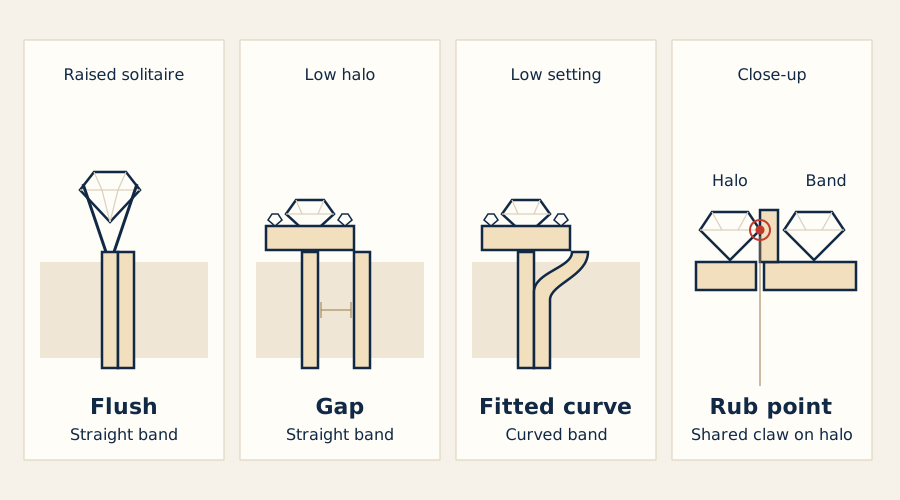
Whether any band sits flush also depends on how high the engagement ring's centre stone sits. If the basket or halo comes down to the finger, a straight band will leave a gap. The fix is a curved or notched band shaped around the setting; see fitted and contoured bands. Our wider guide to matching a band to your engagement ring covers metal, width and height.
- Round solitaire with a raised setting: either style sits flush. Shared-claw gives a soft continuous sparkle; channel gives a crisp contrast.
- Princess engagement ring: a channel-set princess band echoes the square shape and sits flat. See bands that suit a princess engagement ring.
- Halo engagement ring: the halo's diamonds sit low, so a channel band avoids diamond-against-diamond rubbing. A shared-claw band usually needs a slight gap or a fitted curve.
- Pavé-set engagement shank: matching the engagement ring's setting style (shared-claw next to shared-claw) keeps the look consistent, but ask for the edges to be finished smooth.
- Pear, marquise or heart: the point often overhangs the band, so a curved or V-shaped band is usually needed whichever setting you choose. See bands that sit neatly beside a heart and our pear cut diamond guide for how the point affects the fit.
Which suits your work and everyday life?
Think about what your hands do all day. The setting that suits a desk job may not suit a nurse, a chef, a gardener or a rock climber.
- Hands in gloves often (health care, labs, food prep): channel-set. Claws can tear gloves, and smooth walls are easier to keep hygienic on the outside.
- Knitwear, long hair, fine fabrics: channel-set or a shared-claw band with low, well-rounded claws.
- Gym, trades, outdoor work: channel-set, or take any diamond band off and wear a plain band for the hard work.
- Office work, light daily wear, maximum sparkle: shared-claw is a good fit.
- Lotion, sunscreen, cooking: both trap residue. Channel bands collect it under the stones; shared-claw bands are easier to brush clean.
Channel setting is also the usual choice when diamonds are added to a men's band, because it keeps a flat, solid look and suits wider bands of 5–8 mm. Flush setting (each stone sunk into the metal with no claws or walls showing) is the other common option. Our men's wedding band styles and widths page compares them.
Can you resize or repair a shared-prong or channel-set band?
Any band with stones set around it is harder to resize than a plain band, because stretching or cutting the metal moves the settings. As a rule of thumb, a half eternity band can usually go up or down about one to two sizes, with work done in the plain section at the back. A full eternity band has no plain section, so it usually cannot be resized meaningfully; it has to be made to the right size from the start, or remade.
| Job | Shared-prong band | Channel-set band |
|---|---|---|
| Resizing a half eternity | Usually possible; claws re-tightened after | Possible with care; walls can spread and loosen stones |
| Resizing a full eternity | Rarely practical | Rarely practical |
| Re-tipping worn claws | Routine: new metal added to each claw tip | Not applicable |
| Replacing a lost stone | Fairly simple; neighbouring claws re-shaped | Harder; walls opened, stone fitted, walls closed |
| Straightening a bent setting | Individual claws adjusted | Walls reshaped; nearby stones may need resetting |
| Re-polishing | Easy around claws | Easy on the walls; take care not to thin them |
With channel bands, one loose stone is often the warning sign that a wall has opened slightly, and its neighbours may follow. If you notice a stone that rattles or turns, stop wearing the band until it is checked. Our guide to common channel-set repairs and what they involve goes through each job. Ultrasonic cleaners are safe for diamonds themselves but can shake loose stones out of a worn setting, so have the setting checked before using one.
How much does a shared-prong or channel-set wedding band cost in Australia?
Price depends far more on the diamonds and the metal than on which setting you choose. The two styles use similar setting time per stone. Channel bands use a little more metal for the walls, while U-cut and French-cut shared-claw bands need extra fine cutting. Across the market, prices for the two styles at the same diamond weight tend to be broadly similar.
| Half eternity, about 0.50 ct total, 18ct gold | Approximate price range (AUD) |
|---|---|
| Lab-grown diamonds, shared-claw or channel | about $1,200–$2,800 |
| Natural diamonds, shared-claw or channel | about $2,000–$4,500 |
| Same band in platinum | add roughly $500–$1,500 |
These are broad ranges only; gold and platinum prices move, and stone quality changes the figure considerably. Lab-grown diamonds are real diamond grown in a laboratory rather than mined, look identical to natural diamonds and cost much less. Natural diamonds are rarer. In a wedding band the stones are small, so most people choose about G–H colour and VS–SI clarity, which looks white and clean at this size. For budgeting, sizing and timelines, start with the full wedding ring buying guide, and if you are weighing the extra cost of stones, see whether a diamond band suits you or a plain one does.
Create your eternity ring or wedding band
Shared prong vs channel set wedding band: how do you choose? Step by step
- Wear your engagement ring and look at its side profile. Note how low the centre setting, halo or shoulder stones sit, and whether a straight band could sit flush.
- Be honest about your hands. Gloves, gym, trades or knitwear point towards channel-set; light wear and a love of sparkle point towards shared-claw.
- Decide half or full eternity. A half eternity is easier to resize and more comfortable for most; a full eternity needs an accurate size from the start.
- Choose the stone size. Match the band's visual weight to your engagement ring, and go up one size for channel-set if you want the same presence.
- Pick the metal. Match your engagement ring where possible; platinum or 18ct gold suits fine claws.
- Check the finish in person or on a close-up video. Claws should be even and rounded; channel walls straight, smooth and closed over every stone.
- Confirm sizing and aftercare. Get your finger sized when your hands are warm, read up on ring sizing and budgeting basics, and plan a claw or wall check every 6–12 months. If your rings leave a gap, ask about a curved band made to fit.
Free consultation
Talk to a gemologist
Compare stones in person or online with Raj Sood, Graduate Gemologist (GIA), AJP (GIA).
Book a consultationShop this shape
FAQ
Common questions
Is a channel-set or shared-prong wedding band more secure?
A well-made channel-set band is generally more secure, because continuous walls protect each stone's edge. A shared-claw band is secure for everyday wear too, but its small claws need checking every 6–12 months.
Do shared-prong wedding bands snag?
They can, especially on knitwear, hair and gloves, and more so as claws wear or lift. Rounded, well-finished claws reduce snagging, and a channel-set band rarely catches.
Can a channel-set wedding band be resized?
A channel-set half eternity can usually be resized about one to two sizes, but it needs care, because the walls can spread and loosen stones. A full eternity band generally cannot be resized and needs to be made to the correct size.
Which sparkles more, shared-prong or channel-set?
Shared-claw sparkles more, because the sides and girdle of each diamond are open to light. Channel-set gives a cleaner line of diamonds framed in metal, with a little less sparkle.
Will a diamond wedding band damage my engagement ring?
It can if diamonds or claws rub against each other over years. A smooth-sided channel band, a small gap or a fitted curved band prevents most wear.
Can I get lab-grown diamonds in a channel-set or shared-prong band?
Yes. Lab-grown diamonds are set in exactly the same way as natural diamonds, cost much less and should be disclosed as lab-grown on the paperwork.

Ask a gemologist
Not sure which diamond to choose?
Raj Sood is a Graduate Gemologist (GIA) and master jeweller. Bring the stones you are considering, or send the reports, and he will tell you honestly which one is better and why.
Keep learning
Related guides
 Engagement Rings & SettingsChannel-Set Diamonds: Pros, Cons and Repairs
 Wedding Bands & EternityHow to Match a Wedding Band to an Engagement Ring
 Wedding Bands & EternityFitted Wedding Bands Explained | Custom Curved Bands
 Wedding Bands & EternityPlain vs Diamond Wedding BandsWedding Bands & EternityWedding Ring Buying Guide
 Wedding Bands & EternityWedding Ring vs Wedding Band
 Wedding Bands & EternityMen’s Wedding Band Guide
 Wedding Bands & EternityWedding Band Profiles Explained
Explore more
More guides on this topic
Education