
- Education
- Lab-Grown Diamonds
- What Is Post-Growth Treatment in a Lab-Grown Diamond? HPHT, Colour and Reports
Lab-Grown Diamonds
What Is Post-Growth Treatment in a Lab-Grown Diamond? HPHT, Colour and Reports
Many lab-grown diamonds are heated or irradiated after they leave the growth chamber. Here is what post-growth treatment in a lab-grown diamond actually does, how grading reports disclose it, and what Australian consumer law expects sellers to tell you.
 Reviewed by Raj Sood, Graduate Gemologist (GIA), AJP (GIA)Master jeweller and Graduate Gemologist (GIA) · reviewed 4 November 2026
Quick answer
Post-growth treatment is a process applied to a lab-grown diamond after it is grown to change its colour. Most often a CVD diamond is HPHT annealed to remove a brown tint, which is permanent. Pink and other fancy colours may be irradiated. Treatment does not change what the stone is, but it must be disclosed, and reports state it.
What is post-growth treatment in a lab-grown diamond?
Post-growth treatment is any process applied to a lab-grown diamond after it comes out of the growth chamber or press, to change how it looks. Most often that means heating the crystal under high pressure to remove a brownish tint, but it can also mean irradiating it to create a pink, blue or green colour. The diamond is the same material afterwards: crystallised carbon, 10 on the Mohs hardness scale, with a refractive index of about 2.42. If you are new to the topic, start with our complete guide to lab-grown diamonds, and for the science behind the label, see why a lab-grown diamond is real diamond.
Treatment is not unique to lab-grown stones. Natural diamonds, sapphires, rubies and many other gems have been heated or otherwise treated for decades. What matters to you as a buyer is that the treatment is disclosed, that you know whether it is stable (permanent in normal wear and care), and that the price reflects the stone's actual grades. Treatment changes appearance; it does not change what the stone is.
A quick note on words. As grown means the diamond has not been treated after growth. Treated, post-growth treated and HPHT processed all mean it has. Any term you have not met before is explained in our plain-English jewellery glossary.
Why are lab-grown diamonds treated after growth?
To see why treatment is so common, you need to know a little about how lab-grown diamonds are made. There are two methods, both explained fully in how HPHT and CVD diamonds are grown:
- HPHT (high pressure, high temperature): a small diamond seed sits in a large press with a carbon source and a molten metal solvent, at roughly 5–6 gigapascals (around 50,000–60,000 times atmospheric pressure) and about 1,300–1,600 °C. The crystal grows over days to weeks.
- CVD (chemical vapour deposition): thin diamond seed plates sit in a vacuum chamber filled with methane and hydrogen. A microwave plasma breaks the gas apart and carbon builds up on the seeds layer by layer, at low pressure and roughly 700–1,200 °C, over several weeks.
CVD growth is fast, and the conditions are very different from the deep-Earth environment where natural diamonds form. As a result, many CVD crystals come out with a brown or greyish tint. The cause is tiny defects in the crystal lattice: clusters of missing carbon atoms (called vacancies), traces of nitrogen and hydrogen, and internal strain. Straight from the chamber, a CVD diamond can sit well down the colour scale.
Growers can slow the process to produce whiter crystals, but slower growth costs more chamber time. Treating the crystal afterwards is often quicker and cheaper, so it has become a routine step in CVD production. HPHT-grown diamonds face a different problem: nitrogen tends to turn them yellow, and growers usually control that during growth, by adding materials that capture nitrogen, rather than treating the stone later.
What types of post-growth treatment are used?
Several kinds of post-growth treatment exist. Only the first two are common in the colourless lab-grown diamonds sold in Australia; the others turn up mainly in fancy colours or lower-priced goods.
| Treatment | What it does | Usually used on | Stable? |
|---|---|---|---|
| HPHT annealing | Heats the crystal to roughly 1,800–2,300 °C under high pressure; breaks up vacancy clusters and removes brown tint, often lifting colour by several grades | CVD diamonds | Yes, permanent |
| Low-pressure annealing | Similar heating without the large press, in a vacuum or controlled gas; usually a milder colour improvement | CVD diamonds | Yes, permanent |
| Irradiation, then annealing | Radiation creates colour centres (defects that absorb light); gentle heating then turns them pink, red, blue or green | Fancy colour lab-grown diamonds | Stable in normal wear; can change with strong heat |
| Surface coating | A very thin film adds colour or masks a tint | Rare; low-cost fancy colours | No; can wear or be removed by polishing |
| Laser drilling or fracture filling | Burns a fine channel to a dark inclusion, or fills a crack with glass-like material | Mainly natural diamonds; rare in lab-grown | Drilling is permanent; fillings can be damaged by heat |
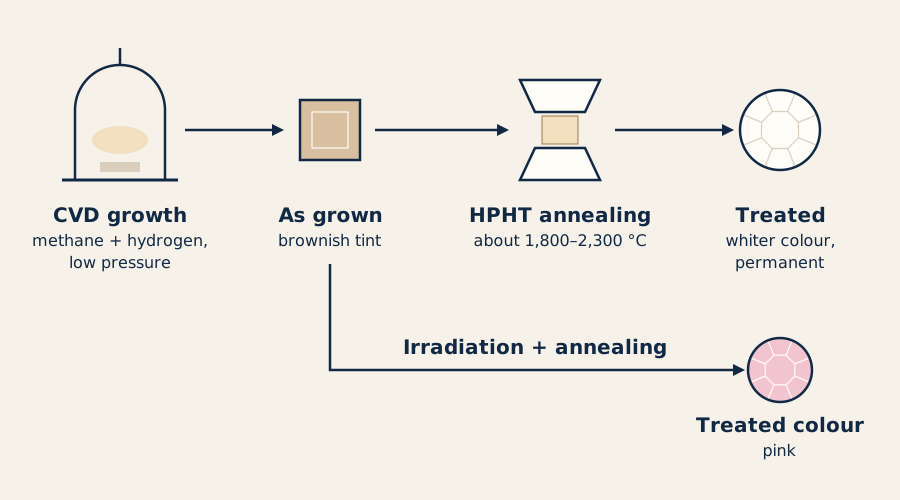
HPHT annealing works like an intense reset. At those temperatures the carbon atoms have enough energy to move back into place, so the vacancy clusters that absorb light and cause the brown colour break apart. Much of the strain inside the crystal relaxes too. The stone that comes out looks whiter, and it stays that way. Because it is usually done on the rough crystal, before final cutting and polishing, it is really the second half of the growth process that comes before treatment.
Treatment changes colour, not clarity. If a CVD diamond has small dark pinpoints of non-diamond carbon before treatment, it still has them afterwards. Our page on what clarity grades are typical in lab-grown stones covers which inclusions to expect from each growth method.
Fancy colours follow their own recipes. Pink lab-grown diamonds are usually made by growing a CVD crystal with a little nitrogen, then irradiating and annealing it so the nitrogen pairs with vacancies to form NV centres, which absorb green-yellow light and leave pink to red. The heart is a popular shape for these pinks, and our guide to heart shaped diamonds, including pink hearts shows how treated colour appears on their reports. Blue lab-grown diamonds are mostly coloured by boron added during growth, which is not a post-growth treatment, although some blues and greens are produced by irradiation.
Is post-growth treatment more common in CVD or HPHT diamonds?
Post-growth treatment is far more common in CVD diamonds. By trade estimates, a large share of colourless CVD diamonds on the market have been annealed after growth. Colourless HPHT-grown diamonds usually reach their colour during growth and are treated less often, although HPHT-grown stones can be treated to create fancy colours.
| CVD lab-grown | HPHT lab-grown | |
|---|---|---|
| How it grows | Layer by layer from methane and hydrogen gas, low pressure, about 700–1,200 °C | From carbon dissolved in molten metal, about 5–6 GPa and 1,300–1,600 °C |
| Typical colour straight from growth | Often brown or greyish | Colourless to yellow depending on nitrogen; blue if boron is added |
| Post-growth treatment for white stones | Very common (HPHT or low-pressure annealing) | Less common |
| Rough crystal shape | Flat, square plates | Cube-octahedron (a cube with clipped corners) |
| Typical inclusions | Dark pinpoints of non-diamond carbon; growth banding | Metallic flux inclusions; some stones are slightly magnetic |
| Diamond type (most stones) | Type IIa (almost no nitrogen) | Type IIa; type IIb if boron-doped |
Even after annealing, CVD stones keep fingerprints of their growth, such as fine banding visible under a gemmological microscope with crossed polarising filters. Our article on CVD growth striations and whether they matter explains why these are normally invisible in everyday wear.
Treatment does not stop a diamond from behaving like diamond. A treated lab-grown stone conducts heat like any other diamond and passes a standard thermal tester, which is why identifying the growth method and any treatment needs laboratory spectroscopy. See how lab-grown diamonds behave on a diamond tester.
Related guideHow Are Lab-Grown Diamonds Manufactured?Not sure which one is right?
Send us the stones you are looking at and our gemologist will tell you which to choose and why.
How does a grading report show post-growth treatment?
Grading labs screen lab-grown diamonds with tools such as photoluminescence spectroscopy, infrared spectroscopy and ultraviolet fluorescence imaging. These reveal the defects left by growth and by heating, so the lab can state both how the diamond was grown and whether it was treated. Wording differs between labs and is updated from time to time, but these are the kinds of statements you will see:
| What you see on the report | What it means |
|---|---|
| Laboratory-grown diamond (or laboratory-created) | The stone is lab-grown, not natural. A matching laser inscription should be on the girdle (the thin outer edge). |
| Growth method: CVD or HPHT | How the crystal was grown. |
| As Grown, or no indications of post-growth treatment | No treatment was detected after growth. |
| Indications of post-growth treatment | The stone was treated after growth, usually annealed to improve colour. |
| Treated colour (fancy colours) | The colour was created or changed after growth, often by irradiation and annealing. |
| Comments such as surface coated or clarity enhanced | Less common treatments; ask exactly what was done and how to care for it. |
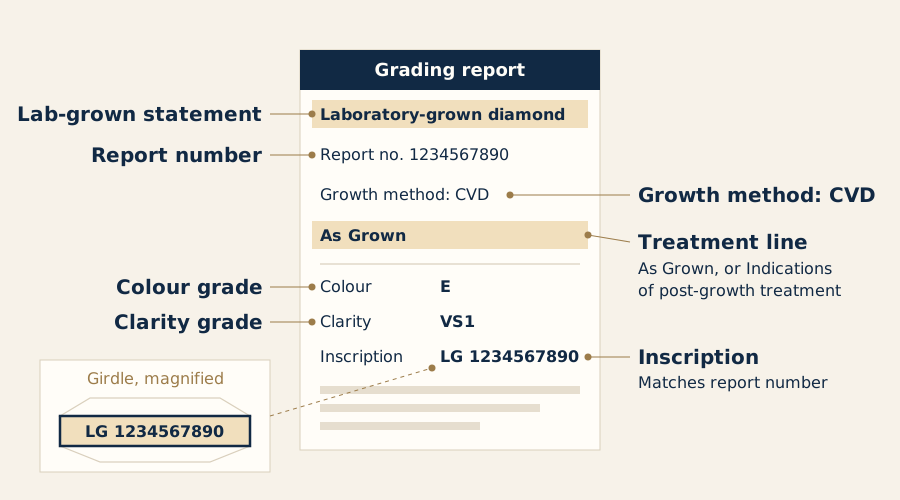
IGI, which grades a large share of the lab-grown diamonds sold in Australia, uses an As Grown designation for stones with no detected treatment. GIA reports for lab-grown diamonds state the growth method and note post-growth treatment where it is found; GIA has also revised how it describes lab-grown diamond quality, so check the current report format on any stone you compare. Report words such as girdle, inscription and fluorescence are covered in our definitions of grading report terms.
The treatment line is only one part of the report. Cut, polish and symmetry matter just as much to how the stone looks in a ring; our guide to judging cut quality in lab-grown diamonds explains what to look for.
Does post-growth treatment affect a lab-grown diamond's quality or price?
For a colourless stone treated by HPHT or low-pressure annealing, the honest answer is: very little. The treatment is permanent, hardness and sparkle are unchanged, and the grades on the report describe the stone as it is now. A treated G colour and an as-grown G colour look the same to the eye.
| As-grown CVD | Post-growth treated CVD | |
|---|---|---|
| Hardness and refractive index | Mohs 10, about 2.42 | Mohs 10, about 2.42 |
| Colour stability | Stable | Stable after annealing; irradiated colours can shift with strong heat |
| Report wording | As Grown | Indications of post-growth treatment |
| Availability in D–F colour | Less common | Common |
| Price | Some sellers ask a small premium | Priced mainly on cut, colour, clarity and carat |
Some buyers prefer an as-grown stone because less has been done to it, and some growers market as-grown CVD diamonds at a modest premium. That is a personal preference rather than a difference you can see. As a broad guide, a 1 carat round lab-grown diamond in G–H colour and VS clarity sits at roughly AUD $700–$2,500 at retail in Australia, and lab-grown prices have fallen for several years running. Treatment status moves the price far less than cut, colour and carat do, and shape matters too; see how price changes from one diamond shape to another.
Treatment matters more in fancy colours. An irradiated pink needs a little more care at the jeweller's bench (see below), and a coated stone should be priced very differently from one with a stable colour. For small stones set in multiples, such as lab-grown diamonds for studs and tennis bracelets, each tiny stone is rarely reported individually, so ask what the supplier states about treatment.
Keep treatment in perspective: a treated lab-grown diamond is still diamond crystal, which is a completely different thing from a simulant. Our page on how lab-grown diamond differs from cubic zirconia sets out the gap in hardness, sparkle and price.
Shop lab-grown diamonds
How does treatment in lab-grown diamonds compare with natural diamonds?
The same HPHT annealing now used on CVD stones was first applied commercially to natural diamonds in the late 1990s, turning some brownish type IIa natural diamonds colourless. Natural diamonds are also laser drilled, fracture filled, coated and irradiated for fancy colours. All of these must be disclosed, and a treated natural diamond generally sells for much less than an untreated natural of the same appearance.
That price gap is the key difference. With natural diamonds, rarity drives price, and an untreated colour is part of that rarity. With lab-grown diamonds, price follows production cost and grades, so treated and as-grown stones sit much closer together. At GemTrove we sell both natural and lab-grown diamonds, and we explain treatment the same way for each: what was done, whether it is stable and how it appears on the report. For a wider look at natural and lab-grown diamonds side by side, see our main guide.
- Natural, untreated: colour and clarity formed in the earth; the report states natural with no treatment detected.
- Natural, treated: must be disclosed; usually priced well below an untreated equivalent.
- Lab-grown, as grown: no treatment after growth; the report says As Grown.
- Lab-grown, treated: usually annealed for colour; the report notes post-growth treatment; price close to as-grown.
What do Australian rules say about disclosing diamond treatment?
There is no Australian law written specifically about diamond treatment. Instead, the Australian Consumer Law (ACL), enforced by the ACCC and state and territory fair trading agencies, applies to every jewellery sale. It prohibits misleading or deceptive conduct and false or misleading representations about the quality, composition or origin of goods. In practice, a seller must not describe a lab-grown diamond in a way that suggests it is natural, and must not hide a treatment a reasonable buyer would want to know about. Under Australian law, staying silent about a material fact can itself be misleading in some circumstances.
International trade standards point the same way. ISO 18323 sets out diamond terminology, including that laboratory-grown diamonds must be described as such, and the CIBJO Diamond Book, used by jewellery trade bodies worldwide, calls for treatments to be disclosed. Neither is Australian law, but both are widely treated as the benchmark for good practice.
- The words lab-grown, laboratory-grown or laboratory-created on the label, invoice and report, never just diamond.
- The growth method and treatment status, where the report states them.
- For fancy colours, a clear statement that the colour is treated, if it is.
- Written care advice for any treatment that is sensitive to heat or chemicals.
If you are insuring the ring, the valuation should record the same details. Our guide to insuring a lab-grown diamond in Australia covers what insurers usually ask for.
Can a treated lab-grown diamond be repaired or reset safely?
Yes, in almost every case. HPHT annealing happens at temperatures and pressures far beyond anything at a jeweller's bench, so a torch, ultrasonic cleaner or steam cleaner will not undo it. Diamond can still be marked by direct torch heat in open air, which can burn and cloud the surface, but that risk is the same for natural and lab-grown stones, and careful jewellers protect or remove the stone before heavy soldering.
Irradiated fancy colours are different. The colour centres that make a pink or green lab-grown diamond can change if the stone is heated strongly, for example when retipping a claw or resizing close to the setting. Coated stones can lose colour with harsh cleaning or repolishing. Always tell the jeweller about any treatment before work starts, because a simple diamond tester cannot reveal treatment and they may not know otherwise.
How do you check a lab-grown diamond for post-growth treatment? Step by step
- Confirm it is lab-grown. The report, label and invoice should all say lab-grown or laboratory-grown.
- Find the growth method. Look for CVD or HPHT on the report; CVD stones are the ones most often treated.
- Read the treatment line. As Grown means no treatment was detected; indications of post-growth treatment means it was treated, usually for colour.
- Check fancy colours closely. For pink, blue, green or yellow stones, look for a treated colour statement and ask how the colour was produced.
- Match the inscription. Under a 10× loupe, check the girdle inscription matches the report number.
- Get it in writing. Ask for the growth method and treatment status on your invoice and any valuation.
- Tell your jeweller. Mention any irradiation or coating before resizing, retipping or cleaning.
If any of these details are missing, ask before you decide; a careful seller can answer each one in writing. To make sure your cover matches the stone, read what an insurance valuation should record.
Free consultation
Talk to a gemologist
Compare stones in person or online with Raj Sood, Graduate Gemologist (GIA), AJP (GIA).
Book a consultationShop this shape
FAQ
Common questions
Are most lab-grown diamonds treated?
Many colourless CVD diamonds are, usually by HPHT or low-pressure annealing to remove a brown tint. Colourless HPHT-grown stones are treated less often. The grading report states whether treatment was detected.
Is a post-growth treated lab-grown diamond still a real diamond?
Yes. Treatment changes the colour, not the material: it is still crystallised carbon with a hardness of 10 and a refractive index of about 2.42.
Does HPHT treatment wear off?
No. Colour improved by HPHT or low-pressure annealing is permanent and is not affected by normal wear, cleaning or jewellery repairs.
Is an as grown lab-grown diamond better than a treated one?
Not in appearance. A treated and an as-grown stone with the same grades look the same; choosing as grown is a personal preference, and some sellers charge a small premium for it.
Do sellers in Australia have to tell me if a lab-grown diamond is treated?
The Australian Consumer Law bans misleading conduct, and hiding a material fact such as treatment can be misleading. Check the report and ask for treatment status in writing on your invoice.
Are pink lab-grown diamonds treated?
Usually, yes. Most pink lab-grown diamonds get their colour from irradiation and annealing after growth, and the report should say the colour is treated.

Ask a gemologist
Not sure which diamond to choose?
Raj Sood is a Graduate Gemologist (GIA) and master jeweller. Bring the stones you are considering, or send the reports, and he will tell you honestly which one is better and why.
Keep learning
Related guides
 Lab-Grown DiamondsHow Are Lab-Grown Diamonds Manufactured?
 Lab-Grown DiamondsCVD Growth Striations: Should Buyers Worry?Lab-Grown DiamondsLab-Grown Diamond Clarity: What's Typical
 Lab-Grown DiamondsAre Lab-Grown Diamonds Real Diamonds
 Lab-Grown DiamondsLab-Grown Diamond Cut Quality
 Lab-Grown DiamondsLab-Grown Diamonds for Earrings and Tennis BraceletsLab-Grown DiamondsDo Lab-Grown Diamonds Test as Diamonds
Explore more
More guides on this topic
Education