
- Education
- Engagement Rings & Settings
- Ring Claw Types Explained: Round, Eagle, Tab, V-Prong and Double Claws
Engagement Rings & Settings
Ring Claw Types Explained: Round, Eagle, Tab, V-Prong and Double Claws
The claws are the only thing holding your diamond on the ring, and the five common ring claw types look, wear and protect a stone in very different ways. Here is how each is built, what it suits and how it holds up over years of daily wear.
 Reviewed by Raj Sood, Graduate Gemologist (GIA), AJP (GIA)Master jeweller and Graduate Gemologist (GIA) · reviewed 4 November 2026
Quick answer
The main ring claw types are round (the common ball-tipped claw), eagle (pointed, talon-like), tab (flat and squared), V-prong (a V-shaped claw that wraps a point or corner) and double (two thin claws side by side). Round claws are easiest to retip, V-prongs protect pointed shapes, and double claws spread the hold for extra security.
What are ring claws and how are they built?
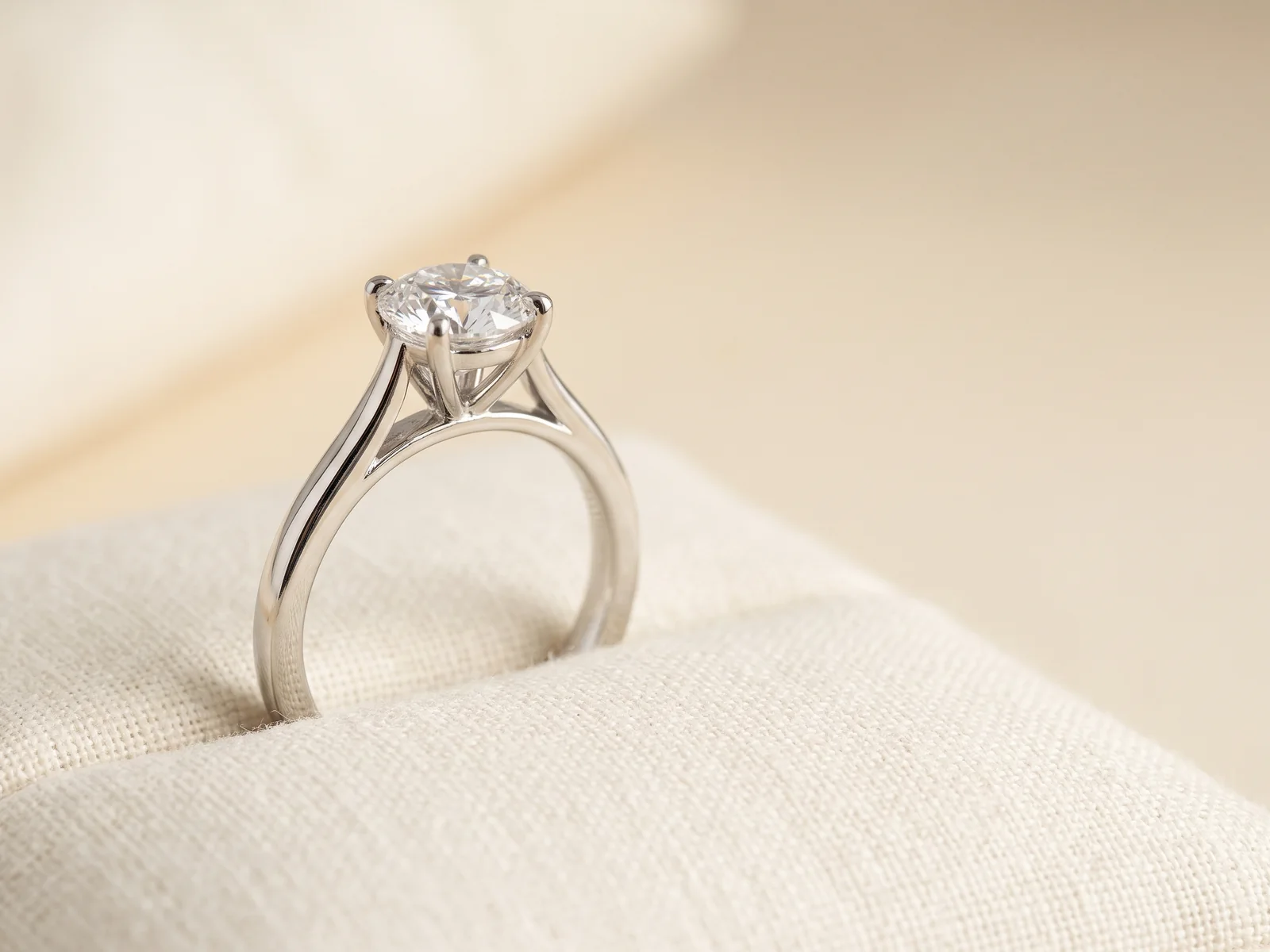
A claw (in the US it is called a prong) is a thin post of metal that rises from the ring and bends over the edge of a stone to hold it in place. Most solitaire engagement rings use four or six. Together, the claws and the frame that joins them are called the head or basket, and the open area under the stone is the gallery. Claw setting is one of the main engagement ring setting styles, and it is popular because it leaves most of the diamond open to light.
Each claw works in two places. On the inside, the setter cuts a small notch called the seat, shaped to the angles of the stone, so the girdle (the thin outer edge of the diamond) sits snugly in it. Then the top of the claw, the tip, is pushed down over the crown (the upper part of the stone) and shaped. The shape of that tip is what jewellers mean by claw type: round, eagle, tab, V-prong or double. Our page on how different claw styles change a ring's look shows each one on a finished ring.
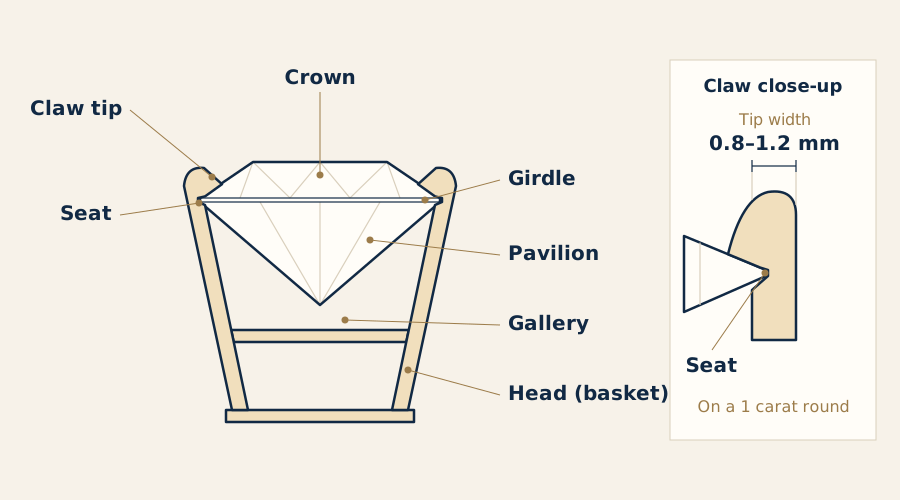
Claws are usually cast as part of the head from a CAD (computer-aided design) model, or made from hard-drawn wire and soldered into place. On a 1 carat round, a finished claw is typically about 0.8–1.2 mm across at the tip. Thinner claws look lighter but wear through sooner; thicker claws are stronger but cover more of the diamond. Diamond is 10 on the Mohs hardness scale, while platinum sits around 4–4.5 and 18 carat gold around 2.5–3, so over the years it is always the metal that wears, never the stone.
Claws are not the only way to hold a diamond. A bezel (a rim of metal around the whole edge) or a tension or channel setting hold the stone differently. If any of the terms on this page are new to you, our glossary of jewellery and setting terms defines them in plain English.
What are the main ring claw types?
There are five claw tip styles you will see on most engagement rings. The table compares how each one looks, how well it holds and what it needs over the years.
| Claw type | Tip shape | Look | Security | Upkeep | Usually suits |
|---|---|---|---|---|---|
| Round | Rounded ball or dome | Classic and soft, the most familiar | Good; solid tip with plenty of metal | Easiest to check and retip | Round, oval, cushion; almost any everyday ring |
| Eagle | Tapers to a fine point, like a talon | Slimmer; more of the stone shows | Good if the base is full thickness | Point softens and shortens with wear | Round, oval, vintage-style and six-claw rings |
| Tab | Flat, squared or rectangular | Clean, modern, architectural | Good on straight edges; broad contact | Flat face shows scratches; corners soften | Emerald, asscher, cushion, radiant, modern rounds |
| V-prong | V-shaped, folded around a point or corner | Follows the outline; tip is tucked away | Very good for points that could chip | Check the V for lifting; harder to rebuild | Pear, marquise, heart, princess, trillion |
| Double | Two slim claws side by side at each position | Detailed and ornate; more metal visible | Very good; a partner claw holds if one lifts | More tips to check and clean | Round, oval and cushion from about 0.75 ct |
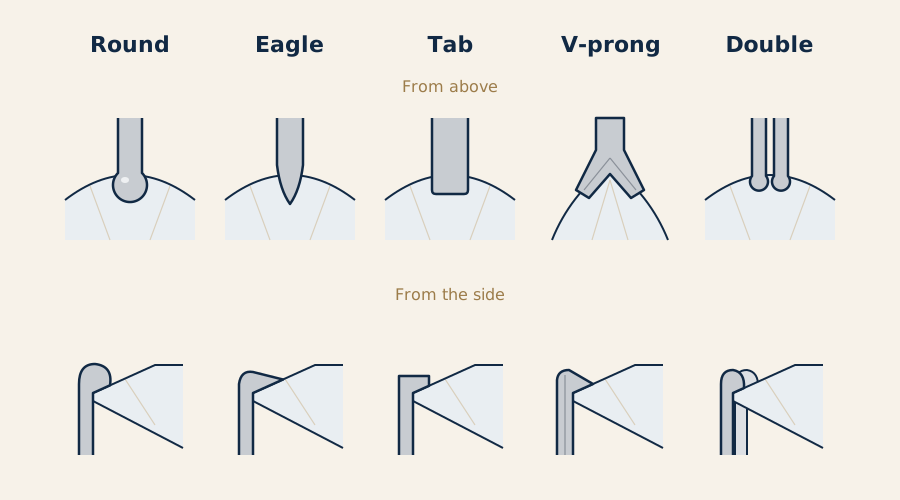
Claw type and claw number are separate choices. You can have four round claws, six eagle claws or four pairs of double claws (eight tips in all). Many rings also mix types: a pear shaped diamond usually has two or three round claws around its rounded end and a V-prong at the point, while a princess cut uses a V-prong at each of its four corners.
What is a round claw and who is it for?
The round claw, also called a ball claw, is the most common type on Australian engagement rings. The tip is domed and smooth, so it sits neatly over the crown and catches less on jumpers and hair than a sharp tip does. It is also the simplest to look after: when the top wears flat, a jeweller adds new metal (called retipping) and shapes it back into the same dome, so the ring looks as it did when new.
Round claws work with almost every shape, but their natural home is the round brilliant diamond, where four or six balls echo the circle of the stone. Four claws show more diamond and make a round look very slightly squarer; six claws hold more evenly and keep the outline looking perfectly circular. We compare the two in detail in four claws against six on a solitaire, and our guide to settings that suit round diamonds covers the other options, from halos to bezels.
- Good for: everyday wear, first-time buyers, active hands and anyone who wants low maintenance.
- Watch for: claws that are too small for the stone. On a 1 ct round, a ball that looks like a pinhead will wear through quickly.
- Over the years: the top flattens first. A flat-topped claw is a sign it is time for a check, not an emergency.
Are eagle claws secure enough for everyday wear?
Eagle claws (also called talon or pointed claws) taper to a fine point that lies over the crown of the stone. Because the tip narrows, less metal covers the diamond and it looks a little larger and more open from above. They are popular on six-claw solitaires and on vintage-inspired rings, including settings made for vintage Old European cut diamonds, whose softer, chunkier faceting suits a finer claw. They also look at home on star and Portuguese cuts from the round brilliant family.
Whether an eagle claw is secure depends on its base, not its point. A well-made eagle claw is full thickness where it meets the girdle and only tapers above that, so the part doing the holding is as strong as a round claw. A poorly made one is thin all the way up and can bend if it takes a knock. Ask to see the ring from the side: the claw should look solid down to the stone, with the point as a finishing detail.
From the repair bench, the eagle point is the first part to go. After several years of daily wear it softens, rounds off and gets shorter, and the ring starts to look like it has ball claws. Retipping restores it, but rebuilding a fine point neatly takes more skill and time than rebuilding a ball. A brand-new eagle claw can also feel a little sharp against fine knits until it settles.
Not sure which one is right?
Send us the stones you are looking at and our gemologist will tell you which to choose and why.
When should you choose tab claws or V-prongs?
Tab claws have a flattened, squared or rectangular tip that lies flat across the crown. That broad face gives good contact along a straight edge, which is why tabs suit step cuts such as the emerald and asscher, and squarer stones such as radiants and cushions. On a round, tab claws give a crisp, geometric look that reads as modern. The flat face does show scratches, and the sharp corners soften with wear, but a polish brings them back and retipping can rebuild a worn tab.
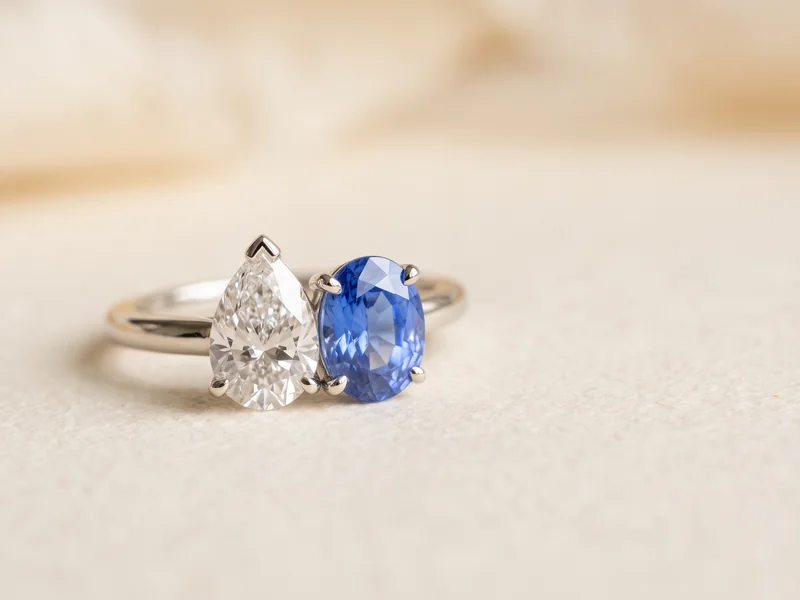
V-prongs (sometimes called chevron claws) are folded into a V shape that wraps around a point or corner. Their job is protection. Diamond is the hardest natural material, but it is not the toughest: it can chip or split along its cleavage planes if a thin point takes a sharp knock. A V-prong covers that point on a pear, marquise or heart, and all four corners of a princess. Our guide to where claws should sit on pointed shapes shows exactly how far the V should reach.
Cushions have rounded corners, so they rarely need V-prongs; round, tab or double claws all work. If you are still deciding on the stone itself, our comparison of round versus cushion cut diamonds covers how each shape sits in a setting.
| Diamond shape | Usual claw choice | Why |
|---|---|---|
| Round | 4 or 6 round, eagle or double | Even hold around a circle |
| Oval | 4 or 6 round or double | Rounded ends have no fragile points |
| Cushion | 4 round, tab or double | Soft corners need no V |
| Princess | 4 V-prongs | Protects the sharp corners |
| Emerald / asscher | 4 tab or double at the cut corners | Flat contact on short corner facets |
| Pear | 1 V-prong at the point, 2–3 round | The point is the fragile part |
| Marquise | 2 V-prongs at the points, 2–4 round or double | Two points to protect |
| Heart | 1 V-prong at the point, 2 round at the lobes | Protects the point; some add a claw at the cleft |
Do double claws make an engagement ring more secure?
Double claws pair two slimmer claws at each position, so four positions give eight tips and six give twelve. Each claw is thinner than a single claw would be, but together they cover more of the girdle and share the load. The real advantage shows up when something goes wrong: if one tip snags and lifts, its partner usually keeps the stone in place until it can be repaired. That is why double claws are a common choice for people who want extra peace of mind on a claw setting.
The trade-offs are practical. More metal is visible from above, there are more small gaps for soap and hand cream to collect in, and there are eight or twelve tips to check instead of four or six. Each slim claw also wears through a little faster than a single heavy one. Double claws look balanced on stones from about 0.75 ct upwards; on smaller stones the pairs can crowd the diamond and make it look busy.
They suit rounds, cushions and elongated shapes. On an oval, double claws at the sides give a secure hold without blocking the ends; if you are weighing up shapes, see our page on choosing between an oval and a round. Double claws also appear often on halo rings, where the centre stone is set into a frame of small diamonds, as in many double halo engagement ring designs.
Which ring claw types last longest over the years?
Every claw wears. Hands brush against benchtops, steering wheels, dishes and gym equipment every day, and the claw tips take most of that contact. How fast they wear depends on the metal, the claw type and how the ring is worn. Platinum tends to push and smear rather than lose metal, so its claws thin slowly but can bend; 18 carat white gold wears metal away a little faster, and its rhodium plating (a thin bright-white coating) wears off to show a warmer tone. As a rough guide, have claws checked every 6–12 months, and expect a first retip somewhere around 5–10 years of daily wear, though this varies a great deal between people.
| Claw type | How it usually wears | Typical repair |
|---|---|---|
| Round | Top of the ball flattens | Retip with new metal and reshape the ball; looks unchanged |
| Eagle | Point softens, rounds off and shortens | Retip and re-form the point; needs more skill |
| Tab | Face scratches and thins; corners soften | Add metal and re-square, or fit a new tab |
| V-prong | Tip of the V thins and can lift off the point | Rebuild the V, or replace the whole claw |
| Double | Each slim claw wears a little faster, but the load is shared | Retip in pairs; more claws to do each time |
Claws rarely fail on their own. A band that has been squeezed or knocked out of shape flexes the head and slowly loosens every claw; our guide to why a ring band goes out of round explains how that happens. We cover what to look and feel for in the signs that claws need retipping. Retipping usually costs roughly AUD $50–$150 per claw, depending on the metal and the claw type, and rebuilding a whole claw costs more. If you are very hard on your hands, it is worth comparing bezel and claw settings for everyday wear before you decide.
Related guideWhen Do Ring Claws Need Retipping?Which wedding band sits best with each claw type?
Claw type affects how a wedding band sits beside your engagement ring. On a low-set head, the base of the claws can touch the band, and over years that rubbing wears both rings. A higher, cathedral-style head (where the shoulders sweep up to hold the stone) lets a straight band slide underneath. Our guide to wedding bands that sit neatly beside a round shows the main combinations.
- Round and eagle claws: the slimmest footprint at the base, so a straight band usually sits flush if the head is high enough.
- Tab claws: the flat tips can sit close to the band on square stones; check there is a small gap so they do not rub.
- Double claws: wider at the base, so they can stop a band sitting flush on a low head. A slightly higher head or a shaped band solves it.
- V-prongs: on a pear or heart set point-down, the V faces the band directly and often needs a contoured or curved band.
- Halo rings: the halo usually decides the band fit more than the claws do.
The easiest way to be sure is to try the two rings together, or ask to see the CAD model with the band in place before the ring is made.
How do you choose a claw type for your ring? Step by step
- Start with the shape. Pointed shapes and sharp corners need V-prongs; rounds, ovals and cushions can take any claw type.
- Think about your hands. If you work with your hands, train or garden, lean towards round or double claws in platinum, or consider a bezel.
- Pick the look. Round claws are classic, eagle claws are fine and open, tabs are modern and double claws are detailed.
- Check the claw size. On a 1 ct stone, look for tips around 0.8–1.2 mm; ask to see the ring from the side as well as the top.
- Plan the band. Make sure the head height and claw base leave room for the wedding band you want.
- Book regular checks. Have the claws looked at every 6–12 months and retipped before they wear through.
The claw choice is the same whether your diamond is natural or lab-grown. Lab-grown diamonds are real diamond grown in a laboratory rather than mined, with the same hardness of 10 and the same need to protect thin points and corners.
Browse round diamonds, ring settings and repairs
Free consultation
Talk to a gemologist
Compare stones in person or online with Raj Sood, Graduate Gemologist (GIA), AJP (GIA).
Book a consultationFAQ
Common questions
What is the most secure claw type for an engagement ring?
Double claws and well-made round claws are usually the most secure for everyday wear, because they put plenty of metal over the stone. For pointed shapes, a V-prong at each point matters more than the style of the other claws.
Are eagle claws weaker than round claws?
Not if the base of the claw is full thickness where it holds the girdle. The fine point wears faster and takes more skill to rebuild, so eagle claws need retipping attention a little sooner.
Do I need a V-prong for a pear shaped diamond?
Yes, in most cases. The point of a pear is its thinnest part and the most likely to chip, and a V-prong wraps around it to protect it.
How often should ring claws be checked?
Every 6–12 months is a sensible routine. Many rings need a first retip after about 5–10 years of daily wear, but it depends on the metal, the claw size and how you wear the ring.
Is four or six claws better?
Four claws show more of the diamond and look slightly squarer on a round; six claws hold more evenly and keep a round looking circular. Both are secure when the claws are a good size.
Can I change the claw type on an existing ring?
Often, yes. A jeweller can retip claws into a different shape or replace the head entirely, though changing from single to double claws usually means a new head.
Terms in this guide

Ask a gemologist
Not sure which diamond to choose?
Raj Sood is a Graduate Gemologist (GIA) and master jeweller. Bring the stones you are considering, or send the reports, and he will tell you honestly which one is better and why.
Keep learning
Related guides
 Engagement Rings & SettingsEngagement Ring Claw Styles Explained
 Engagement Rings & SettingsClaw Placement for Pointed Shapes
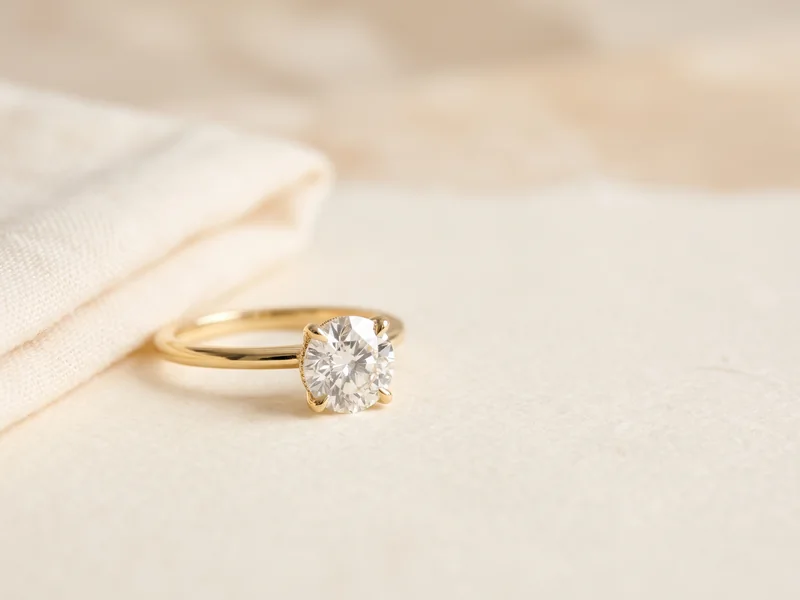 Care, Repairs & RemodellingWhen Do Ring Claws Need Retipping?Engagement Rings & SettingsFour-Claw vs Six-Claw Solitaire Engagement RingsEngagement Rings & SettingsEngagement Ring Setting Styles GuideEngagement Rings & SettingsBest Settings for Round Diamonds
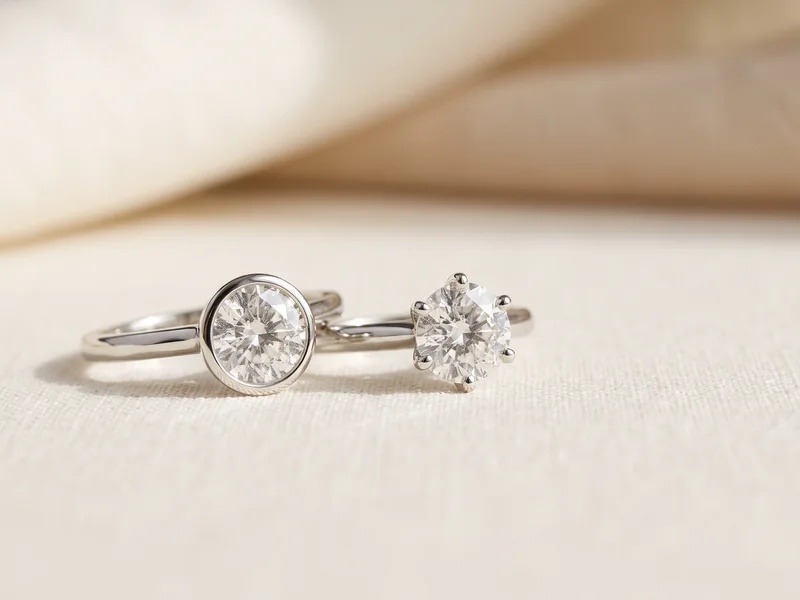 Engagement Rings & SettingsBezel vs Claw Settings for Everyday Wear
 Diamond ShapesRound Brilliant Diamonds
Explore more
More guides on this topic
Education